Minimal MQTT: Building A Broker

In this short series, we’re going to get you set up with a completely DIY home automation system using MQTT. Why? Because it’s just about the easiest thing under the sun, and it’s something that many of you out there will be able to do with material on-hand: a Raspberry Pi as a server and an ESP8266 node as a sensor client. Expanding out to something more complicated is left as an exercise to the motivated reader, or can be simply left to mission creep.

We’ll do this in four baby steps. Each one should take you only fifteen minutes and is completely self-contained. There’s a bunch more that you can learn and explore, but we’re going to get you a taste of the power with the absolute minimal hassle.

In this installment, we’re going to build a broker on a Raspberry Pi, which is the hub of your MQTT network. Next time, we’ll get an ESP8266 up and running and start logging some data. After that, we’ll do some back-end scripting in Python to make the data speak, and in the last installment, we’ll explore some of the useful frills and fancy bits. Let’s get started!

Continue reading “Minimal MQTT: Building A Broker”

The Coming Wide-Spread Use Of Drones In Agriculture

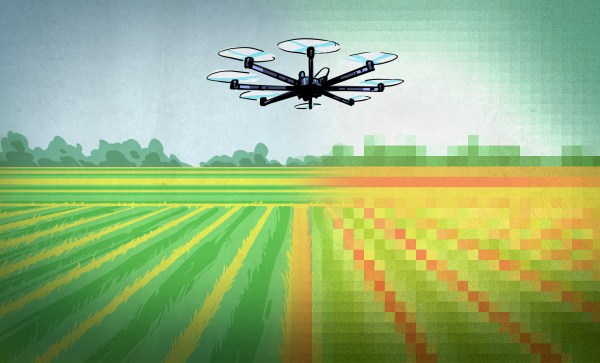
Whether you call them UAVs (Unmanned Aerial Vehicles), UAS (Unmanned Aerial System), Drones, or something less polite – people are more familiar than ever with them. We’ll call them drones, and we’re not talking about the remote-controlled toy kind – we’re talking about the flying robot kind. They have sensors (GPS and more), can be given a Flight Plan (instructions on where to go), and can follow that plan autonomously while carrying out other instructions – no human pilot required. Many high-end tractors are already in service with this kind of automation and we’ve even seen automated harvesting assistance. But flying drones are small and they don’t plant seeds or pull weeds, so what exactly do they have to do with agriculture?

There are certain things that drones are very good at, and there are things in agriculture that are important but troublesome to do or get. Some of these things overlap, and in those spaces is where a budding industry has arisen.

Continue reading “The Coming Wide-Spread Use Of Drones In Agriculture”

Carbon Monoxide: Hunting A Silent Killer

Walt and Molly Weber had just finished several long weeks of work. He was an FBI agent on an important case. She had a management job at Houghton Mifflin. On a sunny Friday evening in February of 1995, the two embarked on a much needed weekend skiing getaway. They drove five hours to the Sierra Mountains in California’s Mammoth Lakes ski area. This was a last-minute trip, so most of the nicer hotels were booked. The tired couple checked in at a lower cost motel at around 11:30pm on Friday night. They quickly settled in and went to bed, planning for an early start with a 7am wakeup call Saturday morning.

When the front desk called on Saturday, no one answered the phone. The desk manager figured they had gotten an early start and were already on the slopes. Sunday was the same. It wasn’t until a maid went to check on the room that the couple were found to be still in bed, unresponsive.

Continue reading “Carbon Monoxide: Hunting A Silent Killer”

The Dark Arts: Anonymity

Love him or hate him, Edward Snowden knew a thing or two about anonymity. In June of 2013, he blew the whistle on the NSA’s out-of-control programs that can target virtually anyone plugged into the digital age. The former CIA employee was working as a contractor for the NSA, where he had access to highly classified documents for many of these general populace surveillance programs. He eventually took off to Hong Kong and released the documents to a handful of reporters. One of these documents was a power point presentation of the NSA complaining about how the TAILS operating system was a major thorn in their side. Naturally, Snowden insisted that the reporters and himself only communicate via the TAILS O/S. He used PGP, which is an encryption method with the highly sophisticated title of “Pretty Good Privacy”, and asked not to be quoted at length for fear of identification via stylometry.

In this article, we’re going to go over the basics of anonymity, and introduce you to methods of staying anonymous while online.

Continue reading “The Dark Arts: Anonymity”

Blue Ribbon Microphone

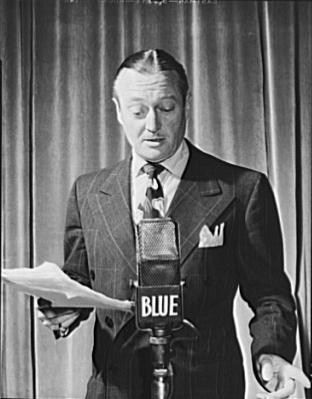
Edmund_Lowe_fsa_8b06653If you’ve ever seen an old movie or TV show where there was a radio announcer, you’ve probably seen a ribbon microphone. The RCA 44 (see Edmund Lowe, on right) had exceptional sound quality and are still valued today in certain applications. The name ribbon microphone is because the sound pickup is literally a thin strip of aluminum or other conductive material.

Unlike other common microphones, ribbons pick up high frequencies much better due to the high resonant frequency of the metallic ribbon. This is not only better in general, but it means the ribbon mic has a flatter frequency response even at lower frequencies. Another unique feature is that the microphone is bidirectional, hearing sounds from the front or back equally well. It is possible to build them with other directional patterns, although you rarely see that in practice.

Invention

In the early 1920s, Walter Schottky and Erwin Gerlach developed the ribbon microphone (and, coincidentally, the first ribbon loudspeaker). Harry Olson at RCA developed a ribbon mic that used coils and permanent magnets which led to the RCA Photophone Type PB-31 in 1931. Because of their superior audio response, they were instant hits and Radio City Music Hall started using the PB-31 in 1932. A newer version appeared in 1933, the 44A, which reduced reverberation.

Continue reading “Blue Ribbon Microphone”

Debunking The Drone Versus Plane Hysteria

The mass media are funny in the way they deal with new technology. First it’s all “Wow, that’s Cool!”, then it’s “Ooh, that’s scary”, and finally it’s “BURN THE WITCH!”. Then a year or so later it’s part of normal life and they treat it as such. We’ve seen the same pattern repeated time and time again over the years.

The mass media tech story cycle. Our apologies to Gartner. Curve image: Jeremykemp [ CC BY-SA 3.0 ], via Wikimedia Commons
Seasoned readers may remember silly stories in the papers claiming that the Soviets could somehow use the technology in Western 8-bit home computers for nefarious purposes, since then a myriad breathless exclusives have predicted a youth meltdown which never materialised as the inevitable result of computer gaming, and more recently groundless panics have erupted over 3D printing of gun parts. There might be a British flavour to the examples in this piece because that’s where it is being written, but it’s a universal phenomenon wherever in the world technologically clueless journalists are required to fill column inches on technical stories.

The latest piece of technology to feel the heat in this way is the multirotor. Popularly referred to as the drone, you will probably be most familiar with them as model-sized aircraft usually with four rotors. We have been fed a continuous stream of stories involving tales of near-misses between commercial aircraft and drones, and there is a subtext in the air that Something Must Be Done.

The catalyst for this piece is the recent story of a collision with a British Airways plane 1700ft over West London approaching London Heathrow. The ever-hyperbolic Daily Mail sets the tabloid tone for the story as a drone strike, while the BBC’s coverage is more measured and holds a handy list of links to near-miss reports from other recent incidents. This incident is notable in particular because a Government minister announced that it is now believed to have been caused by a plastic bag, and since there is already appropriate legislation there was little need for more. A rare piece of sense on a drone story from a politician. The multirotor community is awash with plastic bag jokes but this important twist did not seem to receive the same level of media attention as the original collision.

Are multirotors unfairly being given bad press? It certainly seems that way as the common thread among all the stories is a complete and utter lack of proof. But before we rush to their defence it’s worth taking a look at the recent stories and examining their credibility. After all if there really are a set of irresponsible owners flying into commercial aircraft then they should rightly be bought to book and it would do us no favours to defend them. So let’s examine each of those incident reports from that BBC story.

Continue reading “Debunking The Drone Versus Plane Hysteria”

Centennial Birthday Of Claude E. Shannon The Math And EE Pioneer

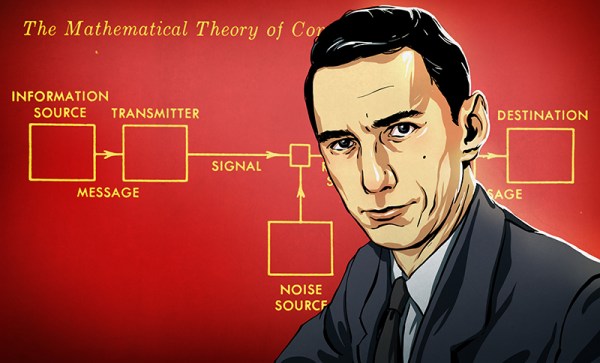
Dr. Claude E. Shannon was born 100 years ago tomorrow. He contributed greatly to the fields of engineering, communications, and computer science but is not a well known figure, even to those in the field. However, his work touches us all many times each day. The network which delivered this article to your computer or smartphone was designed upon important theories developed by Dr. Shannon.

Shannon was born and raised in Michigan. He graduated from the University of Michigan with degrees in Mathematics and Electrical Engineering. He continued his graduate studies at Massachusetts Institute of Technology (MIT) where he obtained his MS and PhD. He worked for Bell Laboratories on fire-control systems and cryptography during World War II and in 1956 he returned to MIT as a professor.
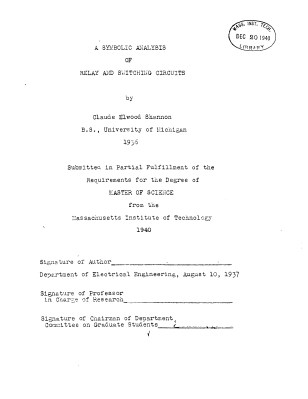
shannon-0Shannon’s first impactful contribution was his masters thesis which took the Boolean Algebra work of George Boole and applied it to switching circuits (then made up of relays). Before his work there was no formal basis for the analysis of switching systems, like telephone networks or elevator control systems. Shannon’s thesis developed the use of symbolic notation to represent networks and applied simplifying rules to optimize the system. These same rules later translated to vacuum tube and transistor logic aiding in the development of today’s computer systems. The thesis — A Symbolic Analysis of Relay and Switching Circuits — was completed in 1937 and subsequently published in 1938 in the Transactions of the American Institute of Electrical Engineers.

Shannon’s doctoral work continued in the same vein of applying mathematics someplace new, this time to genetics. Vannevar Bush, his advisor, commented, “It occurred to me that, just as a special algebra had worked well in his hands on the theory of relays, another special algebra might conceivably handle some of the aspects of Mendelian heredity”. Shannon’s work again is revolutionary, providing a mathematical basis for population genetics. Unfortunately, it was a step further than geneticists of time could take. His work languished, although interest increased over time.

Continue reading “Centennial Birthday Of Claude E. Shannon The Math And EE Pioneer”