Robot Dog In Browser

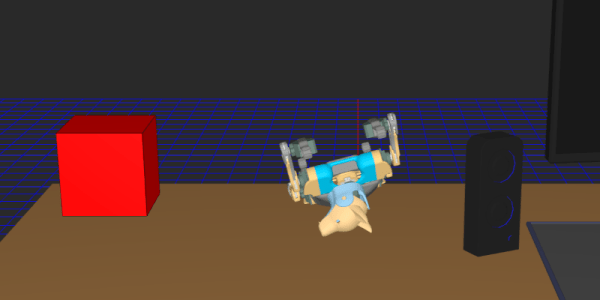
You’ve doubtlessly seen the current crop of robot dogs and, if you are like us, thought about getting one to play with. The problem is that the cheap ones are toys, and the serious ones cost serious money. But now you can experiment with a mid-range cost one for free in your browser. The sponsor will be happy to sell you a robot in kit or assembled form, although it is the OpenCat robot (we’ve covered it before), so you could simply build a real one yourself if you wanted to.

The code is all in a Web-based IDE, and the main file is deceptively simple. However, the real work is in read_serial (in the src/moduleManager.h file, for some reason) and reaction in the aptly-named src/reaction.h file. If you just want to play, you can use the buttons in the simulator or enter serial commands (documented elsewhere). For example, ksit will make the dog sit down.

Continue reading “Robot Dog In Browser”

Engineering Micro-Submarines To Replace Fish

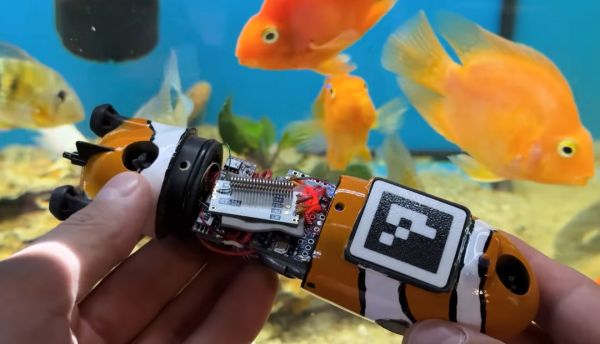
Everybody loves aquariums. There’s something soothing about watching the lil’ critters inside them swimming, crawling and wriggling about. But at the same time few people are up to the task of ensuring that said critters stay alive and happy in said aquarium. This is where small robots may be able to steal some fishy jobs, like a modern take on the gaudy fake aquariums of the 1990s. Cue [CPSDrone]’s mini-drone aquarium with mostly maintenance-free robotic fish.

These pose a few interesting engineering challenges, such as the replacing of feeding fish by having them scuttle back to their charging station like an aquatic Roomba, and giving them some level of intelligence to the point that they at least appear to be doing something fish-like.

Rather than give each robot fish full autonomy, they are instead controlled by a central system. This then raised the problem of radio frequency communication while underwater. The theory was that 433 MHz transceivers would still work for something the size of an aquarium before attenuation spoils things, which a quick test confirmed to be true.

This enabled the construction of a small microcontroller-carrying submarine as a proof of concept before diving into the final version, involving resin 3D printed enclosures that are made water-tight using rubber O-ring seals and UV-cured resin. All that was left now was to add the big control system, which takes up much of the rest of the video.

Sadly they didn’t implement the boids algorithm, as this is pretty good at creating realistic life-like motion, as show with this demonstration by [Ben Eater]. This algorithm is pretty simple, with each ‘creature’ obeying rules on coherence, separation and alignment, creating a pattern that can be observed among schools of fish as well as flocks of birds. Due to its simplicity you could conceivably even omit the central control system and just give each ‘fish’ enough sensors to keep track of its buddies.

Continue reading “Engineering Micro-Submarines To Replace Fish”

Web Tool Lets You Take Steam Controller For A Drive

One of the simplest robots to make is a bristlebot — a motor with an offset weight is attached to the head of a toothbrush, and the resulting vibrations will move the contraption across a flat surface. [Very Lazy Pixels] recently took this idea a bit further by turning the Steam Controller into a steerable, bristlebot-like robot.

To drive one’s Steam Controller across a desk, all that is needed is for a computer with a paired controller and a Chromium-based browser. From there, using the WASD buttons, the web interface converts traditional video game inputs into controller motion by spinning the controller’s rumble motors at a specific frequency. With precise control of these motors, the controller can move forwards and backwards and even turn, which is a great deal more advanced than the traditional bristlebots generally manage.

Part of what makes this possible is Valve’s willingness to release information about many of their products to the general public, enabling anyone to modify or upgrade those products to their liking. While not completely open source, it’s a step in the right direction and enables fun projects like these. We’ve seen other Valve products turned into surprisingly barebones single-board computers as well as custom portable workstations thanks to this philosophy.

Continue reading “Web Tool Lets You Take Steam Controller For A Drive”

Reachy Mini Desktop Robot Gets All-local, Conversational AI

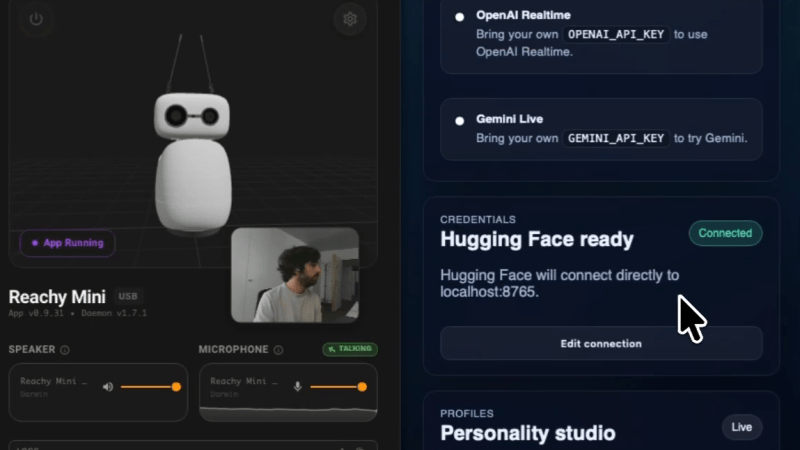
Reachy Mini is a limbless desktop robot from Hugging Face made for human interaction experiments, and to give you an idea of what it’s like is a guide on how to implement expressive, local conversational AI complete with head movements and antenna wiggles. It’s conversational in the sense that it aims to feel natural, with low-latency responses and the ability to interrupt, with everything running on local hardware if one so wishes.

Reachy Mini can use remote services, or work in tandem with a desktop machine or laptop.

The software stack is essentially VAD (voice activity detection) → STT (speech-to-text) → LLM (large language model) → TTS (text-to-speech) which allows users to tweak things to their liking, or independently swap or modify pieces as things evolve.

This also allows users to tailor the services to match whatever their hardware is capable of. For example, one could easily use a frontier AI model via remote API for the LLM while keeping everything else local.

The local models in the example configuration are effective and relatively modest (Qwen3-4B-Instruct for the LLM, and even smaller models for the rest) but it’s nice to have the option to offload parts to remote providers if necessary.

Reachy Mini looked very interesting when it was launched as a kit last year, and since then Hugging Face has built up an impressive software suite and infrastructure through which users can easily share their applications. If you’re curious, there’s a simulator for Reachy Mini which should give you an idea of what it can do.

Increasing Local GPS Accuracy For A Small Robot

Even though GPS makes it possible for us to easily navigate around the planet in almost any vehicle we’d like, whether that’s a passenger vehicle, airplane, or cargo ship, it’s not really suitable for applications that require sub-meter accuracy. For that, some specialized hardware is needed, and [GreatScott!] shows us how to do it using a small robot as a platform.

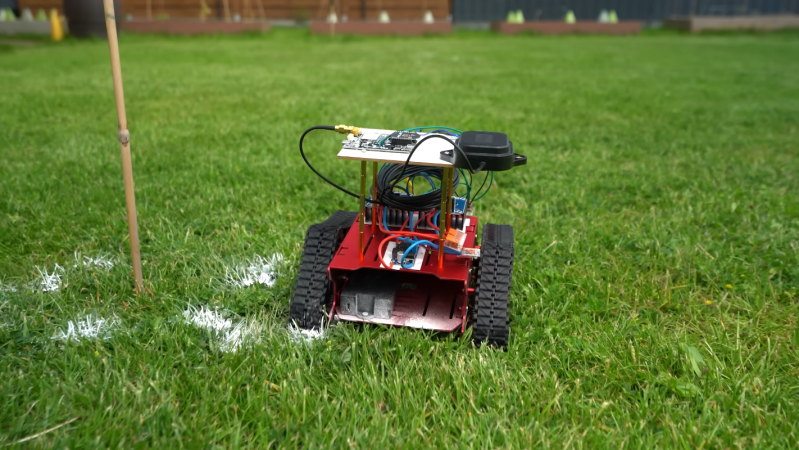
The key to extremely accurate GPS signals in this case is using a receiver that supports real-time kinematic positioning (RTK). This type of system relies on a base station with a known position communicating with local mobile receivers to increase the precision of those mobile receivers by comparing the phase angle of the received signals. Of course these modules are much more expensive than the average standard GPS receiver, but for this kind of accuracy there is always a cost.

After getting a baseline accuracy of around two meters with a standard GPS receiver, [GreatScott!] installs the RTK GPS mobile receiver on a tracked robotic platform and a base station on a fence post. With the RTK system running, the limiting factor in accuracy became the robot’s steering system, as its turning radius and steering algorithms weren’t up to the task of hitting centimeter-sized targets out of the box.

But, as a proof-of-concept, it goes to show how accurate GPS can be as long as the right hardware is used, and for practical applications is good enough to mow a lawn with a robot or even do some amateur land surveying.

Continue reading “Increasing Local GPS Accuracy For A Small Robot”

Come With Me If You Want To Weed: Autonomous Weedinator Robot Back For 2026

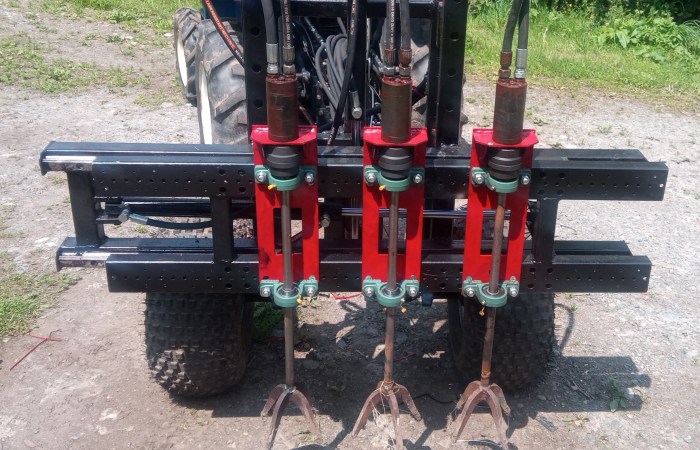
The WEEDINATOR agricultural robot is one of the longer-running projects we’ve featured here on Hackaday. We first featured it way back in 2017 for that year’s Hackaday prize, and after a nearly a decade of work on-and-off it has hit a very important milestone: it is now an effective horticultural instrument, as you can see in the latest demo video below.

There have been some big changes over the years. For one, the scope of the project narrowed considerably with the adoption of a commercial tractor as the base, specifically an Iseki 321 . They picked the Iseki after examining several competitors, and it won out because its hydrostatic drive was best able to handle the very low speeds desired. It looks like they’re now focused on cultivation — that is, tearing out weeds mechanically — rather than the flame weeder they started with. The cultivators are of the claw type, and has three claws powered via the tractor’s hydraulics for control in all three axis: X, Y and Z. Of course the project now leverages modern computer vision toolsets, using a combination of OpenCV and YOLO26n running on a Jetson Nano board. The robotics half of the equation is handled on an STM32 Nucleo.

Aside from being one of our longer-running submissions, we have to call out the team for being one of the very few — perhaps the only — to go to the effort of creating a theme song for their project. If you’ve only got a minute to see the robot run, you might as well look at the second video embedded below and give a listen.

While WEEDINATOR has got the most persistence, they’re not the only ones in the garden robot game. We’ve seen projects using everything from concentrated sunlight to precision-applied herbicides to clear unwanted plants over the years.

Continue reading “Come With Me If You Want To Weed: Autonomous Weedinator Robot Back For 2026”

Building And Testing A DIY Robot Actuator

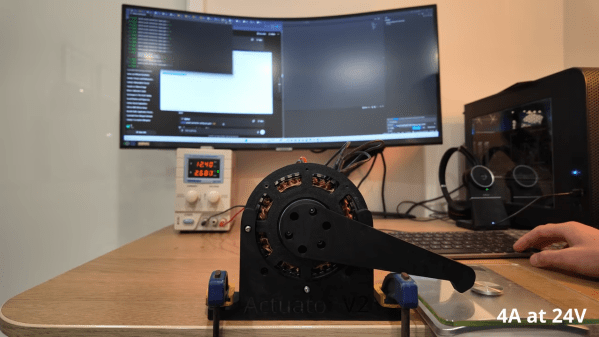
[Brandon Lai] is hoping to build a humanoid robot. To that end, he’s going to need some actuators, and decided to design his own. His second pass at this turned out pretty well, with a few snags found along the way.

Target specs were a actuator that could run at 40 to 60 RPM while delivering 20 Nm of torque for up to an hour continuously. The design was inspired by an MIT research paper, with [Brandon] making a few mods to suit his use case. Where the MIT design uses an inbuilt planetary gearbox, this build substitutes a cycloidal gearbox with a hope it will provide better torque capacity with less backlash. The design is based around a hand-wound stator made with an off-the-shelf core, while using custom CNC parts and 3D printed components for the motor housing itself.

Testing revealed some limitations. Running off a benchtop power supply with limited current, the motor was only able to achieve 7 Nm of torque, though a better PSU would probably improve this. [Brandon] also noted excessive backlash in the cycloidal gearbox, due to poor tolerances, and the $400 construction cost came in well over budget. Still, [Brandon] hopes to tackle many of these problems in a future revision. CAD files are available online if you’d like to dig deeper into the design.

We’ve featured plenty of great actuator builds over the years.

Continue reading “Building And Testing A DIY Robot Actuator”