The Most Secure, Modern Computer Might Be A Mac

The Linux world is currently seeing an explosion in new users, thanks in large part to Microsoft turning its Windows operating system into the most intrusive piece of spyware in modern computing. For those who value privacy and security, Linux has long been the safe haven where there’s reasonable certainty that the operating system itself isn’t harvesting user data or otherwise snooping where it shouldn’t be. Yet even after solving the OS problem, a deeper issue remains: the hardware itself. Since around 2008, virtually every Intel and AMD processor has included coprocessors running closed-source code known as the Intel Management Engine (IME) or AMD Platform Security Processor (PSP).
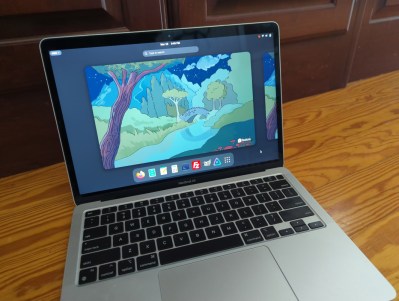
M1 MacBook Air, now with more freedom

These components operate entirely outside the user’s and operating system’s control. They are given privileged access to memory, storage, and networking and can retain that access even when the CPU is not running, creating systemic vulnerabilities that cannot be fully mitigated by software alone. One practical approach to minimizing exposure to opaque management subsystems like the IME or PSP is to use platforms that do not use x86 hardware in the first place. Perhaps surprisingly, the ARM-based Apple M1 and M2 computers offer a compelling option, providing a more constrained and clearly defined trust model for Linux users who prioritize privacy and security.

Before getting into why Apple Silicon can be appealing for those with this concern, we first need to address the elephant in the room: Apple’s proprietary, closed-source operating system. Luckily, the Asahi Linux project has done most of the heavy lifting for those with certain Apple Silicon machines who want to go more open-source. In fact, Asahi is one of the easiest Linux installs to perform today even when compared to beginner-friendly distributions like Mint or Fedora, provided you are using fully supported M1 or M2 machines rather than attempting an install on newer, less-supported models. The installer runs as a script within macOS, eliminating the need to image a USB stick. Once the script is executed, the user simply follows the prompts, restarts the computer, and boots into the new Linux environment. Privacy-conscious users may also want to take a few optional steps, such as verifying the Asahi checksum and encrypting the installation with LUKS but these steps are not too challenging for experienced users. Continue reading “The Most Secure, Modern Computer Might Be A Mac”


Age-Verification And The World Before Social Media

Although it may be hard to believe for current generations, there was a time when the Internet and the World Wide Web were not as integrated into society as it is today. The only forms of online ‘social media’ that existed came in the form of IRC, forums, BBSes, newsgroups and kin, while obtaining new software for your PC involved generally making your way over to a physical store to buy a boxed copy, at least officially.

In this era – and those before it – age-verification already existed, with various goods ranging from tobacco and alcohol to naughty adult magazines requiring you to pass some form of age check. Much like how movies also got age-gated, so did video games, with a sales clerk taking a very good look at you before selling you that naughty puzzle game or boxed copy of Quake 3.

Today we’re seeing a big fuss being made about online age-verification, with the claim being that it is ‘for the children’, but as any well-adjusted adult can attest to, this is essentially a big bucket of hogwash.

Continue reading “Age-Verification And The World Before Social Media”

From Zip To Nought: The Rise And Fall Of Iomega

If you were anywhere near a computer in the mid-to-late 1990s, you almost certainly encountered a Zip drive. That distinctive purple peripheral, with its satisfying clunk as you slotted in a cartridge, was as much a fixture of the era as beige tower cases and CRT monitors. Iomega, the company behind it, went from an obscure Utah outfit to a multi-billion-dollar darling of Wall Street in the span of about two years. And then, almost as quickly, it all fell apart.

The story of Iomega is one of genuine engineering innovation and the fickle nature of consumer technology. As with so many other juggernauts of its era, Iomega was eventually brought down by a new technology that simply wasn’t practical to counter.

The House That Bernoulli Built

Iomega was founded in Utah, in 1980, by Jerome Paul Johnson, David Bailey, and David Norton. The company soon developed a novel approach to removable magnetic storage based on the Bernoulli effect. The Bernoulli Box arrived in 1982, which was a drive relying on PET film disks spun at 1500 RPM inside a rigid, removable cartridge. The airflow generated by the spinning disk pulled the media down toward the read/write head thanks to the eponymous Bernoulli effect. While spinning, the disk would float a mere micron above the head surface on a cushion of air. If the power cut out or the drive otherwise failed, the disk simply floated away from the head rather than crashing into it—a boon over contemporary hard drives for which head crashes were a real risk. The Bernoulli Box made them essentially impossible. Continue reading “From Zip To Nought: The Rise And Fall Of Iomega”

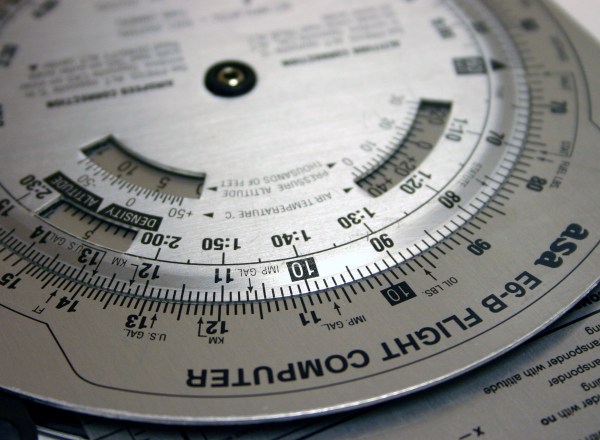
The Zero-Power Flight Computer

In the early days of aviation, pilots or their navigators used a plethora of tools to solve common navigation and piloting problems. There was definitely a need for some kind of computing aid that could replace slide rules, tables, and tedious dead-reckoning computations. This would become even more important during World War II, when there was a massive push to quickly train young men to be pilots.

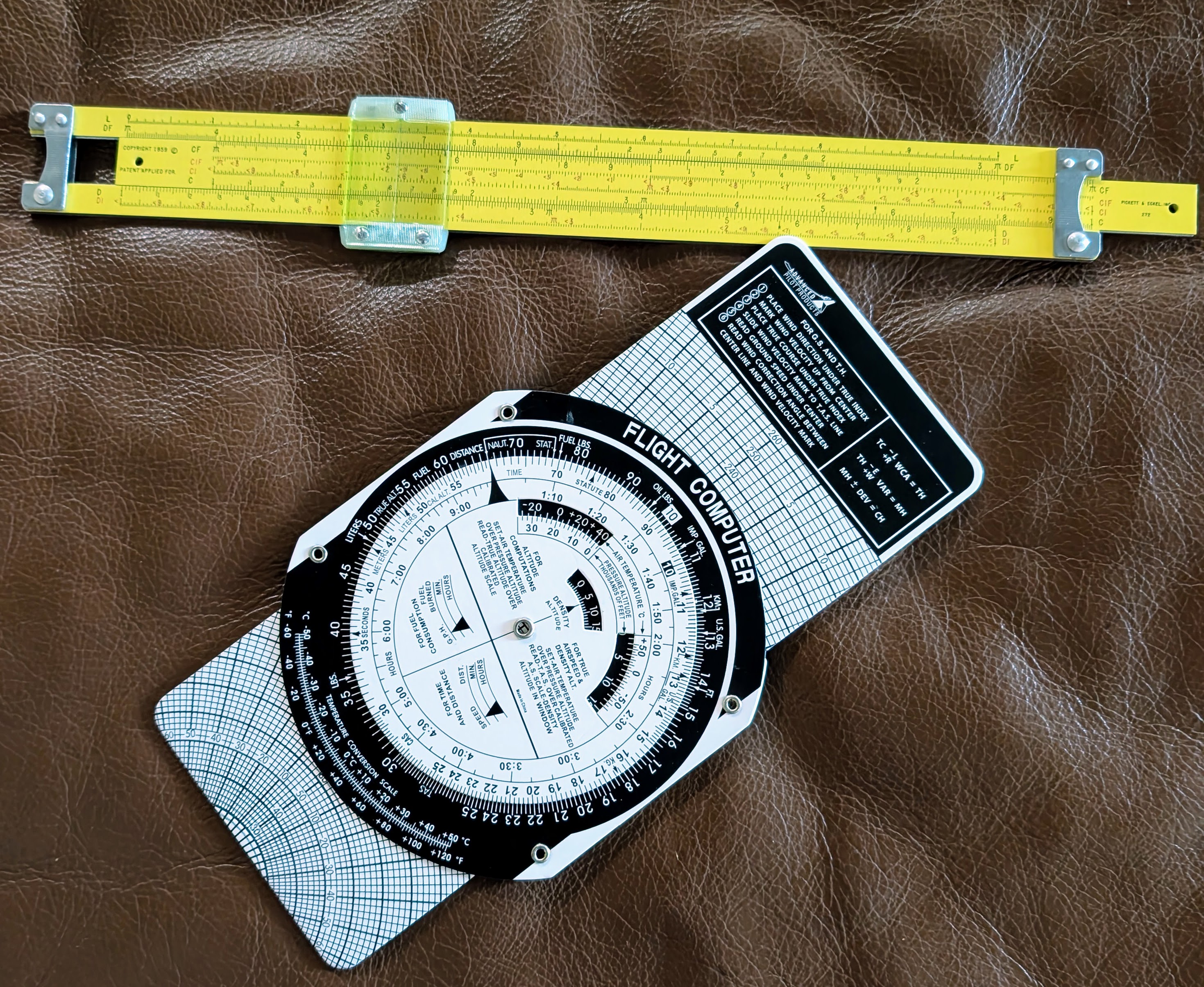
The same, but different. A Pickett slide rule (top) and an E6B slide rule (bottom). (Own Work).

Today, we’d whip up some sort of computer device, but in the 1930s, computers weren’t anything you’d cram on a plane, even if they’d had any. For example, the Mark 1 Fire Control Computer during WW2 was 3,000 pounds of gears and motors.

The computer is made to answer flight questions like “how many pounds of fuel do I need for another hour of flying time?” or “How do I adjust my course if I have a particular crosswind?”

History

There were a rash of flight computers starting in the 1920s that were essentially specialized slide rules. The most popular one appeared in the late 1930s. Philip Dalton’s circular slide rule was cheap to produce and easy to use. As you’ll see, it is more than just an ordinary slide rule. Keep in mind, these were not computers in the sense we think of today. They were simple slide rules that easily did specialized math useful to pilots.

Dalton actually developed a number of computers. The popular Model B appeared in 1933, and there were refinements leading to additional models. The Mark VII was very popular. Even Fred Noonan, Amelia Earhart’s navigator, used a Mark VII. Continue reading “The Zero-Power Flight Computer”

The Unreasonable Power Density Of Lithium-Ion

We’re all used to it by now, but I’d just like to reflect on how insanely power-packed lithium ion batteries are, and everything that’s afforded us. I’m trying to think of a gadget, a hobby, or nearly anything in my house that’s not touched by the battery chemistry.

I’m looking at my portable wireless keyboard in front of me, with a LiPo pack inside. Oddly enough, I’m charging it with a LiPo-based power bank, simply because the cable to the nearest USB-C adapter is too short. A gaming console, cell phone, and a DSLR camera are all within arms reach and powered with lithium.

It’s not just consumer stuff either. I fly FPV quads and airplanes for fun when I can, and of course those are made entirely possible by the combination of smaller brushless DC motors and their drivers, and the high-power-density LiPo packs that power them. For field recharging, I have a huge self-made LiIon pack that can keep them all in the air all day. These days, LiPo and LiIon tech is the heart of hacker projects big and small. Heck, we even powered this year’s Hackaday Supercon badge with a LiPo that allowed it to run all weekend on a charge for many folks, where in the past swapping out AAs during the event was commonplace.

The application that still blows my mind is that we recently got a solar installation on our roof, which means a huge LiFePO battery in the basement. And while it’s one thing to power noisy little quads on the battery tech, it somehow seems another to power our entire house, for multiple hours per day, from a battery. Granted it’s not a couple of AAA cells in a little black plastic box, but it’s simply amazing to run a washing machine, the fridge, the stove, and even the heating off of what amounts to a battery pack.

Of course, I’m aware of the costs of producing the cells, both in terms of money and the environmental damage. It’s not a free lunch, and I’m looking forward to both cleaner and cheaper energy storage chemistries in the future. But for now, I’m still in awe of the many options that lithium-based battery chemistry has brought us. May your pillows remain non-spicy!

Artemis II Agenda Keeps Moon-Bound Crew Busy

With the launch of Artemis II from Cape Canaveral potentially just weeks away, NASA has been releasing a steady stream of information about the mission through their official site and social media channels to get the public excited about the agency’s long-awaited return to the Moon. While the slickly produced videos and artist renderings might get the most attention, even the most mundane details about a flight that will put humans on the far side of our nearest celestial neighbor for the first time since 1972 can be fascinating.

The Artemis II Moon Mission Daily Agenda is a perfect example. Released earlier this week via the NASA blog, the document seems to have been all but ignored by the mainstream media. But the day-by-day breakdown of the Artemis II mission contains several interesting entries about what the four crew members will be working on during the ten day flight.

Of course, the exact details of the agenda are subject to change once the mission is underway. Some tasks could run longer than anticipated, experiments may not go as planned, and there’s no way to predict technical issues that may arise.

Conversely, the crew could end up breezing through some of the planned activities, freeing up time in the schedule. There’s simply no way of telling until it’s actually happening.

With the understanding that it’s all somewhat tentative, a look through the plan as it stands right now can give us an idea of the sort of highlights we can expect as we follow this historic mission down here on Earth.

Continue reading “Artemis II Agenda Keeps Moon-Bound Crew Busy”

FLOSS Weekly Episode 866: BreezyBox And Embedded Compilers

This week Jonathan chats with Valentyn Danylchuk about BreezyBox — an interactive shell and toolkit that provides various tools and a compiler on an ESP32 microcontroller. What was the inspiration for this impressive project, and what direction is it heading? Watch to find out!

Continue reading “FLOSS Weekly Episode 866: BreezyBox And Embedded Compilers”