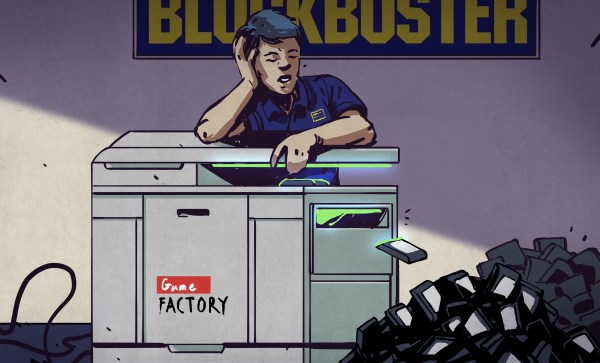
Remember When Blockbuster Video Tried Burning Game Cartridges On Demand?

By the onset of the 1990s one thing was clear, the future was digital. Analog format sales for music were down, CD sales were up; and it was evident, at least in the US, that people were bringing more computing devices into their homes. At the beginning of the decade, roughly 1 in 3 American households had a Nintendo Entertainment System in them, according to this Good Morning America segment.

With all those consoles out there, every shopping season became a contest of “who could wait in line the longest” to pickup the newest titles. This left last minute shoppers resorting to taking a rain check or return home empty handed. Things didn’t have to be this way. The digital world had emerged and physical media just needed to catch up. It would take an unlikely alliance of two disparate companies for others to open their minds.

Continue reading “Remember When Blockbuster Video Tried Burning Game Cartridges On Demand?”

Inductance In PCB Layout: The Good, The Bad, And The Fugly

When current flows through a conductor it becomes an inductor, when there is an inductor there is an electromagnetic field (EM). This can cause a variety of issues during PCB layout if you don’t plan properly, and sometimes we get burned even when we think we have planned for unwanted inductance and the effects that come with them.

When doing high speed logic we need to be able to deliver sudden changes in current to the devices if we want to have proper switching times and logic levels. Unfortunately inductance is usually not a friend in these circumstances as it resists those sudden changes in current. If the high speed devices are driving capacitive loads, which themselves are resisting changes in voltage, even more instantaneous current is needed.

Simply put, inductors resist a change of current, and can act as a low pass filter when in series with the signal or power supply flow. Inductors do this by storing energy in the flux surrounding the conductor. Alternatively capacitors resist a change in voltage (again by storing energy) and can act as a high pass filter when in series with the signal. This makes them a valuable tool in the fight against unwanted inductance in power supply distribution.

In the video below, and the remainder of this article, I’m going to dive into the concept of inductance and how it affects our design choices when laying out circuit boards.

Continue reading “Inductance In PCB Layout: The Good, The Bad, And The Fugly”

Laser Noob: Getting Started With The K40 Laser

Why spend thousands on a laser cutter/engraver when you can spend as little as $350 shipped to your door? Sure it’s not as nice as those fancy domestic machines, but the plucky K40 is the little laser that can. Just head on down to Al’s Laser Emporium and pick one up.  Yes, it sounds like a used car dealership ad, but how far is it from the truth? Read on to find out!

Laser cutting and engraving machines have been around for decades. Much like 3D printers, they were originally impossibly expensive for someone working at home. The closest you could get to a hobbyist laser was Epilog laser, which would still cost somewhere between $10,000 and $20,000 for a small laser system. A few companies made a go with the Epilog and did quite well – notably Adafruit used to offer laptop laser engraving services.

Over the last decade or so things have changed. China got involved, and suddenly there were cheap lasers on the market. Currently, there are several low-cost laser models available in various power levels. The most popular is the smallest – a 40-watt model, dubbed the K40. There are numerous manufacturers and there have been many versions over the years. They all look about the same though: A blue sheet metal box with the laser tube mounted along the back. The cutting compartment is on the left and the electronics are on the right. Earlier versions came with Moshidraw software and a parallel interface.

Continue reading “Laser Noob: Getting Started With The K40 Laser”

Can You “Take Back” Open Source Code?

It seems a simple enough concept for anyone who’s spent some time hacking on open source code: once you release something as open source, it’s open for good. Sure the developer might decide that future versions of the project close up the source, it’s been known to happen occasionally, but what’s already out there publicly can never be recalled. The Internet doesn’t have a “Delete” button, and once you’ve published your source code and let potentially millions of people download it, there’s no putting the Genie back in the bottle.

But what happens if there are extenuating circumstances? What if the project turns into something you no longer want to be a part of? Perhaps you submitted your code to a project with a specific understanding of how it was to be used, and then the rules changed. Or maybe you’ve been personally banned from a project, and yet the maintainers of said project have no problem letting your sizable code contributions stick around even after you’ve been kicked to the curb?

Due to what some perceive as a forced change in the Linux Code of Conduct, these are the questions being asked by some of the developers of the world’s preeminent open source project. It’s a situation which the open source community has rarely had to deal with, and certainly never on a project of this magnitude.

Is it truly possible to “take back” source code submitted to a project that’s released under a free and open source license such as the GPL? If so, what are the ramifications? What happens if it’s determined that the literally billions of devices running the Linux kernel are doing so in violation of a single developer’s copyright? These questions are of grave importance to the Internet and arguably our way of life. But the answers aren’t as easy to come by as you might think.

Continue reading “Can You “Take Back” Open Source Code?”

Hack My House: Raspberry Pi As Infrastructure

I finally had my own house. It was a repossession, and I bought it for a song. What was supposed to be a quick remodel quickly turned into the removal of most of the drywall in the house. There was a silver lining on this cloud of drywall dust and loose insulation. Rather than constantly retro-fitting cabling and gadgets in as needed, I could install everything ahead of time. A blank canvas, when the size of a house, can overwhelm a hacker. I’ve spent hours thinking through the infrastructure of my house, and many times I’ve wished for a guide written from a hacker’s perspective. This is that guide, or at least the start of it.

What do you want your smart house to do? And what do you want to be able to do in your smart house? For example, I wanted to be able to upgrade my cheap 120 V welder to a beefier 240 V model, so adding a 240 V plug in the garage was a must. As a bonus, that same 240 V circuit could be used for charging an electric car, if ever one is parked there.

“Ethernet everywhere” was my mantra. Try to imagine everywhere you might want to plug in a desktop, a laptop, an access point, or even a VoIP phone. I decided I wanted at least two Ethernet drops to each room, and tried to imagine the furniture layout in order to put them in convenient places.

Continue reading “Hack My House: Raspberry Pi As Infrastructure”

Buy A Baofeng While You Still Can? FCC Scowls At Unauthorized Frequency Transmitters

There was a time when a handheld radio transceiver was an object of wonder, and a significant item for any radio amateur to own. A few hundred dollars secured you an FM walkie-talkie through which you could chat on your local repeater, and mobile radio was a big draw for new hams. Thirty years later FM mobile operation may be a bit less popular, but thanks to Chinese manufacturing the barrier to entry is lower than it has ever been. With extremely basic handheld radios starting at around ten dollars and a capable dual-bander being yours for somewhere over twice that, most licencees will now own a Baofeng UV5 or similar radio.

The FCC though are not entirely happy with these radios, and QRZ Now are reporting that the FCC has issued an advisory prohibiting the import or sale of devices that do not comply with their rules. In particular they are talking about devices that can transmit on unauthorised frequencies, and ones that are capable of transmission bandwidths greater than 12.5 kHz.

We’ve reported before on the shortcomings of some of these radios, but strangely this news doesn’t concern itself with their spurious emissions. We’re guessing that radio amateurs are not the problem here, and the availability of cheap transceivers has meant that the general public are using them for personal communication without a full appreciation of what frequencies they may be using. It’s traditional and normal for radio amateurs to use devices capable of transmitting out-of-band, but with a licence to lose should they do that they are also a lot more careful about their RF emissions.

Read the FCC statement and you’ll learn they are not trying to restrict the sale of ham gear. However, they are insisting that imported radios that can transmit on other frequencies must be certified. Apparently, opponents of these radios claim about 1 million units a year show up in the US, so this is a big business. The Bureau warns that fines can be as high as $19,639 per day for continued marketing and up to $147,290 — we have no idea how they arrive at those odd numbers.

So if you’re an American who hasn’t already got a Baofeng or similar, you might be well advised to pick one up while you still can.

UV5-R image via PE1RQM

Productivity, Unfinished Projects, And Letting Go

Most of us have been there, some projects just don’t get finished. Everyone shelves an in-progress build from time to time, and some hackers drop almost every project for fully finishing it. Why does it happen? What can we do about it? Or does it even matter? My own most memorable one is the wine glass rack I was making for my sister’s birthday, still sitting incomplete on a shelf eleven years later.

The answer may lie in what you consider to be a “done” project. Is it a fully completed build with every possible feature implemented and polished? With that rubric you could be counting all of your completed projects on one hand. What are you really getting out of your personal projects? It’s an interesting topic to consider as pivoting your mindset can end up boosting your productivity. So let’s dig in!

Continue reading “Productivity, Unfinished Projects, And Letting Go”