Preparing Your Product For The FCC

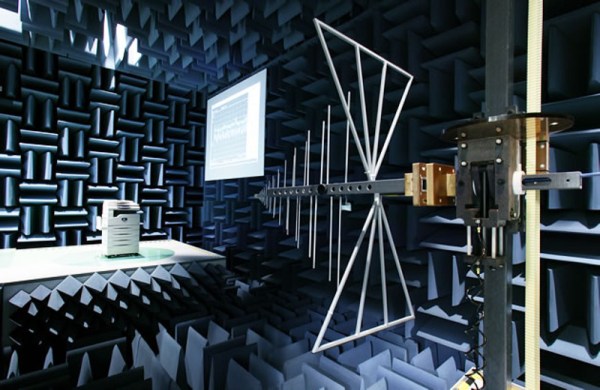
At some point you’ve decided that you’re going to sell your wireless product (or any product with a clock that operates above 8kHz) in the United States. Good luck! You’re going to have to go through the FCC to get listed on the FCC OET EAS (Office of Engineering and Technology, Equipment Authorization System). Well… maybe.

As with everything FCC related, it’s very complicated, there are TLAs and confusing terms everywhere, and it will take you a lot longer than you’d like to figure out what it means for you. Whether you suffer through this, breeze by without a hitch, or never plan to subject yourself to this process, the FCC dance is an entertaining story so let’s dive in!

Continue reading “Preparing Your Product For The FCC”

Spectrum Analyzer With 555 Fits In A Tin

[VK2ZAY] has a thing for 555 chips. Before the ready availability of microcontrollers, the 555 was the hardware hacker’s swiss army knife. After all, even though the chip is supposed to be a timer, it is really a bunch of simple pieces you can use to make a timer: a pair of comparators, a few transistors, and a flip-flop. You can use those parts in many different ways, and a timer is just one of them.

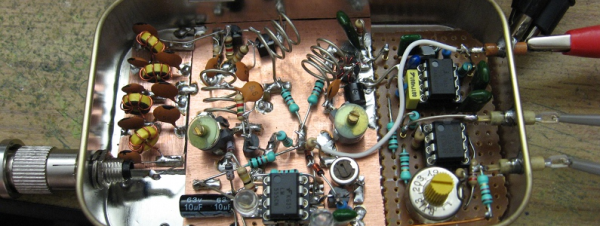
[VK2ZAY] used one as a key component in a simple spectrum analyzer. The 555 generates a ramp voltage which alters the frequency of an oscillator. The oscillator mixes with the input signal and a fixed-frequency superregenerative detector creates an output voltage proportional to the input signal strength. You can see a video of the whole setup, below.

Continue reading “Spectrum Analyzer With 555 Fits In A Tin”

Clustering A Lot Of Raspberry Pi Zeros

It became something of a cliché a few years ago in online discussions, whenever a new single board computer was mentioned someone would pop up and say something like “Imagine a Beowulf cluster…“. Back then it was said largely in jest, but with the current generation of boards it’s a distinct possibility. Who hasn’t looked at a Raspberry Pi and idly thought about a cluster of them, or even created one!

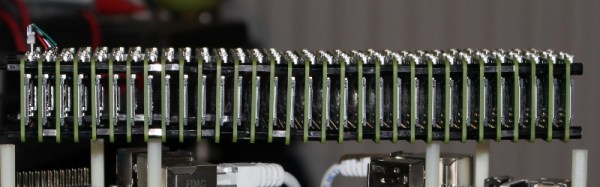
[Electronoob] did just that, creating a variety of Raspberry Pi cluster configurations, the most impressive of which is a stack of 32 Pi Zeros mounted together with stand-offs. The plan was to network it via USB, for which he initially considered building a backplane, but was put off by the cost of vertical USB connectors and instead went for a wired approach. If there is a lesson to be learned from his experiences it is that buying very cheap USB cables is a minefield: his pile of eBay specials turned out to have significant numbers of faults. He’s now faced with a stark choice, solder  32 sets of USB pads on the base of each Zero or buy better cables.

The stack of Zeros is pretty impressive, but so what, you think. It’s still not working properly. But the Zero cluster isn’t his only work. He’s also created a set of very nicely executed Ethernet clusters using the larger Pi boards, and the way he’s mounted them on top of compact Ethernet switches sets them apart from some of the more spaghetti-like Pi clusters.

It’s true a Pi cluster won’t cut it in the world of supercomputers, you could almost certainly buy more bang for your buck without too much effort. But it does represent a very accessible way to learn about cluster computing, and you have to admit it a stack of Zeros does look rather impressive.

We’ve seen quite a few Pi clusters here since 2012, the biggest of which is probably this 120 node behemoth, complete with screens.

Possible Fire Hazard: Wanhao Duplicator I3 3D Printer

A while ago Wanhao was reaching out to its customers and resellers, warning them of a design flaw in their Duplicator i3 that may cause fires. The printers suffered from an issue that caused crimp connections of the nozzle heater cartridge’s supply line to fail due to the mechanical stress in the cable drag chain. In their “Recall” titled note, Wanhao provides instructions on how to fix the issue.

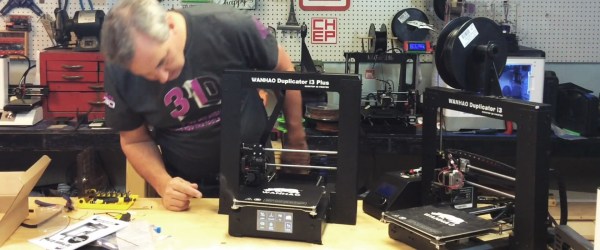
Now, [Chuck Hellebuyck] released an unboxing video on the Duplicator i3 Plus, during which the heated bed emitted magic smoke that could be rationally explained as another design flaw.

Continue reading “Possible Fire Hazard: Wanhao Duplicator I3 3D Printer”

[Geohot] Selling His “Self-Driving” Car Tech For $1k By New Year

This week [Geohot] announced the launch of his self-driving car hardware. This is the natural extension of his proof-of-concept shown off in December which he parlayed into a Silicon Valley startup called comma.ai. [Geohot], whose real name is [George Hotz], is well known for jailbreaking the iPhone and making Sony look like idiots when they retroactively crippled Linux support on PS3. He has hardware chops.

Initial self-driving add-on hardware only works with Honda and Acura models that already have lane-keeping assist features because those vehicles already have built-in front radar. The package, which replaces the rear view mirror, adds a front facing camera. Those lucky (or brave, foolish, daring?) beta users can trade $999 and $24/month for what is currently a green 3D printed enclosure with some smartphone-like hardware inserted.

The company has taken an interesting approach to acquiring data needed for this particular flavor of self-driving. [Hotz] is teasing a chance at beta test invites to those who contribute driving data to the company. This is as simple as downloading an app to your phone and letting it roll from your windshield as you go bumper to bumper from Mountain View to San Francisco. That’s right, the plan is to support just that stretch of the nation’s highway system — although [Hotz] did make a brazen estimate of 90% of commutes for 90% of users within a year. Hey, it’s a startup so it’s either that, selling to a bigger fish, or closing their doors.

That narrow route support is actually an interesting constraint. In fact, the company is most interesting because of its chosen constraints: a small subset of cars, a chosen stretch of highway, and dare we say sanity when it comes to self-driving expectations. Grandiose claims have the general public thinking a vehicle with no human driver will slide up to your stoop and take you anywhere you want to go. That is a dauntingly difficult engineering challenge (dare we say impossible). What [Hotz] is selling is a more stress-free commute, not a nap in the back seat. You still need to be paying attention at all times.

Will this system work? Undoubtedly the engineering is possible (Tesla is already doing it). The biggest question mark that remains is human nature. This system demands your attention even though you’re doing nothing. That seems unrealistic — users are bound to lapse in attention much more frequently than if they were the primary driver. The question then becomes, will people pay attention at the very rare yet very crucial moments, and can a system like this prevent more fatal accidents than it causes?

[via Engadget]

Drone Flies 12 Cm On Wireless Power

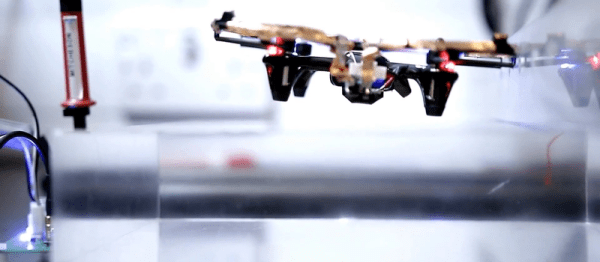
[Sam M] wrote in with a quick proof-of-concept demo that blows our socks off: transferring enough power wirelessly to make a small quadcopter take flight. Wireless power transfer over any real distance still seems like magic to us. Check out the videos embedded below and you’ll see what we mean.

What’s noteworthy about this demo is that neither the transmitter nor the receiver are particularly difficult to make. The transmitting loop is etched into a PCB, and the receiver is made of copper foil tape. Going to a higher frequency facilitates this; [Sam M] is using 13.56 MHz instead of the kilohertz that most power-transfer projects use. This means that all the parts can be smaller and lighter, which is obviously important on a miniature quadrotor.

Continue reading “Drone Flies 12 Cm On Wireless Power”

A New OS For Apple II Computers

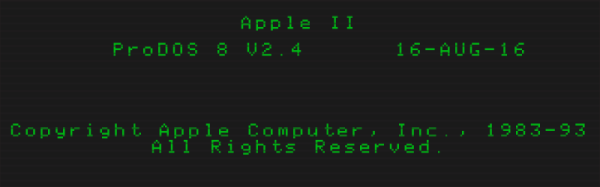
Although this sort of work is usually reserved for KansasFest and other forums for highly technical and very skilled Apple enthusiasts, [John Brooks]’s release of a new version of the ProDOS operating system is no less important. It is, without a doubt, the greatest release the Apple II platform will see for the next few years. This swan song of the Apple II platform is simply ProDOS 2.4, an update to the last version of Apple’s ProDOS, last released in 1993.

For a bit of historical context, ProDOS was not the operating system that shipped with the Apple ][ in 1977. That OS was simply called DOS. ProDOS, released in 1983, included support for the new 3.5″ floppy drives, allowed for hierarchical directories, supported hardware interrupts, and kept the Apple ][ line going well into the 90s. Despite these improvements, not all Apple ][ systems were supported. The original ][ and ][+ were out in the cold. Now, with the ability to add Compact Flash and USB devices to an Apple ][, even the latest version of ProDOS is horribly out of date.

[John]’s release of ProDOS 2.4 fixes all of this. This release is the most important development in the Apple ][ ecosystem in recent memory, and will remain so for at least a decade. The only person who still uses an Apple ][ as a daily driver agrees, and ProDOS 2.4 is now enshrined in The Archive for all eternity.
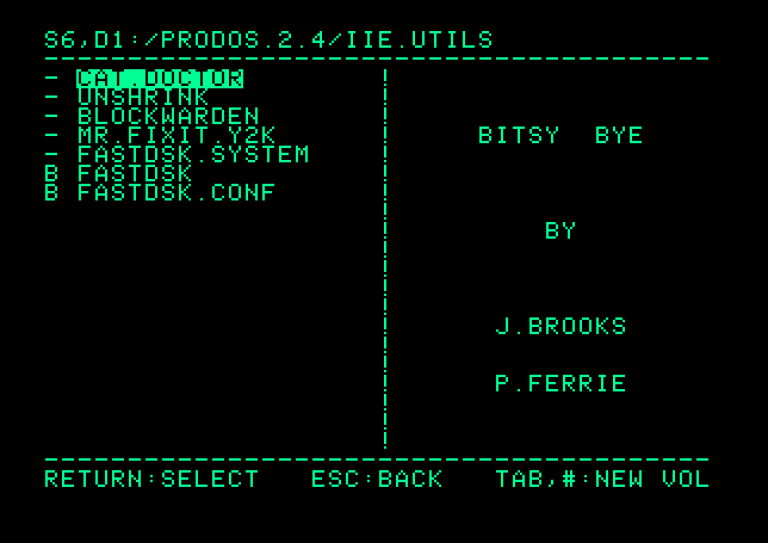
prodos-2-4-bitsy-bye-768x543New features abound, although most of them are geared toward the now thirty-year-old Apple IIGS. These features include enhanced utility in GS/OS – the Apple equivalent of the Commodore GEOS – slot remapping, and an OS that is both smaller and loads faster. Older machines aren’t left out, and ProDOS includes the usual features and improvements found in ProDOS 2.x that weren’t available in the Apple ][, Apple ][+ and un-enhanced Apple //e.

The killer feature and one more thing of this release is the BitsyBye utility, a small ($300!) system program that allows you to boot various Apple II devices and programs. Think of this as the Norton Commander of the Apple II ecosystem, allowing slots to be selected, booting the most recently used ProDOS device, and basic file system exploration. BitsyBye also includes an easter egg. A few utilities are also included on the ProDOS 2.4 disk image including ADTPro, Shrinkit archive expander, and disk utilities.

A 140k ProDOS 2.4 disk image is available on [John]’s site and on Archive.org. Since you’re probably not downloading directly to an Apple II disk, grab ADTPro and load it over audio.