Modding The Monoprice MP Mini Printer

Two weeks after my review of the MP Select Mini 3D printer, Monoprice’s own website has said this printer has been out of stock, in stock, and out of stock again several times. This almost unimaginably cheap 3D printer is proving to be exceptionally popular, and is in my opinion, a game-changing machine for the entire world of 3D printing.

With the popularity of this cheap printer that’s more than halfway decent, there are bound to be improvements. Those of us who have any experience with 3D printers aren’t going to be satisfied with a machine with any shortcomings, especially if it means we can print enhancements and mods for our printers.

Below are the best mods currently available for this exceptional printer. Obvious problems with the printer are corrected, and it’s made a little more robust. There are mods to add a glass build plate, and a few people are even messing around with the firmware on this machine. Consider this volume one of the MP Mini hacks; with a cheap printer that’s actually good, there are bound to be more improvements.
Continue reading “Modding The Monoprice MP Mini Printer”

Dumbing Down A Smart Switch

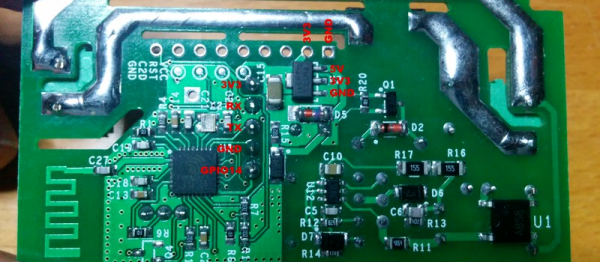
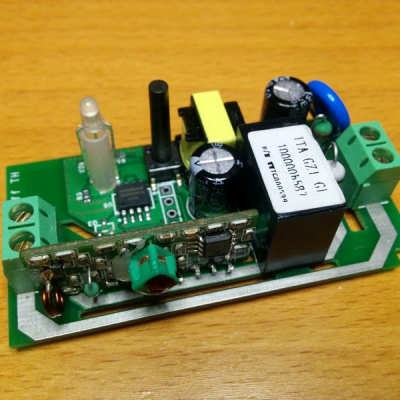
Internet of Everything is the way to go for home automation these days. ITEAD makes an ESP-8266 switch that IoT-ifies your appliances. If you still have an ancient, 433 MHz style radio switch system, they even make one that does WiFi and 433 MHz. But if you’re too cheap to shell out for the dual-mode version, you can always add a $1 433 MHz radio yourself. Or at least, that’s what [Tinkerman] did.

IMG_20160522_163814x_thumbnailAside from the teardown and reverse-engineering of the WiFi-enabled switch, [Tinkerman] also flashed custom firmware into the switch’s ESP-8266, and worked it all into his existing home Node-RED framework. Now he’s got more possible ways to turn on his living-room lights than any person could possibly hope for!
If you want to get into this whole WiFi-based home automation game, you could do worse than to have a look at the series we ran on MQTT just a little while ago. Seeing [Tinkerman]’s Node-RED demo makes us think that we’ll have to give that a look for our home system as well.

42,300 Transistor Megaprocessor Is Complete

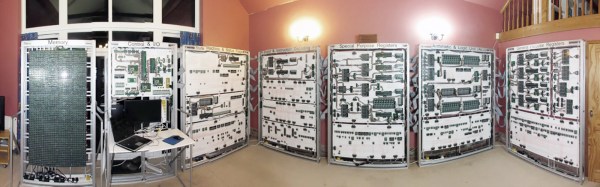
As it turns out, the answer is not 42, it’s 42.3 — thousand. That’s how many discrete transistors spread across the 30 m2 room housing this massive computation machine. [James Newman’s] Megaprocessor, a seriously enlarged version of a microprocessor, is a project we’ve been following with awe as it took shape over the last couple of years.

[James] documented his work in great detail, and by doing so, took us on a journey through the inner workings of microprocessors. His monumental machine is now finished, and it’s the ultimate answer to how a processor – and pretty much everything that contains a processor – works.

Continue reading “42,300 Transistor Megaprocessor Is Complete”

Build A 3D Printer Workhorse, Not An Amazing Disappointment Machine

3D printers have become incredibly cheap, you can get a fully workable unit for $200 – even without throwing your money down a crowdfunded abyss. Looking at the folks who still buy kits or even build their own 3D printer from scratch, investing far more than those $200 and so many hours of work into a machine you can buy for cheap, the question “Why the heck would you do that?” may justifiably arise.

The answer is simple: DIY 3D printers done right are rugged workhorses. They work every single time, they never break, and even if: they are an inexhaustible source of spare parts for themselves. They have exactly the quality and functionality you build them to have. No clutter and nothing’s missing. However, the term DIY 3D printer, in its current commonly accepted use, actually means: the first and the last 3D printer someone ever built, which often ends in the amazing disappointment machine.

This post is dedicated to unlocking the full potential in all of these builds, and to turning almost any combination of threaded rods and plywood into a workshop-grade piece of equipment.

Continue reading “Build A 3D Printer Workhorse, Not An Amazing Disappointment Machine”

Seeing The Truly Invisible With DIY Shortwave UV Imaging

We’ve all seen how to peel IR filters off digital cameras so they can see a little better in the dark, but there’s so much more to this next project than that. How about being able to see things normally completely outside the visual spectrum, like hydrogen combustion or electrical discharges?

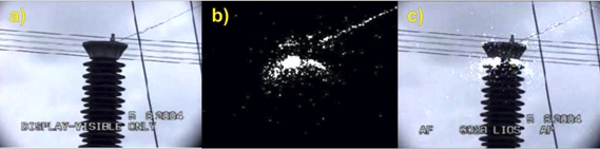
UV Electrical Discharge

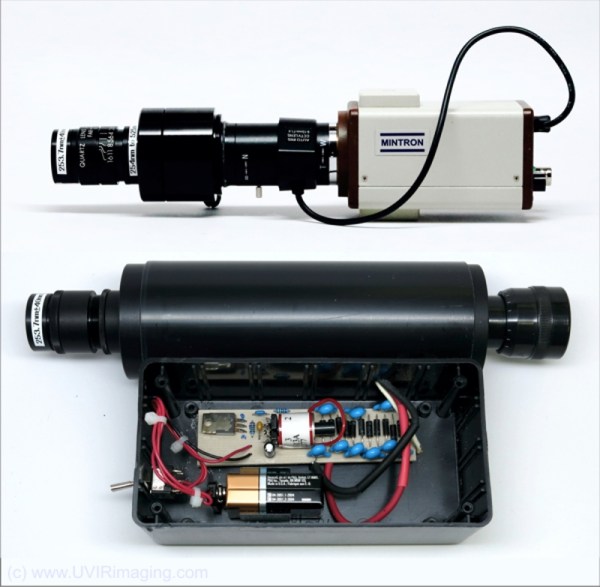
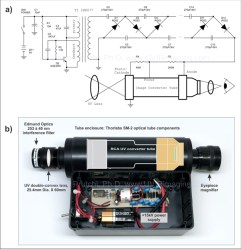
[David Prutchi] has just shared his incredible work on making his own shortwave ultraviolet viewers for imaging entirely outside of the normal visible spectrum – in other words, seeing the truly invisible. The project has not only fascinating application examples, but provides detailed information about how to build two different imagers – complete with exact part numbers and sources.

UV-Viewer-SmallIf you’re thinking UV is a broad brush, you’re right. [David Prutchi] says he is most interested in Solar Blind UV (SBUV):


Solar radiation in the 240 nm to 280 nm range is completely absorbed by the ozone in the atmosphere and cannot reach Earth’s surface…

Without interference from background light, even very weak levels of UV are detectable. This allows ultraviolet-emitting phenomena (e.g. electrical discharges, hydrogen combustion, etc.) to be detectable in full daylight.

There is more to the process than simply slapping a UV filter onto a camera, but happily he addresses all the details and the information is also available as a PDF whitepaper. [David Prutchi] has been working with imaging for a long time, and with his sharing of detailed build plans and exact part numbers maybe others will get in on the fun. He’s also previously shared full build plans for a Raspberry Pi based multispectral imager, [David’s] DOLPHi Polarization Camera was a finalist in the 2015 Hackaday Prize, and he spoke at the Hackaday SuperConference about the usefulness of advanced imaging techniques for things like tissue analysis in medical procedures, and landmine detection for the purposes of cleaning up hazardous areas.

The Future Of Eagle CAD

Last week, Autodesk announced their purchase of CadSoft Eagle, one of the most popular software packages for electronic design automation and PCB layout.

Eagle has been around for nearly thirty years, and has evolved to become the standard PCB design package for electronic hobbyists, students, and engineering firms lead by someone who learned PCB design with Eagle. The reason for this is simple: it’s good enough for most simple designs, and there is a free version of Eagle. The only comparable Open Source alternative is KiCad, which doesn’t have nearly as many dedicated followers as Eagle.  Eagle, for better or worse, is a standard, and Open Source companies from  Sparkfun to Adafruit use it religiously and have created high-quality libraries of parts and multiple tutorials

I had the chance to talk with [Matt Berggren], former Hackaday overlord who is currently serving as the Director of Autodesk Circuits. He is the person ultimately responsible for all of Autodesk’s electronic design products, from Tinkercad, 123D, Ecad.io, and project Wire, the engine behind Voxel8, Autodesk’s 3D printer that also prints electronics. [Matt] is now the master of Eagle, and ultimately will decide what will change, what stays the same, and the development path for Eagle.

Continue reading “The Future Of Eagle CAD”

Don Eyles Walks Us Through The Lunar Module Source Code

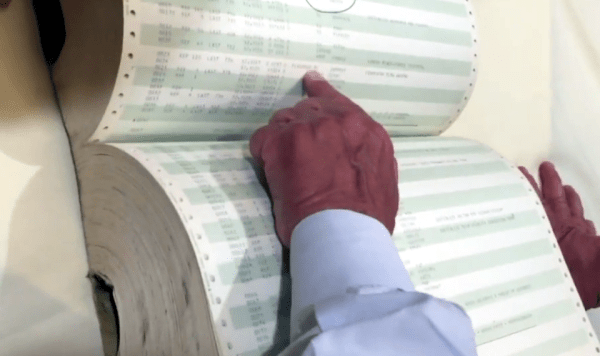
A couple weeks ago I was at a party where out of the corner of my eye I noticed what looked like a giant phone book sitting open on a table. It was printed with perforated green and white paper bound in a binder who’s cover looked a little worse for the wear. I had closer look with my friend James Kinsey. What we read was astonishing; Program 63, 64, 65, lunar descent and landing. Error codes 1201, 1202. Comments printed in the code, code segments hastily circled with pen. Was this what we thought we were looking at? And who brings this to a party?

Continue reading “Don Eyles Walks Us Through The Lunar Module Source Code”