A Dis-Integrated 6502

The 6502 is the classic CPU. This chip is found in the original Apple, Apple II, PET, Commodore 64, BBC Micro, Atari 2600, and 800, the original Nintendo Entertainment System, Tamagotchis, and Bender Bending Rodriguez. This was the chip that started the microcomputer revolution, and holds a special place in the heart of every nerd and technophile. The 6502 is also possibly the most studied processor, with die shots of polysilicon and metal found in VLSI textbooks and numerous simulators available online.

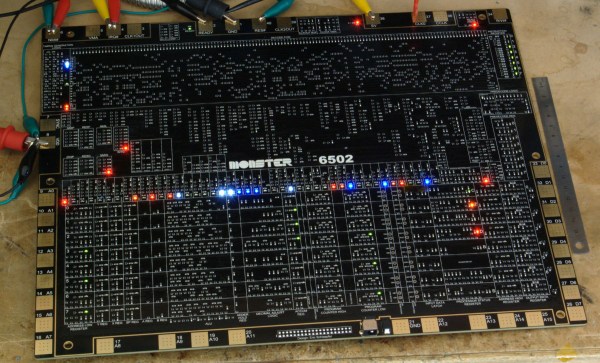
The only thing we haven’t seen, until now, is a version of the 6502 built out of discrete transistors. That’s what [Eric Schlaepfer] has been working on over the past year. It’s huge – 12 inches by 15 inches – has over four thousand individual components, and so far, this thing works. It’s not completely tested, but the preliminary results look good.

The MOnSter 6502 began as a thought experiment between [Eric] and [Windell Oskay], the guy behind Evil Mad Scientist and creator of the discrete 555 and dis-integrated 741 kits. After realizing that a few thousand transistors could fit on a single panel, [Eric] grabbed the netlist of the 6502 from Visual6502.org. With the help of several scripts, and placing 4,304 components into a board design, the 6502 was made dis-integrated. If you’re building a CPU made out of discrete components, it only makes sense to add a bunch of LEDs, so [Eric] threw a few of these on the data and address lines.

This is the NMOS version of the 6502, not the later, improved CMOS version. As such, this version of the 6502 doesn’t have all the instructions some programs would expect. The NMOS version is slower, more prone to noise, and is not a static CPU.

So far, the CPU is not completely tested and [eric] doesn’t expect it to run faster than a few hundred kilohertz, anyway. That means this gigantic CPU can’t be dropped into an Apple II or commodore; these computers need a CPU to run at a specific speed. It will, however, work in a custom development board.

Will the gigantic 6502 ever be for sale? That’s undetermined, but given the interest this project will receive it’s a foregone conclusion.

Correction: [Eric] designed the 555 and 741 kits
Super Strong 3D Component Carbon Fiber Parts

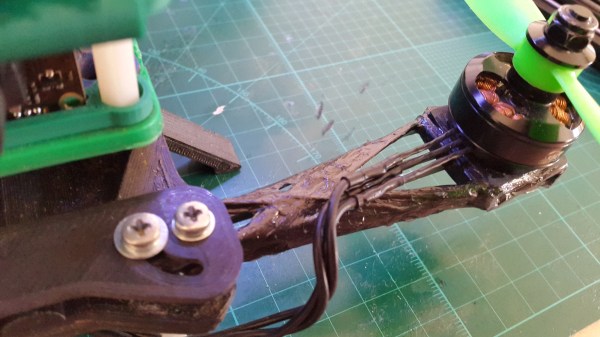
[prubeš] shows that parts printed with carbon fiber filament are as strong, or at least as stiff, as you’d expect. He then shows that his method for producing carbon fiber parts with a mixture of traditional lay-up and 3D printing is even stronger and lighter.

[prubeš] appears to be into the OpenR/C project and quadcopters. These things require light and strong parts for maximum performance. He managed to get strength with carbon fiber fill filament, but the parts weren’t light enough. Then he saw [RichMac]’s work on Thingiverse. [RichMac] designed parts with pre-planned grooves in which he ran regular carbon fiber tow with epoxy. This produced some incredibly strong parts. There’s a section in his example video, viewable after the break, where he tests a T joint. Even though the plastic starts to fail underneath the carbon fiber, the joint is still strong enough that the aluminum tube inside of it fails first.

[prubeš] innovation on [RichMac]’s method is to remove as much of the plastic from the method as possible. He designs only the connection points of the part, and then designs a 3D printable frame to hold them in place. After he has those in hand, he winds the tow around the parts in a sometimes predetermined path. The epoxy cures onto the 3D print creating a strong mounting location and the woven carbon fiber provides the strength.

His final parts are stronger than 100% infill carbon fill prints, but weighs 8g instead of 12g.  For a quadcopter this kind of saving can add up fast.

Continue reading “Super Strong 3D Component Carbon Fiber Parts”

The Ultimate Traveler’s Toolkit

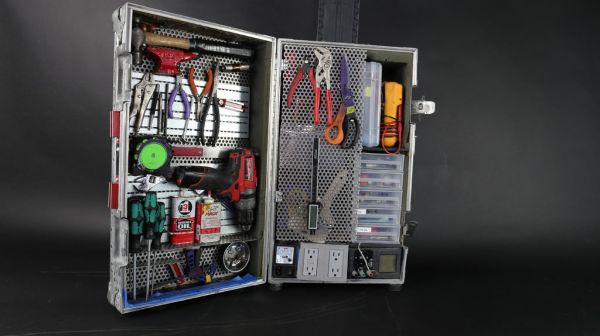
Looking for a better way to store your tools during transportation? While we certainly wouldn’t recommend trying to check this thing as a carry-on (oh and prepare for it to be searched even in checked luggage), this clever use of a road case is probably one of the best tool boxes we’ve ever seen.

This is [Robb Godshaw’s] tool box. It’s been developed over the past five years as he’s become a skilled maker. You might remember him best from his ironic project “Why are we limited to C-Clamps?” — a clamp offering of the entire alphabet.

He also picked up the road case close to home for Hackaday — at Apex Electronics Surplus in LA — one of our favorite places to find parts. But the most clever part of the project is the way he’s divided the case for different tools.

Continue reading “The Ultimate Traveler’s Toolkit”

Captain America’s Mighty Shield With 7200N Of Powerful Electromagnets!

At Hackaday, sometimes we nerd out a bit too hard over comic book movies. With Captain America: Civil War in theaters, I knew I had to do a project dedicated to the movie — so I made a ridiculously over powered electromagnet bracer. The hope? To attract a Captain America replica shield from short distances.

electromagnet bracerI had the idea for this project a while ago after watching Avengers: Age of Ultron.
If you’re not familiar, it appears Captain America gets a suit upgrade (presumably from Stark himself) that features some pretty awesome embedded electromagnets allowing him to call his shield back to him from afar.

Now unfortunately, electromagnets aren’t that strong and I knew I wouldn’t be able to achieve quite the same effect as good ol’ CGI — but I’d be darned not to try!  Continue reading “Captain America’s Mighty Shield With 7200N Of Powerful Electromagnets!”

Two Guys, A Hotel Room And A Radio Fire

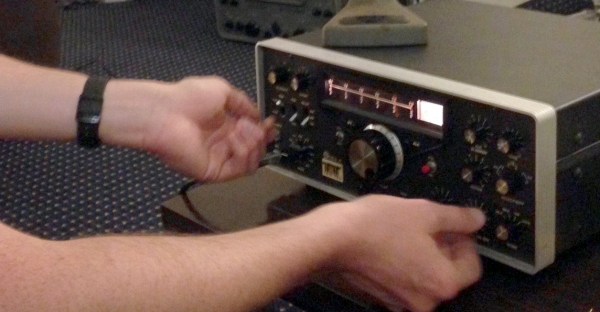
Can you build a HF SSB radio transciever in one weekend, while on the road, at parts from a swap meet? I can, but apparently not without setting something on fire.

Of course the swap meet I’m referring to is Hamvention, and Hamvention 2016 is coming up fast. In a previous trip to Hamvention, Scott Pastor (KC8KBK) and I challenged ourselves to restore tube radio gear in a dodgy Dayton-area hotel room where we repaired a WW2 era BC-224 and a Halicrafters receiver, scrounging parts from the Hamfest.

Our 2014 adventures were so much fun that it drove us to create our own hacking challenge in 2015 to cobble together a <$100 HF SSB transceiver (made in the USA for extra budget pressure), an ad-hoc antenna system, put this on the air, and make an out-of-state contact before the end of Hamvention using only parts and gear found at Hamvention. There’s no time to study manuals, antennas, EM theory, or vacuum tube circuitry.  All you have are your whits, some basic tools, and all the Waffle House you can eat.  But you have one thing on your side, the world’s largest collection of surplus electronics and radio junk in one place at one time.  Can it be done?

Continue reading “Two Guys, A Hotel Room And A Radio Fire”

To See Within: Making Medical X-rays

I was a bit of a lost soul after high school.  I dabbled with electrical engineering for a semester but decided that it wasn’t for me – what I wouldn’t give for a do-over on that one. In my search for a way to make money, I stumbled upon radiologic technology – learning how to take X-rays. I figured it was a good way to combine my interests in medicine, electronics, and photography, so after a two-year course of study I got my Associates Degree, passed my boards, and earned the right to put “R.T.(R) (ARRT)” after my name.

That was about as far as that career went. There are certain realities of being in the health care business, and chief among them is that you really have to like dealing with the patients. I found that I liked the technology much more than the people, so I quickly moved on to bigger and better things. But the love of the technology never went away, so I thought I’d take a look at exactly what it takes to produce medical X-rays, and see how it’s changed from my time in the Radiology Department.

Continue reading “To See Within: Making Medical X-rays”

Path To Craftsmanship: Safety, Cleanliness, And Documentation As Habits

When I started boxing classes I was told, at my level, I could do just as much good for my form by doing core exercises such as crunches, running, push-ups, and pull-ups for a month as I could by doing the class. I consder habits like safety, cleanliness, and documentation to be habits that influence the quality of hacks much the same way. They’re not really related, and the work can get done without them, but their implementation alone improves the quality of everything you do at the workbench.

The best mechanic I’ve ever met had a well-organized shop. All of his employees wore nitrile gloves when they worked on engines to protect their hands from the chemicals inside. They used ear protection and safety glasses. His rates were low, and the car was always repaired fast. I never had to go back for the same repair twice. He knew exactly what repairs were done, and even kept the parts removed from my vehicle to show me if I desired. I got some of the most fantastic explanations of why parts failed from him. Two blocks down the street was a shop which was unorganized and had double rates. The employees were always sitting on the waiting chairs in the lounge. It took one trip there to never return.

Continue reading “Path To Craftsmanship: Safety, Cleanliness, And Documentation As Habits”