First introduced as an IC back in 1968, but with roots that go back to 1941, the 741 has been tweaked and optimized over the years and is arguably the canonical op-amp. [Ken Shirriff] decided to take a look inside everybody’s favorite op-amp, and ended up with some good-looking photomicrographs and a lot of background on the chip.
Rather than risk the boiling acid method commonly used to decap epoxy-potted ICs, [Ken] wisely chose a TO-99 can format to attack with a hacksaw. With the die laid bare for his microscope, he was able to locate all the major components and show how each is implemented in silicon. Particularly fascinating is the difference between the construction of NPN and PNP transistors, and the concept of “current mirrors” as constant current sources. And he even whipped up a handy interactive chip viewer – click on something in the die image and find out which component it is on the 741 schematic. Very nice.
We’ve seen lots of chip decappings before, including this reveal of TTL and CMOS logic chips. It’s nice to see the guts of the venerable 741 on display, though, and [Ken]’s tour is both a great primer for the newbie and a solid review for the older hands. Don’t miss the little slice of history he included at the end of the post.
A couple of days back, we wrote about the HACK – a prototyping platform designed by [Michele Perla] based on the Atmel SAM R21 MCU. It’s one of the new breed of devices consisting of an ARM Cortex-M0 MCU + IEEE 802.15.4 Wireless radio bundled together. This was exciting since we could pack a lot of punch in the HaDge hardware. We planned to use the same design later to power the HaDge. Building HACK would have allowed us to get it in the hands of the software team, while the hardware folks worked on the real HaDge layout.
The HACK design was ready for review and we asked around to verify the antenna layout, which was the part we were not too sure about. We asked Atmel for help with verifying the layout. That’s when we had the facepalm moment. They asked us – “What about FCC certification?” Since we plan to build the badges in quantities of a few hundred at the very least, it’s obvious we cannot escape from FCC certification. A design based around the R21 is ruled out – the cost of obtaining approval is pretty high. This means we need to punt the R21 and instead use an off-the-shelf radio module which is already FCC certified. Sigh.
Now the good news. This is a setback in terms of time, and effort put in by [Michele]. But beyond that, we’re good to go back to the drawing board and start afresh. First off, we decided to revert back to the Atmel D21 as the main controller. It’s a fairly decent MCU, and there’s a fairly robust tool chain available that a lot of people are familiar with. For the Radio, we are looking at some of these available options :
As we work on projects we’re frequently upgrading our tools. That basic soldering iron gives way to one with temperature control. The introductory 3D printer yields to one faster and more capable. One reason for this is we don’t really understand the restrictions of the introductory level tools. Sometimes we realize this directly when the tool fails in a task. Other times we see another hacker using a better tool and realize we must have one!.
The same occurs with software tools. The Arduino IDE is a nice tool for starting out. It is easy to use which is great if you have never previously written software. The libraries and the way it ties nicely into the hardware ecosystem is a boon.
When you start on larger projects, say you upgrade to a Due or Teensy for more code or memory space, the Arduino IDE can hamper your productivity. Moving beyond these limitations requires a new, better tool.
Where do we find a better tool? To begin, recognize, as [Elliot] points out that There is no Arduino “Language”, we’re actually programming in C or C++. We chose which language through the extension on the file, ‘c’ for C and ‘cpp’ for C++. An Arduino support library may be written in C or C++ depending on the developer’s preference. It’s all mix ‘n match.
Potentially any environment that supports C/C++ can replace the Arduino IDE. Unfortunately, this is not easy to do, at least for inexperienced developers, because it means setting up the language tool chain and tools for uploading to the board. A developer with that much experience might eschew an integrated development environment altogether, going directly to using makefiles as [Joshua] describes in Arduino Development; There’s a Makefile for That.
The reality is the Arduino IDE is not much more than a text editor with the ability to invoke the tools needed to compile and download the code to the Arduino. A professional IDE not only handles those details but provides additional capabilities that make the software development process easier.
Cellphone startup Fairphone is now taking pre-orders for their modular smartphone, which is expected to start shipping in December of this year. Although I’m much more familiar with Google’s project Ara, this is the first modular concept to make it to market. It does lead me to a few questions though: is this actually a modular smartphone, and how widely will modular concepts be adopted?
We’ve covered a number of diabetes-related hacks in the past, but this project sets its goals especially high. [Tim] has diabetes and needs to monitor his blood glucose levels and administer insulin accordingly. As a first step, he and a community of other diabetics have been working on Android apps to log the data when combined with a self-made Bluetooth re-transmitter.
But [Tim] is taking his project farther than previous projects we’ve seen and aiming at eventually driving an insulin pump directly from the app. (Although he’s not there yet, and user input is still required.) To that end, he’s looking into the protocols that control the dosage pumps.
We just read about [Tim] in this article in the Guardian which covers the diabetic-hacker movement from a medical perspective — the author currently runs a healthcare innovation institute and is a former British health minister, so he’s not a noob. One passage made us pause a little bit. [Tim] speaks the usual praises of tech democratization through open source and laments “If you try to commercialize [your products], you run up against all sorts of regulatory barriers.” To which the author responds, “This should ring alarm bells. Regulatory barriers are there for a reason.”
We love health hacking, and we’re sure that if we had a medical condition that could be helped by constant monitoring, that we’d absolutely want at least local smart-phone logging of the relevant data. But how far is too far? We just ran an article on the Therac-25 case study in which subtle software race conditions ended up directly killing people. We’d maybe hesitate a bit before we automated the insulin pump, but perhaps we’re just chicken.
The solution suggested by [Lord Ara Darzi] in the Guardian piece is to form collaborations between patients motivated by the DIY spirit, and the engineers (software and hardware) who would bring their expertise, and presumably a modicum of additional safety margin, to the table. We like that a lot. Why don’t we see more of that?
Self-driving cars are starting to pop up everywhere as companies slowly begin to test and improve them for the commercial market. Heck, Google’s self-driving car actually has its very own driver’s license in Nevada! There have been minimal accidents, and most of the time, they say it’s not the autonomous cars’ fault. But when autonomous cars are widespread — there will still be accidents — it’s inevitable. And what will happen when your car has to decide whether to save you, or a crowd of people? Ever think about that before?
It’s an extremely valid concern, and raises a huge ethical issue. In the rare circumstance that the car has to choose the “best” outcome — what will determine that? Reducing the loss of life? Even if it means crashing into a wall, mortally injuring you, the driver? Maybe car manufacturers will finally have to make ejection seats a standard feature!
Today, Hackaday.io passed 100,000 registered users. It seems like yesterday that I wrote a post about passing 10k but that was last year already! Much has happened in that year, and there is much more to come. Thank you to everyone that makes Hackaday.io great by interacting with each other, posting about what is going on in basements, garages, hackerspaces, and workplaces, and finding new and interesting ways of making the site your very own. Your involvement has made Hackaday.io the greatest open source hardware resource in the world.
We don’t call it project hosting. The seed idea did start as project hosting for the hardware hacker, but Hackaday.io has long since outgrown that pair of shoes. It’s become a self-sustaining reaction that grows ever bigger and more awesome as everyone gets involved and decides how and what they want to do.
One of the major additions to Hackaday.io this year was group messaging. This spawned an explosion of new communities within Hackaday.io starting with the Hacker Channel. Anyone may request to be a team member and will then gain access to the group messaging; there are now well over 500 members. We’ve scheduled many somewhat-formal events on the channel over the last few months that invited people to show off what they’re building and ask for feedback. That evolved into topic-based sessions on things like FPGA design and what you need to know about manufacturing. Many of these were co-hosted by Hackaday Staff and community members.
This bizarre text is part of the itanimulli profile
A curious event on the site was the appearance of the user itanimulli who join and registered the vanity URL: /conspiracy. This is an enigma. The user is a puzzler and has posted a number of images and other challenges that appear to include hidden data. How do you solve something like this? Get all of your friends involved, of course! Thomas Wilson started a project to solve the itanimulli puzzle and posted about it on the stack to invite teammates to the challenge.
Hackaday.io has spilled over into the real world too. Do you ever look at the valuable odds and ends in your workshop that you know someone will use, but you never will? The Travelling Hacker Box is the answer to that conundrum. It’s the “take a penny, leave a penny” of the hacker world. Get on the project and get in line to receive the box. When it hits your workshop, take out something cool but then we want to see you build something with it! Replace what you took with something of your own and send it to the next person. International shipping has not been solved yet for this particular box, but nothing is stopping you from starting an EU version.
The support we’ve seen from the hardware community for Hackaday.io is one of the reasons we’ve set out to do something new. In just a few weeks the first ever Hackaday SuperConference will be held. Two days of talks and workshops let us meet in person the users we’ve grown close to through the site. I hope to see you there. But if not just ping me on Hackaday.io!
Or course 100k isn’t the only interesting number. We’ve got more juicy statistics in the image below.

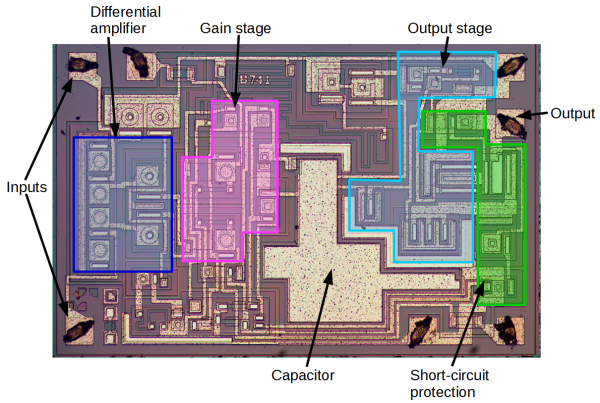
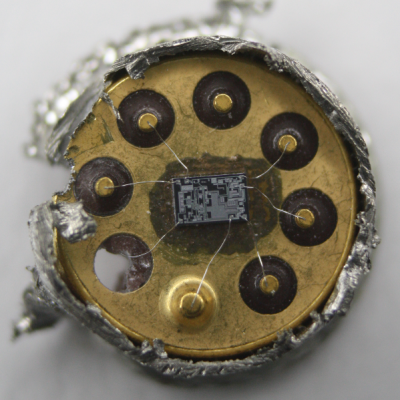 Rather than risk the boiling acid method commonly used to decap epoxy-potted ICs, [Ken] wisely chose a TO-99 can format to attack with a hacksaw. With the die laid bare for his microscope, he was able to locate all the major components and show how each is implemented in silicon. Particularly fascinating is the difference between the construction of NPN and PNP transistors, and the concept of “current mirrors” as constant current sources. And he even whipped up a handy interactive chip viewer – click on something in the die image and find out which component it is on the 741 schematic. Very nice.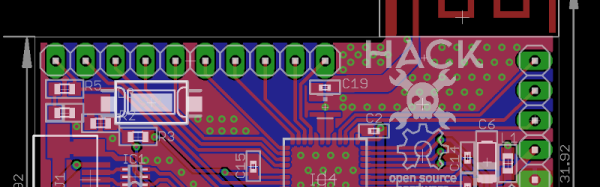





 One of the major additions to Hackaday.io this year was group messaging. This spawned an explosion of new communities within Hackaday.io starting with