Jump Into AI With A Neural Network Of Your Own

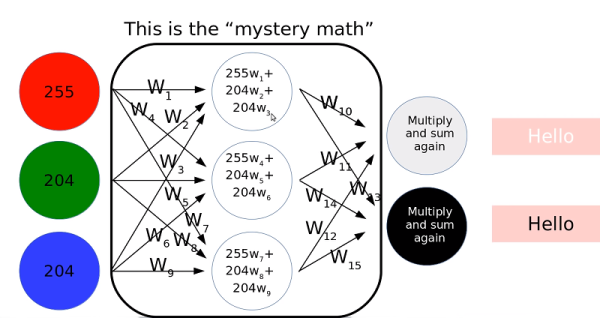
One of the difficulties in learning about neural networks is finding a problem that is complex enough to be instructive but not so complex as to impede learning. [ThomasNield] had an idea: Create a neural network to learn if you should put a light or dark font on a particular colored background. He has a great video explaining it all (see below) and code in Kotlin.

[Thomas] is very interested in optimization, so his approach is very much based on mathematics and algorithms of optimization. One thing that’s handy is that there is already an algorithm for making this determination. He found it on Stack Exchange, but we’re sure it’s in a textbook or paper somewhere. The existing algorithm makes the neural network really impractical, but it makes training easy since you can algorithmically develop a training set of data.

Once trained, the neural network works well. He wrote a small GUI and you can even select among various models.

Don’t let the Kotlin put you off. It is a derivative of Java and uses the same JVM. The code is very similar, other than it infers types and also adds functional program tools. However, the libraries and the principles employed will work with Java and, in many cases, the concepts will apply no matter what you are doing.

If you want to hardware accelerate your neural networks, there’s a stick for that. If you prefer C and you want something lean and mean, try TINN.

Continue reading “Jump Into AI With A Neural Network Of Your Own” →

Use Nodes To Code Loads Of G-code For 3D CNC Carving

Most CNC workflows start with a 3D model, which is then passed to CAM software to be converted into the G-code language that CNC machines love and understand. G-code, however, is simple enough that rudimentary coding skills are all you need to start writing your very own programmatic CNC tool paths. Any language that can output plain text is fully capable of enabling you to directly control powerful motors and rapidly spinning blades.

[siemenc] shows us how to use Grasshopper – a visual node-based programming system for Rhino 3D – to output G-code that makes some interesting patterns and shapes in wood when fed to a ShopBot. Though the Rhino software is a bit expensive and thus is not too widely available, [siemenc] walks through some background, theory, and procedures that could be useful and inspirational no matter what software or programming language you’re using to create your bespoke G-code.

For links to code and related blog posts, plus more lovely pictures of intricately carved plywood, check out [siemenc]’s personal site as well.

[via Bantam Tools]

Creating KiCad Parts From A PDF Automagically

For anyone out there who has ever struggled finding a part for Eagle or KiCad, there are some who would say you’re doing it wrong. You’re supposed to make your own parts if you can’t find them in the libraries you already have. This is really the only way; PCB design tools are tools, and so the story goes you’ll never be a master unless you can make your own parts.

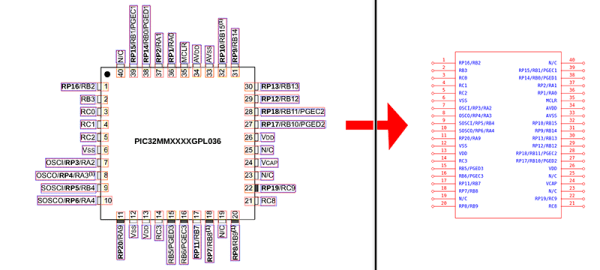
That said, making schematic parts and footprints is a pain, and if there’s a tool to automate the process, we’d be happy to use it. That’s exactly what uConfig does. It automatically extracts pinout information from a PDF datasheet and turns it into a schematic symbol.

uConfig is an old project from [sebastien caux] that’s been resurrected and turned into an Open Source tool. It works by extracting blocks of text from a PDF, sorts out pin numbers and pin labels, and associates those by the relevant name to make pins. It’s available as a pre-built project (for Windows, even!), and works kind of like magic.

The video demo below shows uConfig importing a PDF datasheet — in this case a PIC32 — automatically extracting the packages from the datasheet, and turning that into a schematic symbol. It even looks as if it’ll work, too. Of course, this is just the schematic symbol, not the full part including a footprint, but when it comes to footprints we’re probably dealing with standard packages anyway. If you’re looking to build a software tool that takes a datasheet and spits out a complete part, footprint and all, this is the place to start.

Continue reading “Creating KiCad Parts From A PDF Automagically” →

Doom Battle Royale Mod With 64 Players Hurts Plenty

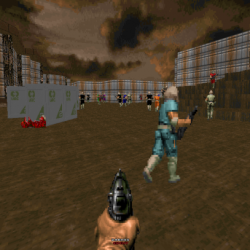
Sixty-four players are dropped into a map, but there can be only one that emerges victorious…heard that before, right? Thanks to PC Game modder [Bambamalicious] there is yet another entrant into the rapidly growing videogame genre. The difference this time, however, is that their 64 player DooM Royale (with cheese) mod is ready to show all those other also-ran games how the granddaddy of FPS games does it.

Doom Battle Royale WIth Cheese Mod Screenshot

According to the announcement post the mod is “…a 64 player Battle Royale using Doom 2 as the IWAD, and the Zandronum engine as it’s base. The speed of gameplay will be unchanged from normal Doom, and when you die, that’s not the end for you!”. There is a respawn system, but each player is given a limited number of lives. To ensure no server feels like a ghost town [Bambamalicious] included bots that will spawn in matches with low participation. Each game inevitably results in a “last man standing” face off that has the victor coming away with the coveted “Royale with cheese”. Other than the aforementioned changes, this is still the seminal classic Doom (1993).

Do note that in order to play the mod, the Zandronum engine is a required in order to take part in the fun. The engine is the backbone that allows for leaderboards as well as hopping between custom servers. Zandronum additionally supports many other multiplayer match types for instance: Team Deathmatch, Capture the Flag, Possession, and Skulltag. Up to 64 players are supported in those match types as well.

From the looks of the DooM Royale (with cheese) map, there should be frequent enemy player encounters and no respite for those seeking to just “hide in a bathtub”. The multiple levels should supply plenty of opportunity to take advantage by attacking from above. Test footage of the mod in action can be seen in the video below.

For more on the DOS game that just won’t die, check out Doom running on an ATM.

Continue reading “Doom Battle Royale Mod With 64 Players Hurts Plenty” →

Microsoft Releases Crown Jewels — From 1982!

If you look back 30 or so years ago, it wasn’t clear what was going to happen with personal computers. One thing most people would have bet on, though, was that CP/M — the operating system from Digital Research — would keep growing and power whatever new machines were available. Except it didn’t. MS-DOS took over the word and led — eventually — to the huge number of Windows computers we know today. Microsoft has released the source code to MS-DOS 1.25 and 2.0 on GitHub.

Microsoft — then another fledgling computer company — had written some BASIC interpreters and wanted in on the operating system space. They paid the princely sum of $75,000 to Seattle Computer Products for something called QDOS written by [Tim Paterson]. Rebranded as MS-DOS, the first version appeared in late 1981 and version 1.25 was out about a year later.

While you might not think having MS-DOS source code is a big deal, there’s still a lot of life left in DOS and it is also interesting from an educational and historical perspective. If you don’t want to read x86 assembly language, there’s also the BASIC source for the samples (paradoxically, in the bin subdirectory) along with compiled COM files for old friends like EDLIN and DEBUG.

Continue reading “Microsoft Releases Crown Jewels — From 1982!” →

Nim Writes C Code — And More — For You

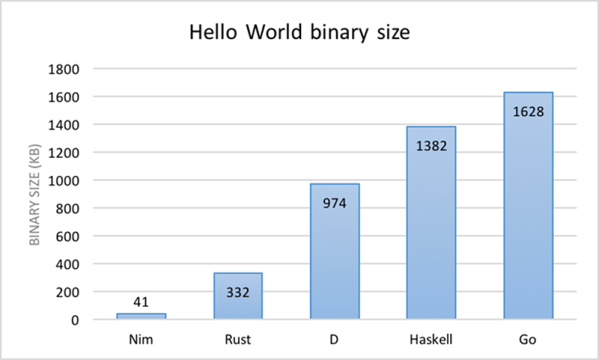
When we first heard Nim, we thought about the game. In this case, though, nim is a programming language. Sure, we need another programming language, right? But Nim is a bit different. It is not only cross-platform, but instead of targeting assembly language or machine code, it targets other languages. So a Nim program can wind up compiled by C or interpreted by JavaScript or even compiled by Objective C. On top of that, it generates very efficient code with — at least potentially — low overhead. Check out [Steve Kellock’s] quick introduction to the language.

The fact that it can target different compiler backends means it can support your PC or your Mac or your Raspberry Pi. Thanks to the JavaScript option, it can even target your browser. If you read [Steve’s] post he shows how a simple Hello World program can wind up at under 50K. Of course, that’s nothing the C compiler can’t do which makes sense because the C compiler is actually generating the finished executable, It is a bit harder though to strip out all the overhead yourself.

Continue reading “Nim Writes C Code — And More — For You” →

Final Fantasy Exploit Teaches 32-bit Integer Math

One of the fun things about old video games, besides their obvious nostalgia, is that some of the more popular games have been pried apart and tinkered with for years, leading to a lot of new “development” within the games. This often uncovers some hidden gems that gamers might not have had any knowledge of during the game’s heyday, like this coding oddity found in Final Fantasy 7 that illustrates a lot about how 32-bit processors do math.

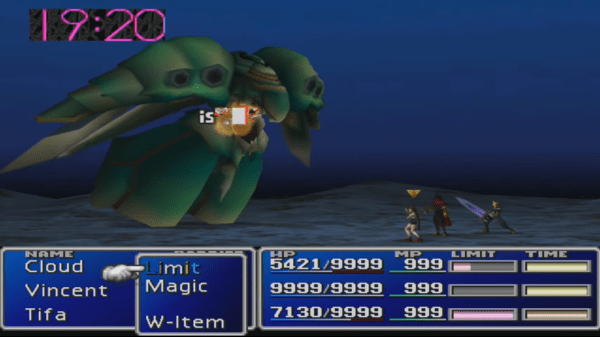
The original PlayStation used a 32-bit RISC processor, but the most significant bit could be used for integer signing. This means that if you have an integer that has a value of 2,147,483,647 (01111111111111111111111111111111 in binary) and you add one, the value is suddenly negative 2147483648 because the most significant digit is also an indicator of the integer’s sign. In this situation, the integer is said to “overflow”. In Final Fantasy 7, if you can somehow get a character to deal 262,144 damage in one hit (much less than two billion, due to the way the game does damage calculations), the game has a little bit of a meltdown.

[4-8Productions] had to do a lot of work to show how this glitch can be exploited in the game as well. Usually damage in this game is limited to 9,999 but under certain configurations (admittedly obtained by using other exploits and tools available for FF7 like a savegame editor) two of the characters can deal more damage than this critical value, exposing the 32-bit processor’s weak spot.

Even though integer signing is a pretty basic concept for most of us, the video is definitely worth a watch especially if you’re fans of the classic game. Of course, Final Fantasy 7 isn’t the only classic that has been exploited and reverse-engineered to the extreme. You can use a Super Mario World level to implement a calculator now, too.

Continue reading “Final Fantasy Exploit Teaches 32-bit Integer Math” →