Eavesdropping On Cosmonauts With An SDR

Usually when we hear about someone making contact with astronauts in orbit, it’s an intentional contact between a ham on the ground and one of the licensed radio amateurs on the ISS. We don’t often see someone lucky enough to snag a conversation between ground controllers and a spacecraft en route to the ISS like this.

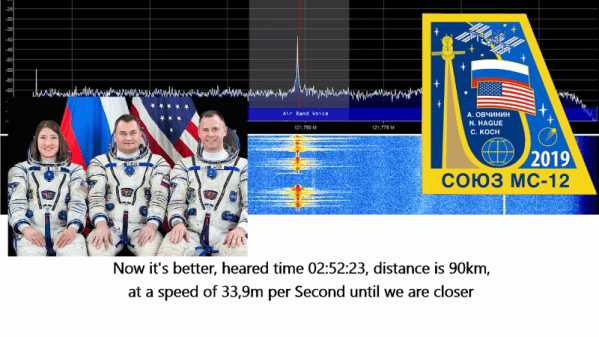
For [Tysonpower], this was all about being in the right place at the right time, as well as having the right equipment and the know-how to use it properly. Soyuz MS-12 launched from Baikonur on March 14 with cosmonaut [Aleksey Ovchinin] and NASA astronauts [Nick Hague] and [Kristina Koch] onboard, destined for the ISS after a six-hour flight. The lucky bit came when [Tysonpower] realized that the rendezvous would happen when the ISS was in a good position relative to his home in Cologne, which prompted him to set up his gear for a listening session. His AirSpy Mini SDR was connected to a home-brew quadrifilar helical (QFH) “eggbeater” antenna on his roof. What’s nice about this antenna is that it’s fixed rather than tracking, making it easy to get on the air with quickly. After digging around the aviation bands at about 121 MHz for a bit, [Tysonpower] managed to capture a few seconds of a conversation between [Ovchinin] and Moscow Flight Control Center. The commander reported his position and speed relative to the ISS a few minutes before docking. The conversation starts at about 1:12 in the video below.

We think it’s just cool that you can listen in on the conversations going on upstairs with a total of less than $50 worth of gear. Actually talking to the hams aboard the ISS is another matter, but not a lot more involved really.

Continue reading “Eavesdropping On Cosmonauts With An SDR”

Extraterrestrial Excavation: Digging Holes On Other Worlds

We humans are good at a lot of things, but making holes in the ground has to be among our greatest achievements. We’ve gone from grubbing roots with a stick to feeding billions with immense plows pulled by powerful tractors, and from carving simple roads across the land to drilling tunnels under the English Channel. Everywhere we go, we move dirt and rock out of the way, remodeling the planet to suit our needs.

Other worlds are subject to our propensity for digging holes too, and in the 50-odd years that we’ve been visiting or sending robots as our proxies, we’ve made our marks on quite a few celestial bodies. So far, all our digging has been in the name of science, either to explore the physical and chemical properties of these far-flung worlds in situ, or to actually package up a little bit of the heavens for analysis back home. One day we’ll no doubt be digging for different reasons, but until then, here’s a look at the holes we’ve dug and how we dug them.

Continue reading “Extraterrestrial Excavation: Digging Holes On Other Worlds”

Could Orion Ride Falcon Heavy To The Moon?

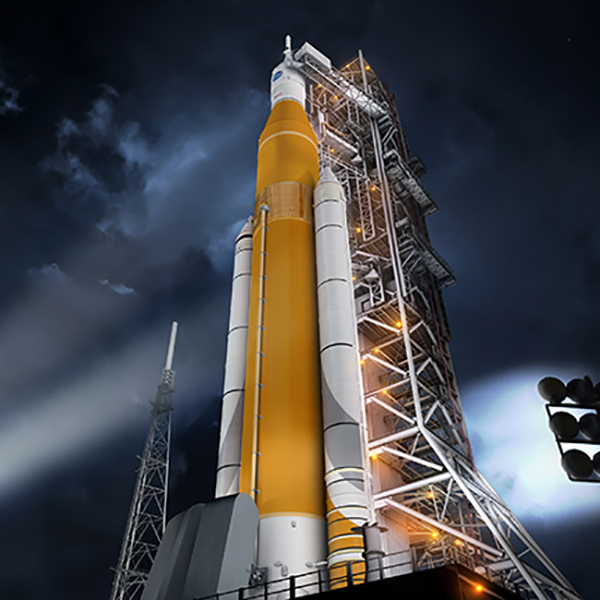
Things aren’t looking good for NASA’s Space Launch System (SLS). Occasionally referred to as the “Senate Launch System”, or even less graciously, the “Rocket to Nowhere”, the super heavy-lift booster has long been a bone of contention for those in the industry. Designed as an evolution of core Space Shuttle technology, the SLS promised to reuse existing infrastructure to deliver higher payload capacities and lower operating costs than its infamous winged predecessor. But in the face of increased competition from commercial launch providers and proposed budget cuts targeting future upgrades and expansions of the core booster, the significantly over budget and behind schedule program is in a very precarious position.

Which is not to say the SLS doesn’t look impressive, at least on paper. In its initial configuration it would easily take the title as the world’s most powerful rocket, capable of lifting nearly 105 tons into low Earth orbit (LEO), compared to 70 tons for SpaceX’s Falcon Heavy. It would still fall short of the mighty Saturn V’s 155 tons to LEO, but the proposed “Block 2” upgrades would increase SLS payload capability to within striking distance of the iconic Apollo-era booster at 145 tons. Since the retirement of the Space Shuttle in 2011, NASA has been adamant that the might of SLS was the only way the agency could accomplish bigger and more ambitious missions to the Moon, Mars, and beyond.

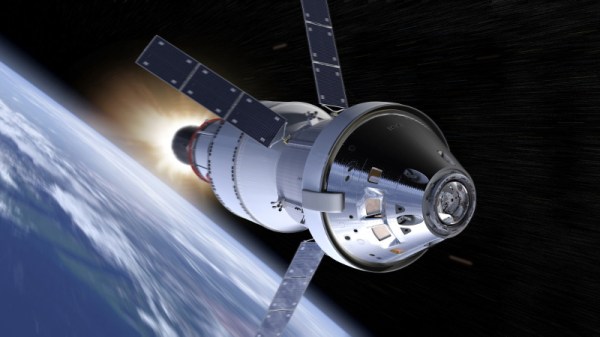
Or at least, they were. On March 13th, NASA Administrator Jim Bridenstine testified to Congress that in an effort to avoid further delays, the agency is exploring the possibility of sending their Orion spacecraft to the Moon with a commercial launcher. The statement came as a shock to many in the aerospace community, as it would seem to call into question the future of the entire SLS program. If commercial rockets can do the job of SLS, at least in some cases, why does the agency need it?

NASA is currently preparing a report which investigates what physical and logistical modifications would need to be made to missions originally slated to fly on SLS; a document which is sure to be scrutinized by SLS supporters and critics alike. Until the report is released, we can speculate about what this hypothetical flight to the Moon might look like.

Continue reading “Could Orion Ride Falcon Heavy To The Moon?”

Es’hail-2: Hams Get Their First Geosynchronous Repeater

In the radio business, getting the high ground is key to covering as much territory from as few installations as possible. Anything that has a high profile, from a big municipal water tank to a roadside billboard to a remote hilltop, will likely be bristling with antennas, and different services compete for the best spots to locate their antennas. Amateur radio clubs will be there too, looking for space to locate their repeaters, which allow hams to use low-power mobile and handheld radios to make contact over a vastly greater range than they could otherwise.

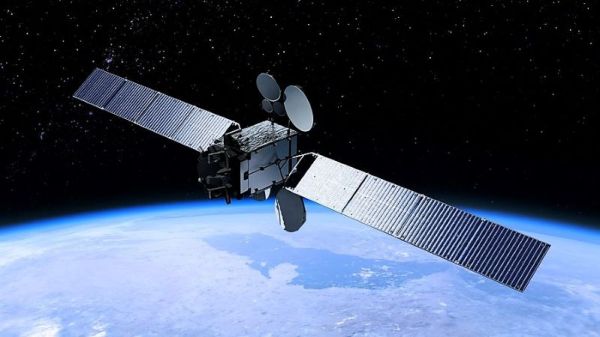
Now some hams have claimed the highest of high ground for their repeater: space. For the first time, an amateur radio repeater has gone to space aboard a geosynchronous satellite, giving hams the ability to link up over a third of the globe. It’s a huge development, and while it takes some effort to use this new space-based radio, it’s a game changer in the amateur radio community.

Continue reading “Es’hail-2: Hams Get Their First Geosynchronous Repeater”

Hitchhiking To The Moon For Fun And Profit

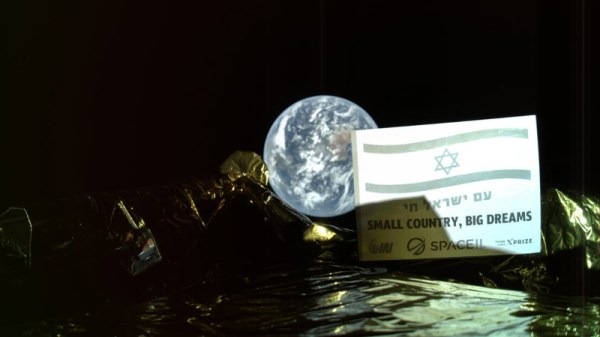
On February 22nd, a Falcon rocket lifted off from Cape Canaveral carrying the Indonesian communications satellite Nusantara Satu. While the satellite was the primary payload for the mission, as is common on the Falcon 9, the rocket had a couple of stowaways. These secondary payloads are generally experiments or spacecraft which are too small or light to warrant a rocket of their own such as CubeSats. But despite flying in the economy seats, one of the secondary payloads on this particular launch has a date with destiny: Israel’s Beresheet, the first privately-funded mission to attempt landing on the Moon.

But unlike the Apollo missions, which took only three days to reach our nearest celestial neighbor, Beresheet is taking a considerably more leisurely course. It will take over a month for the spacecraft to reach the Moon, and it will be a few weeks after that before it finally makes a powered descent towards the Sea of Serenity, not far from where Apollo 17 landed 47 years ago. That assumes everything goes perfectly; tack a few extra weeks onto that estimate if the vehicle runs into any hiccups on the way.

At first glance, this might seem odd. If the trip only took a few days with 1960’s technology, it seems a modern rocket like the Falcon 9 should be able to make better time. But in reality, the pace is dictated by budgetary constraints on both the vehicle itself and the booster that carried it into space. While one could argue that the orbital maneuvers involved in this “scenic route” towards the Moon are more complicated than the direct trajectory employed by the manned Apollo missions, it does hold promise for a whole new class of lunar spacecraft. If you’re not in any particular hurry, and you’re trying to save some cash, your Moon mission might be better off taking the long way around.

Continue reading “Hitchhiking To The Moon For Fun And Profit”

Proposed NASA Budget Signals Changes To Space Launch System

The White House’s proposed budget for 2020 is out, and with it comes cuts to NASA. The most important item of note in the proposed budget is a delay of the Space Launch System, the SLS, a super-heavy lifting launch vehicle designed for single use. The proposed delay would defer work on the enhanced version of the SLS, the Block 1B with the Exploration Upper Stage.

The current plans for the Space Launch System include a flight using NASA’s Orion spacecraft in June 2020 for a flight around the moon. This uncrewed flight, Exploration Mission 1, or EM-1, would use the SLS Block 1 Crew rocket. A later flight, EM-2, would fly a crewed Orion capsule around the moon in 2022. A third proposed flight in 2023 would send the Europa Clipper to Jupiter. The proposed 2020 budget puts these flights in jeopardy.

Continue reading “Proposed NASA Budget Signals Changes To Space Launch System”

When New Space Loses Out To NASA Pragmatism

You’ve got to admit, things have been going exceptionally well for SpaceX. In the sixteen years they’ve been in operation, they’ve managed to tick off enough space “firsts” to make even established aerospace players blush. They’re the first privately owned company to not only design and launch their own orbital-class rocket, but to send a spacecraft to the International Space Station. The first stage of their Falcon 9 rocket is the world’s only orbital booster capable of autonomous landing and reuse, and their Falcon Heavy has the highest payload capacity of any operational launch system. All of which they’ve managed to do at a significantly lower cost than their competition.

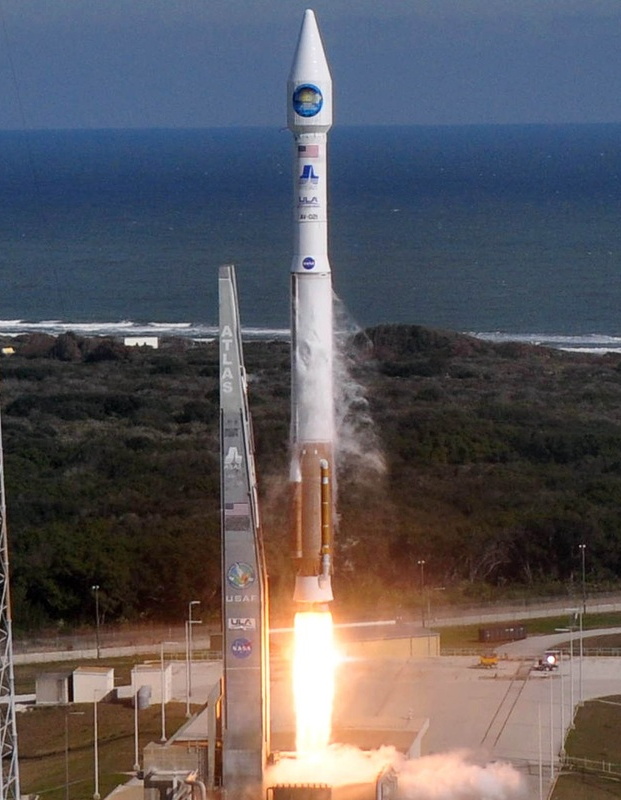
United Launch Alliance Atlas V

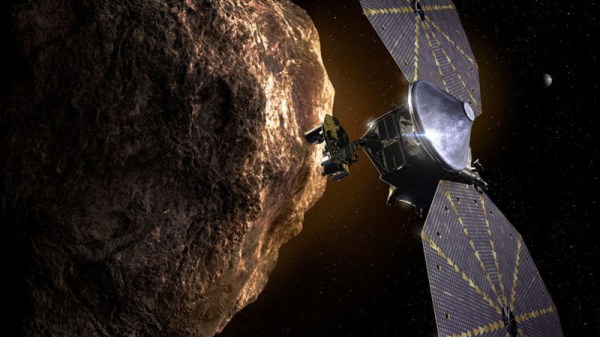
So it might come as a surprise to hear that SpaceX recently lost out on a lucrative NASA launch contract to the same entrenched aerospace corporations they’ve been running circles around for the last decade. It certainly seems to have come as a surprise to SpaceX, at least. Their bid to launch NASA’s Lucy mission on the Falcon 9 was so much lower than the nearly $150 million awarded to United Launch Alliance (ULA) for a flight on their Atlas V that the company has decided to formally protest the decision. Publicly questioning a NASA contract marks another “first” for the company, and a sign that SpaceX’s confidence in their abilities has reached the point that they’re no longer content to be treated as a minor player compared to heavyweights like Boeing and Lockheed Martin.

But this isn’t the first time NASA has opted to side with more established partners, even in the face of significantly lower bids by “New Space” companies. Their decision not to select Sierra Nevada Corporation’s Dream Chaser spaceplane for the Commercial Crew program in 2014, despite it being far cheaper than Boeing’s CST-100 Starliner, triggered a similar protest to the US Government Accountability Office (GAO). In the end, the GAO determined that Boeing’s experience and long history justified the higher sticker price of their spacecraft compared to the relative newcomer.

NASA has yet to officially explain their decision to go with ULA over SpaceX for the Lucy mission, but in light of what we know about the contract, it seems a safe bet they’ll tell SpaceX the same thing they told Sierra Nevada in 2014. The SpaceX bid might be lower, but in the end, NASA’s is willing to pay more to know it will get done right. Which begs the question: at what point are the cost savings not compelling enough to trust an important scientific mission (or human lives) to these rapidly emerging commercial space companies?

Continue reading “When New Space Loses Out To NASA Pragmatism”