Do Space Probes Fail Because Of Space Weather?

Over the past few decades, numerous space probes sent to the far-flung reaches of the Solar System have fallen silent. These failures weren’t due to communications problems, probes flying into scientifically implausible anomalies, or little green men snatching up the robotic scouts we’ve sent out into the Solar System. No, these space probes have failed simply because engineers on Earth can’t point them. If you lose attitude control, you lose the ability to point a transmitter at Earth. If you’re managing a space telescope, losing the ability to point a spacecraft turns a valuable piece of scientific equipment into a worthless, spinning pile of junk.

The reasons for these failures is difficult to pin down, but now a few people have an idea. Failures of the Kepler, Dawn, Hayabusa, and FUSE space probes were due to failures of the reaction wheels in the spacecraft. These failures, in turn, were caused by space weather. Specifically, coronal mass ejections from the Sun. How did this research come about, and what does it mean for future missions to deep space?

Continue reading “Do Space Probes Fail Because Of Space Weather?”
Apollo 12 Was The Lucky Number Among Apollo Disasters

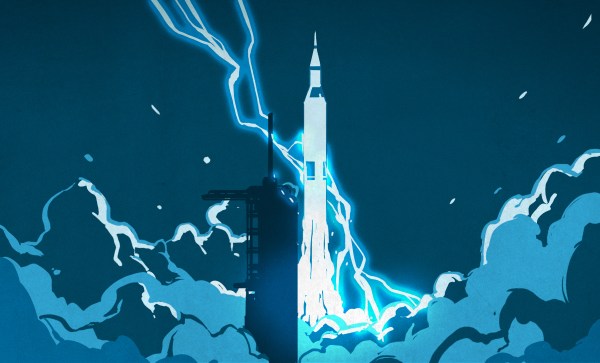
I recently saw Apollo 13 again — this time with the score played live by the Houston Symphony. What a crazy coincidence that thirteen has long been considered an unlucky number and that Apollo 13 would be the one we almost lost. However, Apollo 12 almost became a disaster which — after the ordeal with flight 13 — was largely forgotten.

When all was said and done, Apollo 12 would result in a second manned moon landing in November 1969, just four months after Apollo 11. Commanded by Pete Conrad, Alan Bean accompanied Conrad to the surface while Richard Gordon, Jr. kept the getaway vehicle running. But less than a minute after launch something happened that could have been a disaster. Lightning struck the vehicle.

Continue reading “Apollo 12 Was The Lucky Number Among Apollo Disasters”

The Largest Aircraft Ever Built Will Soon Launch Rockets To Space

Deep in the mojave, the largest aircraft ever made will soon be making test flights. This is the Stratolaunch, and it’s measured the largest to ever fly based on wingspan. The Stratolaunch was constructed out of two 747s, and is designed for a single purpose: as a mobile launch platform for orbital rockets.

There are a couple of ways to measure the size of an aircraft. The AN-225 Mriya has the highest payload capacity, but only one of those was ever built (though that might change soon). The Spruce Goose was formerly the largest aircraft by wingspan, but it only flew once, and only in ground effect. The Stratolaunch is in another category entirely. This is an aircraft that contains some of the largest composite structures on the planet. Not only can you park a school bus between the fuselages of the Stratolaunch, you can strap that school bus to the plane and carry it up to 30,000 feet.

But why build this astonishing aircraft? The reasons go back more than a decade, and the end result is a spaceplane.

Continue reading “The Largest Aircraft Ever Built Will Soon Launch Rockets To Space”

Martian Dust Storm May Spell Doom For Rover

Everyone knows that space is an incredibly inhospitable place, but the surface of Mars isn’t a whole lot better. It’s a dim, cold, and dry world, with a wisp of an atmosphere that provides less than 1% of Earth’s barometric pressure. As the planet’s core no longer provides it with a magnetosphere, cosmic rays and intense solar flares bathe the surface in radiation. Human life on the surface without adequate environmental shielding is impossible, and as NASA’s fleet of rovers can attest, robotic visitors to the planet aren’t completely immune to the planet’s challenges.

Opportunity Mission Patch

As a planet-wide dust storm finally begins to settle, NASA is desperately trying to find out if the Red Planet has claimed yet another victim. The agency hasn’t heard from the Opportunity rover, which landed on Mars in 2004, since before the storm started on June 10th; and with each passing day the chances of reestablishing contact are diminished. While they haven’t completely given up hope, there’s no question this is the greatest threat the go-kart sized rover has faced in the nearly 15 years it has spent on the surface.

Opportunity was designed with several autonomous fail-safe systems that should have activated during the storm, protecting the rover as much as possible. But even with these systems in place, its twin Spirit succumbed to similar conditions in 2010. Will Opportunity make it through this latest challenge? Or has this global weather event brought the long-running mission to a dramatic close?

Continue reading “Martian Dust Storm May Spell Doom For Rover”

If You Are Planning On Building Your Own Space Shuttle…

One of the most complicated machines ever built was the US space shuttle (technically, the STS or Space Transportation System). Despite the title, we doubt anyone is going to duplicate it. However, one of the most interesting things about the shuttle’s avionics — the electronics that operate the machine — is that being a government project there is a ridiculous amount of material available about how it works. NASA has a page that gathers up a description of the vehicle’s avionics. If you are more interested in the actual rocket science, just back up a few levels.

We will warn you, though, that if you’ve never worked on space hardware, some of the design choices will seem strange. There are two reasons for that. First, the environment is very strange. You have to deal with high acceleration, shock, vibration, and radiation, among other things. The other reason is that the amount of time between design and deployment is so long due to testing and just plain red tape that you will almost certainly be deploying with technology that is nearly out of date if not obsolete.

Continue reading “If You Are Planning On Building Your Own Space Shuttle…”

Before Sending A Probe To The Sun, Make Sure It Can Take The Heat

This past weekend, NASA’s Parker Solar Probe took off for a journey to study our local star. While its mission is well covered by science literate media sources, the equally interesting behind-the-scenes information is a little harder to come by. For that, we have Science News who gave us a look at some of the work that went into testing the probe.

NASA has built and tested space probes before, but none of them were destined to get as close to the sun as Parker will, creating new challenges for testing the probe. The lead engineer for the heat shield, Elizabeth Congdon, was quoted in the article: “Getting things hot on Earth is easier than you would think it is, getting things hot on Earth in vacuum is difficult.” The team used everything from a concentrated solar facility to hacking IMAX movie projector lenses.

The extreme heat also posed indirect problems elsewhere on the probe. A rocket launch is not a gentle affair, any cargo has to tolerate a great deal of shock and vibration. A typical solution for keeping fasteners in place is to glue them down with an epoxy, but they’d melt where Parker is going so something else had to be done. It’s not all high technology and exotic materials, though, as when the goal was to verify that the heat shield was strong enough to withstand up to 20G of acceleration expected during launch, the test team simulated extra weight by stacking paper on top of it.

All that testing should ensure Parker can perform its mission and tell us a lot of interesting things about our sun. And if you got in on the publicity campaign earlier this year, your name is along for the ride.
Not enough space probe action for the day? We’ve also recently featured how creative hacking gave the exoplanet hunter Kepler a second lease on life.

Virgin Orbit Readies First Launch

Ever since the Pan Am “Space Clipper” first slid into frame in 1968’s “2001: A Space Odyssey”, the world has been waiting for the day that privately funded spaceflight would become as routine as air travel. Unfortunately, it’s a dream that’s taken a bit longer to become reality than many would have hoped. The loss of Challenger and Columbia were heartbreaking reminders that travel amongst the stars is not for the faint of heart or the ill-equipped, and pushed commercial investment in space back by decades.

Although Pan Am has since folded, we now have a number of companies working hard towards making the dream of commercial spaceflight a reality. SpaceX and Rocket Lab have shown private companies developing and operating their own orbital class vehicles is a concept no longer limited to science fiction. Now that private industry has a foot in the door, more companies are coming forward with their own plans for putting their hardware into orbit. In many ways we’re seeing the dawn of a second Space Race.

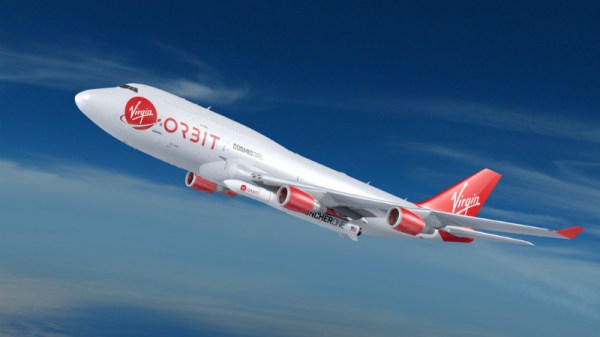
If all goes according to plan, a new challenger should be entering the ring in the very near future. Scheduled to perform their first test launch before the end of the year, Virgin Orbit (a spin-off of the passenger carrying Virgin Galactic) promises to deliver small payloads to Earth orbit faster and cheaper than their competitors. But while most other commercial space companies are using fairly traditional booster rockets to do their heavy lifting, Virgin Orbit is opting for a the less common air launched approach. Before Virgin joins the ranks of commercial companies exploring the final frontier, lets take a look at their plan for getting into space and the advantages it offers compared to the competition.

Continue reading “Virgin Orbit Readies First Launch”