Visual Hardware Identification Guide

hardwareguide

Check out this visual hardware guide from deviantART member [Sonic840]. It has everything from memory modules, to bus sockets, to power connectors, to an entire array of CPU sockets that have been used over the years. You’re bound to see something in there you didn’t know existed.

[via Gizmodo]

Adjustable Breadboard Supply

breadboardpowersupply

adafruit industries’ latest product is an adjustable breadboard power supply kit. We’ve seen breadboard supplies before, but like most of adafruit’s kits, this is the best design you’re going to encounter. It uses an MIC2941 voltage regulator instead of the more commonplace LM317. It has a very low dropout which means your output voltage can be much closer to the input voltage. Their example is using 3AAA or a Li-Ion battery for an output of 3.3V. Input can be through a barrel jack or terminal blocks. There is a selection switch for 3.3, 5, and adjustable voltage. Using the adjustment pot you can select an output voltage anywhere from 1.3V to within .5V of the 20V maximum input. The adjusted output voltage will remain the same even if you increase the input voltage. Like all of their kits, you can find schematics, assembly and usage instructions, on their project site.

Gimbal Camera Stabilizer

steadycam

Professional cameramen use steadicams to make their shots look smooth and clean. However, their prices are generally way too high for an indie’s budget. Previous attempts have tried adding a counterweight and moving the camera away from the hands. [YB2Normal] took a different method and used a bob and gimbal to hold the camera upright. The gimbal is free to rotate along 3 axes, so the camera can stay in place. The whole thing cost less than $15. The first video he made with he mount is after the break.

[youtube http://www.youtube.com/watch?v=nXB0ncUQLn4%5D

Related: Building a Snorricam

[via Gizmodo]

Etch PCBs With Ferric Chloride And A Sponge

F7Z9JTTFX23V5VV

Etching a printed circuit board generally takes a bit of time and uses a lot of etchant. [TechShopJim] posted a method that uses a sponge to reduce the amount of etchant used while speeding up the entire process. First, a resist is applied using either a sharpie or the toner transfer method. Using gloves to handle everything, he soaked a sponge in ferric chloride and continually wiped a copper-clad board until all the exposed copper was removed. This technique moves the etchant around more, keeping “fresh” etchant closer to the copper. If you can’t procure ferric chloride, you can also use our method that uses 2 household chemicals: hydrogen peroxide and hydrochloric acid.

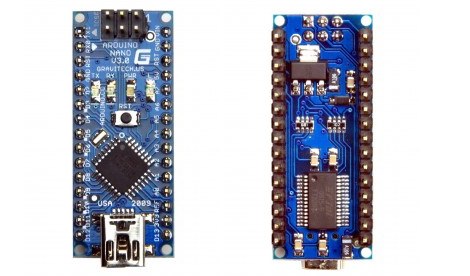
Arduino Nano Updated

The official Arduino Nano design has been updated to version 3.0. Like other new Arduino designs, it’s using the ATmega328 instead of the ATmega168. It’s also a slightly more reasonable $35. The small board is designed to be plugged directly into a breadboard and accessed via mini USB cable. This new design is also two layers instead of four making it easier to produce and modify. The new Nanos will ship at the end of the month.

Photo Interrupters Explained

img_0147 (Custom)

[Eric] sent in this very informative writup on how to use Photo interrupters. These things can be used for many things, he lists pellet dispensing and limit switches. He found one in his junk box and realized he knew very little about it. After some exploring and research, he’s here to educate the rest of us. There’s a good breakdown of the circuit itself which is pretty simple as well as a test circuit and some sample code.