Arcades: Don’t Call It A Comeback

nothing2Video arcades may be a thing of the past, but they’re still alive, well and were ready to play at this year’s World Maker Faire. The offerings weren’t old favorites, all were brand new games many being shown for the first time like the long-awaited VEC9. The Hall of Science building was filled with cabinets and no quarters were necessary, all were free-play.

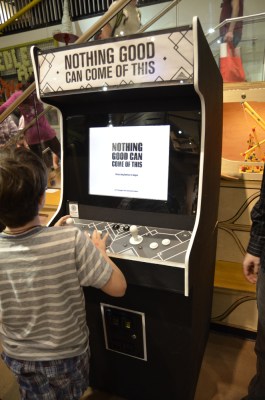
Death By Audio Arcade was there in force with games like Particle Mace and Powerboat Italia ’88. Our personal favorite was Nothing Good Can Come of This. [Michael P. Consoli] devised a simple game: Two players in an empty room. A bullet drops from a hole in the ceiling, followed by a gun shortly thereafter. What happens next is up to the players. The simple graphics and gameplay give this title its charm. [Michael] was showing off a new stand-up cabinet for the game this year. He built the entire thing himself, working until the wee hours before load-in at Maker Faire.

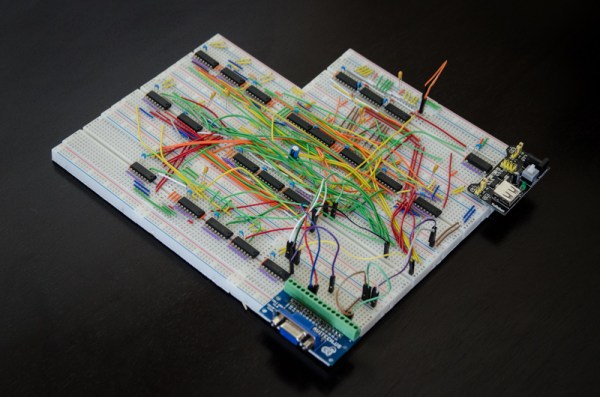
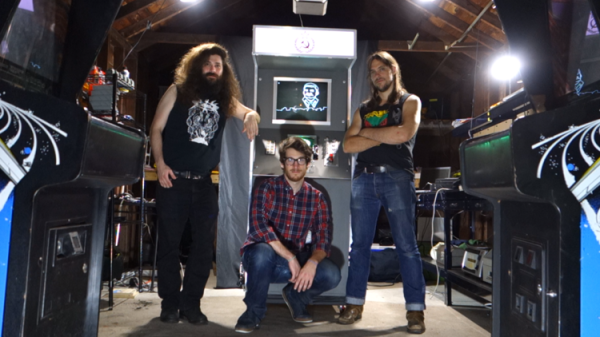
[Batsly Adams], [Todd Bailey], and [Mike Dooley] teamed up to create what may be the first new vector arcade in decades. VEC9 has been teased for over 2 years. They’ve finally wrapped this game up and showed it off at the faire. VEC9 started with an old
Asteroids vector monitor found by [Batsly].

Continue reading “Arcades: Don’t Call It A Comeback”

Electronics For Aliens

We are surrounded by displays with “millions” of colors and hundreds of pixels per inch. With super “high fidelity” sound producing what we perceive to be realistic replicas of the real world.

Of course this is not the case, we rarely stop and think how our electronic systems have been crafted around the limitations of human perception. So to explore this issue, in this article we ask the question: “What might an alien think of human technology?”. We will assume a lifeform which senses the world around it much as we do. But has massively improved sensing abilities. In light of these abilities we will dub it the Oculako.

Let’s begin with the now mostly defunct CRT display and see what our hypothetical alien thinks of it. The video below shows a TV screen shot at 10,000 frames per second.

Continue reading “Electronics For Aliens”

Creating Video Trails In OpenCV

The video trail effect is nothing new: it was first used in music videos like “Blame it on the boogie” from the Jackson 5 in 1978. Now,  [Antonio Ospite] has put together a nice article that shows the basics of using OpenCV to create this effect in live video. He used the open source video processing package OpenCV for this, creating the effect with a short script. It can run in multiple ways, creating video trail effects, or “catch-up”trails (where the trail reverses into a final frame).

This provides an interesting example of how these video effects have become so much easier to create. The Jackson 5 video was created using a Scanimate and Quantel Paintbox system that was as big as a closet and cost hundreds of thousands of dollars. Now, you can create these effects with free software and a cheap PC. Now you just need to figure out what in our modern world looks awesome with this throwback effect.

Continue reading “Creating Video Trails In OpenCV”

DIY Lego Slit-Scan 2001 Stargate

[Filmmaker IQ] has a bunch of great tutorials on the technical aspects of making movies, but this episode on copying the stargate Stanley Kubrick’s famous 2001: A Space Odyssey using Legos is a hacker’s delight.

The stargate in 2001 is that long, trippy bit where our protagonist Dave “I’m sorry Dave” Bowman gets pulled through space and time into some kind of alternate universe and is reborn as the star child. (Right, the plot got a little bit bizarre.) But the stargate sequence, along with the rest of the visual effects for the film, won them an Academy Award.

Other examples of slit scan animations you’ll recognize include the opening credits for Doctor Who and the warp-drive effect in Star Trek: TNG.

Continue reading “DIY Lego Slit-Scan 2001 Stargate”

Numato Opsis: FPGA-based Open Video Platform

Imagine that you’re running a conference and you want to do a professional job recording the speakers and their decks. You’ll need to record one video stream from the presenter’s laptop, and it’d be nice to have another of the presenter taken with a camera. But you also need to have the presenter’s screen displayed on a projector or two for the live audience. And maybe you’d like all of this dumped down to your computer so that you can simultaneously archive the presentation and stream it out over the Internet.

io-ports_png_project-bodyThat’s exactly the problem that the hdmi2usb project tries to solve on the software side for open-source software conventions. And to go with this software, [Tim Ansell] has built the Numato Opsis FPGA video board, to tie everything together. What’s great about the platform is that the hardware and the firmware are all open source too.

Because everything’s open and it’s got an FPGA on board doing the video processing, you’re basically free to do whatever you’d like with the content in transit, so it could serve as an FPGA video experimenter board. It also looks like they’re going to port code over so that the Opsis could replace the discontinued, but still open source, Milkimist One video effects platform.

One thing that’s really cute about the design is that it reports over USB as being a camera, so you can record the resulting video on any kind of computer without installing extra drivers. All in all, it’s an FPGA-video extravaganza with a bunch of open-source software support behind it. Very impressive, [Tim]!

Captain Disillusion To The Rescue

We all get those emails from well meaning friends and family members about some internet video that “you just have to watch – it’s unbelievable!” Facebook is full of such posts that get passed around more than a doobie at a Grateful Dead concert. If you’re like us, they often make you cringe a bit knowing that they are fake, but you just can’t put your finger on why, or how they did it. All you know is some fancy video trickery is involved.

Well, fear not! [Captain Disillusion] is here!!!! Although he doesn’t put out videos on a regular basis, when he does, we find them very entertaining and informative – we thought you might as well. Think of his Youtube channel like Mythbusters for those annoying viral videos. In his latest work, he debunks a video that was passed around several year back. The original video claimed you can take a cup that is upside down and full of water and it will remain in the shape of the cup – just by giving it a good spin as you lift up. We won’t ruin the surprise for you, but lets just say there was some computer magic involved.

We can’t help but to think his videos might be a great way to get kids (and perhaps some adults) into critical thinking, and not accepting everything they see on the internet at face value. If you like what you see, you can watch the full video after the break, or subscribe to his Youtube channel.

Continue reading “Captain Disillusion To The Rescue”

DisplayPort With An FPGA

One of the challenges with display technology is the huge increase in bandwidth that has occurred since LCD panels took over from Cathode Ray Tubes. Low end laptops have a million pixels, UHD (“4K”) displays
have 8 million and the latest Full Ultra HD (“8k”) displays have over 33 million pixels. Updating all those pixels takes a lot of bandwidth – to update a 4k display at 60 Hz refresh rates takes close to a gigabyte per second. 8 billion bits – that is a lot of bits! That’s why VGA ports and even DVI ports are starting to vanish in favor of standards like HDMI and DisplayPort.

The current release of HDMI is 2.0, and is tightly licensed with NDAs and licensing fees. VESA, who created the DisplayPort standard, states the standard is royalty-free to implement, but since January 2010, all new DisplayPort related standards issued by VESA are no longer available to non-members.

So after receiving a new Digilent Nexys Video FPGA development board, Hackaday regular [Hamster] purchased a UHD monitor, scoured the internet for an old DisplayPort 1.1 standard, and started hacking.

A couple of months and 10,000 lines of VHDL code later what may be the first working Open Source DisplayPort
implementation is available. The design includes a 16-bit scrambler, an 8b/10b encoder, and multichannel support.

Continue reading “DisplayPort With An FPGA”