Audio Processing In Rust

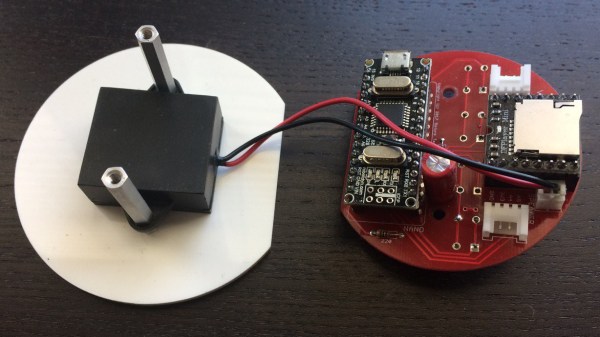
[Michael] volunteers with emergency services, and sometimes has to monitor radio traffic. Sometimes there’s a lot to review, and to make it easier he wrote a noise gate — think of it as a squelch — to break apart recorded audio into parts. Rust has been gaining popularity for writing low level software, and that’s the language he uses. However, you’ll see even if you don’t know Rust, it is pretty easy to figure out.

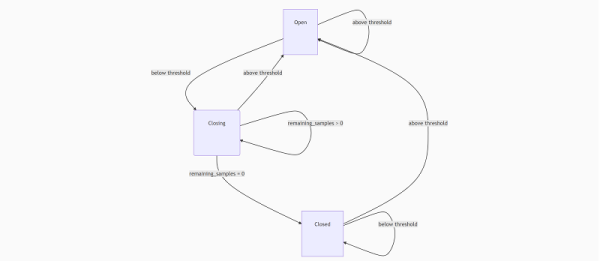
For test data, [Michael] took some publicly-available recordings of air traffic control. Using some ready-made audio processing functions and a simple state machine makes the code easy to write.

Continue reading “Audio Processing In Rust”

Use Your Earbud’s Media Controls On Your Laptop With This Useful Dongle

[David] sends in his very nicely designed “Thumpware Media Controller” that lets your mobile phone headphones control the media playback on your PC.

We realize that some PCs have support for the extra pins on cellphone earbuds, but at least some of us have experienced the frustration (however small) of habitually reaching up to touch the media controls on our earbuds only to hear the forlorn click of an inactive-button. This solves that, assuming you’re still holding on to those 3.5mm headphones, at least.

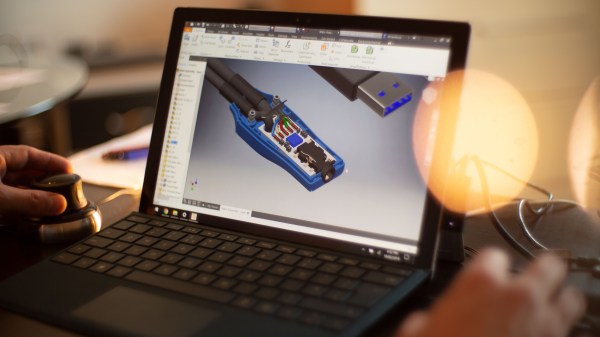
The media controls are intercepted by a PIC16 and a small board splits and interprets the signals into a male 3.5mm and a USB port. What really impressed us is the professional-looking design and enclosure. A lot of care was taken to plan out the wiring, assembly, and strain relief. Overall it’s a pleasure to look at.

All the files are available, so with a bit of soldering, hacking, and careful sanding someone could put together a professional looking dongle for their own set-up.

Laser-Based Audio Injection On Voice-Controllable Systems

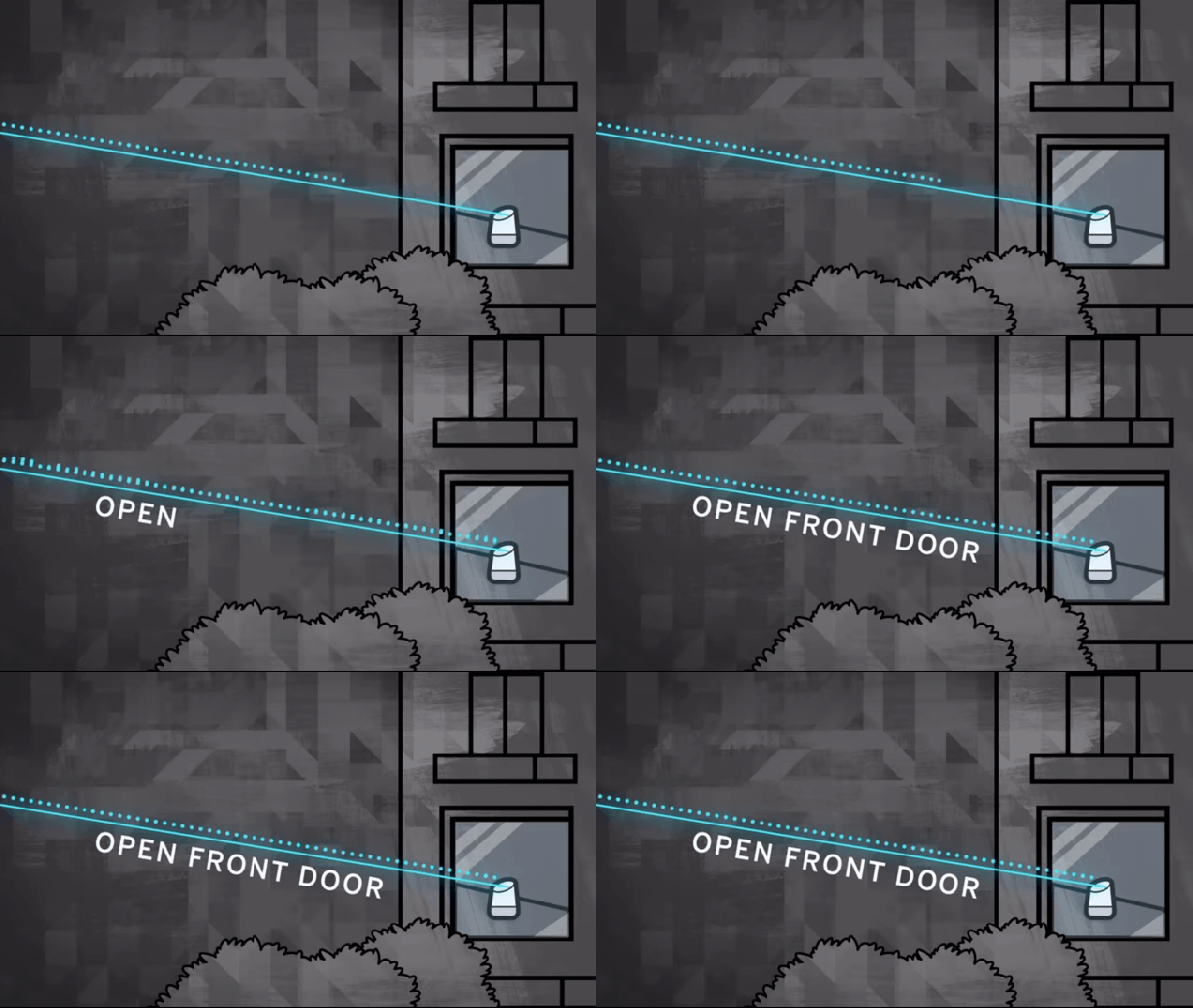
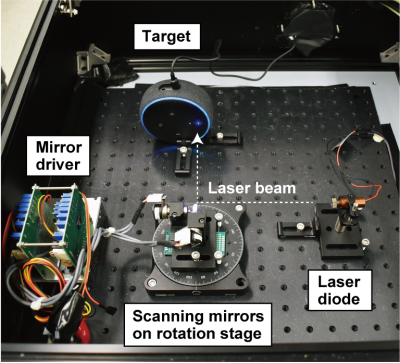
In one of the cooler hacks we’ve seen recently, a bunch of hacking academics at the University of Michigan researched the ability to flicker a laser at audible sound frequencies to see if they could remotely operate microphones simply by shining a light on them. The results are outstanding.
While most Hackers will have heard about ‘The Thing’ – a famous hack where Russian KGB agents would aim a radio transmitter at the great seal in the US embassy,  almost none of us will have thought of using lasers shined in from distant locations to hack modern audio devices such as Alexa or Google Assistant. In the name of due diligence, we checked it out on Wikipedia: ‘The Photoacoustic Effect’ , and indeed it is real – first discovered in 1880 by Alexander Bell! The pulsing light is heating the microphone element and causing it to vibrate along with the beam’s intensity. Getting long range out of such a system is a non-trivial product of telescopes, lasers, and careful alignment, but it can be made to work.

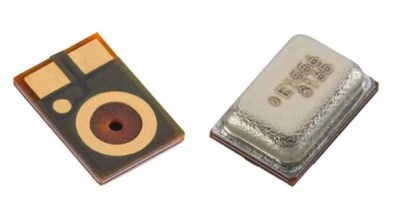
Digging deeper into the hack, we find that the actual microphone that is vulnerable is the MEMS type, such as the Knowles SPV0842LR5H. This attack is relatively easy to prevent; manufacturers would simply need to install screens to prevent light from hitting the microphones. For devices already installed in our homes, we recommend either putting a cardboard box over them or moving them away from windows where unscrupulous neighbors or KGB agents could gain access. This does make us wonder if MEMS mics are also vulnerable to radio waves.

As far as mobile phones are concerned, the researchers were able to talk into an iPhone XR at 10 metres, which means that, very possibly, anybody with a hand held ultra violet / infra red equipped flashlight could hack our phones at close range in a bar, for example. The counter-measures are simple – just stick some black electrical tape over the microphone port at the bottom of the phone. Or stay out of those dodgy bars. Continue reading “Laser-Based Audio Injection On Voice-Controllable Systems”

Tearing Down IKEA’S Sonos Speaker

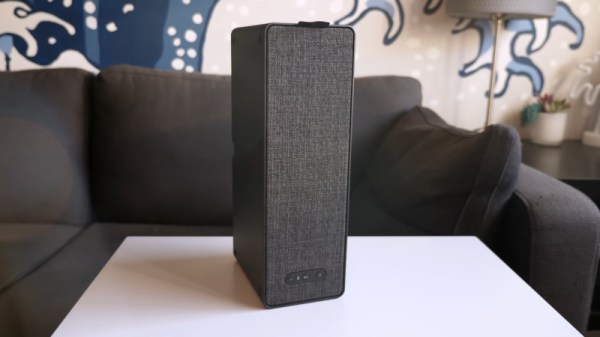
There’s little better way to learn about a piece of electronics than by tearing it down. Taking a peek under the hood can reveal all manner of things about a device’s design, manufacturing, and origins. [This Does Not Compute] does a great job of doing just that, digging into the guts of IKEA’s Symfonisk speaker.

Symfonisk is a WiFi-enabled speaker, working with the Sonos ecosystem. Tearing down the device reveals some similarities to IKEA’s earlier Eneby speaker, with both devices sharing similar speaker drivers, apparently sourced from GGEC. However, upon digging deeper, it’s revealed that the Symfonisk has more in common with a speaker from another manufacturer entirely.

The video does a great job of not only investigating the manufacturing origins of the device, but breaking down the way it all works. This shows how the speaker relies on an Atheros WiFi-only chipset, thus explaining the lack of Bluetooth functionality, as well as discussing things like the neat solutions for cable management. Interestingly, the speaker uses a two-channel DAC and Class-D amplifier, but only operates in mono. Instead, the two channels are instead used to separately drive the tweeter and woofer, allowing EQ to be done in software on the main CPU, negating the need for analog crossover electronics.

It’s a teardown that would serve as a great primer for anyone considering building a piece of consumer electronics, but particularly those involved in the hi-fi space. To see how it was done way back when, perhaps try this 8-track teardown instead. Video after the break.

Continue reading “Tearing Down IKEA’S Sonos Speaker”

Everything Makes Sound If You Try Hard Enough

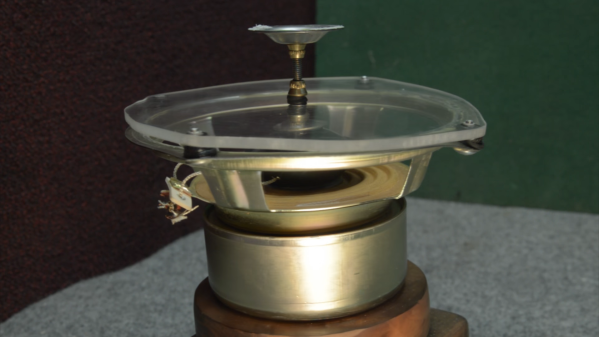
Speaker cone materials can be a deep rabbit hole ranging from inexpensive paper to kevlar. We’ve all cut apart, or blown out, the cheapies to see their inner workings, but the exotic material list does not stop at audiophile-quality models. It can include mirrors, microwave ovens, and a European hacker’s forehead. Video also after the break. In addition to the speakers with expensive elements, there are sound-generating transducers with no cones. These are sometimes called surface speakers, and they vibrate something, anything, to make a sound. At their cores, they have many of the same parts, and making a surface speaker from a traditional speaker is not difficult.

The first step is to find a raw speaker, one with no crossover components, possibly from a garage sale or from a set your spouse insists are outdated, ugly, and better off as firewood. Power specifications should not change since we will be using the same solenoid, and that means your amplifier can follow the speakers back from the dead. The video provides step-by-step instructions, and the goal is to create a module with a moving shaft, but the range must be limited so it cannot be pushed back into the speaker or pulled away, both could destroy it. Once you have that, go around and make everything noisy. Don’t use this on pets or children, but spouses are fair game.

We would love to see a chip bender experiment with different speaker mediums to add an extra layer of complexity, but for the rest of us, bone conduction is already a real thing, and if you enjoy impractical speakers, you are not the only one with your head in the clouds.

Continue reading “Everything Makes Sound If You Try Hard Enough”

Professional Audio On An ESP32

Audiophiles have worked diligently to alert the rest of the world to products with superior sound quality, and to warn us away from expensive gimmicks that have middling features at best. Unfortunately, the downside of most high quality audio equipment is the sticker price. But with some soldering skills and a bit of hardware, you can build your own professional-level audio equipment around an ESP32 and impress almost any dedicated audiophile.

The list of features the tiny picoAUDIO board packs is impressive, starting with a 3.7 watt stereo amplifier and a second dedicated headphone amplifier. It also has all of the I/O you would expect something based on an ESP32 to have, such as I2S stereo DAC, an I2S microphone input, I2C GPIO extenders and, of course, a built-in MicroSD card reader. The audio quality is impressive too, and the project page has some MP3 files of audio recorded using this device that are worth listening to.

Whether you want the highest sound quality for your headphones while you listen to music, or you need a pocket-sized audio recording device, this might be the way to go. The project files are all available so you can build this from the ground up as well. Once you have that knocked out, you can move on to building your own speakers.

Continue reading “Professional Audio On An ESP32”

Putting 3D Printed Speaker Drivers To The Test

Over the years, we’ve seen numerous projects that attempted to 3D print speaker enclosures that deliver not only a bit of custom flair, but hopefully halfway decent sound. Though as you’d probably expect, the drivers themselves are always standard run-of-the mill hardware mounted into the plastic enclosure. But given the research being conducted by [Paul Ellis], that might not be a safe assumption for much longer.

His quest to develop a full-range 3D speaker has taken him through several design revisions over the last two years, with each one being put through testing procedure that compared its frequency response to “real” speakers from manufacturers like Dayton and Bose. The project is very much ongoing, but a recently completed iteration of the driver design managed to exceed 80 dB at 1 W. In terms of audio quality, [Paul] reports they can hold their own against commercially available drivers. You can hear for yourself in the video after the break.

Ultimately, he hopes to be able to sell his 3D printed speakers in kit form to anyone who’s looking for the last word in bespoke audio hardware. The idea being that the drivers and enclosure will be completely modular, allowing the user to swap out individual components for ones printed (or not) in different materials so they can tune the in-person sound to their exact specifications. To facilitate this rapid reconfiguring of the drivers, the designs use some neat tricks like having the magnets be removable rather than glued in so they could be swapped out non-destructively.

This isn’t the first fully 3D printed speaker driver we’ve ever seen, Formlabs showed one off that was made on their SLA printer back in 2015, and we actually saw a rudimentary take on the same idea earlier this year. But the work that [Paul] has done here is certainly the most thorough, and dare we say practical, take we’ve ever seen on the concept.

Continue reading “Putting 3D Printed Speaker Drivers To The Test”