Reverse-Engineering A Smoker

In certain parts of the world, cooking meat in a regionally-specific way is a critical part of the local culture. From barbeque in the American south to boerewors and braaivleis in South Africa to MontrĂ©al smoked meat in French Canada, almost every location has its cookout specialty. So much so that various manufacturers of the tools used for these foods include all kinds of gadgets to monitor the sometimes days-long process of cooking various cuts of meat. [megamarco833]’s smoker, though, includes some tools of his own design.

The smoker is made by a company called Pitboss and includes a rotary switch and control board for maintaining a precise temperature in the smoker. The switch works by changing the voltage value sent to a small microcontroller. By interfacing an ESP32 to this switch, [megamarco833] can remotely change the smoke level and temperature of the smoker. On the software side, it uses a combination of Node-RED and Domoticz to handle the automation and control.

For a cookout that can last hours (if not days) a remotely accessible smoker like this is an invaluable tool if you want to do something other than manually monitor the temperature of your meat for that much time. And, if your barbeque grill or smoker of choice doesn’t already have an embedded control board of some type, we’ve seen analog cooking tools adapted to much the same purpose as this one.

Thanks to [Peter] who sent in the tip and also helped [megamarco833] with the reverse-engineering of the control board!

Automate Internet Life With Python

Most of us are adept enough with computers that you know what they can easily do and what they can’t. Invent a new flavor of ice cream? Not easy. Grab the news headlines related to Arduinos from your favorite news feed? Relatively easy. But, of course, the devil is in the details. FreeCodeCamp has a 3-hour course from [Frank Andrade] that dives into the gory details of automating web tasks using Python and a variety of libraries like Path, Xpath, and Selenium. You can watch the course, below.

Topics start off with grabbing tables from websites and PDFs. But it quickly graduates to general-purpose web scraping and even web automation. These techniques can be very useful for testing browser-based applications, too.

By the end, you’ve created an executable that grabs news every day and automatically generates an Excel report. There’s also a little wind down about WhatApp automation. A little something for everyone. We also greatly approved of [Frank]’s workspace which appears in the background. Looks like he would enjoy reading Hackaday.

Honestly, while we’ve seen easier methods of automating the browser, there’s something appealing about having the control something like Python affords. Sure beats building hardware to simulate a human-in-the-loop.

Continue reading “Automate Internet Life With Python”

Automated Mushroom Cultivation Yields Delicious Fried Goodies

[Kyle Gabriel] knows mushrooms, and his years of experience really shine through in his thorough documentation of an automated mushroom cultivation environment, created with off-the-shelf sensors and hardware as much as possible. The results speak for themselves, with some delicious fried oyster mushrooms to show for it!

Fried oyster mushrooms, grown from scratch.

The most influential conditions for mushroom cultivation are temperature, humidity, and CO2 concentration, and to automate handling the environmental conditions [Kyle] created Mycodo, an open-source system that leverages inexpensive hardware and parts while also having the ability to take regular photos to keep an eye on things.

Calling [Kyle]’s documentation “comprehensive” doesn’t do it justice, and he addresses everything from setting up a positive pressure air filtration system for a work area, to how to get usable cultures from foraged mushrooms, all the way through growth and harvesting. He even includes a delicious-looking recipe for fried mushrooms. It just doesn’t get more comprehensive than that.

We’ve seen [Kyle]’s earlier work before, and it’s fantastic to see the continued refinement. Check out a tour of the whole thing in the video embedded below (or skip to 16:11 if you want to make yourself hungry.)

Continue reading “Automated Mushroom Cultivation Yields Delicious Fried Goodies”

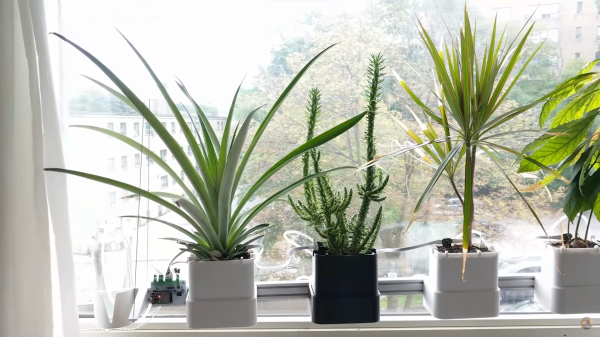
Photo of an automated plant watering system attached to four potted plants.

Automation Allows You To Leaf Your Plants Alone

The greatest threat to a potted plant stems from its owner’s forgetfulness, but [Sasa Karanovic] has created an automation system that will keep his plants from getting too thirsty. Over the past year [Sasa] has been documenting an elegant system for monitoring and watering plants which has now blossomed into a fully automated solution.

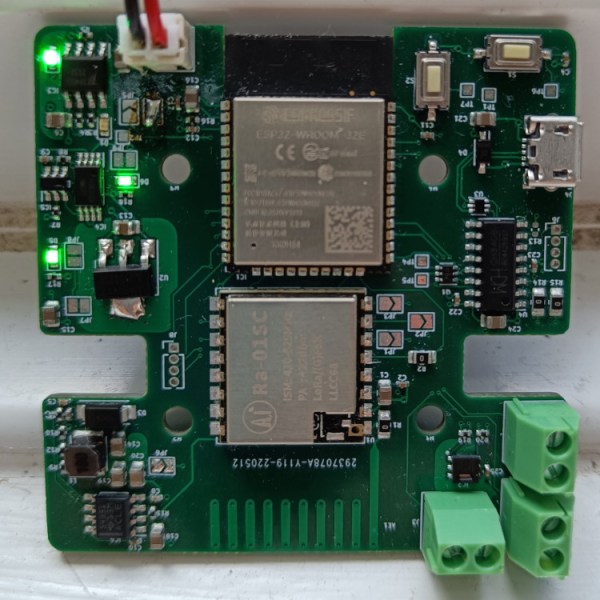
If you haven’t seen the earlier stages of the project, they’re definitely worth checking out. The short version is that [Sasa] has developed a watering system that uses I2C to communicate with soil moisture, temperature, and light sensors as well as to control solenoids that allow for individual plants to be watered as needed. An ESP32 serves as a bridge, allowing for the sensors to be read and the water to be dispensed via an HTTP interface.

In this final part, [Sasa] integrates his watering system into a home automation system. He uses a MySQL database to store logs of sensor data and watering activity, and n8n to automate measurement and watering. If something isn’t quite right, the system will even send him a Telegram notification that something is amiss.

If you think automation might be the best way to save your plants from a slow death, [Sasa] has kindly shared his excellent work on GitHub. Even if you don’t have a green thumb, this is still a great example of how to develop a home automation solution from scratch. If you’re more interested in television than gardening, check out [Sasa]’s approach to replacing a remote control with a web interface!

Continue reading “Automation Allows You To Leaf Your Plants Alone”

Occam’s Razor: Gardening Edition

While the impulse to solving problems in complex systems is often to grab a microcontroller and some sensors to automate the problem away, interfacing with the real world is often a lot more difficult than it appears. Measuring soil moisture, for example, seems like it would be an easy way of ensuring plants get the proper amount of water, but soil is a challenging environment for electronics and this solution often causes more problems than it solves. [Kevin] noticed this problem with soil moisture sensors and set about solving this problem with a much simpler, though indirect, method of monitoring his plants electronically.

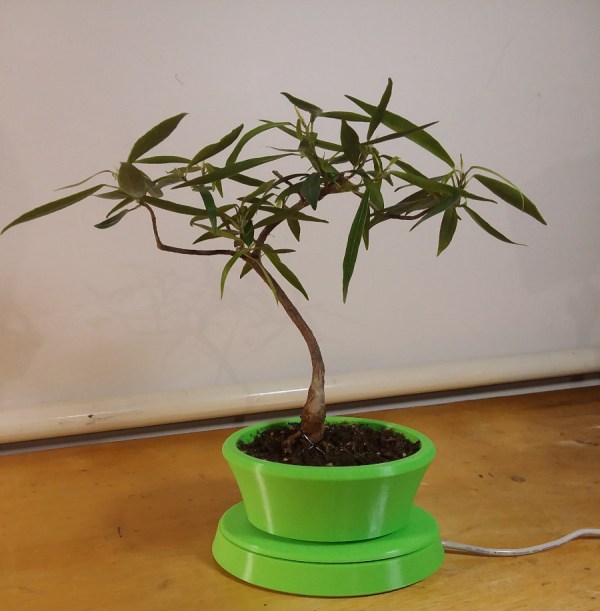
Rather than relying on soil conductivity for testing soil moisture levels, he has developed an alternate method of determining if the plants need to be watered simply by continuously weighing them. The hypothesis that he had was that a plant that needs water will weigh less as the available water respirates out of the plant or evaporates from the soil. This means that using a reliable sensor like a load cell to measure weight rather than an unreliable one like a soil moisture sensor will result in more reliable data he can use to automate his plants’ watering.

[Kevin]’s build is based around an ESP32 and a commercially-available load cell which are all built into the base of the plant’s pot. The design hides all of the electronics in a pleasant enclosure and is able to communicate relevant info wirelessly as well. The real story here, however, isn’t a novel use of an ESP32 chip, but rather out-of-the-box problem solving by using an atypical sensor to solve this problem. That’s not to say that you can’t ever use other sensors to directly monitor your garden and automate its health, though.

Voice-Controlled Smart Home From The Foundation Up

Smart homes are becoming an increasingly popular way to automate one’s home, whether it’s turning on lights, closing blinds, or even feeding pets. But the commercial offerings often rely on an internet connection to reach servers in order to work, which invites a lot of privacy concerns for a large percentage of us as well as being inconvenient when the internet is down. Essentially the only way to have a privacy-respecting, self-sufficient smart home is to build one on your own from the ground up, which is exactly what [Xasin] has done with this project.

This build is based on ESP32 modules with a Raspberry Pi as a hub, but it’s not as simple as a MQTT implementation. Not only does the self-contained home automation setup not rely on any outside services, but a failure of the central Pi server will not impact the nodes either as they are configured to continue operating independently even without central control. This allows for a robust home automation implementation without a single point of failure, and also includes some other features that are helpful as well including voice control, all while retaining a core design philosophy that makes it relatively easy to build.

Not only is the build technologically impressive for its standalone capabilities and its elimination of privacy concerns, but [Xasin] also did an excellent job with the physical design as well, adding plenty of RGB and a hexagonal enclosure that gives it a unique look wherever its is placed. If you’re renting right now or otherwise unable to interface any automation with your current home, be sure to take a look at some projects that do home automation without making any permanent changes.

Continue reading “Voice-Controlled Smart Home From The Foundation Up”

Automate The Farm With Acorn

Farming has been undergoing quite a revolution in the past few years. Since World War 2, most industrial farming has relied on synthetic fertilizer, large machinery, and huge farms with single crops. Now there is a growing number of successful farmers bucking that trend with small farms growing many crops and using natural methods of fertilizing that don’t require as much industry. Of course even with these types of farms, some machinery is still nice to have, so this farmer has been developing an open-source automated farming robot.

The robot is known as Acorn and is the project of [taylor] who farms in California. The platform is powered by an 800 watt solar array feeding a set of supercapacitors for energy storage. It uses mountain bike wheels and tires fitted with electric hub motors which give it four wheel drive and four wheel steering to make it capable even in muddy fields. The farming tools, as well as any computer vision and automation hardware, can be housed under the solar panels. This prototype uses an Nvidia Jetson module to handle the heavy lifting of machine learning and automation, with a Raspberry Pi to handle the basic operation of the robot, and can navigate itself around a farm using highly precise GPS units.

While the robot’s development is currently ongoing, [taylor] hopes to develop a community that will build their own versions and help develop the platform. Farming improvements like this are certainly needed as more and more farmers shift from unsustainable monocultures to more ecologically friendly methods involving multiple simultaneous crops, carbon sequestration, and off-season cover crops. It’s certainly a long row to hoe but plenty of people are already plowing ahead.

Continue reading “Automate The Farm With Acorn”