3D Printed Clock Just Taps It In

The famous cuckoo clock, with its moving, chirping mechanical bird indicating various divisions of time, has been around since at least the 1600s. The most famous of them come from the Black Forest area of Germany, and are still being made worldwide even today. Other clocks with different themes take their inspiration from the standard bird-based clocks from history, and thanks to modern 3D printing and other technologies we can make clocks with almost any type of hour indicator we’d like with relative ease like [Jason]’s golf clock.

While the timekeeping mechanism is a fairly standard analog clock, the hour indicator mechanism in this build is a small figure which putts a golf ball into a hole once every hour. It uses an ESP32-C3 at its core, which controls a pair of servos. One controls the miniature golfer, and the other lifts the ball up into position on the green at the appointed time. Once the ball is in place, the figure rotates, striking the ball towards the hole. Although it looks almost like the ball is guided by a magnet of some sort at first glance, the ball naturally finds its way into the hole by the topography of the green alone.

Almost all of the parts in this build are 3D printed, including the green, the golfer, the frame, and a number of the servo components. There’s also a small sensor that detects if the ball has actually made it into the hole and back to the lifting mechanism, and to that end there’s also a number of configurations that can be made in the software to ensure that the servos controlling everything all work together to putt the ball properly.

While not a cuckoo clock in the strict sense, we always appreciate a unique clock around here, but if you demand your clocks have ideological purity we’ll point you to this cuckoo clock built into a wristwatch.

Continue reading “3D Printed Clock Just Taps It In”

Retro Weather Display Acts Like It’s Windows 95

Sometimes you really need to know what the weather is doing, but you don’t want to look at your phone. For times like those, this neat weather display from [Jordan] might come in handy with its throwback retro vibe.

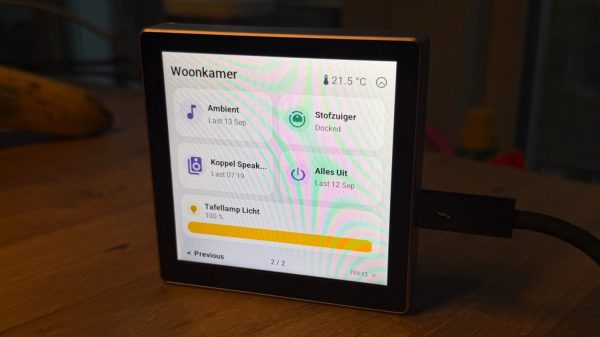
The build is based around the ESP32-2432S028—also known as the CYD, or Cheap Yellow Display, for the integrated 320 x 240 LCD screen. [Jordan] took this all-in-one device and wrapped it in an attractive 3D-printed housing in the shape of an old-school CRT monitor, just… teenier. A special lever mechanism was built in to the enclosure to allow front panel controls to activate the tactile buttons on the CYD board. The ESP32 is programmed to check Open-Meteo feeds for forecasts and current weather data, while also querying a webcam feed and satellite and radar JPEGs from available weather services. These are then displayed on screen in a way that largely resembles the Windows 95 UI design language, with pages for current conditions, future forecasts, wind speeds, and the like.

We’ve seen some fun weather displays over the years, from graphing types to the purely beautiful. If you’ve found a fun way to display the weather (or change it) don’t hesitate to notify the tipsline. Particularly in the latter case.

Simple MIDI Sample Player Runs On ESP32

[Jakub] is a musician, and found himself in need of a simple way to trigger samples via MIDI when on stage. So many commercial solutions exist, but most were overkill for the job or too messy and complicated to justify their use in a live environment. Thus, [Jakub] worked up Samplotron to do exactly the job needed with a minimum of fuss.

The project is based around the ESP32. It’s effectively a lightweight hardware sampler that can trigger sounds on command via MIDI. Sample data is loaded from an SD card, which also stores the device configuration. The Samplotron plays back mono 16-bit WAV files at 44,100 Hz, delivering audio via an ES8388 audio codec module connected via I2S. Two encoders are used to control the device, with a menu system presented via an SSD1309 OLED screen. Samples can be loaded and managed via this interface, and it allows tweaks to be made to volume levels and one-shot/loop playback as needed. MIDI input to the device is simply handled via the onboard UART functionality of the ESP32 itself.

It’s a neat little bit of music hardware that does exactly what [Jakub] needs and nothing more. We’ve featured similar builds before, like this neat RP2040 soundboard. If you’re building rad custom hardware for your own musical adventures, we’d love to know all about it. 

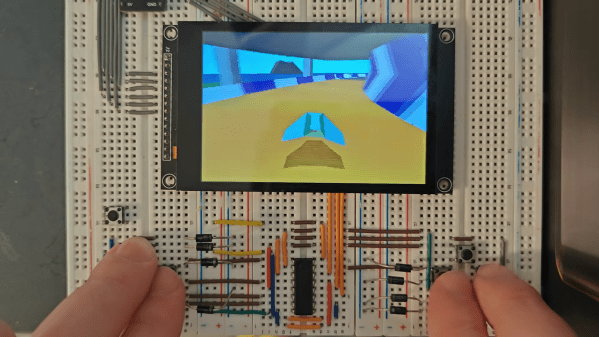
FLOSS Weekly Episode 866: BreezyBox And Embedded Compilers

This week Jonathan chats with Valentyn Danylchuk about BreezyBox — an interactive shell and toolkit that provides various tools and a compiler on an ESP32 microcontroller. What was the inspiration for this impressive project, and what direction is it heading? Watch to find out!

Continue reading “FLOSS Weekly Episode 866: BreezyBox And Embedded Compilers”

Every Ham Shack Needs A Ham Clock

Every ham radio shack needs a clock; ideally one with operator-friendly features like multiple time zones and more. [cburns42] found that most solutions relied too much on an internet connection for his liking, so in true hacker fashion he decided to make his own: the operator-oriented Ham Clock CYD.

A tabbed interface goes well with the touchscreen LCD.

The Ham Clock CYD is so named for being based on the Cheap Yellow Display (CYD), an economical ESP32-based color touchscreen LCD which provides most of the core functionality. The only extra hardware is a BME280 temperature and humidity sensor, and a battery-backed DS3231 RTC module, ensuring that accurate time is kept even when the device is otherwise powered off.

It displays a load of useful operator-oriented data on the touchscreen LCD, and even has a web-based configuration page for ease of use. While the Ham Clock is a standalone device that does not depend on internet access in order to function, it does have the ability to make the most of it if available. When it has internet access over the built-in WiFi, the display incorporates specialized amateur radio data including N0NBH solar forecasts and calculated VHF/HF band conditions alongside standard meteorological data.

The CYD, sensor, and RTC are very affordable pieces of hardware which makes this clock an extremely economical build. Check out the GitHub repository for everything you’ll need to make your own, and maybe even put your own spin on it with a custom enclosure. On the other hand, if you prefer your radio-themed clocks more on the minimalist side, this Morse code clock might be right up your alley.

Building A Neatly Framed Word Clock

Reading analog clocks is a pretty straightforward skill to learn. However, if you’ve already learned to read and don’t want to pick up the extra skill, a word clock is a perfect solution for telling time. [povey_tech] found some nice examples in the wild but didn’t appreciate the price, so he set about building his own.

The build is based around an ESP32 microcontroller. While many projects in this vein would use the onboard wireless connectivity to query network time servers, in this case, the board relies on the user manually setting the time and a DS1307 real-time-clock module to keep a steady tick. Also onboard is a VEML7700 ambient light sensor, which the microcontroller uses to control the brightness of the WS2812 LEDs inside the board.

The words themselves are laser cut out of acrylic panels, with everything set inside a tidy oak picture frame. A layer of anti-reflective glass in front helps cut down on glare, while [povey_tech] was so kind as to implement two LEDs per letter to allow for lovely color gradients to be displayed. Configuring the clock is easy thanks to a webpage hosted on the ESP32 that allows for control of dimming modes, colors, and setting the time. Home Assistant integration is something planned for the future.

We’ve seen many great word clocks over the years. Perhaps the biggest leap forward in this world was the development of the addressable LED strip which made constructing these clocks much easier.

Continue reading “Building A Neatly Framed Word Clock”

Simple D-STAR Transceiver Uses Inexpensive Hardware

[Yeckel] recently put the finishing touches on an ambitious implementation of a simple D-STAR (Digital Smart Technologies for Amateur Radio) transceiver using some very accessible and affordable hardware. The project is D-StarBeacon, and [Yeckel] shows it working on a LilyGO TTGO T-Beam, an ESP32-based development board that includes a SX1278 radio module and GPS receiver. It even serves a web interface for easy configuration.

What is D-STAR? It’s a protocol used by radio operators for voice that also allows transmitting low-speed data, such as short text messages or GPS coordinates. While voice is out of scope for [Yeckel]’s project (more on that in a moment) it can do all the rest, including send images. That makes beacon-type functions possible on inexpensive hardware, instead of requiring a full-blown radio.

As mentioned, voice is a big part of D-STAR. While [Yeckel] was able to access the voice data, attempts to decode it were unsuccessful. A valiant effort, but we suppose voice decoding isn’t terribly relevant to beacon-type operations like transmitting APRS (Automatic Packet Reporting System).

So far as [Yeckel] is aware, D-StarBeacon is currently the only open-source implementation of a D-STAR radio available on the internet, which is pretty interesting. We’ve seen projects that touch indirectly on D-STAR, but nothing like this.

Watch it go through its paces in the video embedded below. Since the T-Beam is just a microcontroller development board, the user interface comes from an Android app on a mobile phone, which is why you see a phone in the video.

Continue reading “Simple D-STAR Transceiver Uses Inexpensive Hardware”