Remote Controlled Electric Snowblower Sports FPV For Safety

As summer scorches the northern hemisphere, here’s something to cool your thoughts: winter is only four months away. And with it will come the general misery and the proclamations that “It’ll never be warm again,” not to mention the white stuff and the shoveling. Or perhaps not, if you’re lucky enough to have a semi-autonomous electric snowblower in the garage.

The device [Dane Kouttron] describes is a strange beast indeed, and one that came to him under somewhat mysterious circumstances. It appears to be a standard Ariens two-stage blower, the kind normally driven by a fairly beefy internal combustion engine so as to have enough power to run the auger, the impeller, and the drive wheels. But a previous owner had removed the gas engine and attached a 4-kW brushless motor to run the auger and impeller. Realizing the potential of this machine and with a winter storm heading his way, [Dane] used the old engine mount to hold giant LiFePO₄ batteries from a cell tower backup battery, slapped a couple of electric wheelchair motors onto the drive wheels, mounted a motor to swivel the exhaust chute, and added control electronics from a retired battlebot. Setting such a machine loose in the wild would be bad, so an FPV system was added just in time for storm cleanup. Upgrades for version 2 include better weight distribution for improved stability and traction, and of course googly eyes. Check out the video below to see it flinging snow and moving around faster than any snowblower we’ve ever seen.

We’ll never get lucky enough to have such wonders gifted on us as [Dane] did, but we applaud him for picking up the torch where someone else obviously left off. And who knows; perhaps the previous maker took inspiration from this remote-controlled snowblower build?

Continue reading “Remote Controlled Electric Snowblower Sports FPV For Safety” →
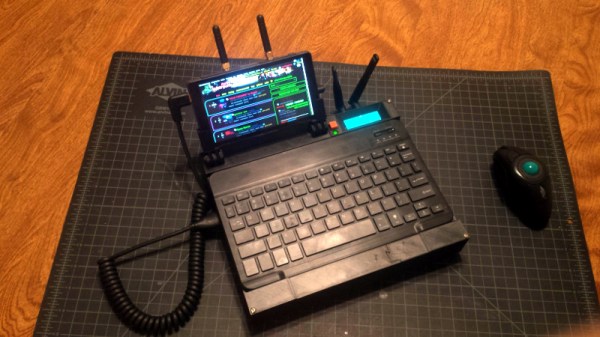
A Mobile Computer To Make William Gibson Jealous

The personal computers in science fiction books, movies, and games are way cooler than the dinky pieces of hardware we’re stuck with in the real world. Granted the modern laptop has a bit more style than the beige boxes of yesteryear, but they still aren’t half as l33t as the custom PowerBooks in Hackers. Luckily for those who dream of jacking into the Matrix, the average hacker now has access to the technology required to make a custom computer to whatever fanciful specifications they wish.

A perfect example is this “cyberdeck” created by [Tinfoil_Haberdashery]. Inspired by William Gibson’s Neuromancer, this wild-looking machine is more than just a cosplay prop or conversation piece. It packs in enough power to be a daily-driver computer, as well as some special features which make it well suited for field work.

The body of the cyberdeck is 3D printed, but as [Tinfoil_Haberdashery] doesn’t have a 3D printer big enough to do the whole thing in one piece he had to break it up into subsections. He added a dovetail pattern to the edges of each piece, which makes for much stronger joint than simply gluing it together. A worthwhile tip if you ever find yourself in need of printing something really big.

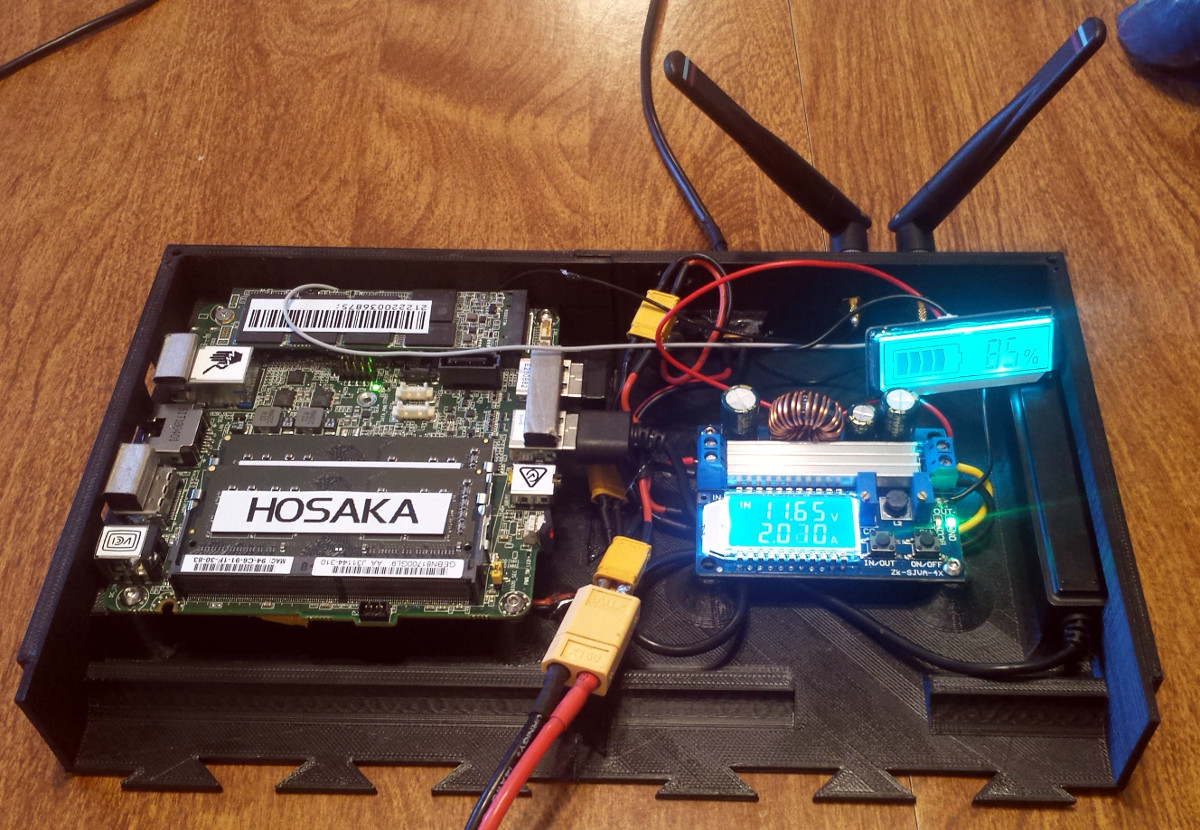
Raspberry Pi aficionados might be disappointed to see the Intel NUC motherboard inside; which features a 3.4 Ghz dual-core CPU, 8 GB of RAM, and a roomy 500 GB SSD in an incredibly small package. To keep everything running the machine can take up to twelve 18650 cells, giving it a maximum run-time of sixteen hours or so. There’s even a 12 V power jack so he can power a soldering iron and other low voltage gadgets off of the deck’s batteries in a pinch. The integrated charger can take anywhere from 6 to 30 V, which gives [Tinfoil_Haberdashery] the ability to charge up from a wide array of sources.

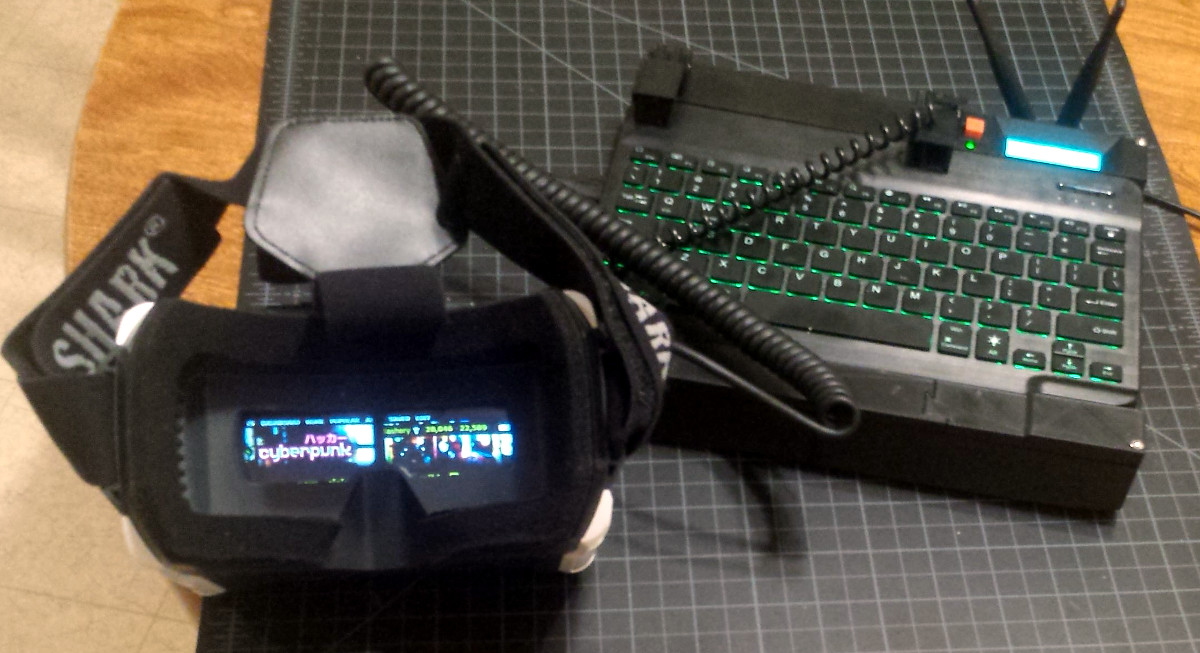
But perhaps the best feature of the cyberdeck is the display. It uses a Fat Shark Transformer, a five inch 720p display designed for FPV drone use, which can not only fold flat against the deck for storage, but can be removed and slipped into a pair of goggles. This gives the cyberdeck a head mounted display that looks like something straight out of the movies. It even supports 3D, if you’re willing to cut the resolution in half.

Things have come a long way in the world of DIY head mounted computer displays. Really makes you wonder what the dedicated hacker is going to be able to pull off in another 10 years or so.

[via /r/cyberpunk]

FPV-Rover 2.0 Has 3D Printed Treads And Plenty Of Zip

[Markus_p] has already finished one really successful 3D printed tracked robot build. Now he’s finished a second one using standard motors and incorporating what he learned from the first. The results are pretty impressive and you can see a video demo of the beast, below.

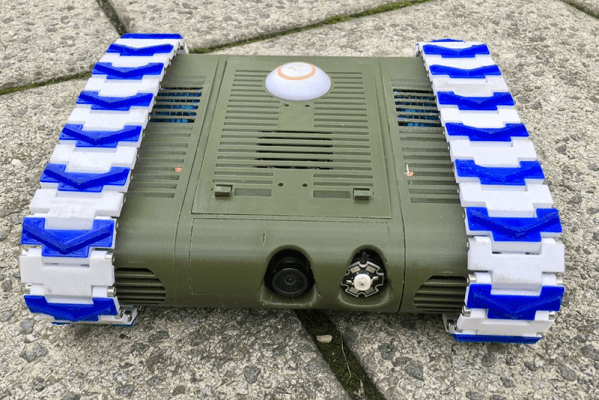
Most of the robot is PLA, although there are some parts that use PETG and flex plastic. There is an infrared-capable camera up front and another regular camera on the rear. All the electronics are pretty much off the shelf modules like an FPV transmitter and an electronic controller for the motors. There’s a servo to tilt the camera, as you can see in the second video.

The body fits together using nuts and magnets. The robot in the video takes a good beating and doesn’t seem to fall apart so it must be sufficient. What appealed to us was the size of the thing. It looks like it would be trivially easy to mount some processing power inside or on top of the rover and it could make a great motion base for a more sophisticated robot.

We’ve seen some similar projects, of course. This tracked robot uses mind control. And OpenWheel is a great place to get treads and other locomotion designs.

Continue reading “FPV-Rover 2.0 Has 3D Printed Treads And Plenty Of Zip” →

Super Simple, Super Cheap FPV Drone Tracking

What’s more disruptive to the drone first-person view (FPV) experience than dropouts in your video feed when you’re in the middle of a race? Probably nothing, and there’s probably also not much you can do about it. Or is there? Might a simple tracker based on RSSI help keep your video signal locked in?

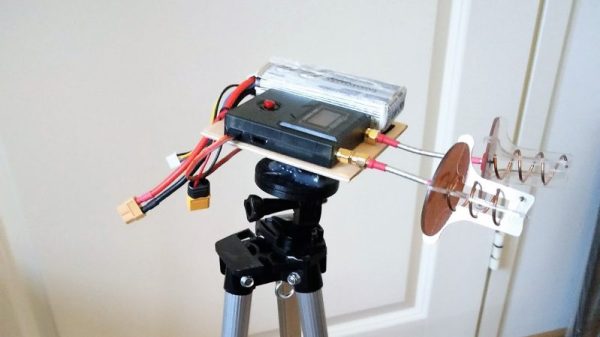
Honestly, we’re not sure it would, but we think it’s pretty nifty to see [FlyerFpv]’s tracker following his drone around. The idea is simple and uses the full-diversity FPV receiver he already has. Diversity receivers constantly monitor signal strength from multiple antennas to determine which one to listen to, which improves reception quality. [FlyerFpv] sends the RSSI outputs to analog inputs on an Arduino which drives a servo to keep the signals as close to each other as possible. The Arduino and the DC-DC converter needed to power it fit nicely inside the receiver case with no modifications, which is a nice touch. With a 3D-printed servo mount and some fancy directional antennas, the setup keeps pretty good track of his drone now. See it in action below.

Sure, the response could be snappier, and we’d love to see another receiver and servo added to track pitch as well as yaw. For a first pass, we think it’s great, but [FlyerFpv] should enjoy it while he can in case AI takes over our flying fun soon.

Continue reading “Super Simple, Super Cheap FPV Drone Tracking” →

3D Drone Video

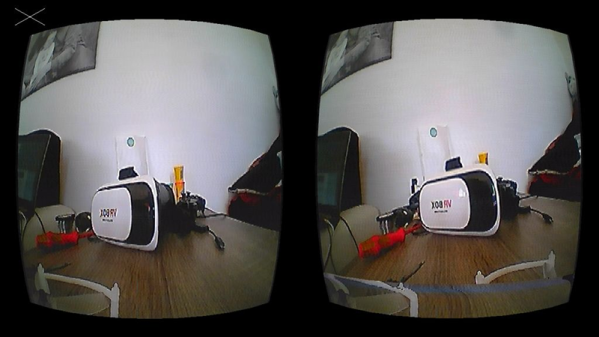
If you enjoy flying quadcopters, it is a good bet that you’ll have a drone with a camera. It used to be enough to record a video for later viewing, but these days you really want to see a live stream. The really cool setups have goggles so you can feel like you are actually in the cockpit. [Andi2345] decided to go one step further and build a drone that streams 3D video. You can see a video of the system, below.

Outdoors, there’s probably not a lot of advantage to having a 3D view, but it ought to be great for a small indoor drone. The problem is, of course, a small drone doesn’t have a lot of capacity for two cameras. The final product uses two cameras kept in sync with a sync separator IC and a microcontroller, while an analog switch intersperses the frames.

On the viewing side, a USB frame grabber and a Raspberry Pi splits the images again. At first, the system used an LCD screen married with a Google Cardboard-style goggle, but eventually, this became a custom Android application.

Continue reading “3D Drone Video” →

The M1 NerfBot: When Prototypes Evolve

What do you get when you cross a self-taught maker with an enthusiasm for all things Nerf? A mobile nerf gun platform capable of 15 darts per second. Obviously.

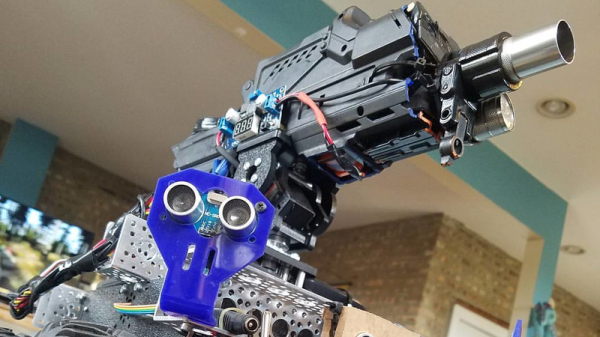
The M1 NerfBot built by [GrimSkippy] — posting in the ‘Let’s Make Robots’ community — is meant to be a constantly updating prototype as he progresses in his education. That being the case, the progress is evident; featuring two cameras — a webcam on the turret’s barrel, and another facing forward on the chassis, a trio of ultrasonic sensors, controlled by an Xbox 360 controller, and streaming video to a webpage hosted on the M1 itself, this is no mere beginner project.

Perhaps most compelling is how the M1 tracks its targets. The cameras send their feeds to the aforementioned webpage and — with a little reorganization — [GrimSkippy] accesses the the streams on an FPV headset-mounted smartphone. As he looks about, gyroscopic data from the phone is sent back to the M1, translating head movement into both turret and chassis cam movement. Check it out!

Continue reading “The M1 NerfBot: When Prototypes Evolve” →

3D Printing A Better Quadcopter Frame

Before you smash the “Post Comment” button with the fury of Zeus himself, we’re going to go ahead and say it: if you want to build a decent quadcopter, buy a commercial frame. They are usually one of the cheaper parts of the build, they’re very light for how strong they are, and replacement parts are easily available. While you could argue the cost of PLA/ABS filament is low enough now that printing it would be cheaper than buying, you aren’t going to be able to make a better quadcopter frame on a 3D printer than what’s available on the commercial market.

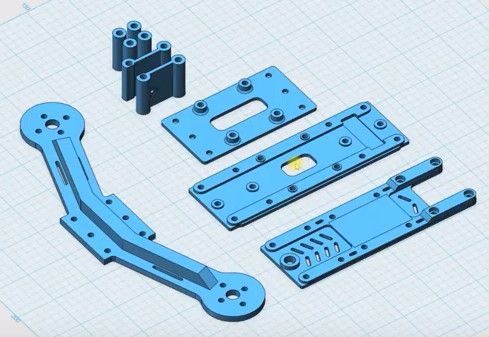
The frame features a surprisingly low part count.

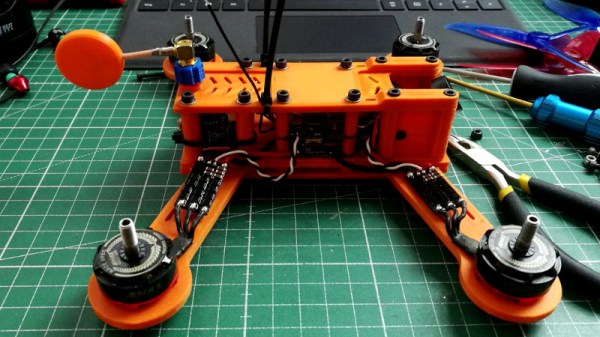
Having said that, [Paweł Spychalski] has recently shown off his 3D printed FPV racing quadcopter frame with some surprising results. The frame ended up being surprisingly stiff, and while the weight is a bit high, it’s actually lighter than he expected. If you’re looking to build a quad with the absolute minimum of expense his design might be something to look into.

Of course, [Paweł] is hardly the first person to think about printing a quad frame. But he did give his design some extra consideration to try and overcome some of the shortcomings he noticed in existing 3D printed designs. For one, rather than have four separate arms that mount to a central chassis, his design has arms that go all the way across with a thick support that goes between the motors. The central chassis is also reassuringly thick, adding to the overall stiffness of the frame.

The key here is that [Paweł] printed all the parts with 2 mm thick walls. While that naturally equates to longer print times and greater overall weight, it’s probably more than worth it to make sure the frame doesn’t snap in half the first time it touches the ground.

Beyond the printed parts, all you need to assemble this frame are about a dozen M3 nuts and bolts. Overall, between the hardware and the plastic you’re looking at a total cost of under $5 USD. In the video below [Paweł] puts the frame through its paces doing some acrobatic maneuvers, and it looks like 5 bucks well spent to us.

If you want to go all-in on 3D printed quadcopter parts, you can pair this frame with some printed propellers. Perhaps even a printed camera gimbal while you’re at it. Continue reading “3D Printing A Better Quadcopter Frame” →