Detecting Helium Leaks With Sound In A Physics-Based Sensor

Helium is inert, which makes it useful in a lot of different industries. But helium’s colorless and odorless non-reactivity also means traditional gas sensing methods don’t work. Specialized detectors exist, but are expensive and fussy. Thankfully, researcher [Li Fan] and colleagues found a physics-based method of detecting helium that seems as elegant as it is simple.

The new sensor relies on a topological kagome structure, and doesn’t depend on any chemical reaction or process whatsoever. The cylinders in the structure are interconnected; air can flow in and speakers at the three corners inject sound.

Sound waves propagate through the air within the structure at a fixed rate, and as helium enters the sensor it changes how fast the sound waves travel. This measurable shift in vibration frequency indicates the concentration of helium. It’s stable, calibration-free, doesn’t care much about temperature, and resets quickly. Even better, the three corners act as separate sensors, making it directional. It’s even quite rugged. Just as a basket weaved in a kagome pattern is stable and resistant to damage or imperfections in the individual strips that make up the pattern, so too is this sensor only marginally affected by physical defects.

The sensor design has been tested and shown to work with helium, but could possibly be applied to other gases. More detail is available at ResearchGate, with some information about the math behind it all in a supplemental paper.

Hackaday Links Column Banner

Hackaday Links: September 1, 2024

Why is it always a helium leak? It seems whenever there’s a scrubbed launch or a narrowly averted disaster, space exploration just can’t get past the problems of helium plumbing. We’ve had a bunch of helium problems lately, most famously with the leaks in Starliner’s thruster system that have prevented astronauts Butch Wilmore and Suni Williams from returning to Earth in the spacecraft, leaving them on an extended mission to the ISS. Ironically, the launch itself was troubled by a helium leak before the rocket ever left the ground. More recently, the Polaris Dawn mission, which is supposed to feature the first spacewalk by a private crew, was scrubbed by SpaceX due to a helium leak on the launch tower. And to round out the helium woes, we now have news that the Peregrine mission, which was supposed to carry the first commercial lander to the lunar surface but instead ended up burning up in the atmosphere and crashing into the Pacific, failed due to — you guessed it — a helium leak.
Continue reading “Hackaday Links: September 1, 2024”

Rebuilding A $700k Refrigerator

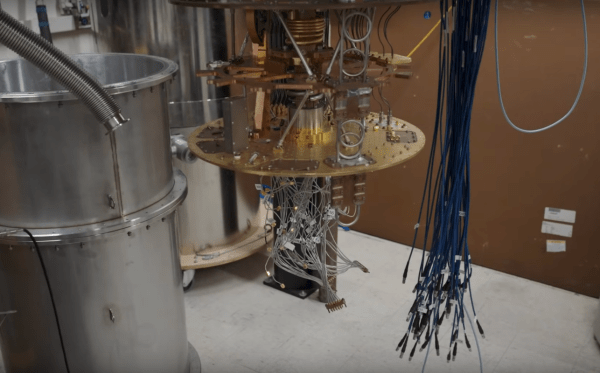
When cleaning out basements, garages, or storage units we often come across things long forgotten. Old clothes, toys, maybe a piece of exercise equipment, or even an old piece of furniture. [Ben] and [Hugh] were in a similar situation cleaning out an unused lab at the University of California Santa Barbara and happened upon an old refrigerator. This wasn’t just a mini fridge left over from a college dorm, though. This is a dilution refrigerator which is capable of cooling things down to near absolute zero, and these scientists are trying to get it to its former working state.

The pair are hoping to restore the equipment to perform dark matter experiments, but the refrigerator hasn’t been in use since about 2016 (and doesn’t have an instruction manual), which is a long time for a piece of specialty scientific equipment to be collecting dust. The first step is to remove wiring and clean it of all the grime it’s accumulated in the last decade. After that, the pair work to reassemble the layers of insulation around the main cooling plate and then hook up a vacuum pump to the device which also needed some repair work.

The critical step at this point is to evacuate the refrigerant lines so they can be filled with expensive Helium-3 and Helium-4. The problem is that there’s still some of this valuable gas in the lines that needs to be recovered, but the risk is that if any air gets into the cold section of the refrigerator it will freeze and clog the whole system. After chasing some other electrical and vacuum gremlins and discovering a manual from a similar refrigerator, they eventually get it up and running and ready for new scientific experiments. While most of us won’t discover a fridge like this cleaning out our attics, this refrigerator powered by rubber bands is a little more accessible to the rest of us.

Continue reading “Rebuilding A $700k Refrigerator”

Hackaday Links Column Banner

Hackaday Links: September 10, 2023

Most of us probably have a vision of how “The Robots” will eventually rise up and deal humanity out of the game. We’ve all seen that movie, of course, and know exactly what will happen when SkyNet becomes self-aware. But for those of you thinking we’ll get off relatively easy with a quick nuclear armageddon, we’re sorry to bear the news that AI seems to have other plans for us, at least if this report of dodgy AI-generated mushroom foraging manuals is any indication. It seems that Amazon is filled with publications these days that do a pretty good job of looking like they’re written by human subject matter experts, but are actually written by ChatGPT or similar tools. That may not be such a big deal when the subject matter concerns stamp collecting or needlepoint, but when it concerns differentiating edible fungi from toxic ones, that’s a different matter. The classic example is the Death Cap mushroom (Amanita phalloides) which varies quite a bit in identifying characteristics like color and size, enough so that it’s often tough for expert mycologists to tell it apart from its edible cousins. Trouble is, when half a Death Cap contains enough toxin to kill an adult human, the margin for error is much narrower than what AI is likely to include in a foraging manual. So maybe that’s AI’s grand plan for humanity — just give us all really bad advice and let Darwin take care of the rest.

Continue reading “Hackaday Links: September 10, 2023”

Hackaday Links Column Banner

Hackaday Links: January 8, 2023

Something odd is afoot in the mountains around Salt Lake City, Utah, at least according to local media reports of remote radio installations that have been popping up for at least the past year. The installations consist of a large-ish solar panel, a weatherproof box full of batteries — and presumably other electronics, including radios — and a mast bearing at least one antenna. Local officials aren’t quite sure who these remote setups belong to or what they’re intended to do, but the installations obviously represent a huge investment in resources.

The one featured in the story was located near the summit of Twin Peaks, which is about 11,000 feet (3,300 meters) in elevation, which with that much gear was probably a hell of a hike. Plus, the owner took great pains to make sure the site would withstand the weather, with antenna mast guy wires that must have required lugging a pretty big drill up with them. There aren’t any photos of the radios in the enclosure, but one photo shows a 900-MHz LORA antenna, while another shows what appears to be a panel antenna, perhaps pointing toward another site. So maybe a LORA mesh network? Some comments in the Twitter thread show most people are convinced this is a Helium crypto mining rig, but the Helium Explorer doesn’t show any hotspots listed in that area. Either way, the owners are out of luck, since their gear is being removed if it’s on public land.

Continue reading “Hackaday Links: January 8, 2023”

Mining And Refining: Helium

With a seemingly endless list of shortages of basic items trotted across newsfeeds on a daily basis, you’d be pardoned for not noticing any one shortage in particular. But in among the shortages of everything from eggs to fertilizers to sriracha sauce has been a growing realization that we may actually be running out of something so fundamental that it could have repercussions that will be felt across all aspects of our technological society: helium.

The degree to which helium is central to almost every aspect of daily life is hard to overstate. Helium’s unique properties, like the fact that it remains liquid at just a few degrees above absolute zero, contribute to its use in countless industrial processes. From leak detection and welding to silicon wafer production and cooling the superconducting magnets that make magnetic resonance imaging possible, helium has become entrenched in technology in a way that belies its relative scarcity.

But where does helium come from? As we’ll see, the second lightest element on the periodic table is not easy to come by, and considerable effort goes into extracting and purifying it enough for industrial use. While great strides are being made toward improved methods of extraction and the discovery of new deposits, for all practical purposes helium is a non-renewable resource for which there are no substitutes. So it pays to know a thing or two about how we get our hands on it.

Continue reading “Mining And Refining: Helium”

Helium Recovery System Saves Costs

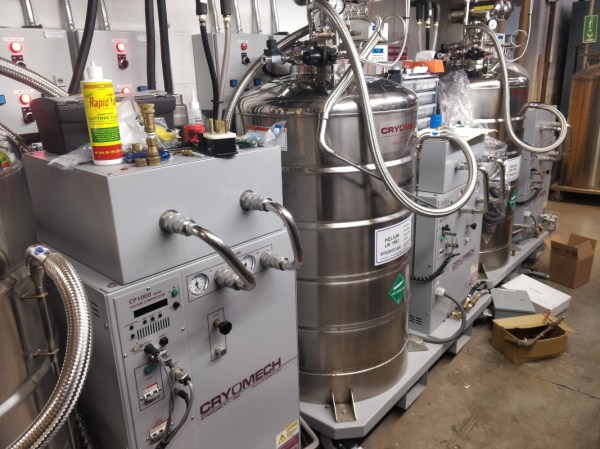
Helium is the most common element in the universe besides hydrogen, but despite this universal abundance it is surprisingly difficult to come across on Earth. Part of the problem is that it is non-renewable, so unless it is specifically captured during mining its low density means that it simply escapes the atmosphere. For that reason [Meow] maintains a helium recovery system for a lab which is detailed in this build.

The purpose of the system is to supply a refrigerant to other projects in the lab. Liquid helium is around 4 Kelvin and is useful across a wide variety of lab tests, but it is extremely expensive to come across. [Meow]’s recovery system is given gaseous helium recovered from these tests, and the equipment turns it back into extremely cold liquid helium in a closed-cycle process. The post outlines the system as a whole plus goes over some troubleshooting that they recently had to do, and shows off a lot of the specialized tools needed as well.

Low-weight gasses like these can be particularly difficult to deal with as well because their small atomic size means they can escape fittings, plumbing, and equipment quite easily compared to other gasses. As a result, this equipment is very specialized and worth a look. For a less lab-based helium project, though, head on over to this helium-filled guitar instead.