Tachometer Uses Light, Arduinos

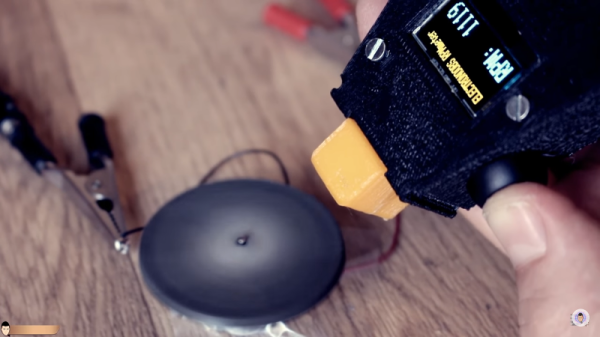
To measure how fast something spins, most of us will reach for a tachometer without thinking much about how it works. Tachometers are often found in cars to measure engine RPM, but handheld units can be used for measuring the speed of rotation for other things as well. While some have mechanical shafts that must make physical contact with whatever you’re trying to measure, [electronoobs] has created a contactless tachometer that uses infrared light to take RPM measurements instead.

The tool uses an infrared emitter/detector pair along with an op amp to sense revolution speed. The signal from the IR detector is passed through an op amp in order to improve the quality of the signal and then that is fed into an Arduino. The device also features an OLED screen and a fine-tuning potentiometer all within its own self-contained, 3D-printed case and is powered by a 9 V battery, and can measure up to 10,000 RPM.

The only downside to this design is that a piece of white tape needs to be applied to the subject in order to get the IR detector to work properly, but this is an acceptable tradeoff for not having to make physical contact with a high-speed rotating shaft. All of the schematics and G code are available on the project site too if you want to build your own, and if you’re curious as to what other tools Arduinos have been used in be sure to check out the Arduino-based precision jig.

Continue reading “Tachometer Uses Light, Arduinos”

Harvesting Energy From The Earth With Quantum Tunneling

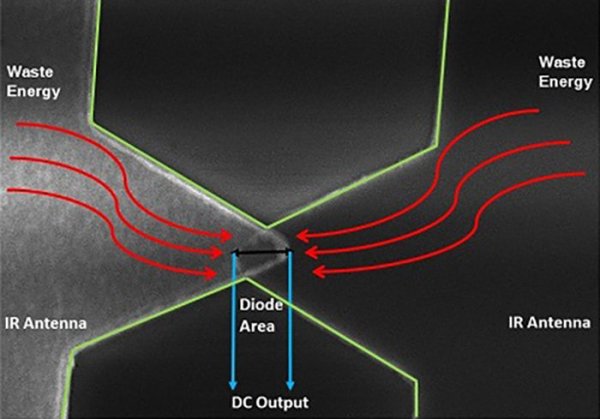
More energy hits the earth in sunlight every day than humanity could use in about 16,000 years or so, but that hasn’t stopped us from trying to tap into other sources of energy too. One source that shows promise is geothermal, but these methods have been hindered by large startup costs and other engineering challenges. A new way to tap into this energy source has been found however, which relies on capturing the infrared radiation that the Earth continuously gives off rather than digging large holes and using heat exchangers.

This energy is the thermal radiation that virtually everything gives off in some form or another. The challenge in harvesting this energy is that since the energy is in the infrared range, exceptionally tiny antennas are needed which will resonate at that frequency. It isn’t just fancy antennas, either; a new type of diode had to be manufactured which uses quantum tunneling to convert the energy into DC electricity.

While the scientists involved in this new concept point out that this is just a prototype at this point, it shows promise and could be a game-changer since it would allow clean energy to be harvested whenever needed, and wouldn’t rely on the prevailing weather. While many clean-energy-promising projects often seem like pipe dreams, we can’t say it’s the most unlikely candidate for future widespread adoption we’ve ever seen.

Your Audio Will Be Back, Right After This Commercial Break

[LittleTern] — annoyed by repetitive advertisements — wanted the ability to mute their Satellite Box for the duration of every commercial break. Attempts to crack their Satellite Box’s IR protocol went nowhere, so they thought — why not simply mute the TV?

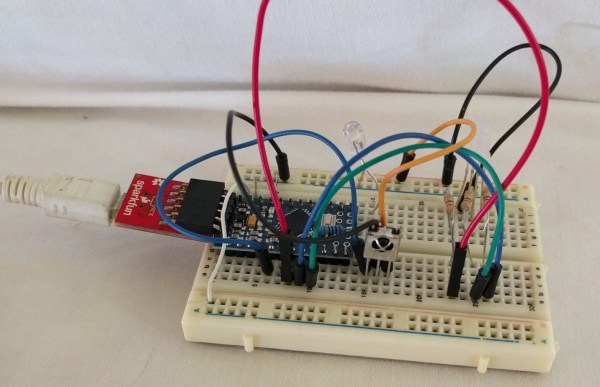
Briefly toying with the idea of a separate remote for the function, [LittleTern] discarded that option as quickly as one tends to lose an additional remote. Instead, they’re using the spare RGYB buttons on their Sony Bravia remote — cutting down on total remotes while still controlling the IR muting system. Each of the four coloured buttons normally don’t do much, so they’re set do different mute length timers — customized for the channel or time of day. The system that sends the code to the TV is an Arduino Pro Mini controlling an IR LED and receiver, with a status LED set to glow according to which button was pressed.

Continue reading “Your Audio Will Be Back, Right After This Commercial Break”

Play A Few Games Of Smash Brothers On The Go With A Portable Wii

How would you approach a build that required you to hack apart a perfectly good console motherboard? With aplomb and a strong finish. [jefflongo] from [BitBuilt.net] — a forum dedicated to making consoles portable — has finished just such a task, unveiling his version of a portable Wii to the world.

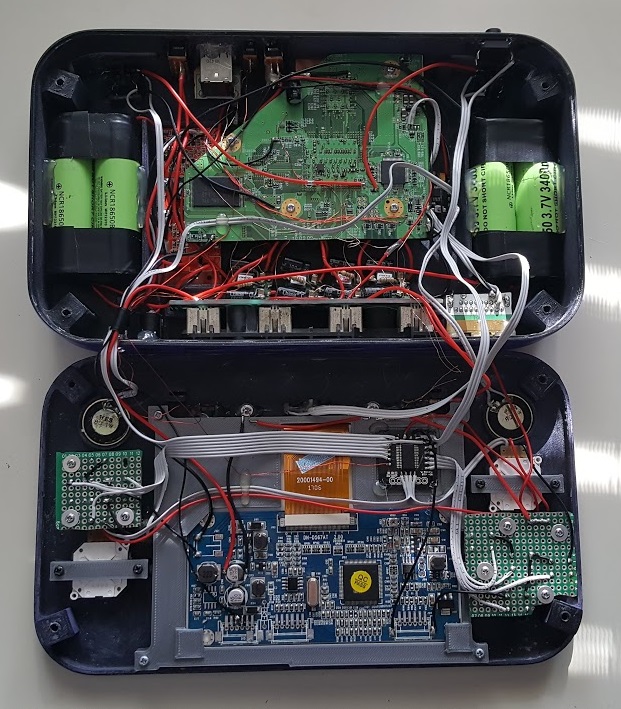
While this bears the general appearance of a portable GameCube, it’s what inside that counts. A heavily modified   Wii motherboard — to reduce size — forms this portable’s backbone, and it includes two infrared LEDs on its faceplate for Wii Remotes.  A single player can use the built-in controller, but [jefflongo] has included four GameCube controller ports for maximum multiplayer mayhem. Although he’ll likely plan on taking advantage of the built-in AV Out port to play on a TV and charge port for those extended gaming sessions, four 3400mAh batteries — with an estimated four hour battery life — should keep him satisfied on the go until he can recharge.

While the electronics display an impressive amount of work, but the final piece is a sight to behold. Check out the demo video after the break!

Continue reading “Play A Few Games Of Smash Brothers On The Go With A Portable Wii”

Cryptanalyse Your Air Con

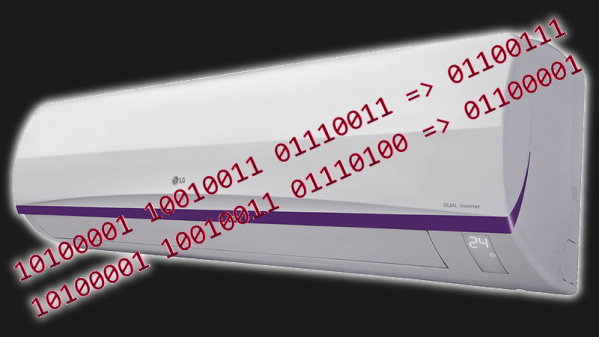
Infrared remote controls are simple and ubiquitous. Emulating them with the aid of a microcontroller is a common project that hackers use to control equipment as diverse as televisions, cable boxes, and home stereos. Some air conditioners can be a little more complicated, however, but [Ken]’s here to help.

The root of the problem is that the air conditioner remote was using a non-obvious checksum to verify if commands received were valid. To determine the function generating the checksum, [Ken] decided to bust out the tools of differential cryptanalysis. This involves carefully varying the input to a cryptographic function and comparing it to the differences in the output.

With 35 signals collected from the remote, a program was written to find input data that varied by just one bit. The checksum outputs were then compared to eventually put together the checksum function.

[Ken] notes that the function may not be 100% accurate, as they’re only using a limited sample of data in which not all the bytes change significantly. However, it shows that a methodical approach is valuable when approaching such projects.

Thirsty for more checksum-busting action? Check out this hacked weather station.

Mike Ossmann And Dominic Spill: IR, Pirates!

Mike Ossmann and Dominic Spill have been at the forefront of the recent wave of software-defined radio (SDR) hacking. Mike is the hardware guy, and his radio designs helped bring Bluetooth and ISM-band to the masses. Dominic is the software guy who makes sure that all this gear is actually usable. The HackRF SDR is still one of the best cheap choices if you need an SDR that can transmit and receive.

So what are these two doing on stage giving a talk about IR communication? Can you really turn traffic lights green by blinking lights? And can you spoof a TV remote with a cardboard cutout, a bicycle wheel, and a sparkler? What does IR have to do with pirates, and why are these two dressed up as buccaneers? Watch our video interview and find out, or watch the full talk for all of the juicy details.

Continue reading “Mike Ossmann And Dominic Spill: IR, Pirates!”

A Motion Sensing Light For Your Entrance Hallway

Arriving home to a dark house with an armful of anything is usually an exercise in fumbling confusion until someone manages to turn on a light. [Pavel Gesyuk] has circumvented this problem entirely by building and installing a motion detecting entrance light!

[Gesyuk] is using an Arduino clone by the name of  Funduino Mini Pro, a 2-channel, 2-way relay, — he only needed one, but you use what you have on hand — a recycled power supply to convert 220V AC to 5V DC, and an infrared sensor.

The project’s goal — in excess of a lighting solution for an entrance hallway — was the learn the ins and outs of the Arduino and motion sensors. After some initial hurdles familiarizing himself with the Arduino, [Gesyuk] wired everything together on a protoboard and stuck it in a plastic case — loose wires in a high traffic area doesn’t a safe home make.

Continue reading “A Motion Sensing Light For Your Entrance Hallway”