Berlin Clock Takes Inspiration From Sci-Fi Sources, Looks Incredible

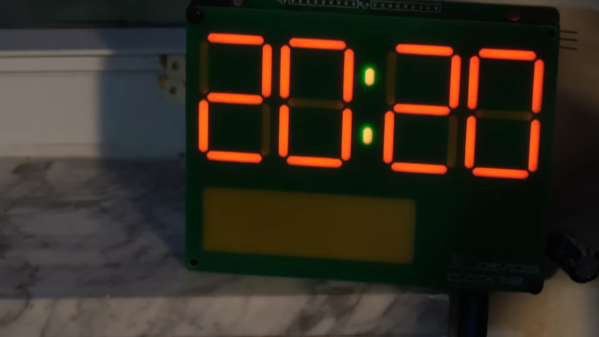
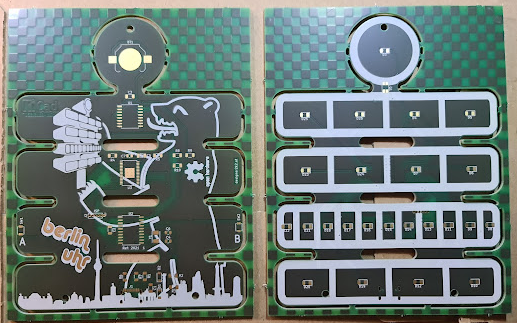
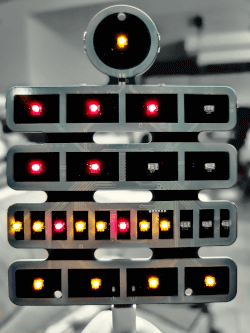
What would a HAL9000 look like if it eye were yellow and sat atop a front panel inspired by an Altair 8800? You’d have today’s feature, [Stephan]’s BerlinUhr, a gorgeous little take on a Berlin Clock.

At Hackaday, we have a soft spot for clock builds. They’ve graced our pages from early times. When we saw this ultra cool Berlin Clock, we couldn’t resist the urge to share it with all of our readers.  For those of you not familiar with a Berlin Clock, it’s a clock that consists of 24 lights, and was the first of its kind back in 1975.

[Stephan]’s build is notable because not only is it a beautiful design, but the work that went into the design and build. At several inches tall, the BerlinUhr is supported solely by a USB-C connection, although it can also be hung on a wall. The RTC is backed up by a CR1216, and an ATtiny167 provides the brains for the operation.

A neat part of the build comes with the KPS-3227 light sensor, used to adjust the LED brightness according to ambient lighting. Rather than being a straightforward part to insert into the PCB, KiCad’s footprint had some pins reversed, causing [Stephan] to learn how to correct it and contribute the fix to KiCad. Well done!

We weren’t kidding about clocks, by the way- check out the link to the Atomic Wrist Watch on this post from 2005, and this Russian VFD based clock from 2006- with video!

Do you have your own favorite clock build you’d love to see grace our pages? Be sure to submit a tip!

When Is An LED A Lamp? When It’s 50mm Wide

Call us childlike, but we sure do get a kick out of both larger-than-life and miniature things, especially when they work as their “normal-sized” counterparts do. So you can imagine our glee when we saw [JGJMatt]’s 50mm LED lamp, which looks like a giant version of something you might have wired up on your bench at any given moment — a bent-legged LED, wired up and ready to blink.

[JGJMatt] started by designing a mold in Fusion360 to make the lens, which he then printed in PLA. However, due to the heat generated by curing resin (especially all enclosed like that), he recommends using PETG or ABS instead to avoid any potential warping issues.

This is where things get a bit dangerous. For the internals, [JGJMatt] went all out, hand forming a reflector cup out of brass pipe, and the anode and cathode plates from flat 1 mm brass stock, plated to a silvery gray finish. The light source itself is a 1 W cool white LED that sits in the reflector cup, safe under a layer of epoxy mixed with a bit of yellow paint that represent the phosphor layer in a standard 5 mm white LED.

Once the innards were ready, it was time to cast the huge lens with them tucked safely inside. After the resin cured, [JGJMatt] sanded away the layer lines and airbrushed it with clear lacquer to clear up the lens and protect it from yellowing down the road. Then it was just a matter of bending the legs to form a stand, and wiring it up. What an awesome way to light up your workbench! Or anywhere, really.

This isn’t the first time we’ve seen a giant, working LED, though it’s probably only the second one since [Mike Szczys] saw some in the flesh at Maker Faire: Rome way back in 2019. Those are for sale on Tindie, BTW, though the shop is on holiday for the foreseeable, so you’ll have to make your own for now.

RGB 7-Segment Display Module Glows In All The Colours

While 7-segment displays are all well and good, they’re considered a bit old hat these days. This project from [Matt Deeds] brings them screaming into the future, though, sporting every color under the rainbow.

[Matt’s] build consists of a PCB filled with SK6812 side-mount LEDs, laid out in a typical 7-segment pattern. Each PCB features two 7-segment digits. The SK6812 LEDs can be driven in the same way as the famous WS2812B addressable LEDs, though they have the benefit of being more stable in color and brightness over a range of supply voltages.

With the LEDs installed, and a second PCB used solely as a diffuser by leaving out sections of solder mask, it’s a compact 7-segment solution at just 2.7 mm thick. The bonus is that each segment can be set to a different color thanks to the nature of the addressable RGB LEDs. Going too ham in this regard will make the displays difficult to read, but it can be used to easily display green, red, or yellow numbers, for example, to create a visual guide to a numerical range.

It’s a great build, and we love to see 7-segment displays re-imagined in different ways – even mechanically! It also takes fewer pins to drive compared to the old way of doing things in the non-addressable LED era. If you’ve got your own neat 7-segment projects under development, please do let us know!

1200 Addressable LEDs Make For The Perfect First Dance

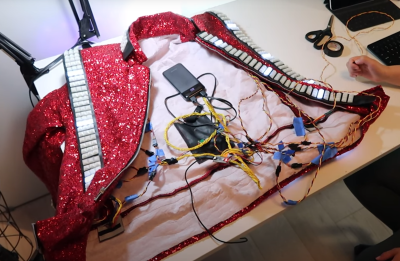
The first dance of a newly married couple at the wedding reception is both a sentimental and memorable event, so why not make it even more so with something a bit special? Hackaday alumnus [Brett Haddoak] and his wife [Rachelle] certainly achieved that, with 1200 addressable LEDs turning her wedding dress into a real-life reproduction of Princess Aurora’s color changing dress from Disney’s Sleeping Beauty.

Tradition dictates that a groom must not see the dress before the Big Day, thus the LEDs were fixed to a petticoat and bustier that go underneath. The design would need so many LEDs that it crossed the limit that an Arduino can address, thus there were two Arduinos to control the whole. Electronics and batteries were worn in a pair of polo shorts, and after some nail-biting moments involving flaky connections, the whole thing came to life. The result can be seen in the video below the break, and certainly comes with a significant wow factor!

We would like to wish the happy couple all the best for the future, and we hope that this won’t be their last such electronic collaboration. If you’re hungry for more, it’s not the first light-up wedding outfit we’ve brought you.

Continue reading “1200 Addressable LEDs Make For The Perfect First Dance”

Big Audio Visualizer Pumps With The Music

A spectrum analyzer is a great way to create exciting visuals that pulse in time with music. [pyrograf] wanted a big one as a display piece, so set about whipping up something of their very own.

An ESP32 microcontroller serves as the heart of the build, with its high clock rate and dual cores making it a highly capable choice for the job. Audio from a microphone is amplified and pumped into the ESP32’s analog input. Core 0 on the ESP32 then runs a Fast Fourier Transform on the input audio in order to determine the energy in each frequency band. The results of this FFT are then passed to Core 1, which is used to calculate the required animations and pipe them out to a series of WS2812B LEDs.

Where this build really shines, though, is in the actual construction. Big chunks of acrylic serve as diffusers for the LEDs which light up each segment of the spectrum display. Combine the big pixel size with a nice smooth 30 Hz refresh rate on the LEDs, and the result is a rather large spectrum analyzer that really does look the business.

We’ve seen some similar builds over the years, too. Video after the break.

Continue reading “Big Audio Visualizer Pumps With The Music”

TWANG32 Brings LED Strip Gaming To The ESP32

Under the Hackaday TV is a modern game console, it’s a well-known model that many of you also probably have, and its main feature is a 3D accelerator which allows it to create the beautifully rendered worlds we’ve all come to know and love. [Mircemk] eschews such fripperies with the Twang project, because it’s a game that’s not 3D, nor 2D, but 1D. The display, indeed the entire gaming surface, is a single strip of addressable LEDs which can be seen int he video below the break.

Behind it all is an ESP32, and a unique one-dimensional joystick using an accelerometer. There’s an audio channel with a little piezoelectric speaker too, and the LED strip is a particularly high-density one from DFRobot. Because this is an ESP32-driven device it has WiFi, upon which is exposed an access point for a network over which is served the game stats as a web page. It may not displace that modern console, but it’s certainly inventive.

Long-time Hackaday readers will be aware that this is only the latest of a long line of one-dimensional games, including a 1D take on the famous PONG.

Continue reading TWANG32 Brings LED Strip Gaming To The ESP32″

The LED tree itself , filmed in the dark - a myriad of small orbs glowing mictures of green, blue and warm white

Kaleidoscope – Feelings Turned Into LED Tree

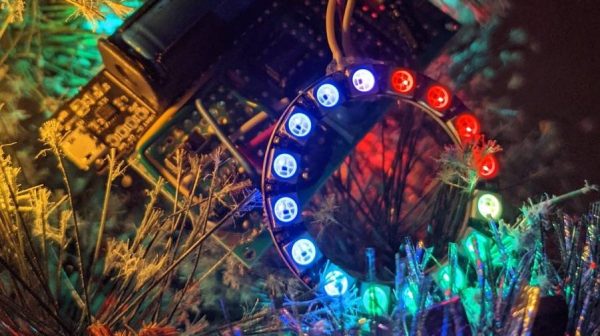
In 2020, [Eddie] found himself with a few hundred RGB LEDs left after a pandemic-interrupted project, and a slew of emotions he wanted to express – so he turned to the language of hardware, and started sculpting his feelings into an art project. He set out to build an LED tree around a piece of wood he picked for its cool shape, and trying out a long-shelved idea of his, while at it – using different resistors to mix colors of the RGB LEDs. The end result, pictured above, has earned “The Most Important Device” spot in our recent Sci-Fi contest, fair and square.

Initially, he wanted to use ATTiny microcontrollers and PWM all the lights in parallel. Having built an intermediate prototype, a small LED flower, he scrapped the idea due to technical problems, and then simplified it by hard-wiring RGB LEDs with randomly selected colors instead. As for the glowing orbs themselves, he made these just by pouring hot glue into silicon orb molds, a simple technique any of us could repeat. After 90 hours of work between him and an assistant he hired, the LEDs were wired up, each with random resistors connected to green and blue LED colors, and some warm white LEDs added into the mix.

He wanted to mostly use blue and green colors, as symbols of a world revived and revitalized – something we can’t help but keep our fingers crossed for. Before putting it all together, they wouldn’t know which colors each of the LEDs would power up in – part of the charm for this art piece, and no doubt a pleasant surprise. In the end, it turned out to be a futuristic decoration that we’re glad a camera could capture properly! If you like what you see, the build logs linked above have a bit more insights into how it all came together.

LED-adorned plants are fun projects that bring joy for a long time after you’ve finished them. You can easily make a LED tree out of what you have on hand, and if you get real fancy, you can create an intricate bonsai, too. And, if you’re ever interested to experiment with castellations, you can design yourself some PCB cube flowers!

This project was an entry into the 2022 Sci-Fi Contest. Check out all of the winning entries here.