Hackaday Links Column Banner

Hackaday Links: March 21, 2021

If you think you’re having a bad day at work, pity the poor sysadmin at Victoria University of Wellington in Australia New Zealand, who accidentally nuked the desktops of pretty much everyone at the university. This apparently happened last week and impacted everyone connected to the university network with a Windows machine, which had any files stored on their desktops deleted and also appears to have reset user profiles to the default state. This caused no end of consternation, especially among those who use their desktop folder to organize work in progress; we’d imagine more than one student at VUW is hating life right now for not storing work on a backed-up network drive. The problem seems to have started with an attempt to clean up files and profiles left behind by former students; how that escalated to nuking files on the desktop will require some ‘splaining.

Speaking of mea culpas, there was quite a dustup this week in the Cricut community. It started when the maker of CNC cutting machines announced its intention to limit uploads to their online design software unless the user signs up for a $10 a month account. After getting an earful from the users, the CEO of the company announced that these changes would be delayed until the end of 2021. That decision still didn’t sit well with the community, which includes a fair number of users designing PCBs, and two days later, the CEO announced that they were throwing in the towel on the whole plan, and that everything was going back to status quo ante. Story over? We’ll see — it seems like Cricut has tipped its hand here that they’re looking to extract more money from the users, and the need for that likely hasn’t gone away just because they relented. As Elliot Williams pointed out when we discussed the whole debacle, it’s easy to see how Cricut could start adding new features to the paid version of their software, basically abandoning the free user base. We’ll have to see how the obviously vociferous community responds to something like that.

Much interesting news from Mars this week, where the Perseverance rover is getting used to its new home and getting itself ready to roll. Late last week, Perseverance successfully dropped the “belly pan” that was covering the sensitive instruments under the rover, including the Adaptive Sample Caching system that will seal up Martian core samples and drop them out onto the surface for later pickup. This seemingly simple task was a critical one; had the pan not cleanly separated, the mission could have been severely impacted. Perseverance also did a little test drive this week, and recorded what it sounds like to drive on Mars. The audio clip is 16 minutes long, and the noises coming from the billion-dollar rover are just awful at times. We hear clunks and clanks and squeals galore, and while we’re sure they all have a good explanation and will provide valuable engineering data, they sound somewhat alarming to us.

But not so alarming as the sounds that must have come from a Jeep that suffered a bad tow job recently. The cringe-making story starts with a brand-new Jeep being towed on its wheels behind a motorhome, which allows the RV owners to park their rig and still have something to drive around in while they camp. The towed vehicle, or “pusher”, is normally equipped with a manual transmission, as towing with the wheels on the ground for extended distances is easier with them. Unfortunately, the Jeep’s owner set up the shift levers wrong and left the transmission in first gear, with the transfer case in low range. The linked article estimates the gearing ratios meant that the poor Jeep’s engine was being spun at something like 54,000 RPM; chances are good the engine exploded long before that point. The damage shown in the video accompanying the article is just brutal — the oil pan and bell housing are gone, the bottom of the crankcase is blown out, and at least two pistons and their share of the crankshaft are missing in action. We feel sorry for the owner, but really wish the Jeep had had a belly cam like the one on Perseverance.
Amazing STARGᐰTE With DHD And Infinity Mirror Wormhole

The Stargate Universe franchise has spawned numerous movies, serials, books, comics and games since 1994, and has been a favorite among science fiction fans. Prop makers and hackers often try building their own Stargate replica – the Einstein–Rosen bridge portal that allows almost instantaneous travel between two distant locations. Building an authentic looking prop requires a lot of attention to detail, and [Kristian]’s The Stargate Project is an amazingly well built rendition of the portal.

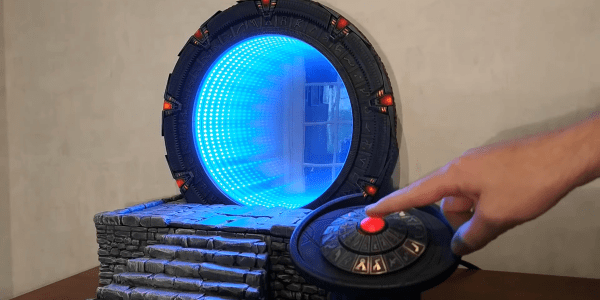
[Kristian]’s Stargate is mostly 3D printed and features a symbol ring, with chevrons that lock and light up when engaged. When the correct address has been dialled in, the wormhole is established, via an infinity mirror effect that uses 122 RGB LEDs. The Dial Home Device (DHD) is a replica of the original pedestal shaped computer, with two concentric sets of 19 buttons and a central activation button.

The Stargate ring is assembled from multiple 3D printed in sections, and measures 390 mm across. The seven Chevrons move along 3D printed rack-and-pinion gears, driven by geared micro-motors. The symbol ring is driven by a separate NEMA14 stepper motor. A Raspberry Pi with three piggy backed motor hats controls the various motors and LEDs. A USB sound card and a powered speaker provide audio effects while dialling. Once a worm hole is established, random audio snippets are played. The wormhole is maintained for 38 minutes, after which the Stargate powers down.

The Dial Home Device is built around a custom, circular PCB which holds the keypad buttons, LEDs and an ATmega 32u4 micro-controller which connects to the Raspberry Pi via USB. The 39 LEDs are APA102C’s so they only need two GPIO pins. For the keyboard, four banks of nine buttons and another bank of three are connected via a resistive ladder to the analog GPIO’s. This allows all 39 buttons to be connected via five analog inputs and was probably done to simplify PCB track layout. The back lit button key caps were printed in two parts. The translucent bases are covered with the opaque symbol caps.

Making a prop like this look like the real deal requires a lot of effort in painting the various parts, and this shows in [Kristian]’s final result, right down to the stone platform on which the Stargate sits. The one improvement we would like to see is a wireless DHD, just like it’s supposed to be. Doing so shouldn’t be too difficult, and losing the USB tether between the Stargate and its DHD would be a great upgrade to this amazing project. Check out the videos after the break, and there are many more on [Kristian]’s project page.

And if you are a fan of the franchise, then the amazingly Droolworthy Animatronic Stargate Horus Helmet is an excellent companion project to this Stargate.

Continue reading “Amazing STARGᐰTE With DHD And Infinity Mirror Wormhole”

Circuit Impedance Calculations Without Cumbersome Simulations

Using circuit simulating software like SPICE can be a powerful tool for modeling the behavior of a circuit in the real world. On the other hand, it’s not always necessary to have all of the features of SPICE available all the time, and these programs tend to be quite expensive as well. To that end, [Wes Hileman] noticed an opportunity for a specific, quick method for performing impedance calculations using python without bulky, expensive software and came up with a program which he calls fastZ.

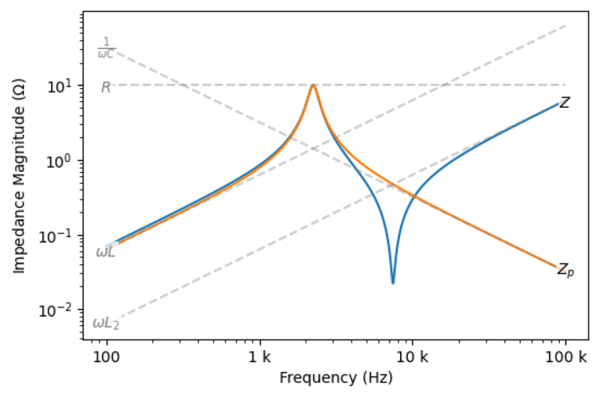
The software works on any network of passive components (resistors, capacitors, and inductors) and the user can specify parallel and series connections using special operators. Not only can the program calculate the combined impedance but it can perform frequency analysis at a specified frequency or graph the frequency response over a wide range of frequencies. It’s also running in python which makes it as simple as importing any other python package, and is also easy to implement in any other python program compared to building a simulation and hoping for the best.

If you find yourself regularly drawing Bode plots or trying to cobble together a circuit simulation to work with your python code, this sort of solution is a great way to save a lot of headache. It is possible to get the a piece of software like SPICE to to work together with other python programs though, often with some pretty interesting results.

Steam Engine Replica From LEGO

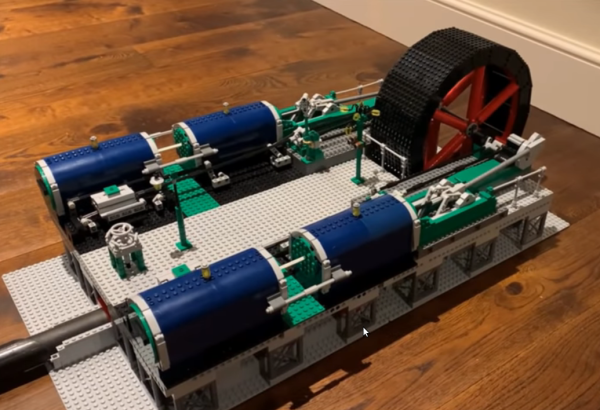
If engineering choices a hundred years ago had been only slightly different, we could have ended up in a world full of steam engines rather than internal combustion engines. For now, though, steam engines are limited to a few niche applications and, of course, models built by enthusiasts. This one for example is built entirely in LEGO as a scale replica of a steam engine originally produced in 1907.

The model is based on a 2500 horsepower triple-expansion four-cylinder engine that was actually in use during the first half of the 20th century. Since the model is built using nothing but LEGO (and a few rubber bands) it operates using a vacuum rather than with working steam, but the principle is essentially the same. It also includes Corliss valves, a technology from c.1850 that used rotating valves and improved steam engine efficiency dramatically for the time.

This build is an impressive recreation of the original machine, and can even run at extremely slow speeds thanks to a working valve on the top,  allowing its operation to be viewed in detail. Maximum speed is about 80 rpm, very close to the original machine’s 68 rpm operational speed. If you’d prefer your steam engines to have real-world applications, though, make sure to check out this steam-powered lawnmower.

Thanks to [Hari] for the tip!

Continue reading “Steam Engine Replica From LEGO”

Movie Magic Hack Chat

Join us on Wednesday, January 20th at noon Pacific for the Movie Magic Hack Chat with Alan McFarland!

If they were magically transported ahead in time, the moviegoers of the past would likely not know what to make of our modern CGI-driven epics, with physically impossible feats performed in landscapes that never existed. But for as computationally complex as movies have become, it’s the rare film that doesn’t still need at least some old-school movie magic, like hand props, physical models, and other practical effects.

To make their vision come to life, especially in science fiction films, filmmakers turn to artists who specialize in practical effects. We’ve all seen their work, which in many cases involves turning ordinary household objects into yet-to-be-invented technology, or creating scale models of spaceships and alien landscapes. But to really sell these effects, adding a dash of electronics can really make the difference.

Enter Alan McFarland, an electronics designer and engineer for the film industry. With a background in cinematography, electronics, and embedded systems, he has been able to produce effects in movies we’ve all seen. He designed electroluminescent wearables for Tron: Legacy, built the lighting system for the miniature Fhloston Paradise in The Fifth Element, and worked on the Borg costumes for Star Trek: First Contact. He has tons of experience making the imaginary look real, and he’ll join us on the Hack Chat to discuss the tricks he keeps in his practical effects toolkit to make movie magic.

https://www.youtube.com/watch?v=e13S0SenmPQ

join-hack-chatOur Hack Chats are live community events in the Hackaday.io Hack Chat group messaging. This week we’ll be sitting down on Wednesday, January 20 at 12:00 PM Pacific time. If time zones have you tied up, we have a handy time zone converter.

Click that speech bubble to the right, and you’ll be taken directly to the Hack Chat group on Hackaday.io. You don’t have to wait until Wednesday; join whenever you want and you can see what the community is talking about.

Continue reading “Movie Magic Hack Chat”

Cardboard Models Trace Design Process Of Vintage Tektronix Miniscopes

There aren’t many brands that inspire the kind of passion and fervency among its customers as Tektronix does. The venerable Oregon-based manufacturer of top-end test equipment has produced more collectible gear over the last 75 years than just about anyone else.

Over that time they have had plenty of innovations, and in the 1970s they started looking into miniaturizing their flagship oscilloscopes. The vintageTEK museum, run by current and former employees, has a review of the design process of the 200 series of portable oscilloscopes that’s really interesting. At a time when scopes were portable in the way a packed suitcase is portable, making a useful instrument in a pocketable form factor was quite a challenge — even for big pockets.

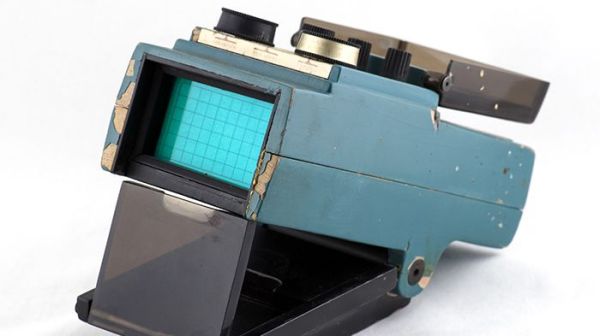
The article goes into great detail on the back-and-forth between the industrial designers, with their endless stream of models, and the engineers who would actually have to stuff a working scope into whatever case they came up with. The models from the museum’s collection are wonderful bits of history and show where the industrial designers really pushed for some innovative designs.

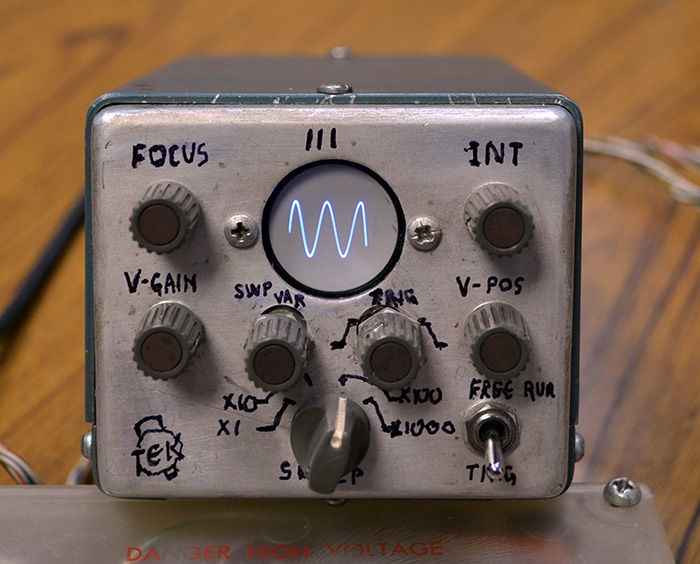
Some of the models are clearly derived from the design of the big bench scopes, but some have innovative flip-down covers and other interesting elements that never made it to production. Most of the models are cardboard, but some were made of aluminum in the machine shop and sport the familiar “Tek blue” livery. But the pièce de résistance of the collection is a working engineering model of what would become the 200-series of miniscopes, a handmade prototype with a tiny round CRT and crudely labeled controls.

The vintageTEK museum sounds like another bucket-list stop for computer and technology history buffs. Tek has been doing things their own way for a long time, and stopping by the museum is sure to be a treat.

Thanks to [Tanner Bass] for the tip.

Falcon 9 Lamp Is Touching Down In The Living Room

Many of us have been inspired by the videos of the Falcon 9 booster, tall as an office building, riding a pillar of flame down to a pinpoint landing at Kennedy Space Center or on one of SpaceX’s floating landing pads in the ocean. It’s not often that we get to see science fiction fantasy become reality on such a short timescale, and while they might not be sold on the practicality of reusable rockets, even the most skeptical of observers have to admit it’s an incredible feat of engineering.

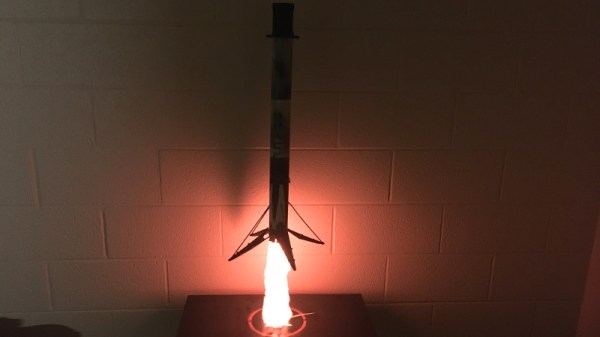
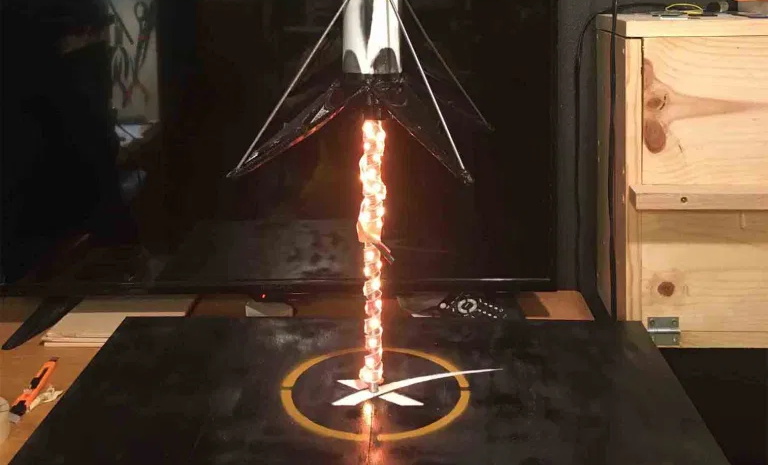
Though it can’t quite compare to the real thing, this 1:60 scale Falcon 9 lamp by [Sir Michael II] promises to bring a little of that excitement home every time you flick on the light. Combining a scratch built model of the reusable booster with some RGB LEDs, the hovering tableau recreates the tense final seconds before the towering rocket comes to a rest on its deployable landing legs. We imagine those last moments must seem like an eternity for the SpaceX engineers watching from home as well.

The LED “exhaust” without the fluff.

[Michael] walks readers through assembling the Falcon 9 model, which cleverly uses a 2 inch white PVC pipe as the fuselage. After all, why waste the time and material printing a long white cylinder when you can just buy one at the hardware store for a few bucks?

Dressed up with 3D printed details from Thingiverse user [twuelfing] and splashed with a bit of paint, it makes for a very convincing model. While the diameter of the pipe isn’t quite right for the claimed 1:60 scale, unless Elon Musk is coming over your place to hang out, we don’t think anyone will notice.

The rocket is attached to the pad with a piece of threaded steel rod, around which [Michael] has wrapped one meter of RGB LEDs controlled by an Arduino Uno. With some polyester fiber filler as a diffuser and a bit of code to get the LEDs flickering, he’s able to produce a realistic “flame” that looks to be coming from the Falcon 9’s center engine. While we admit it may not make a very good lamp in the traditional sense, it certainly gets extra points for style.

We’ve actually seen a similar trick used before to light up the engines of a LEGO Saturn V and Apollo Lunar Module. It’s amazing how realistic the effect can be, and we’d love to see it used more often. We’d also like to see more model rockets that actually levitate over their pads, but one step at a time.