This Pinball Game Doesn’t Come In A Box… It Is The Box

Pinball still has that bit of magic that makes it stand out from first person shooters or those screen mashers eating up your time on the bus. The secret sauce is that sense of movement and feedback, and the loss of control as the ball makes its way through the play field under the power of gravity. Of course the real problem is finding a pinball machine. Pinbox 3000 is swooping in to fix that in a creative way. It’s a cardboard pinball machine that you build and decorate yourself.

We ran into them at Maker Faire New York over the weekend and the booth was packed with kids and adults all mashing flippers to keep a marble in play. The kit comes as flat-pack cardboard already scored and printed with guides for assembly which takes about an hour.

The design is quite clever, with materials limited to just cardboard, rubber bands, and a few plastic rivets. Both the plunger that launches the pinball and the flippers are surprisingly robust. They stand up to a lot of force and from the models on display it seems the friction points of cardboard-on-cardboard are the issue, rather than mechanisms buckling under the force exerted by the player.
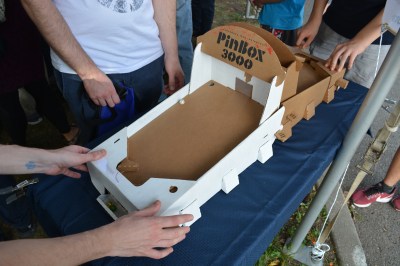
When first assembled the playfield is blank. That didn’t stop the fun for this set of kits stacked back to back for player vs. player action. There’s a hole at the top of playfields which makes this feel a bit like playing Pong in real life. However, where the kit really shines is in customizing your own game. In effect you’re setting up the most creative marble run you can imagine. This task was well demonstrated with cardboard, molded plastic packaging (which is normally landfill) cleverly placed, plus some noisemakers and lighting effects. The company has been working to gather up inspiration and examples for building out the machines. We love the multiple layers of engagement rolled into Pinbox, from building the stock kit, to fleshing out a playfield, and even to adding your own electronics for things like audio effects.

Check out the video below to see the fun being had at the Maker Faire booth.

Continue reading “This Pinball Game Doesn’t Come In A Box… It Is The Box”
Mademoiselle Pinball Table Gets Rock ‘n Roll Makeover

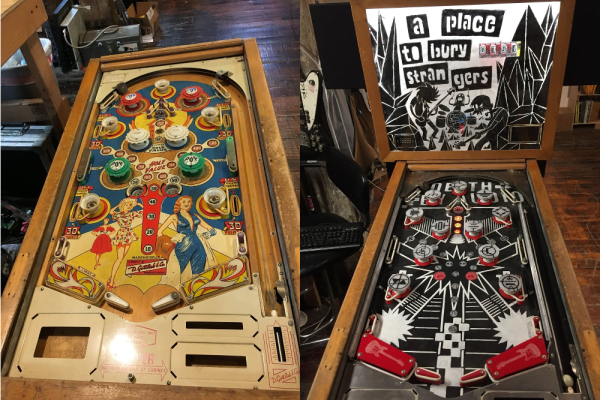
Once upon a time, there was a music venue/artist collective/effects pedal company that helped redefine industry in Williamsburg, Brooklyn. That place was called Death By Audio. In 2014, it suffered a death by gentrification when Vice Media bought the building that DBA had worked so hard to transform. From the ashes rose the Death By Audio Arcade, which showcases DIY pinball cabinets made by indie artists.

Their most recent creation is called A Place To Bury Strangers (APTBS). It’s built on a 1959 Gottlieb Mademoiselle table and themed around a local noise/shoegaze band of the same name that was deeply connected to Death By Audio. According to [Mark Kleeb], this table is an homage to APTBS’s whiz-bang pinball-like performance style of total sensory overload. Hardly a sense is spared when playing this table, which features strobe lights, black lights, video and audio clips of APTBS, and a fog machine. Yeah.

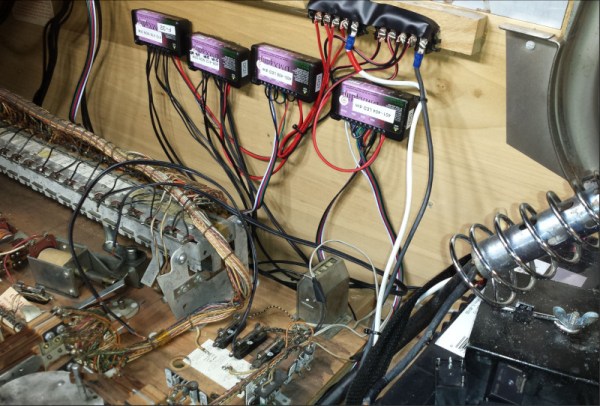
[Mark] picked up this project from a friend, who had already cut some wires and started hacking on it. Nearly every bit of the table’s guts had to be upgraded with OEM parts or else replaced entirely. Now there’s a Teensy running the bumpers, and another Teensy on the switches. An Arduino drives the NeoPixel strips that light up the playfield, and a second Uno displays the score on those sweet VFD tubes. All four micros are tied together with Python and a Raspi 3.

If you’re anywhere near NYC, you can play the glow-in-the-dark ball yourself on July 15th at Le Poisson Rouge. If not, don’t flip—just nudge that break to see her in action. Did we mention there’s a strobe light? Consider yourself warned.

Want to get into DIY pinball on a smaller scale? Build yourself a sandbox and start playing.

Continue reading “Mademoiselle Pinball Table Gets Rock ‘n Roll Makeover”

Pinball Wizard Hacks Table For Tommy Stage Show

Ever since he was a young hacker
[Mark Gibson] has messed with the silver ball.
From Soho down to Denver
he must have fixed them all.
But we ain’t seen anything like this
in any amusement hall.
That darn devious hacker
sure hacks a mean pinball.

He hacks it like an expert,
Becomes part of the machine
Automating all the bumpers
Always wiring clean
His table plays by automation,
And radio control for all
That darn devious hacker
sure hacks a mean pinball.

Continue reading “Pinball Wizard Hacks Table For Tommy Stage Show”

Tiny Pinball Emulator Is Hugely Impressive

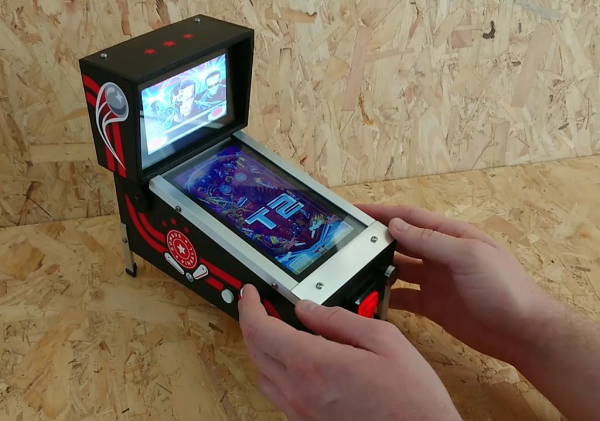
We were wondering what [Circuitbeard] has been up to lately. Turns out he’s been building a mini pinball cabinet to add to his arcade of self-built games.

[Circuitbeard] was forced to break out of his Raspi comfort zone this time. We’re glad he did because this is one impressive build. Finding the pinball emulation community lacking for Linux, he turned to the LattePanda, a tiny Windows 10 SBC with a built-in Arduino Leonardo. This was really the perfect board because he needed to support multiple displays with a minimum of fuss. That Leonardo comes in handy for converting button presses to key presses inside the Visual Pinball emulator.

The 3mm laser-cut plywood cabinet was designed entirely in Inkscape and sized around the two screens: a genuine 7″ LattePanda display for the playfield, and a 5″ HDMI for the back glass. The main box holds the Lattepanda, two Pimoroni mini speakers, and a fan to keep the board cool.

There’s a lot to like about this little cabinet thanks to [Circuitbeard]’s fantastic attention to detail, which you can see for yourself in the slew of pictures. Look closer at the coin drop—it’s really an illuminated button with a custom graphic. If you want to have a go at emulating this emulator, all the code is up on GitHub. Tilt past the break to watch some modern pinball wizardry in action, and then check out his mini Outrun machine.

If pinball emulators don’t score any points with you, here’s one that’s all wood and rubber bands.

Continue reading “Tiny Pinball Emulator Is Hugely Impressive”

Cat Plays The Silver Ball For Treats

It’s pretty easy to train a dog to do things for treats. They’re eager to please. But a cat? Most cats have better things to do than learn tricks no matter how many treats are involved. But if you make an autonomous game out of learning a trick, they just might go for it.

That’s the idea behind Touchy Fishy, a pinball machine for cats. It’s the newest iteration of treat-dispensing machines that [Kim] made for his cat, MIDI. The previous version was shaped like a dog’s head with a joystick for a nose. MIDI was so adept at pulling the joystick toward herself that [Kim] decided to try a new design using a lever.

Humans like challenges, too, and [Kim] wanted to make something purely mechanical this time around. The final product is mostly springs and laser-cut acrylic. MIDI pulls the spring-loaded lever downward, launching a pinball upward in an arc. At the top of its trajectory is a spinner enclosed in a circle. When the pinball hits the spinner, it sweeps a treat toward an opening, and the treat falls down where MIDI can eat it. The best part? The spinner also returns the captive pinball to its starting point, so MIDI can play until [Kim] gets tired of dropping treats into the hole. Watch MIDI claw her way to the high score after the break.

Most of the cat-related projects we’ve seen were built to keep hungry cats from sitting on their owner’s chests at 3AM, demanding to be fed. Here’s one that goes a step further by putting the cat to work collecting wiffle balls which it uses to pay for small amounts of kibble.

Continue reading “Cat Plays The Silver Ball For Treats”

A Sandbox For DIY Pinball Design

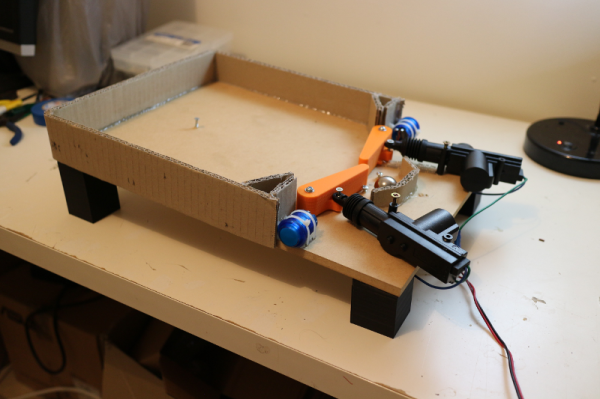
If you’ve always wanted to build your own pinball machine but have no idea where to start, this is the project for you. [Chris] is in the process of building a 3/4 size pinball table and is currently in the waiting-for-parts stage. As they arrive, he is testing them in a sandbox he built in an afternoon. Let [Chris]’s proving ground be your quick-start guide to all the ways you could approach the two most important parts of any pin: the flippers and targets.

The field of play is a sturdy piece of particle board, and the cardboard walls are attached with hot glue. [Chris] designed and printed a pair of flippers that are driven by some cheap remote door lock motors he found at a popular online auction house. You can see how snappy are in the test video after the break.

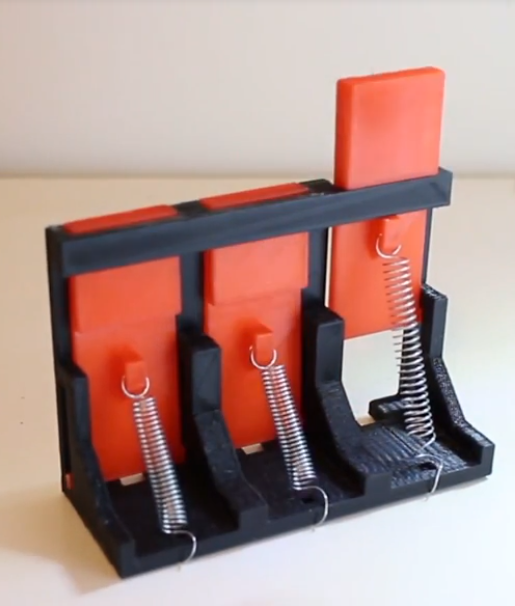
We love the crisp action and elegant simplicity of the spring-loaded drop targets [Chris] designed. Right now he resets them manually, but soon they will be reset by a solenoid or maybe a motor. We can’t wait to see how the table turns out. In the meantime, we’ll have to go back to drooling over this amazing life-size 3D-printed pinball machine.

Continue reading “A Sandbox For DIY Pinball Design”

Antique Pinball Machine Lives As Clock

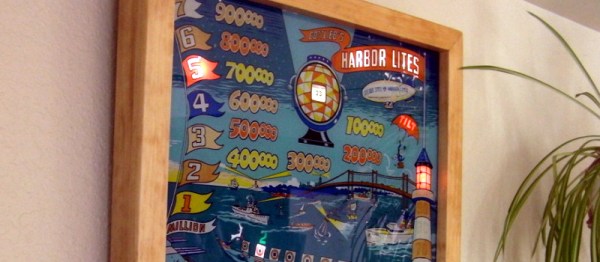
A big problem with restoring old arcade or pinball machines is finding original parts to get them running again. That’s part of the fun, though; when something finally works after weeks or months of effort. On the other hand, sometimes the only hope for old parts that will never be in a pinball machine again is for [Randy] to come across them. One of those parts he had lying around was a backglass for an old machine, and decided to turn it into a unique word clock.

The original pinball machine was built in 1956, and despite its age the backglass had almost no signs of wear or damage. There are 43 lights on this particular machine which is more than enough for 12 hours, minutes (by the 10s), seconds, and a few extras. An ATtiny85 serves as the controller and drives a fleet of Neopixels hidden in the display. There are also three buttons which control the brightness and allow the time to be set.

Be sure to check out the video below of this one-of-a-kind clock in action. A lot more went into this build as well including framing the glass, giving it a coat of paint and polish, and programming the clock into the microcontroller. Old backglasses from pinball machines seem to be relatively popular to repurpose into more conventional clocks, too, even clocks of an atomic nature.

Continue reading “Antique Pinball Machine Lives As Clock”