Vintage Gauges Turned Classy Weather Display

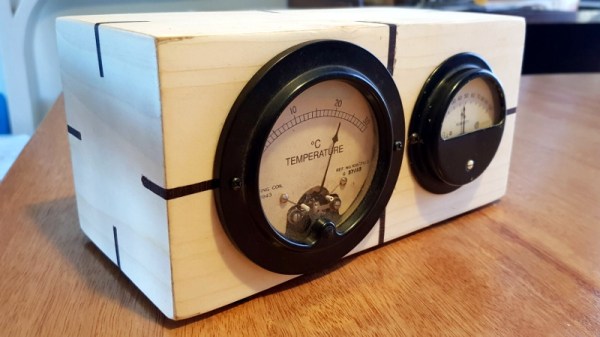
It’s always good to see old hardware saved from the junk pile, especially when the end result is as impressive as this analog gauge weather display put together by [Build Comics]. It ended up being a truly multidisciplinary project, combing not only restoration work and modern microcontroller trickery, but a dash of woodworking for good measure.
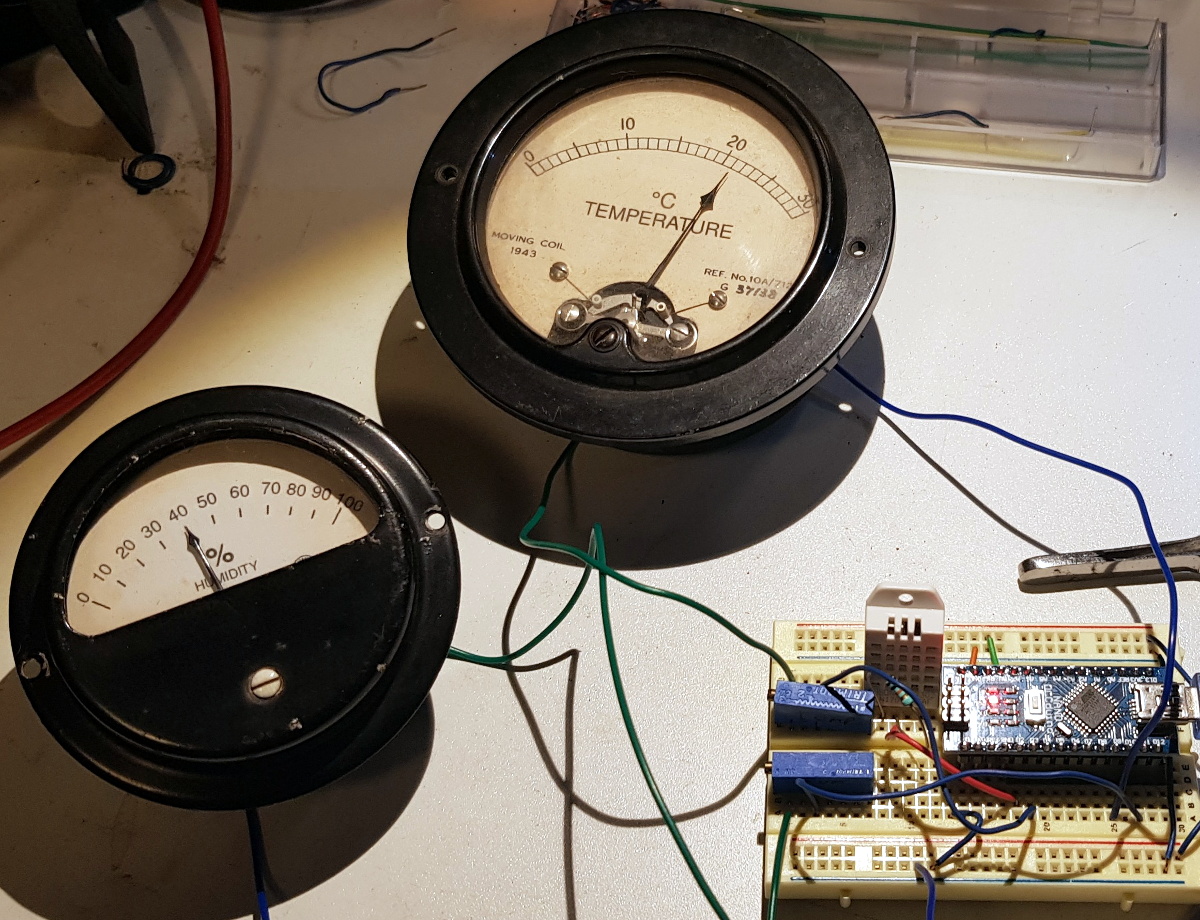
Naturally, the gauges themselves are the real stars of the show. They started out with rusted internals and broken glass, but parts from a sacrificial donor and some TLC from [Build Comics] got them back in working order. We especially like the effort that was put into making the scale markings look authentic, with scans of the originals modified in GIMP to indicate temperature and humidity while retaining the period appropriate details.

To drive the 1940s era indicators, [Build Comics] is using an Arduino Nano and a DHT22 sensor that can detect temperature and humidity. A couple of trimmer pots are included for fine tuning the gauges, and everything is mounted to a small scrap of perfboard hidden inside of the custom-made pine enclosure.

This is hardly the first time we’ve seen analog gauges hooked up to modern electronics, but most of the projects are just that: modern. While the end look might be somewhat polarizing, we think maintaining the hardware’s classic style was the right call.
Reliving Heathkit’s Glory Days Through A Teardown And Rebuild

In its heyday, the experience offered by the Heath Company was second to none. Every step of the way, from picking something out of the Heathkit catalog to unpacking all the parts to final assembly and testing, putting together a Heathkit project was as good as it got.

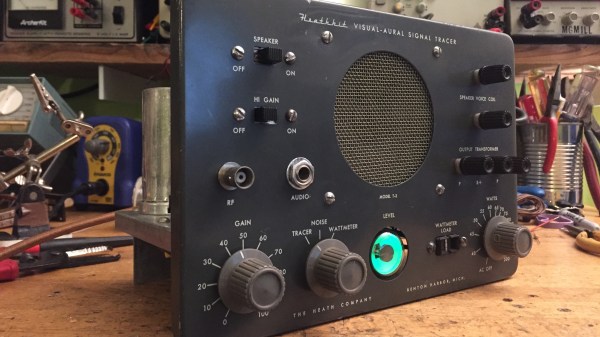
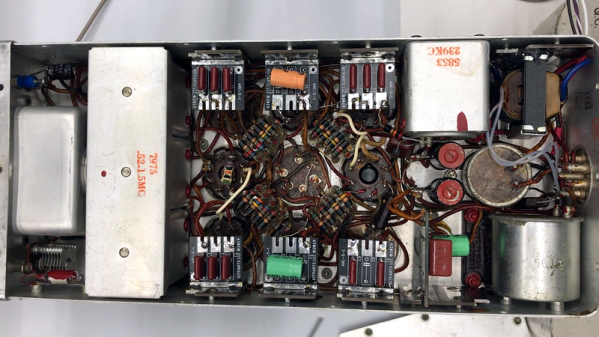
Sadly, those days are gone, and the few remaining unbuilt kits are firmly in the unobtanium realm. But that doesn’t mean you can’t tear down and completely rebuild a Heathkit project to get a little taste of what the original experience was like. [Paul Carbone] chose a T-3 Visual-Aural signal tracer, a common enough piece that’s easy to find on eBay at a price mere mortals can afford. His unit was in pretty good shape, especially for something that was probably built in the early 1960s. [Paul] decided that instead of the usual recapping, he’d go all the way and replace every component with fresh ones. That proved easier said than done; things have changed a lot in five decades, and resistors are a lot smaller than they used to be. Finding hookup wire to match the original was also challenging, as was disemboweling some of the electrolytic cans so they could be recapped. The finished product is beautiful, though — even the Magic Eye tube works — and [Paul] reports that the noise level is so low he wasn’t sure if turned it on at first.

We’ve covered the rise and fall of Heathkit, as well as their many attempted comebacks, including an inexplicable solder-free radio and the “world’s most reliable” clock. Looking at these offerings, we think [Paul] may be onto something here.

Antique Army Surplus Receiver Restored

If you’ve ever been to a hamfest in the United States, you probably have at least seen an ARC 5 Command set. These were very rugged receivers and there were a ton of them made. Hams have been reworking them for years. In a recent video [Tom N3LLL] shared some of his tips for restoring them.

You might think these are just like a regular old radio, but there are some unique challenges, including capacitors filled with beeswax and strange threaded screws. [Tom] made several custom boards to replace the dynamotor with a solid-state inverter, replace odd capacitors, and provided a faceplate. He also 3D printed some replacement studs to replace the often decayed anti-vibration studs for the dynamotor.

The teardown at the end shows how rugged these things are. Tom’s restoration philosophy is to modernize the set while keeping the outward aesthetics. The receivers perform well, and as you might expect are built like tanks.

If you want to try your hand at restoration, these are not very expensive because there were so many of them made. Often the shipping is about the same price as the radio, but one in good shape can cost a bit more. We think the real fun is getting one that is not in such good shape and making it better.

Everyone has their own style and we know some restorers are more purists, but as a practical matter, [Tom’s] restorations look great, sound great, and preserve these great old radios so that someone might still be using them in another 75 years.

We’ve covered the ARC 5 before, unsurprisingly, and that restoration was a bit more traditional if you prefer it that way. If you need something to listen to on the AM band, try a matching transmitter.

Continue reading “Antique Army Surplus Receiver Restored”

Hacking Apollo Hack Chat

Join us on Wednesday, April 22 at noon Pacific for the Hacking Apollo Hack Chat with “CuriousMarc” VerdiellKen ShirriffMike Stewart, and Carl Claunch!

When President Kennedy laid down the gauntlet to a generation of scientists and engineers to land a man on the Moon before the close of the 1960s, he likely had little idea what he was putting in motion. The mission was dauntingly complex, the science was untested, and the engineering was largely untried. Almost everything had to be built from scratch, and entire industries were born just from the technologies that had to be invented to make the dream come true.

Chief among these new fields was computer science, which was barely in its infancy when the 1960s started. By the end of the decade and the close of the Space Race, computers had gone from room-filling, power-guzzling machines to something compact and capable enough to fly men to the Moon and back. The computers that followed all built on the innovations that came about as a result of Apollo, and investigating the computers of the era and finding out what made them tick is an important part of our technological culture.

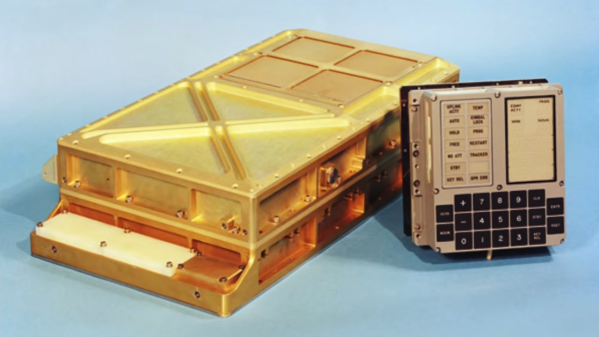
That’s where this retrocomputing dream team came into play. Together, they’ve poked and prodded at every bit of hardware from the Space Race era they could find, including a genuine Apollo Guidance Computer (AGC) that was rescued from the trash. What’s more, they actually managed to restore it to working condition with a series of epic hacks and sheer force of will.

Marc, Ken, Mike, and Carl will stop by the Hack Chat to talk about everything that went into getting the AGC working again, along with anything else that pops up. Come ready to have your Apollo-era hardware itches scratched by the people who’ve been inside a lot of it, and who have seen first-hand what it took to make it to the Moon and back.

join-hack-chatOur Hack Chats are live community events in the Hackaday.io Hack Chat group messaging. This week we’ll be sitting down on Wednesday, April 22 at 12:00 PM Pacific time. If time zones have got you down, we have a handy time zone converter.

Click that speech bubble to the right, and you’ll be taken directly to the Hack Chat group on Hackaday.io. You don’t have to wait until Wednesday; join whenever you want and you can see what the community is talking about.

Continue reading “Hacking Apollo Hack Chat”

’54 Motorcycle Saved By Electric Conversion

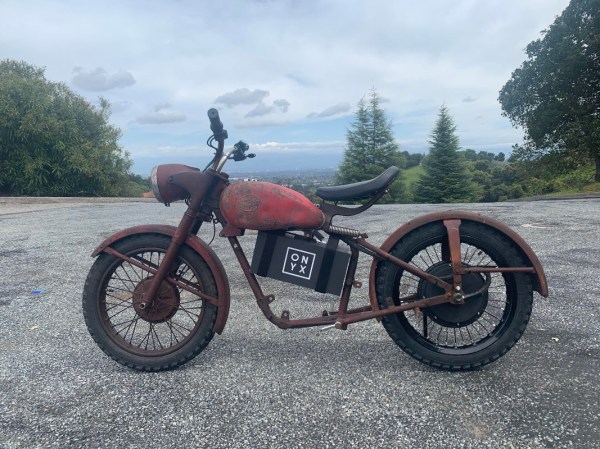
While it’s nice to be able to fully restore something vintage to its original glory, this is not always possible. There might not be replacement parts available, the economics of restoring it may not make sense, or the damage to parts of it might be too severe. [onyxmember] aka [Minimember Customs] was in this position with an old ’54 Puch Allstate motorcycle frame that he found with no engine, rusty fuel tank, and some other problems, so he did the next best thing to a full restoration. He converted it to electric.

This build uses as much of the original motorcycle frame as possible and [onyxmember] made the choice not to weld anything extra to it. The fuel tank was cut open and as much rust was cleaned from it as possible to make room for the motor controller and other electronics. A hub motor was laced to the rear wheel, and a modern horn and headlight were retrofitted into the original headlight casing. Besides the switches, throttle, and voltmeter, everything else looks original except, of course, the enormous 72V battery hanging off the frame where the engine used to be.

At a power consumption of somewhere between three and five kilowatts, [onyxmember] reports that this bike likely gets somewhere in the range of 55 mph, although he can’t know for sure because it doesn’t have a speedometer. It’s the best use of an old motorcycle frame we can think of, and we also like the ratrod look, but you don’t necessarily need to modify a classic bike for this. A regular dirt bike frame will do just fine.

Continue reading “’54 Motorcycle Saved By Electric Conversion”

Restoring A Dead Commodore 128DCR

Another day, another retro computer lovingly restored to like-new condition by [Drygol]. This time, the subject of his attention is a Commodore 128DCR that earned every bit of the “For Parts, Not Working” condition it was listed under. From a spider infestation to a cracked power supply PCB, this computer was in quite a state. But in the end he got the three decade old machine back in working condition and even managed to teach it a few new tricks along the way.

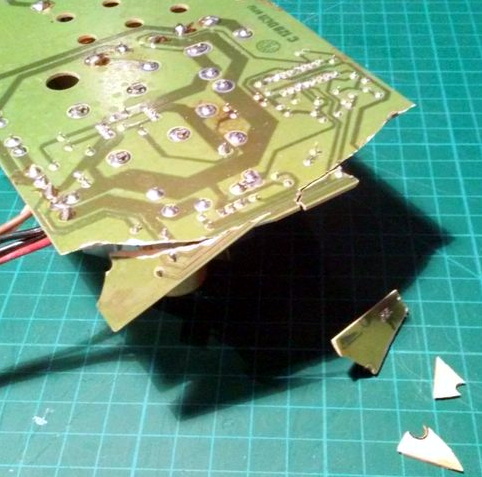
Obviously the shattered PSU was the most pressing issue with the Commodore. Interestingly, the machine still had its warranty seal in place on the back, so whatever happened to this PSU seems to have occurred without human intervention.

Rather than just replacing the PSU, [Drygol] first pieced the board back together with the help of cyanoacrylate glue, and then coated the top with an epoxy resin to give it some mechanical strength. On the back side the traces were either repaired or replaced entirely with jumper wires where the damage was too severe.

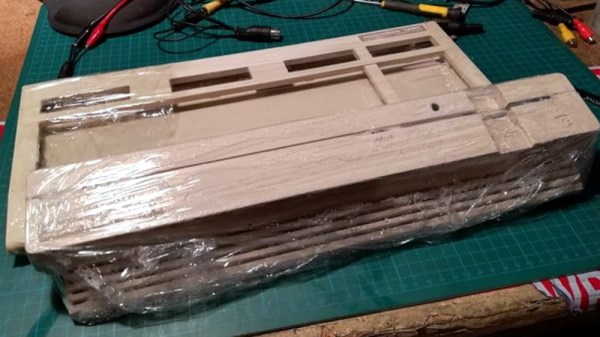
With the PSU repaired and tested, he moved on to cleaning the computer’s main board and whitening all the plastic external components. Even the individual keycaps took a bath to get them looking like new again. This put the computer in about as close to like-new condition as it could get.

But why stop there? He next installed the JiffyDOS modification to improve system performance, and wired in an adapter that lets the computer output a crisp 80 columns over S-Video. It’s safe to say this particular Commodore is in better shape now than it was when it rolled off the assembly line.

While an impressive enough final result, this is still fairly tame for [Drygol]. If you want to see a real challenge, take a look at the insane amount of work that went into recreating this smashed Atari 800XL case.

Amstrad Portable Gets A Modern LCD Transplant

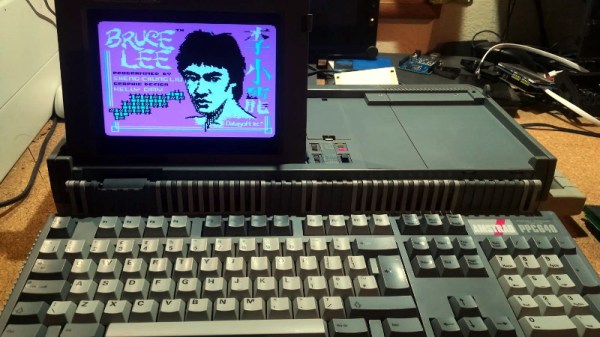
Playing classic games on the real hardware is an experience many of us enjoy, but sometimes the hardware is just a bit too retro for modern sensibilities. A case in point is the miserable monochrome LCD that was originally installed in the Amstrad PPC640 portable 8086 PC that [Drygol] recently picked up. He decided that his portable Amstrad sessions would be far more enjoyable if he swapped it out for a display that didn’t have 30+ years on the clock.

To quell the complaints of any of the vintage hardware aficionados out there, it’s worth mentioning that the original LCD was actually damaged and needed to be replaced anyway. Granted [Drygol] could have tried to find a contemporary panel to replace it with, but looking at the incredible before and after shots of the modded PPC640, it’s hard to argue he didn’t make the right decision by throwing a modern display into the otherwise largely original computer.

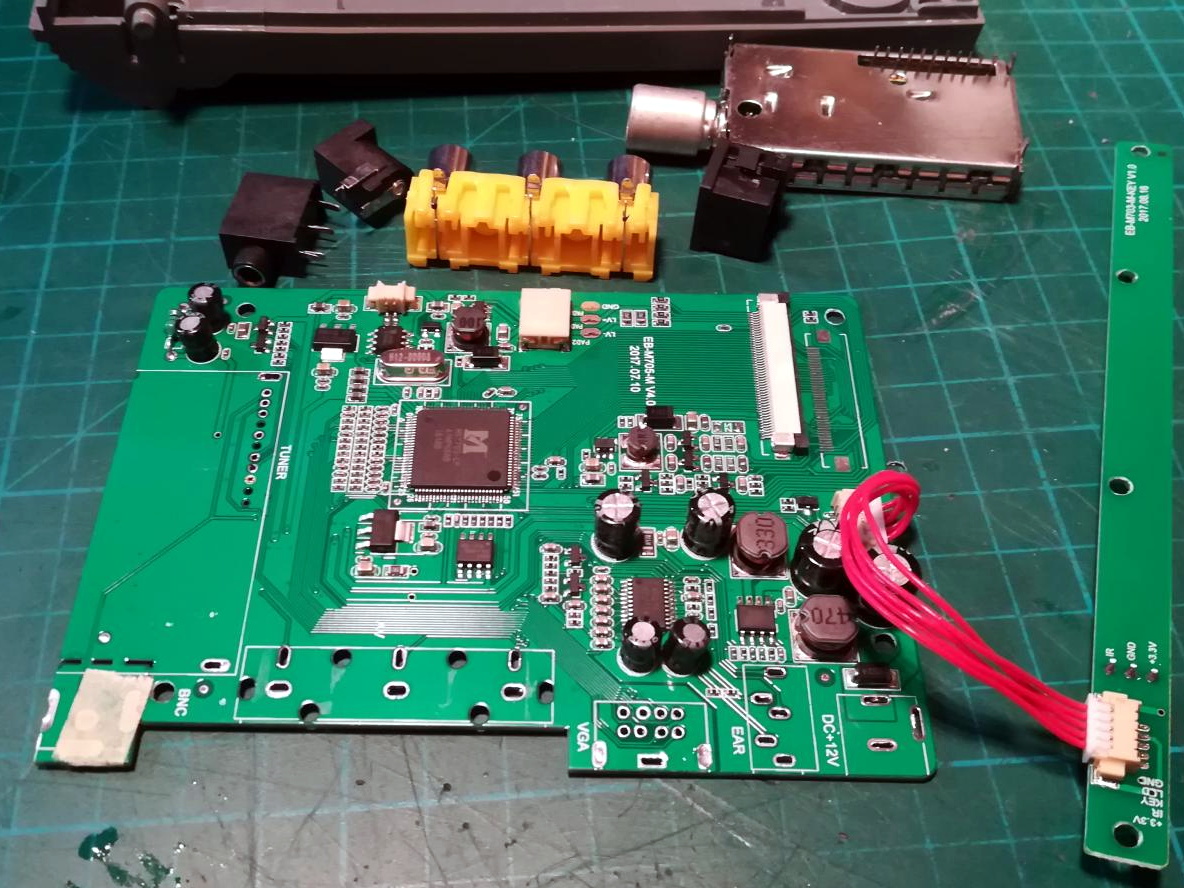
Getting the new LCD’s PCB ready for installation.

[Drygol] says he picked up a cheap 4:3 LCD TV on eBay, and as luck would have it, found that the new panel dropped perfectly into the original frame. Getting it buttoned back up required the removal of the RF can and all the female connections on the TV’s PCB, plus he had to cut some holes in the back of the display enclosure to mount the LCD’s controls, but overall it looks very stock.

Of course, getting the new LCD display in the original frame was only half the battle, it still needs to be connected up to the computer somehow. To get everyone playing nicely with each other, [Drygol] is using a commercially available MDA/CGA/EGA to VGA converter that is installed where the batteries would have gone originally. Wired to the PPC640’s external monitor connector, it allows him to drive the new display without having to use the original LCD interface.

[Drygol] has made something of a name for himself by performing some of the most impressive restorations and modifications of retro hardware in recent memory. From the unbelievable work that went into repairing a smashed Atari 800XL case to his gorgeous custom Amiga A500, his projects are sure to please the retro hardware lovers in the audience.

Continue reading “Amstrad Portable Gets A Modern LCD Transplant”