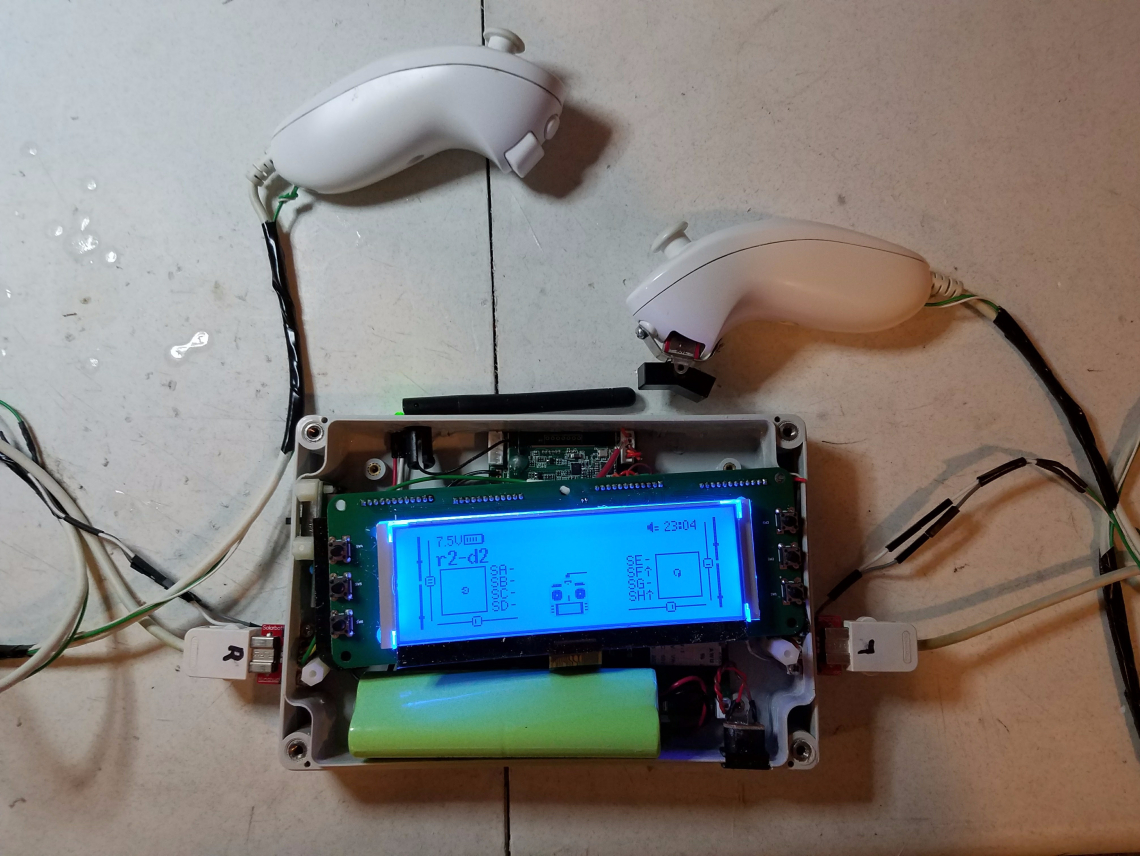
Who loves a good R2-D2 robot? Everyone, but especially young Star Wars fans who — frustratingly — have no problem spotting a controller and spoiling the illusion of an R2 unit brought to life. [Bithead942]’s concealed his R2-D2’s remote and re-establishes the illusion of an autonomous droid — no Jedi mind-tricks necessary.
[Bithead942] prefers to accompany his droid in traditional a Rebel Alliance pilot’s suit, so that gives him a bit of extra space under the jumpsuit to help conceal the controller. Dismantling a Frsky Taranis X9D controller, [Bithead942] meditated on how to use it while so concealed. In a stroke of insight, he thought of his unused Wiimote nunchucks, and launched into the build.
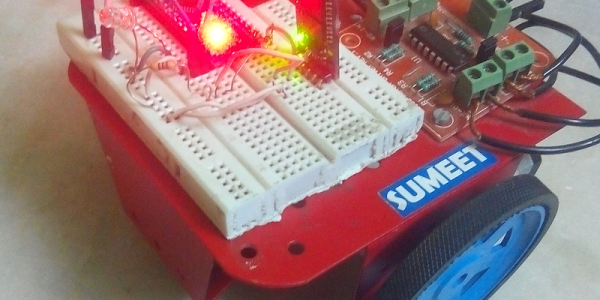
Remote control robots are nothing new. Using Bluetooth isn’t all that unusual, either. What [SayantanM4] did was make a Bluetooth robot that accepts voice commands via his phone. The robot itself isn’t very remarkable. An Arduino and an HC05 module make up most of the electronics. A standard motor driver runs the two wheels.
The Arduino doesn’t usually do much voice processing, and the trick is–of course–in the phone application. BT Voice Control for Arduino is a free download that simply sends strings to a host computer via Bluetooth. If you say “Hello” into your phone, the robot receives *Hello# and that string could be processed by any computer that can receive Bluetooth data.
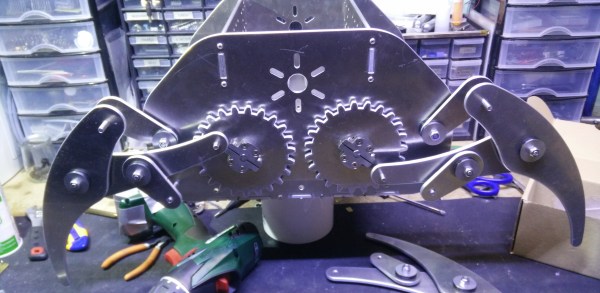
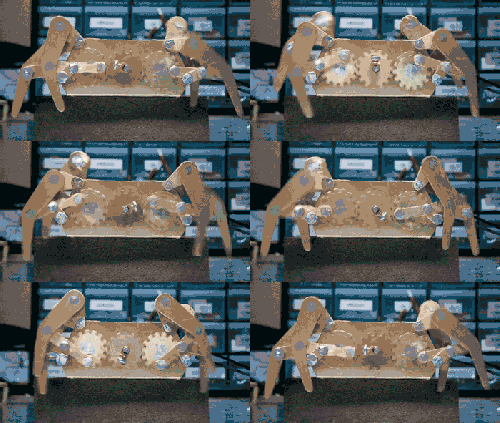
Walkers like the Strandbeest are favorites due in part to their smooth design and fluid motion, but [Leandro] is going a slightly different way with Octo, an octopodal platform for exploring rough terrain. Octo is based on the Klann linkage which was developed in 1994 and intended to act as an alternative to wheels because of its ability to deal with rough terrain. [Leandro] made a small proof of concept out of soldered brass and liked the results. The next version will be larger, made out of aluminum and steel, and capable of carrying a payload.
The Strandbeest and Octo have a lot in common but differ in a few significant ways. Jansen’s linkage (which the Strandbeest uses) uses eight links per leg and requires relatively flat terrain. The Klann linkage used by Octo needs only six links per leg, and has the ability to deal with rougher ground.
[Leandro] didn’t just cut some parts out from a file found online; the brass proof of concept was drawn up based on an animation of a Klann linkage. For the next version, [Leandro] used a simulator to determine an optimal linkage design, aiming for one with a gait that wasn’t too flat, and maximized vertical rise of the leg to aid in clearing obstacles.
We’ve seen the Klann linkage before in a LEGO Spider-bot. We’re delighted to see [Leandro]’s Octo in the ring for the Wheels, wings, and walkers category of The Hackaday Prize.
As often happens while engaged in a mundane task, my mind wandered while I was mowing my small suburban plot of green this weekend. “Why, in 2017, am I still mowing the lawn?” In a lot of ways we’re living in the future — we walk around with fantastically powerful computers in our pockets, some of us have semi-autonomous cars, and almost anything can be purchased at the touch of a finger and delivered the next day or sooner. We even have robots that can vacuum the floor, so why not a robot lawnmower?
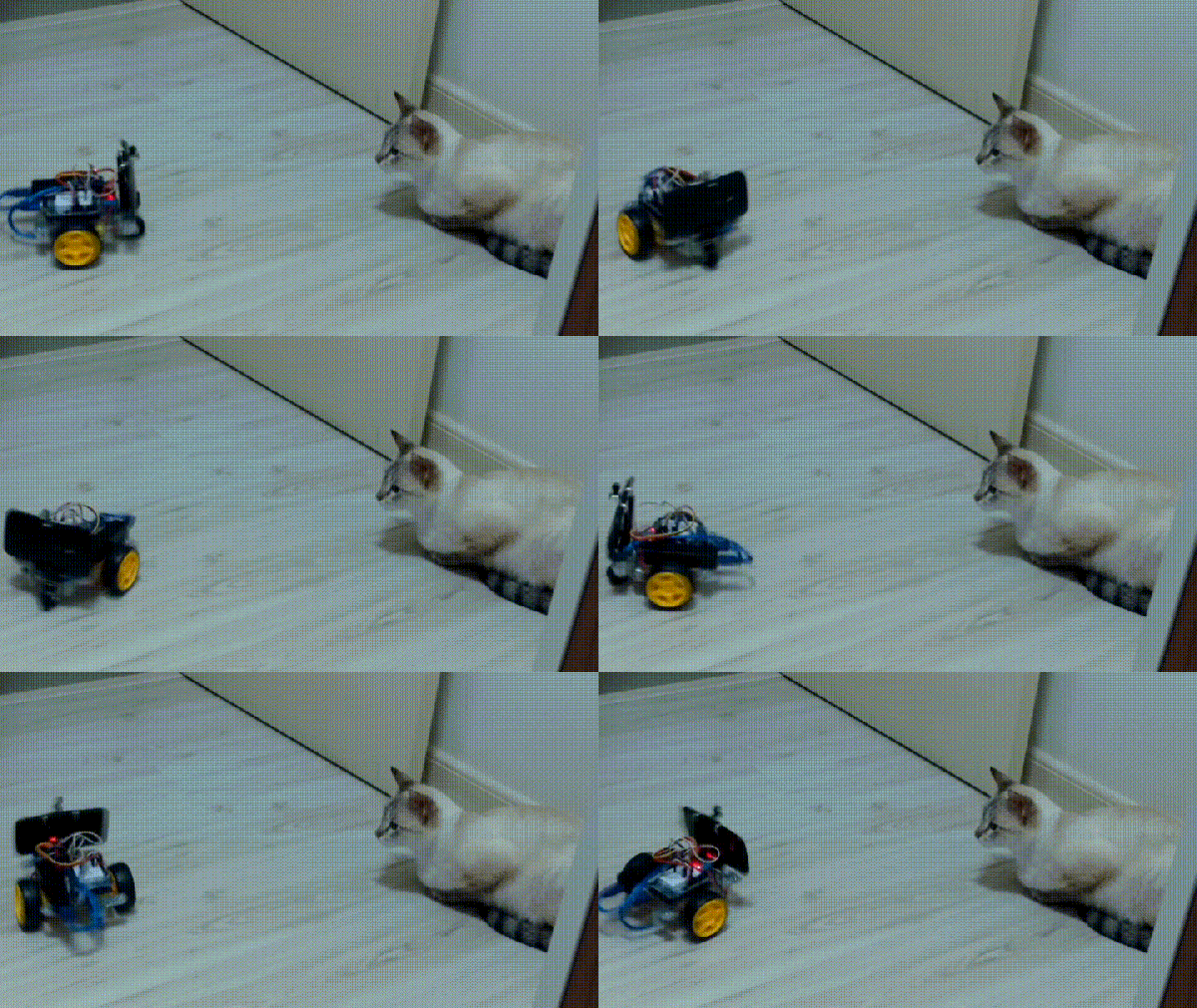
A good robot is always welcome around here at Hackaday, and Hackaday.io user [igorfonseca83]’browser-controlled ‘bot s is no exception. Felines beware.
[igorfonseca83] — building on another project he’s involved in — used simple materials for the robot itself, but you could use just about anything. His goal for this build was to maximize accessibility in terms of components and construction using common tools.
An Arduino Uno gets two D/C motors a-driving using an H-bridge circuit — granting independent control the wheels — an ESP8266 enabling WiFi access, with power provided by a simple 5V USB power bank. [igorfonseca83] is using an Android smartphone to transmit audio and video data; though this was mostly for convenience on his part, a Raspberry Pi and camera module combo as another great option!
Space is a mess, and the sad truth is, we made it that way. Most satellites that have been lofted into Earth orbit didn’t have a plan for retiring them, and those dead hulks, along with the various bits of jetsam in the form of shrouds, fairings, and at least one astronaut’s glove, are becoming a problem.
A mission intended to clean up space junk would be fantastically expensive, but money isn’t the only problem. It turns out that it’s really hard to grab objects in space unless they were specifically designed to be grabbed. Suction cups won’t work in the vacuum of space, not everything up there is ferromagnetic, and mechanical grippers would have to deal with a huge variety of shapes, sizes, and textures.
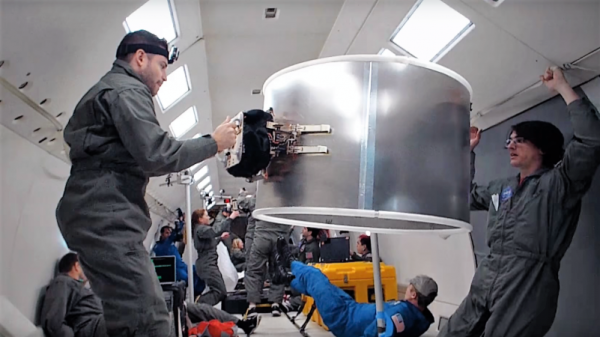
But now news comes from Stanford University of a dry adhesive based on the same principle a gecko uses to walk up a wall. Gecko feet have microscopic flaps that stick to surfaces because of Van der Waals forces. [Mark Cutkosky] and his team’s adhesive works similarly, adhering to surfaces only when applied in a certain direction. This is an advantage over traditional pressure-sensitive adhesives; the force needed to apply them would cause the object to float away in space. The Stanford grippers have been tested on the “vomit comet” and aboard the ISS.
We can think of tons of terrestrial applications for this adhesive, including the obvious wall-walking robots. The Stanford team also lists landing pads for drones that would let then perch in odd locations, which we find intriguing.
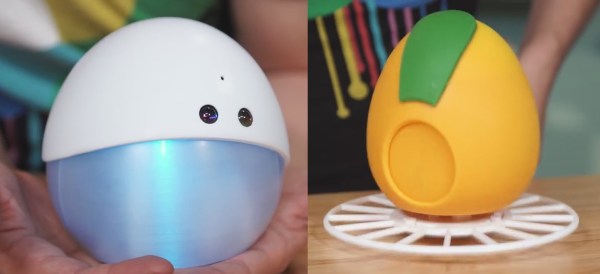
[Alonso Martinez] is an artist working on virtual characters at Pixar so it’s no wonder that his real life robots, Mira and Gertie, have personalities that make them seem like they jumped straight out of a Pixar movie. But what we really like are the tricks he’s used inside to bring them to life that are sure to get reused for the same or other things.
Mira’s head rotation mechanism
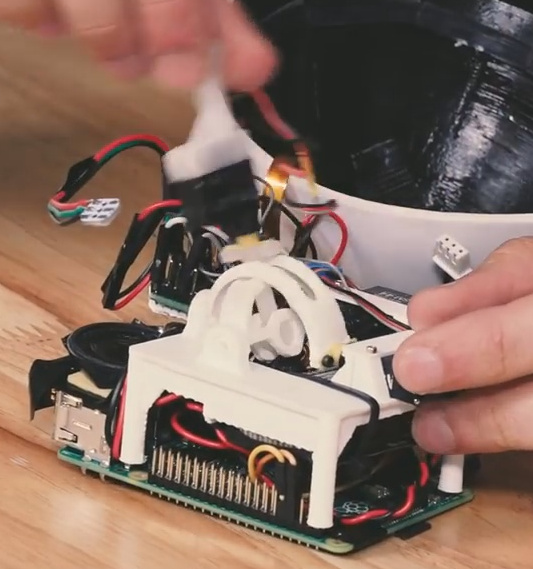
For example, Mira’s head can rotate in yaw, pitch and roll. To figure out how to make it do that he recalled having a joystick called the Microsoft Sidewinder Pro that had force feedback. That meant it might have had motors in line with the motions, much like what he wanted. To see how it worked, he bought one on eBay, took it apart, and improved on it to come up with his own design. But besides making use of the design in joysticks and heads, we can imagine it used to make robot eyeballs rotate in their sockets too. And as a side note, he’s running the robot off a Raspberry Pi, but notice the clever, space-saving way he’s mounted the whole mechanism to the Pi’s four mounting holes.
What also piqued our interest are the two tiny servos used in the head mechanism, two HD-DSM44 digital servos. These are even smaller than Tower Pro SG90s and with the added advantage of being metal geared.
Gertie’s delta jumping legs
To make the eyes blink he had to overcome the fact the head was a thin-walled sphere sliding over the body, and the eyes had to fit in the thin wall without contacting the body. His solution was to make them out of OLED screens with acrylic hemispheres for the protruding eyeballs. The circuit boards talk to the screens through ribbon cables that are around 32 connections per inch, which made for some careful soldering. And to further create a thin profile he even sanded the solder points flat.
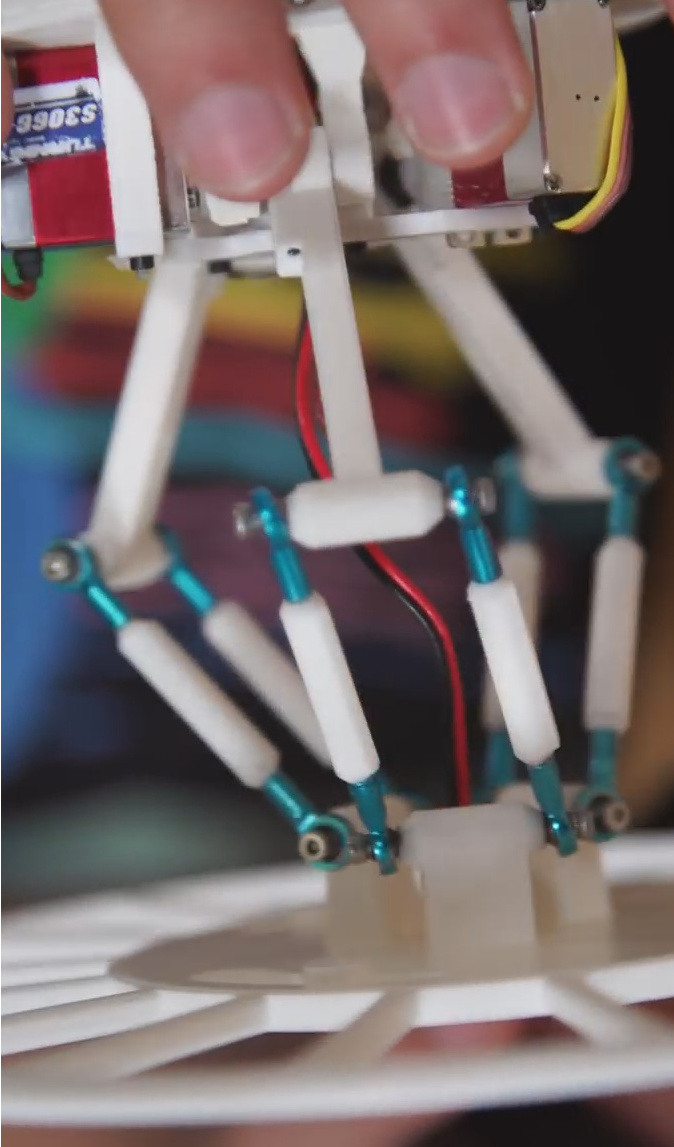
His other robot, the yellow and green Gertie, jumps to move around and its internal mechanism is also a joy to examine. To swivel and hop, it uses much the same design as a delta 3D printer, with three legs that can move the upper body in any direction, and compress like a spring before leaping. We like how his method for determining the appropriate thickness of 3D printed PLA parts such that they wouldn’t break was simply trial an error, taking advantage of the rapid prototyping possible with 3D printers. He did cheat on one main part of each leg though, and that was to go with RC car tie rods for the lower half of each leg — but we won’t tell on him if you won’t.
And that’s only a small sample of the neat tips and tricks you’ll find in the video below (they start looking inside the robots at 7:35).