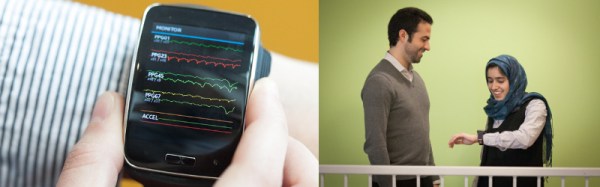
If you’ve ever wondered how people are really feeling during a conversation, you’re not alone. By and large, we rely on a huge number of cues — body language, speech, eye contact, and a million others — to determine the feelings of others. It’s an inexact science to say the least. Now, researchers at MIT have developed a wearable system to analyze the tone of a conversation.
The system uses Samsung Simband wearables, which are capable of measuring several physiological markers — heart rate, blood pressure, blood flow, and skin temperature — as well as movement thanks to an on-board accelerometer. This data is fed into a neural network which was trained to classify a conversation as “happy” or “sad”. Training consisted of capturing 31 conversations of several minutes duration each, where participants were asked to tell a happy or sad story of their own choosing. This was done in an effort to record more organic emotional states than simply eliciting emotion through the use of more typical “happy” or “sad” video materials often used in similar studies.
The technology is in a very early stage of development, however the team hopes that down the road, the system will be sufficiently advanced to act as an emotional coach in real-life social situations. There is a certain strangeness about the idea of asking a computer to tell you how a person is feeling, but if humans are nothing more than a bag of wet chemicals, there might be merit in the idea yet. It’s a pretty big if.
Machine learning is becoming more powerful on a daily basis, particularly as we have ever greater amounts of computing power to throw behind it. Check out our primer on machine learning to get up to speed.
Continue reading “Wearable Predicts Tone Of Conversation From Speech, Vital Signs”




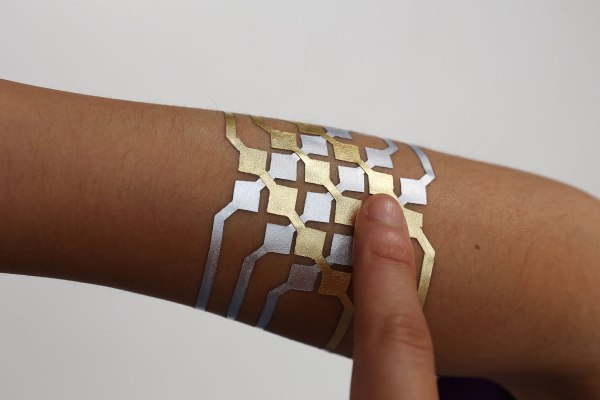
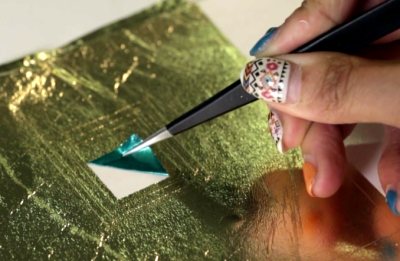 Generally speaking, gold leaf is incredibly fragile. In this process to yield the cleanest looking leaf the gold is not actually cut. Instead, the temporary tattoo film and backer are cut on a standard desktop vinyl cutter. The gold leaf is then applied to the entire film surface. The cut film/leaf can then be “weeded” — removing the unwanted portions of film which were isolated from the rest by the cutting process — to complete the temporary tattoo. The team tested this method and found that traces 4.5 mm or more thick were resilient enough to last the entire day on your skin.