Controllable Bristlebot

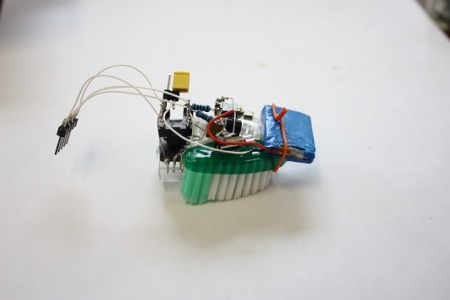
[sprite_tm], whose projects we have covered in the past, took the popular bristlebot to an extreme and created a controllable version. A bristlebot consists of a small vibrating motor mounted with a battery on the head of a toothbrush. These micro-robots buzz around randomly, and he attempted to tame them. He used a platform of twin bristlebots and added an optical sensor from a laser mouse and an ATtiny13. The optical sensor is used to determine the relative motion of the robot, so that the motors can be adjusted accordingly. He also has a video of the bot using the sensor to find a mark on the floor and stay within bounds. Although it isn’t as accurate, it acts like a traditional line-following robot.
Continue reading “Controllable Bristlebot”

Arduino Experimentation Kit

ARDX

[Oomlout] has created an Arduino Experimentation Kit that uses basic sensors, buttons, and LEDs to teach electronics and programming. Printed overlays are secured on a breadboard, indicating components and connections. The Arduino is then used to drive the circuit. Examples include driving motors, using shift registers, and making beeps with a piezo element. These are backed up by explanations and code. The breadboarding kit is very similar to the classic 300-in-1 project kits marketed to beginners. In addition, all of the materials are released as open source. Kits are also available that include everything needed to create the circuits.

Related: Opensource Robotic Arm

[via Hack a Day flickr pool]

Dell Vostro A90 Hackintosh

dell_vostro_a90

A friend recently commissioned us to install OSX on a netbook. We advised him to purchase the Dell Vostro A90. It’s essentially a rebadged Dell Mini 9, a model that has been discontinued, but is well suited for OSX. It’s only available with a 1.6GHz Atom processor, 1GB RAM, and 16GB SSD. Depending on what deals are available, it’s $250-$300. We also had him purchase a 2GB stick of RAM which is the upper limit supported by the BIOS. Continue reading “Dell Vostro A90 Hackintosh”

C64 Twitter Client

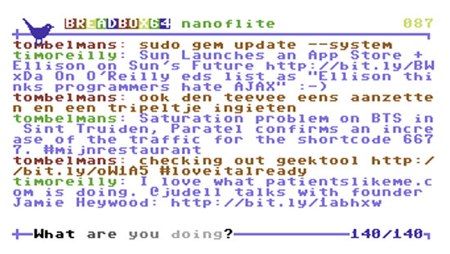
The last of the Commodore 64’s shortcomings has been addressed; it finally has a Twitter client. [Johan Van den Brande] wrote BREADBOX64 for use on the C64/128. It’s running on top of the open source Contiki operating system. The hardware is an MMC Replay cartridge with an ethernet adapter. If you don’t have the hardware available, you can run it inside an emulator like VICE. Embedded below is a C128D running the program.

(P.S. all of our posts are on @hackadaydotcom)

Continue reading “C64 Twitter Client”

Theremin Controlled Mario

[youtube=http://www.youtube.com/watch?v=YnZeI8uLJnw]

In the video above, [conquerearth] is using a theremin to control Super Mario Bros. Moving his hand toward and away from the vertical antenna increases the theremin’s pitch. The computer monitors this in real time and moves Mario left and right. The loop antenna controls the theremin’s volume and acts as the jump button. The controls seem to work well, much better than the sound of one man flailing at a theremin.

[via Gizmodo]

RGBike POV

rgbike_pov

[Hazard] wanted a full color POV display for his bike wheel. Adafruit’s SpokePOV is single color and Monkeylectric’s original version didn’t display images. He also balked at the cost and decided to manufacture his own version. It uses 16 RGB LEDs on a single layer board he manufactured himself. It’s an entirely through-hole design to make assembly easy. It uses a hall effect sensor to synchronize the image display. The two main components are an ATmega328p microcontroller, which should make it Arduino compatible, and a TLC5940 PWM LED driver. It’s a very well documented build and certainly a good looking effect.

[via adafruit]

Bluetooth Motorcycle Control Panel With Arduino

Motorcycle_in_neutral

[Bill2009] has made some nice progress on a control panel for his motorcycle over at the arduino.cc forums.  It can show speed, tachometer readings for the wheel and engine, as well as indicate the current gear. He reads the square wave coming off of his tachometer input and pulses from a reed switch mounted on the wheel to calculate all this. To top it all off he can monitor the data via a Bluetooth module attached to the board, which is much better than trying to balance a laptop on your knees while cruising down the highway.  He is working on getting the size down so that he can mount the whole assembly inside of his motorcycle. He also plans to add new software features like wind resistance calculations and0 to 60mph timing.