Control An IRL Home From Minecraft

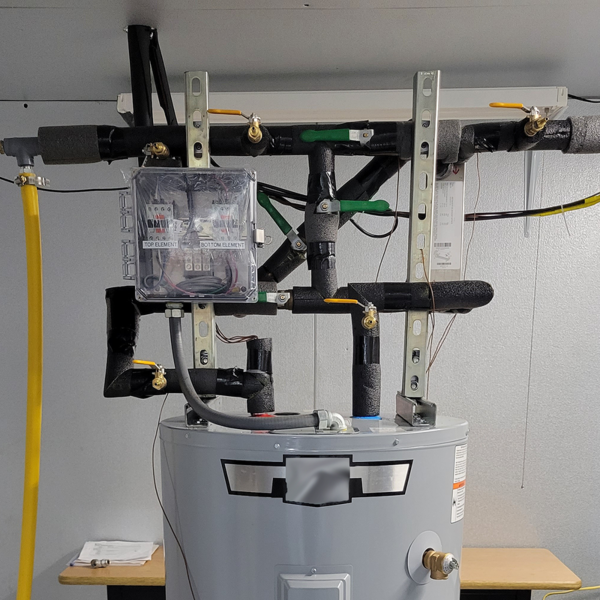
Minecraft seems to be a game in which anything is possible, both in the virtual world and in the real one. As a sandbox-style game, we’ve seen all kinds of things implemented in it including arithmetic logic units and microcontroller emulators. On the other end of reality we’ve also seen a lot of projects in which real-world interfaces impact the virtual world in some way. As a game, the lines between these two worlds often seem to blur, and that’s no different for this project that allows for control of a smart home from within the game itself.

The project is called HomeAssistantMC and is built with Forge. The mod interfaces directly with a Minecraft game. From within the game, players can create a model of their home complete with light switches and other control interfaces. A WebSocket API listens to the game for changes to these devices, and interfaces with real-world controllers which control the home in real life. The game uses special state blocks to handle the control, and the entire control system can be configured in-game once all of the appropriate software has been installed.

For anyone willing to experiment with this software, all of the code for this project is available on its GitHub page. One of the other interesting things about this project is the ability to use other creations within Minecraft for home automation. For example, building logic gates allows for nuanced control of the home automation setup with creations we’ve already seen in Minecraft before. And, if you really want to go deep into the weeds, you could even build a complete 6502 processor from within the game as well.

Cracking A GBA Game With NSA Tools

[Wrongbaud] is a huge fan of Japanese kaiju-style movies, including Godzilla and King Kong. In honor of the release of a new movie, he has decided to tackle a few projects to see how both of these monsters can hold their own against other legendary monsters. In this project, he is using Ghidra, named after another legendary kaiju, against the password system of the Game Boy Advance game Kong: King of Atlantis.

Since this project is a how-to, [wrongbaud] shows how to search Ghidra for existing scripts that might already have the functionality needed for GBA analysis and emulation. When not, he also illustrates how to write scripts to automate code analysis, and then moves on to cracking the level password system on the game.

The key to finding the passwords on this game was looking for values in the code that were seven characters long, and after some searching [wrongbaud] is finally able to zero in on the code responsible for handling passwords. Once found a brute force method was automated to find viable passwords, and from there the game was officially pwned. For anyone interested in security, reverse engineering, or just the way that binaries work, it’s quite the detailed breakdown. Of course, it’s not the only example we have seen that uses this software tool to extract passwords.

Analog Camera Goes Digital

The digital camera revolution swept through the world in the early 2000s, and aside from some unique situations and a handful of artists still using film, almost everyone has switched over to digital since then. Unfortunately that means that there’s a lot of high quality film cameras in the world that are gathering dust, but with a few pieces of equipment it’s possible to convert them to digital and get some more use out of them.

[befinitiv]’s latest project handles this conversion by swapping in a Raspberry Pi Zero where the film cartridge would otherwise be inserted into the camera. The Pi is attached to a 3D-printed case which mimics the shape of the film, and also houses a Pi camera right in front of the location where the film would be exposed. By removing the Pi camera’s lens, this new setup is able to take advantage of the analog camera’s optics instead and is able to capture images of relatively decent quality.

There are some perks of using this setup as well, namely that video can be broadcast to this phone over a wireless connection to a computer via the Raspberry Pi. It’s a pretty interesting build with excellent results for a remarkably low price tag, and it would be pretty straightforward to interface the camera’s shutter and other control dials into the Raspberry Pi to further replicate the action of an old film camera. And, if you enjoy [befinitiv]’s projects of bringing old tech into the modern world, be sure to check out his 80s-era DOS laptop which is able to run a modern Linux installation.

Continue reading “Analog Camera Goes Digital”

Get Yourself A Pupper (For Education)

While the disquieting appearance of some of the robots coming out of DARPA and other labs might give us some reservations about how much intelligence we want to give to those robots, there’s a lot to be learned from them before their inevitable global takeover. This small quadruped called the Mini Pupper is just the robot for that job. With a low cost and familiar platform, it’s the ideal robot to learn some of the tricks of the trade.

For a quadruped so small, some unique changes had to be made to ensure the robot’s functionality. There have been a few developments since it was first shown over a year ago. The first was to design a custom servo that could handle the unique characteristics of this robot. From there, some other improvements were made to the robot chassis such as using threaded rods for ease of assembly and maintenance. Some other things have stayed the same though like using a Raspberry Pi to handle the control systems and self-navigation.

Of course everything needed to make this robot yourself is open source, from the code to the schematics. For experimenting with quadrupeds and even with automatic navigation, this would be a great way to get started, and the small size will also limit its ability for a Skynet-style takeover as well. That’s a nice bonus.

Continue reading “Get Yourself A Pupper (For Education)”

Hamster Trades Crypto Better Than You

The inner machinations of the mind of cryptocurrency markets are an enigma. Even traditional stock markets often seem to behave at random, to the point that several economists seriously suggest that various non-human animals might outperform one market or another just by random chance alone. The classic example is a monkey picking stocks at random, but in the modern world the hamster [Mr Goxx] actively trades crypto from inside his hamster cage.

[Mr Goxx]’s home comprises a normal apartment and a separate office where he can make his trades. The office contains an “intention wheel” where he can run in order to select a currency to trade, and two tunnels that [Mr Goxx] can use to declare his intention to buy or sell the currency he selected with the wheel. The wheel is connected to an Arduino Nano with an optical encoder, and the Nano also detects the hamster’s presence in the “buy” or “sell” tunnel and lights up status LEDs when he wants to execute a trade. The Nano also communicates with an intricate Java program which overlays information on the live video feed and also executes the trades in real life with real money.

Live updates are sent directly both on Twitter and Reddit, besides the live Twitch stream of [Mr Goxx] we linked above. The stream only shows his office and not his apartment, and he’s mostly active at night (Berlin time). But we can’t wait for his random walks to yield long-term results which can be analyzed for years to come. In the meantime we’ll see if others have been able to make any profits in crypto with any less-random methods.

You Can Put Toothpaste In The Tube (With Effort)

Old wives’ tales, folk knowledge, common sayings, and even cliches and idioms are often taken as givens since they form an often unnoticed part of our vocabulary and culture. There’s so many examples that it’s possible to fill a 17-season TV show busting potential myths like these, and even then there are some that slipped by. For example, the saying “you can’t put toothpaste back in the tube” which, as it turns out, is not as impossible as we might be led to believe.

This video is the product of [Tyler Bell] who has taken this idiom on as a challenge. To figure out if it was possible he first got to work building a vacuum chamber, which turned out to be a little easier than he thought it would be. After cutting a piece of polycarbonate tube and sanding it down, all that was needed were some rubber gaskets and fittings for the vacuum pump.

From there, the theory was to put an empty toothpaste tube into the vacuum chamber, pump all of the air out, and let atmospheric pressure “push” the toothpaste back into the tube. During [Tyler]’s first run he thought that it had worked successfully but it turned out that he had just inflated the empty toothpaste tube like a balloon. Further iterations were able to return some of the toothpaste to the tube, but each time some air would eventually work its way into the toothpaste which would immediately fill the remaining space in the tube with air rather than toothpaste.

While not completely successful, he was able to get some toothpaste back into the tube with a relatively small bill of materials. It’s not likely that this experiment will result in a change of this particular idiomatic expression, but it was interesting to put it to the test nonetheless. For other instances of toothpaste and its relationship to tubes, both inside and out, be sure to check out this recent piece on various methods of toothpaste storage.

Continue reading “You Can Put Toothpaste In The Tube (With Effort)”

Understanding Custom Signal Protocols With Old Nintendos

For retro gaming, there’s really no substitute for original hardware. As it ages, though, a lot of us need to find something passable since antique hardware won’t last forever. If a console isn’t working properly an emulator can get us some of the way there, but using an original controller is still preferred even when using emulators. To that end, [All Parts Combined] shows us how to build custom interfaces between original Nintendo controllers and a PC.

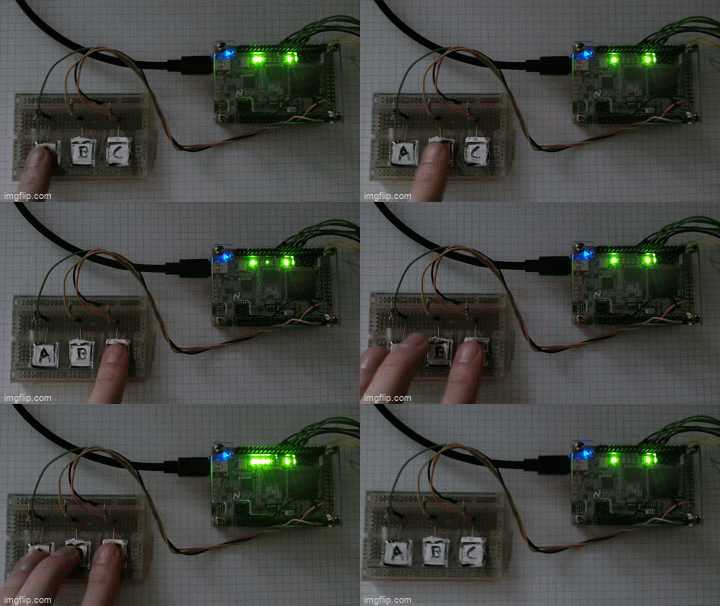
The build starts by mapping out the controller behavior. Buttons on a SNES controller don’t correspond directly to pins, rather a clock latches all of the button presses at a particular moment all at once during each timing event and sends that information to the console. To implement this protocol an Adafruit Trinket is used, and a thorough explanation of the code is given in the video linked below. From there it was a simple matter of building the device itself, for which [All Parts Combined] scavenged controller ports from broken Super Nintendos and housed everything into a tidy box where it can be attached via USB to his PC.

While it might seem like a lot of work to get a custom Nintendo controller interface running just because he had lost his Mega Man cartridge, this build goes a long way to understanding a custom controller protocol. Plus, there’s a lot more utility here than just playing Mega Man; a method like this could easily be used to interface other controllers as well. We’ve even seen the reverse process where USB devices were made to work on a Nintendo 64.

Continue reading “Understanding Custom Signal Protocols With Old Nintendos”