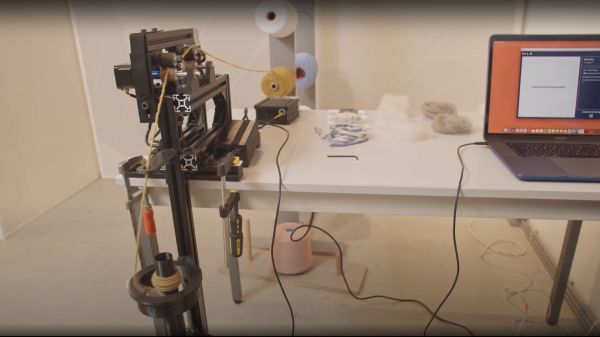
open hardware textile spinning machine constructed from aluminium extrusions, arduino electronics and 3D printed parts

An Open Hardware Automatic Spinning Machine

The team at the Berlin-based Studio HILO has been working on ideas and tools around developing a more open approach to small-scale textile production environments. Leveraging open-source platforms and tools, the team has come up with a simple open hardware spinning machine that can be used for interactive yarn production, right on the desktop. The frame is built with 3030 profile aluminium extrusions, with a handful of 3D printed, and a smidge of laser cut parts. Motion is thanks to, you guessed it, NEMA 17 stepper motors and the once ubiquitous Arduino Mega 2560 plus RAMPS 1.4 combination that many people will be very familiar with.

The project really shines on the documentation side of things, with the project GitLab positively dripping with well-organised information. One minor niggle is that you’ll need access to a polyjet or very accurate multi-material 3D printer to run off the drive wheel and the associated trailing wheel. We’re sure there’s a simple enough way to do it without those tools, for those sufficiently motivated.

We liked the use of Arduino for the firmware, keeping things simple, and in the same vein, Processing for the user interface. That makes sending values from the on-screen slider controls over the USB a piece of cake. Processing doesn’t seem to pop up on these pages too often, which is a shame as it’s a great tool to have at one’s disposal. On the subject of the user interface, it looks like for now only basic parameters can be tweaked on the fly, with some more subtle parameters needing fixing at firmware compilation time. With a bit more time, we’re sure the project will flesh out a bit more, and that area will be improved.

Of course, if you only have raw fibers, that are not appropriately aligned, you need a carder, like this one maybe?

Continue reading “An Open Hardware Automatic Spinning Machine”

RP2040 DMA Hack Makes Another ‘CPU Core’

[Bruce Land] of Cornell University will be a familiar name to many Hackaday readers, searching the site for ‘ECE4760′ will bring up many interesting topics around embedded programming. Every year [Bruce] releases yet more of the students’ work out into the wild to our great delight. This RP2040-based project is a bit more abstract than some previous work and shows yet another implementation of an older hack to utilise the DMA hardware of the RP2040 as another CPU core. While the primary focus of the RP2040 DMA subsystem is moving data between memory spaces, with minimal CPU intervention, the DMA control blocks have some fairly complex behaviour. This allows for a Turing-complete CPU to be implemented purely with the DMA hardware and a sprinkling of memory.

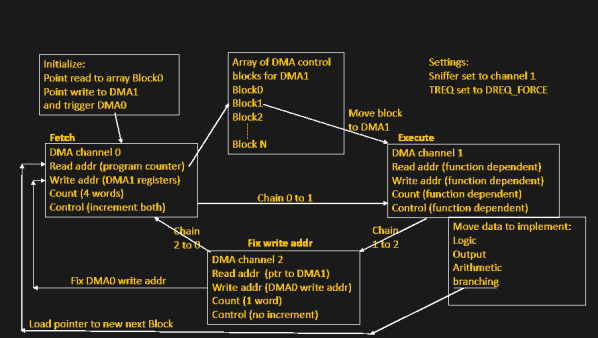
The method ties up three of the twelve DMA channels, and is estimated to have a similar performance to ‘an Arduino’ but [Bruce] doesn’t specify which one of the varied models that could be. But who cares anyway? Programming the CPU is a matter of leveraging the behaviour of the hardware, which is all memory mapped and targetable by the DMA. For example, the CPU can waggle GPIO pins by using the DMA to write values to the peripheral address space. The basic flow can be seen in the image above. DMA0 is used as the program counter, which points DMA1 to an array of DMA control blocks, a sequence of which codes for some of the ‘opcodes’ of the CPU model. DMA0 chains to (hands over control to) DMA1 which reads the control blocks and configures itself accordingly. DMA1 performs whatever data move is programmed, chains to DMA2, which in turn reprograms the DMA0 program counter to point to the next block in the list to be executed by DMA1.

Continue reading “RP2040 DMA Hack Makes Another ‘CPU Core’”

Chataigne: An Open-Source Swiss Army Knife

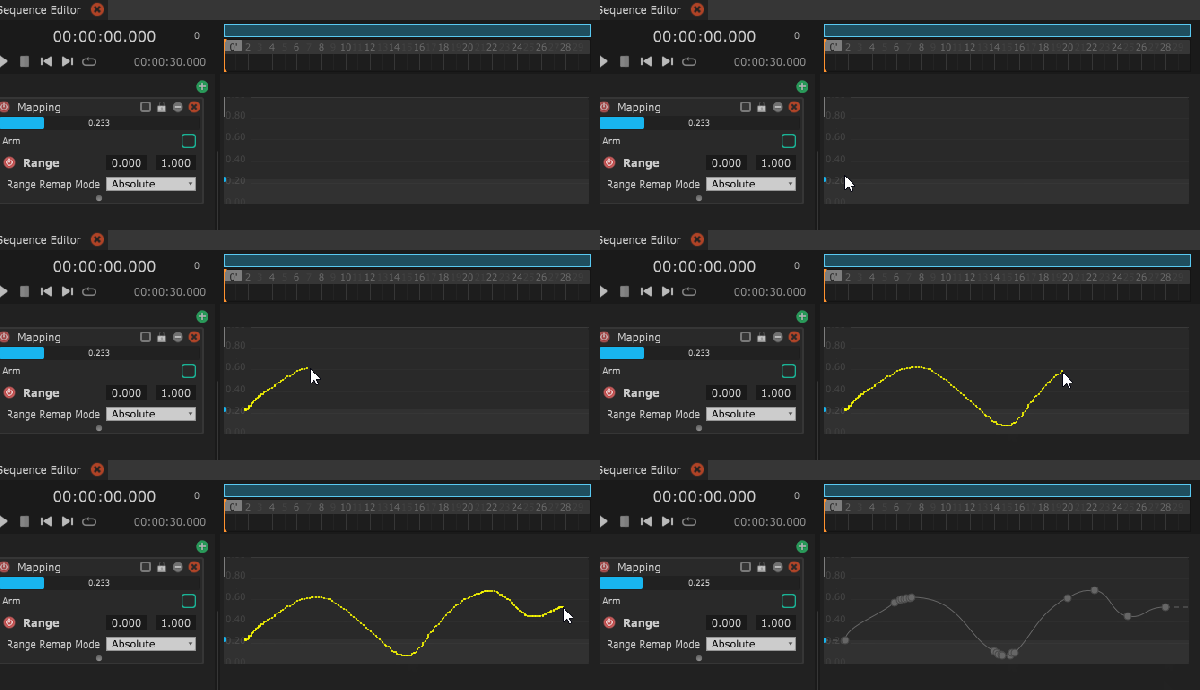
[Ben Kuper] is a developer with a history of working on art installations, and had hit upon a common problem often cited by artists. When creating installations involving light, sound, and motion, they often spend too much time on the nuts and bolts of electronics, programming, and so on. Such matters are a huge time sink with a steep learning curve and oftentimes just a plain distraction from the actual artistic intent they’re trying to focus upon. [Ben] has been working for a few years on a software tool, Chataigne which is designed as the glue between various software tools and hardware interfaces, enabling complex control of the application using simple building blocks. Continue reading “Chataigne: An Open-Source Swiss Army Knife”

AIOC: The Ham Radio All-In-One Cable For Audio And APRS

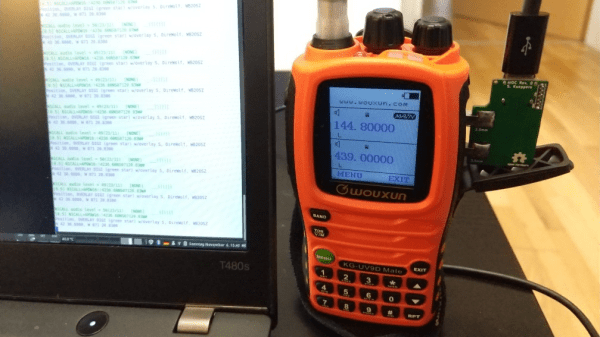
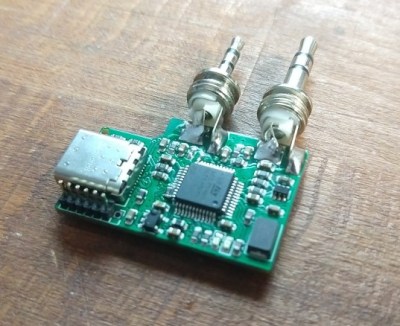
The Ham Radio All-in-one cable (AIOC) is a small PCB attachment for a popular series of radio transceivers which adds a USB-attached audio interface and virtual TTY port for programming and the push-to-talk function. The STM32F373 microcontroller (which, sadly is still hard to find in the usual channels) is a perfect fit for this application, with all the needed hardware resources.

With USB-C connectivity, the AIOC enumerates as a sound card as well as a virtual serial device, so interfacing to practically any host computer should be plug-and-play. Connection to the radio uses 12mm separation 3.5mm and 2.5mm TRS connectors, so is compatible with at least the Baofeng UV-5R but likely many other cheap transceivers that have the same physical setup.

Instructions are provided to use the AIOC with Dire Wolf for easy access to APRS applications, which makes a nice out-of-the-box demo to get you going. APRS is not all about tracking things though since other applications can sit atop the APRS/AX.25 network, for example, HROT: the ham radio of things.

We’ve seen quite a few Baofeng (and related products) hacks, like this sketchy pile of wires allowing one to experiment with the guts of the radio for APRS. Of course, such cheap radio transceivers cut so many engineering corners that there are movements to ban their sale, so maybe a new batch of better radios from our friends in the East is on the horizon?

Thanks to [Hspil] for the tip!

Alpakka: A Creative Commons Game Controller

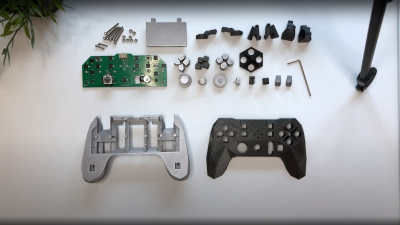
Input Labs’ mission is to produce open-source Creative Commons hardware and software for creating gaming controllers that can be adapted to anyone. Alpakka is their current take on a generic controller, looking similar to a modern Xbox or PlayStation controller but with quite a few differences. The 3D printed casing has a low-poly count, angular feel to it, but if you don’t like that you can tweak that in blender to just how you want it. Alpakka emulates a standard USB-attached keyboard, mouse, and Xinput gamepad in parallel so should just work out of the box for both Linux and Windows PC platforms. The firmware includes some built-in game profiles, which can be selected on the controller.

No special parts here, just 3D prints, a PCB and some nuts and bolts

The dual D-pads, augmented with an analog stick, is not an unusual arrangement, but what is a bit special is the inventive dual-gyro sensor arrangement –which when used in conjunction with a touch-sensitive pad — emulates a mouse input. Rest your thumb on the right-hand directional pad and the mouse moves, or else it stays fixed, kind of like lifting a mouse off the pad to re-center it.

The wired-only controller is based around a Raspberry Pi Pico, which has plenty of resources for this type of application giving a fast 250 Hz update rate. But to handle no fewer than nineteen button inputs, as well as a scroll wheel, directional switch, and that analog stick, the Pico doesn’t have enough I/O, needing a pair of NXP PCAL6416A I2C IO expanders to deal with it.

The PCB design is done with KiCAD, using a simple 3D printed stand to hold the PCB flat and the through-hole components in place while soldering. Other than a few QFN packages which might be a problem for some people, there is nothing tricky about hand-soldering this design.

We’ve been seeing custom game controllers as long as we’ve been hacking, here’s an interesting take on the mouse-integration theme. If you’re comfortable rolling the hardware side of things, but the firmware is a sticking point, then perhaps look no further than this neat RP2040 firmware project.

Continue reading “Alpakka: A Creative Commons Game Controller”

This Is The Future Of Waste Management

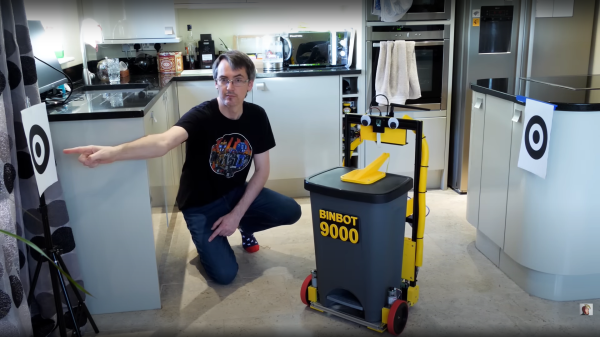
Many of us have been asking for some time now “where are our robot servants?” We were promised this dream life of leisure and luxury, but we’re still waiting. Modern life is a very wasteful one, with items delivered to our doors with the click of a mouse, but the disposal of the packaging is still a manual affair. Wouldn’t it be great to be able to summon a robot to take the rubbish to the recycling, ideally have it fetch a beer at the same time? [James Bruton] shares this dream, and with his extensive robotics skillset, came up with the perfect solution; behold the Binbot 9000. (Video, embedded below the break)

Continue reading “This Is The Future Of Waste Management”

Is That A Typewriter In Your Pocket Or Are You Just Pleased To See Me?

Don’t have the right milling tool? Just make one!

[Attoparsec] wondered what if you could carry a typewriter in your pocket, then followed through with that and built one. (Video, embedded below.) Kind of. The plan was to use an existing set of striker bars, but not wanting to destroy a perfectly good typewriter, they realised that you can easily source just the bar set on eBay.

The first problem was that the striker bars are shaped to allow the typewriter mechanism to operate, but that would not make for a compact arrangement. After a spot of straightening in a big vice, and drilling in a custom jig, they were in a suitable state to be arranged inside the case. The casing is milled from a chunk of aluminium, complete with a nice recess to hold an ink-impregnated felt pad. To prevent this pad from drying out when stowed, and to keep the whole thing clear of pocket lint, a U-shaped metal cover was bent from some sheet. This slides into a set of slots that are milled near the edges, in a very satisfying manner. This last bit was causing them a little trouble, so a custom slotting tool was created especially for the job. And a good job was indeed done. The final results look as you might expect from a manual ‘typewriter’ quirky, a bit wonky, but fabulous all the same.

If you have an old typewriter that needs some attention, here’s a quick guide for giving it a once-over. Some of you of a certain age may remember electronic typewriters with some fondness. They died a rapid death, but if you’ve still got one lurking, you could convert it into a Linux terminal for some clackity nostalgic fun.

Continue reading “Is That A Typewriter In Your Pocket Or Are You Just Pleased To See Me?”