SCiO “Pocket Molecular Scanner” Teardown

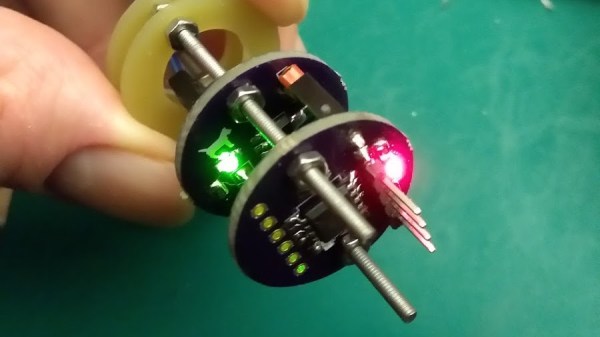
Some of you may remember the SCiO, originally a Kickstarter darling back in 2014 that promised people a pocket-sized micro spectrometer. It was claimed to be able to scan and determine the composition of everything from fruits and produce to your own body. The road from successful crowdsourcing to production was uncertain and never free from skepticism regarding the promised capabilities, but the folks at [Sparkfun] obtained a unit and promptly decided to tear it down to see what was inside, and share what they found.

The main feature inside the SCiO is the optical sensor, which consists of a custom-made NIR spectrometer. By analyzing the different wavelengths that reflect off an object, the unit can make judgments about what the object is made of. The SCiO was clearly never built to be disassembled, but [Sparkfun] pulls everything apart and provides some interesting photos of a custom-made optical unit with an array of different sensors, various filters, apertures, and a microlens array.

It’s pretty interesting to see inside the SCiO’s hardware, which unfortunately required destructive disassembly of the unit in question. The basic concept of portable spectroscopy is solid, as shown by projects such as the Farmcorder which is intended to measure plant health, and the DIY USB spectrometer which uses a webcam as the sensor.

Microorganisms Can’t Hide From DropoScope

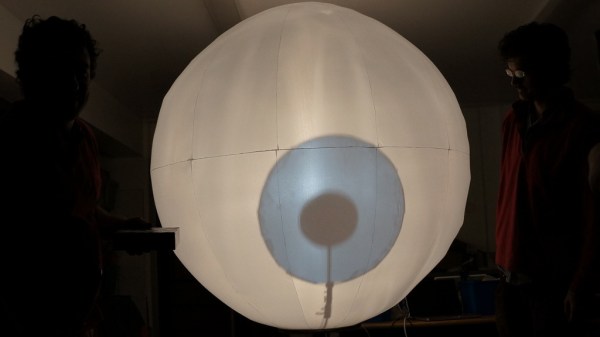
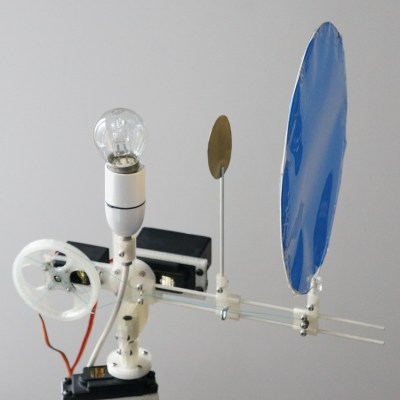
The DropoScope is a water-drop projector that works by projecting a laser through a drop of water, ideally dirty water crawling with microorganisms. With the right adjustments, a bright spot of light is projected onto a nearby wall, revealing a magnified image of the tiny animals within. Single celled organisms show up only as dark spots, but larger creatures like mosquito larvae exhibit definite structure and detail.

While simple in concept and requiring nothing more high-tech than a syringe and a laser pointer, getting useful results can require a lot of fiddly adjustment. But all that is a thing of the past for anyone with access to a laser cutter, thanks to [ingggis].  His design for a laser-cut a fixture lets anyone make and effortlessly adjust their own water-drop projector.

If you’d like to see some microorganisms in action, embedded below is video from a different water-drop projector (one identical in operation, but not lucky enough to benefit from [ingggis]’s design.)

Continue reading “Microorganisms Can’t Hide From DropoScope”

Reflective Sensor Becomes Kart Racing Lap Counter

Once you have a track and a kart to race on it, what’s missing? A lap counter that can give your lap times in hardcopy, obviously! That’s what led [the_anykey] to create the Arduino-based Lap Timer to help him and his kids trim those precious seconds off their runs, complete with thermal printer for the results.

The hardware uses an infrared break-beam sensor module (a Velleman PEM10D) to detect when a kart passes by. This module is similar to a scaled-up IR reflective object sensor; it combines an IR emitter and receiver on one end, and is pointed at a reflector placed across the track, up to 10 meters away. When a kart breaks the beam, the module reports the event to the rest of the hardware. Only needing electronics on one side allows the unit to be self-contained.

An obvious shortcoming of this system is the inability to differentiate between multiple karts, but for timing a single driver’s performance it does the trick. What’s great about this project is it showcases how accessible hardware is today; a device like this is possible to put together with what are essentially off-the-shelf components available to any hobbyist, using an Arduino as the glue to hold it together. We’d only comment that a red-tinted piece of plastic as an overlay for the red display (and a grey-tinted one for the green) would make the LED displays much easier to read. Still, this is a very clean and well-documented build. See it in action in the video embedded below.

Continue reading “Reflective Sensor Becomes Kart Racing Lap Counter”

Hackaday Prize Entry: PCBs On Demand With Etchr

The ambitious etchr – the PCB Printer is just a concept at the moment, but it’s not often we see someone trying to tackle desktop PCB production in a new way. Creator [Jonathan Beri] is keenly aware that when it comes to creating electronics, the bottleneck for most workflows is the PCB itself. Services like OSH Park make professionally fabricated PCBs accessible at a low cost, but part of the bargain is that turnaround times are often measured in weeks.

[Jonathan]’s concept for etchr is a small system that automates not only etching a copper-clad board with all the attendant flooding and draining of chemicals, but applying a solder mask and silkscreen layer labeling as well. The only thing left to do would be to drill any required holes.

The idea behind etchr is to first take a copper-clad board with photoresistive film or spray applied to it, and fix it into a frame. A UV projector takes care of putting the traces pattern onto the board (and also handles a UV-curable solder mask in a later step) and the deep frame doubles as a receptacle for any chemical treatments such as the etching and cleaning. It’s an ambitious project, but the processes behind each step are well-understood and bringing them all together in a single machine is an intriguing approach.

Desktop production of PCBs can be done in a few ways, including etching via the toner transfer method (whose results our own Elliot Williams clearly explained how to take from good to great). An alternative is to mill the PCBs out directly, a job a tool like the Othermill is designed specifically to do. It’s interesting to see an approach that includes applying a solder mask.

Improved Game Tokens With Laser Cutting And Clever Design

[Martin Raynsford] is a prolific project maker, especially when it comes to using a laser cutter. These laser-cut token counters for the board game Tigris & Euphrates demonstrate some clever design, and show that some simple touches can make a big difference.

In the digital version of the game, the tokens conveniently display a number representing their total power value. [Martin] liked this feature, and set out to design a replacement token for the tabletop version that could display a number while still keeping the aesthetic of the originals. The tokens were designed as a dial with a small cutout window to show a number, but the surface of the token showing color and icon is still mostly unchanged.

Magnets hold the top and bottom together, and because of the small size of the assembly, no detents are needed. Friction is enough to keep things from moving unintentionally. The second noteworthy design feature is the material for the top layer of the token. This layer is made from 0.8 mm birch plywood; a nice and thin top layer means a wider viewing angle because the number is nearer to the surface. If the top layer were thicker, the number would be recessed and harder to see.

[Martin] made the design file available should anyone wish to try it out. No stranger to games, he even once game-ified the laser itself, turning it into a physical version of Space Invaders. Be sure to check it out!


Hackaday Prize Entry: Octo, The Robotic Walker

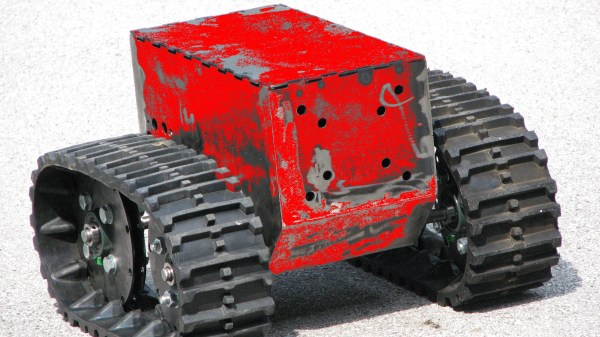
Walkers like the Strandbeest are favorites due in part to their smooth design and fluid motion, but [Leandro] is going a slightly different way with Octo, an octopodal platform for exploring rough terrain. Octo is based on the Klann linkage which was developed in 1994 and intended to act as an alternative to wheels because of its ability to deal with rough terrain. [Leandro] made a small proof of concept out of soldered brass and liked the results. The next version will be larger, made out of aluminum and steel, and capable of carrying a payload.

The Strandbeest and Octo have a lot in common but differ in a few significant ways. Jansen’s linkage (which the Strandbeest uses) uses eight links per leg and requires relatively flat terrain. The Klann linkage used by Octo needs only six links per leg, and has the ability to deal with rougher ground.

[Leandro] didn’t just cut some parts out from a file found online; the brass proof of concept was drawn up based on an animation of a Klann linkage. For the next version, [Leandro] used a simulator to determine an optimal linkage design, aiming for one with a gait that wasn’t too flat, and maximized vertical rise of the leg to aid in clearing obstacles.

We’ve seen the Klann linkage before in a LEGO Spider-bot. We’re delighted to see [Leandro]’s Octo in the ring for the Wheels, wings, and walkers category of The Hackaday Prize.

Hackaday Prize Entry: DIY 6-Axis Micro Manipulator

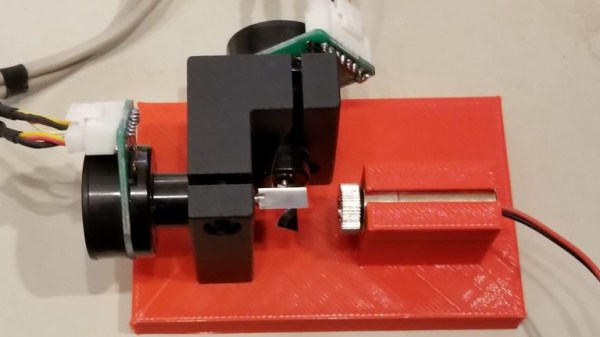
[David Brown]’s entry for The Hackaday Prize is a design for a tool that normally exists only as an expensive piece of industrial equipment; out of the reach of normal experimenters, in other words. That tool is a 6-axis micro manipulator and is essentially a small robotic actuator that is capable of very small, very precise movements. It uses 3D printed parts and low-cost components.

SLS Nylon Actuator Frame. Motor anchors to top right, moves the central pivot up and down to deflect the endpoints.

The manipulator consists of six identical actuators, each consisting of a single piece of SLS 3D printed nylon with a custom PCB to control a motor and read positional feedback. The motor moves the central pivot point of the 3D printed assembly, which in turn deflects the entire piece by a small amount. By anchoring one point and attaching the other, a small amount of highly controllable movement can be achieved. Six actuators in total form a Gough-Stewart Platform for moving the toolhead.

Interestingly, this 6-Axis Micro Manipulator is a sort of side project. [David] is interested in creating his own digital UV exposer, which requires using UV laser diodes with fiber optic pig tails attached. In an industrial setting these are created by empirically determining the optimal position of a fiber optic with regards to the laser diode by manipulating it with a micro manipulator, then holding it steady while it is cemented in place. Seeing a distinct lack of micro manipulators in anything outside of lab or industrial settings, and recognizing that there would be applications outside of his own needs, [David] resolved to build one.