Got Oxygen? Future Mars Missions Are Relying On The MOXIE Of Perseverance

The rule of thumb with planetary exploration so far has been, “What goes up, stays up.” With the exception of the Moon and a precious few sample return missions to asteroids and comets, once a spacecraft heads out, it’s never seen again, either permanently plying the void of interplanetary or interstellar space, or living out eternity on the surface of some planet, whether as a monument to the successful mission that got it there or the twisted wreckage of a good attempt.

At the risk of jinxing things, all signs point to us getting the trip to Mars reduced to practice, which makes a crewed mission to Mars something that can start turning from a dream to a plan. But despite what some hardcore Martian-wannabees say, pretty much everyone who goes to Mars is going to want to at least have the option of returning, and the logistical problems with that are legion. Chief among them will be the need for propellants to make the return trip. Lugging them from Earth would be difficult, to say the least, but if an instrument the size of a car battery that hitched a ride to Mars on Perseverance has anything to say about it, future astronauts might just be making their own propellants, literally pulling them out of thin air.

Continue reading “Got Oxygen? Future Mars Missions Are Relying On The MOXIE Of Perseverance”

Decapping Components Hack Chat With John McMaster

Join us on Wednesday, March 10 at noon Pacific for the Decapping Components Hack Chat with John McMaster!

We treat them like black boxes, which they oftentimes are, but what lies beneath the inscrutable packages of electronic components is another world that begs exploration. But the sensitive and fragile silicon guts of these devices can be hard to get to, requiring destructive methods that, in the hands of a novice, more often than not lead to the demise of the good stuff inside.

To help us sort through the process of getting inside components, John McMaster will stop by the Hack Chat. You’ll probably recognize John’s work from Twitter and YouTube, or perhaps from his SiliconPr0n.org website, home to beauty shots of some of the chips he has decapped. John is also big in the reverse engineering community, organizing the Mountain View Reverse Engineering meetup, a group that meets regularly to discuss the secret world of components. Join us as we talk to John about some of the methods and materials used to get a look inside this world.

join-hack-chatOur Hack Chats are live community events in the Hackaday.io Hack Chat group messaging. This week we’ll be sitting down on Wednesday, March 10 at 12:00 PM Pacific time. If time zones have you tied up, we have a handy time zone converter.

Click that speech bubble to the right, and you’ll be taken directly to the Hack Chat group on Hackaday.io. You don’t have to wait until Wednesday; join whenever you want and you can see what the community is talking about.
Continue reading “Decapping Components Hack Chat With John McMaster”

A Scientist Made An Artificial Black Hole In The Lab, And You Won’t Believe What Happened Next

OK, that was a little click-baity, but then again, so was the announcement this week that a scientist had confirmed Hawking radiation with a lab-grown black hole. It sure got our attention, at least.

As it turns out, the truth is both less and more than meets the eye. The article above was eventually edited to better reflect the truth that, alas, we have not yet found a way to create objects so massive that even light cannot escape them. Instead, physicist [Jeff Steinhauer] and colleagues at the Technion-Israel Institute of Technology have developed an acoustic model of black holes, which is what was used to observe the equivalent of Hawking radiation for the first time. Hawking radiation is the theoretical exception to the rule that nothing makes it out of a black hole and would imply that black holes evaporate over time. The predicted radiation would be orders of magnitude weaker than the background radiation, though, making it all but impossible to detect.

That’s where [Steinhauer]’s sonic black holes come in. In these experiments, phonons, packets of mechanical vibrations that stand in for photons, are trapped in a fast-moving stream of fluid. The point in the stream where its speed straddles the local speed of sound is the equivalent to a real black hole’s event horizon; phonons inside that boundary can never escape. Except, of course, for the sonic equivalent of Hawking radiation, which the researchers found after 97,000 attempts.

When we first stumbled upon this story, we assumed a lab-grown black hole, even an acoustic analog, would take a CERN’s-worth of equipment to create. It turns out to be far simpler than that; [Steinhauer], in fact, built his black hole machine singlehandedly from relatively simple equipment. The experiments do require temperatures near absolute zero and a couple of powerful lasers, so it’s not exactly easy stuff; still, we can’t help but wonder if sonic black holes are within the reach of the DIY community. Paging [Ben Krasnow] and [Sam Zeloof], among others.

[Featured image credit: Nitzan Zohar, Office of the Spokesperson, Technion]

Hackaday Links Column Banner

Hackaday Links: March 7, 2021

It’s March, which means Keysight is back in the business of giving away a ton of test gear. Keysight University Live starts on March 15, with daily events the first week followed by a string of weekly live events through April. We always enjoy these Keysight events; sure, they’re clearly intended to sell more gear, but the demos and tutorials are great, and we always learn a lot. There’s also a feeling of community that feels similar to the Hackaday community; just a bunch of electronics nerds getting together to learn and share. If you’re interested in that community, or even if you’re just looking for a chance to win something from the $300,000 pile of goodies, you’ll need to register.

There’s another event coming up that you’ll want to know about: the 2021 Open Hardware Summit. Because 2021 is the new 2020, the summit is being held virtually again, this year on April 9. Tickets are on sale now, and we’re told there are still plenty of Ada Lovelace Fellowships available to those who consider themselves to be a minority in tech. The Fellowship covers the full cost of a ticket; it usually covers travels costs too, but sadly we’re still not there yet.

Once we do start traveling again, you might need to plan more carefully if cities start following the lead of Petaluma, California and start banning the construction of gas stations. The city, about 40 miles (64 km) north of San Francisco, is believed to be the first city in the United States to ban new gas station construction. The city council’s decision also prevents gas station owners from expanding, reconstructing, or relocating existing gas stations. The idea is to create incentives to move toward non-fossil fuel stations, like electric vehicle charging stations and hydrogen fueling. Time will tell how well that works out.

Go home Roomba — you’re drunk. That could be what Roomba owners are saying after an update semi-bricked certain models of the robotic vacuum cleaners. Owners noted a variety of behaviors, like wandering around in circles, bumping into furniture, and inability to make its way back to base for charging. There’s even a timelapse on reddit of a Roomba flailing about pathetically in a suspiciously large and empty room. The drunken analogy only goes so far, though, since we haven’t seen any reports of a Roomba barfing up the contents of its dust bin. But we’re still holding out hope.

And finally, if you’re not exactly astronaut material but still covet a trip to space, you might luck out courtesy of Japanese billionaire Yusaku Maezawa. He’s offering to pay the way for eight people from around the world on a planned flight to the Moon and back in 2023. Apparently, Maezawa bought up all the seats for the flight back in 2018 with the intention of flying a group of artists to space. His thinking has changed, though, and now he’s opening up the chance to serve as ballast join the crew to pretty much any rando on the planet. Giving away rides on Starship might be a harder sell after this week’s test, but we’re sure he’ll find plenty of takers. And to be honest, we wish the effort well — the age of routine civilian space travel can’t come soon enough for us.


Open-DIP Surgery Cuts Retro Chips Down To Size

At least by today’s standards, some of the early chips were really, really big. They may have been revolutionary and they certainly did shrink the size of electronic devices, but integrating a 40-pin DIP into a modern design can be problematic. The solution: cut off all the extra plastic and just work with the die within.

Continue reading “Open-DIP Surgery Cuts Retro Chips Down To Size”

Magnetic Angle Sensor Mods Make Encoder Better For Blasting

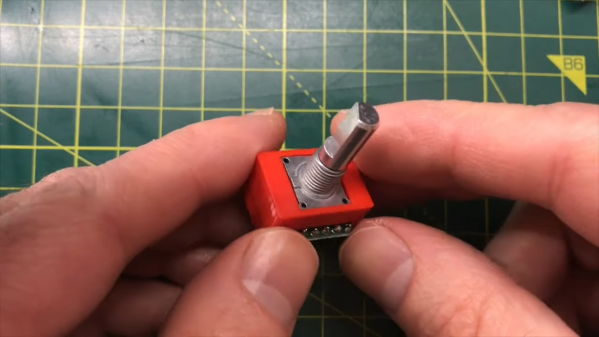
Most of the hacks we see around these parts have to do with taking existing components and cobbling them together in interesting new ways. It’s less often that we see existing components gutted and repurposed, but when it happens, like with this reimagined rotary encoder, it certainly grabs our attention.

You may recall [Chris G] from his recent laser-based Asteroids game. If not you should really check it out — the build was pretty sweet. One small problem with the build was in the controls, where the off-the-shelf rotary encoder he was using didn’t have nearly enough resolution for the job. Rather than choosing a commodity replacement part, [Chris] rolled his own from the mechanical parts of the original encoder, like the shaft and panel bushing, and an AS5048A sensor board. The magnetic angle sensor has 14 bits of resolution, and with a small neodymium ring magnet glued to the bottom of the original shaft, the modified encoder offers far greater resolution than the original contact-based encoder.

The sensor breakout board is just the right size for this job; all that [Chris] needed to do to get the two pieces together was to 3D-print a small adapter. We have to admit that when we first saw this on Hackaday.io, we failed to see what the hack was — the modified part looks pretty much like a run-of-the-mill encoder. The video below shows the design and build process with a little precision rock blasting.

Continue reading “Magnetic Angle Sensor Mods Make Encoder Better For Blasting”

Retrotechtacular: Philips Factory Tour, Circa 1930s

If you’ve got a half-hour or so to spare, you could do worse than this video trip through a Philips factory in the 1930s.

The film is presented without narration, but from the Dutch title cards and the fact that it’s Philips, we gather that this factory of gigantic proportions was somewhere in the Netherlands. In any case, it looks like something right out of [Fritz Lang]’s Metropolis and turned the rawest of materials into finished consumer products.

Much of the film focuses on the making of vacuum tubes; the sheer physicality of the job is what really stands out here. The upper body strength that the glassblowers had to have boggles the mind. Check out the chops — and the soon-to-be very unfashionable mustache — on the glassblower at the 12:00 mark. And it wasn’t just the gents who had mad skills — the fine motor control needed for the delicate assembly of the innards of the tubes, which seems to be mostly staffed by women, is just as impressive. We were also surprised by the amount these manual crafts were assisted by automated systems.

Especially interesting is the section where they build the luidspreker. Without narration or captions, it’s a little hard to tell what’s going on, but it appears that they used an enormous press to form chips of Bakelite into sleek covers for the speakers, which themselves are super-chunky affairs made from scratch in the factory. We’re also treated to assembly of the radios, packaging of finished products, and a group of dockworkers who clearly didn’t read the “Fragile” labels pasted on the boxes.

One can’t help but wonder if these people had the slightest inkling of what was about to sweep over them and the rest of the world. And if they did, would they even begin to comprehend how much the very products that they were making would contribute to both the slaughter of the coming war as well as to the sparing of so many lives? Likely not, but the film is still an interesting glimpse into the creation of an industry, one that relied very much on craftsmanship to get it started.

Continue reading “Retrotechtacular: Philips Factory Tour, Circa 1930s”