Print-in-Place Connectors Aim To Make Wiring Easier

One thing some of us here in the United States have always been jealous of is the WAGO connectors that seem so common in electrical wiring everywhere else in the world. We often wonder why the electrical trades here haven’t adopted them more widely — after all, they’re faster to use than traditional wire nuts, and time is money on the job site.
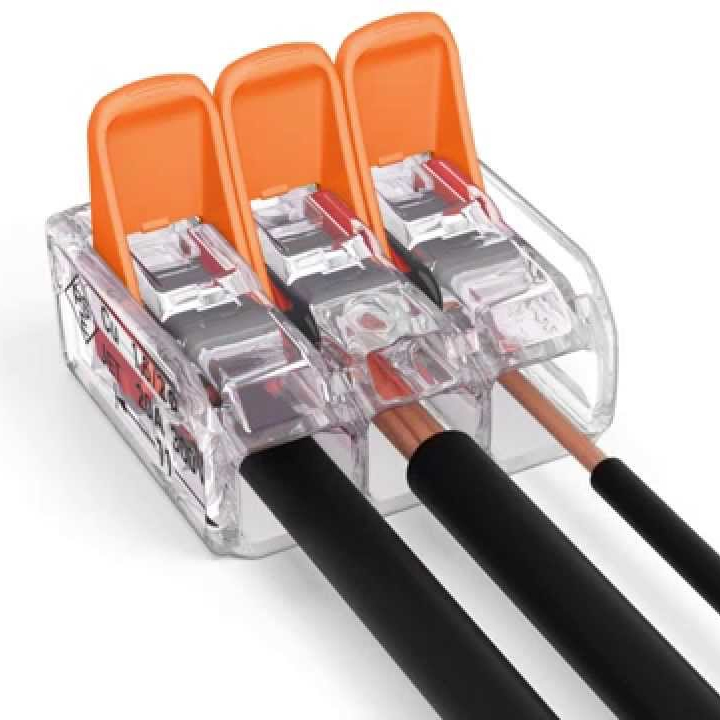
Wago 221 compact lever connector via the Wago YouTube channel

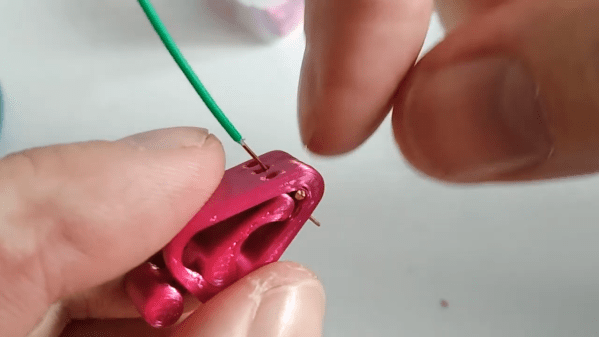
This print-in-place electrical connector is inspired by the WAGO connectors, specifically their Lever Nut series. We’ll be clear right up front that [Tomáš “Harvie” Mudruňka’s] connector is more of an homage to the commercially available units, and should not be used for critical applications. Plus, as a 3D-printed part, it would be hard to compete with something optimized to be manufactured in the millions. But the idea is pretty slick. The print-in-place part has a vaguely heart-shaped cage with a lever arm trapped inside it.

After printing and freeing the lever arm, a small piece of 1.3-mm (16 AWG) solid copper wire is inserted into a groove. The wire acts as a busbar against which the lever arm squeezes conductors. The lever cams into a groove on the opposite wall of the cage, making a strong physical and electrical connection. The video below shows the connectors being built and tested.

We love the combination of print-in-place, compliant mechanisms, and composite construction on display here. It reminds us a bit of these printable SMD tape tamers, or this print-in-place engine benchmark.

Continue reading “Print-in-Place Connectors Aim To Make Wiring Easier”
Machine Learning Helps You Track Your Internet Misery Index

We all seem to intuitively know that a lot of what we do online is not great for our mental health. Hang out on enough social media platforms and you can practically feel the changes your mind inflicts on your body as a result of what you see — the racing heart, the tight facial expression, the clenched fists raised in seething rage. Not on Hackaday, of course — nothing but sweetness and light here.

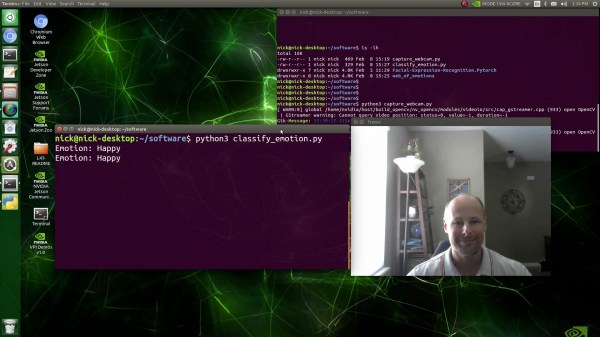
That’s all highly subjective, of course. If you’d like to quantify your online misery more objectively, take a look at the aptly named BrowZen, a machine learning application by [Nick Bild]. Built around an NVIDIA Jetson Xavier NX and a web camera, BrowZen captures images of the user’s face periodically. The expression on the user’s face is classified using a facial recognition model that has been trained to recognize facial postures related to emotions like anger, surprise, fear, and happiness. The app captures your mood and which website you’re currently looking at and stores the results in a database. Handy charts let you know which sites are best for your state of mind; it’s not much of a surprise that Twitter induces rage while Hackaday pushes [Nick]’s happiness button. See? Sweetness and light.

Seriously, we could see something like this being very useful for psychological testing, marketing research, or even medical assessments. This adds to [Nick]’s array of AI apps, which range from tracking which surfaces you touch in a room to preventing you from committing a fireable offense on a video conference.

Continue reading “Machine Learning Helps You Track Your Internet Misery Index”

Tuning Fork Keeps This Throwback Digital Clock Ticking

Whatever kind of clock you’re interested in building, you’re going to need to build an oscillator of some sort. Whether it be a pendulum, a balance wheel, or the atomic transitions of cesium or rubidium, something needs to go back and forth in a predictable way to form the timebase of the clock. And while it might not make the best timepiece in the world, a tuning fork certainly fits the bill and makes for a pretty interesting clock build.

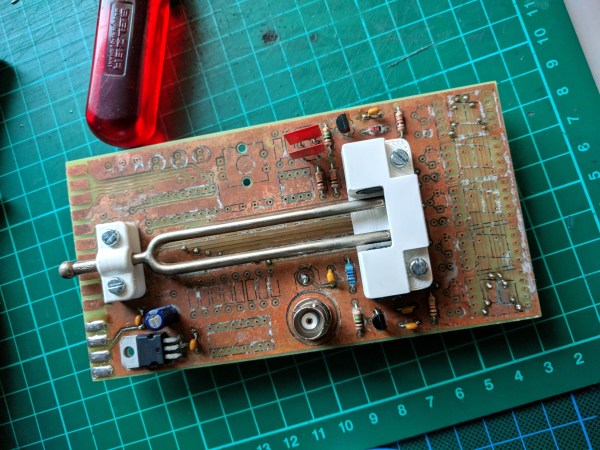
One of the nice things about this build is that [Kris Slyka] got their inspiration from a tuning fork clock that we covered a while back — we love it when someone takes a cool concept and makes it their own. While both clocks use a 440 Hz tuning fork — that’s an A above middle C for the musically inclined — [Kris] changed up the excitation method for their build. She used a pair of off-the-shelf inductors, placed near the ends of each arm and bridged by a strong neodymium magnet to both sense the 440-Hz vibrations and to provide the kick needed to keep the fork vibrating.

As for the aesthetic of the build, we think [Kris] really nailed it. Using through-hole components, old-school seven-segment displays, and a home-etched PCB, she was able to capture a retro look that really works. The RS-232 port and the bell jar enclosure complete the feel, although we’re not sure about the custom character set [Kris] designed — it’s cool and all, but makes it hard for anyone else to read without a little practice. Regardless, this is a fun build, and we’d imagine the continuous tone coming from the clock is pretty pleasing.

Continue reading “Tuning Fork Keeps This Throwback Digital Clock Ticking”

Tonewheels Warble In This Organ-Inspired Musical Instrument

Younger readers may not recall the days when every mall had a music store — not the kind where tapes and LPs were sold, but the kind where you could buy instruments. These places inevitably had an employee belting out mall-music to all and sundry on an electric organ. And more often than not, the organist was playing a Hammond organ, with the distinct sound of these instruments generated by something similar to this tonewheel organ robot.

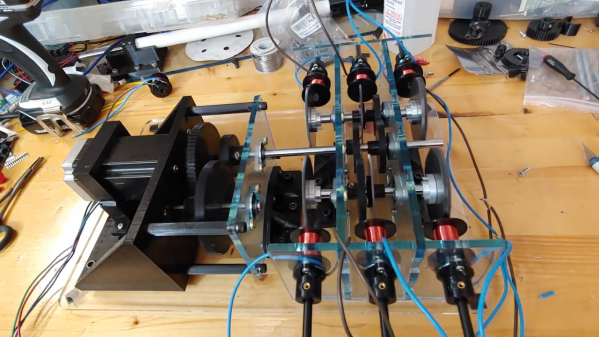
Tonewheels are toothed ferromagnetic wheels that are rotated near a pickup coil. This induces a current that can be amplified; alter the tooth profile or change the speed of rotation, and you’ve got control over the sounds produced. While a Hammond organ uses this technique to produce a wide range of sounds, [The Mixed Signal]’s effort is considerably more modest but nonetheless interesting. A stepper motor and a 1:8 ratio 3D-printed gearbox power a pair of shafts which each carry three different tonewheels. The tonewheels themselves are laser-cut from mild steel and range from what look like spur gears to wheels with but a few large lobes. This is a step up from the previous version of this instrument, which used tonewheels 3D-printed from magnetic filament.

Each tonewheel has its own pickup, wound using a coil winder that [TheMixed Signal] previously built. Each coil has a soft iron core, allowing for the addition of one or more neodymium bias magnets, which dramatically alters the tone. The video below shows the build and a demo; skip ahead to 16:10 or so if you just want to hear the instrument play. It’s — interesting. But it’s clearly a work in progress, and we’re eager to see where it goes. Continue reading “Tonewheels Warble In This Organ-Inspired Musical Instrument”

Simple Slide Whistle Gets A MIDI Makeover

On today’s episode of “Will it MIDI?” we have the common slide whistle. Spoiler alert: yes, it will, and the results are just on the edge of charming and — well, a little weird.

As maker [mitxela] points out, for all its simplicity, the slide whistle is a difficult instrument to play. Or, at least a difficult one to hit a note repeatably. It’s a bit like a tiny plastic trombone, in that both lack keys or stops that limit the vibrating column of air to a specific length. Actually, the beginning of the video below shows a clever fix for that problem on the slide whistle using magnets, but that’s mainly a side project.

[mitxela]’s MIDI-fication of the slide whistle required a bit more than a few magnets. To move the slide to defined positions, a pair of high-precision servos was connected by a laser-cut plywood scissors linkage. The lung-power of the musician is replaced by a small electric blower, mounted away from the whistle and supplying air through a long hose. The fan’s speed, and therefore the speed of the airflow, can be varied; this prevents low notes from shifting up in register from over-blowing, if that’s the right term. Another servo controls a damper that shuts off the flow of air from the mouth of the whistle to control notes without having to turn off the fan completely. The main article goes into detail about the control electronics and the calibration process.

The video has a few YouTube copyright strikes demo songs, and we have to say we’re impressed with the responsiveness of the mechanism. Some will object to the excess servo noise, but we found it nice — almost like guitar string-squeak. We like the tunes where [mitxela]’s servo-plucked music box joined in, too.

The $50 Ham: Digital Modes With WSJT-X

As it is generally practiced, ham radio is a little like going to the grocery store and striking up a conversation with everyone you bump into as you ply the aisles. Except that the grocery store is the size of the planet, and everyone brings their own shopping cart, some of which are highly modified and really expensive. And pretty much every conversation is about said carts, or about the grocery store itself.

With that admittedly iffy analogy in mind, if you’re not the kind of person who would normally strike up a conversation with someone while shopping, you might think that you’d be a poor fit for amateur radio. But just because that’s the way that most people exercise their ham radio privileges doesn’t mean it’s the only way. Exploring a few of the more popular ways to leverage the high-frequency (HF) bands and see what can be done on a limited budget, in terms of both cost of equipment as well as the amount of power used, is the focus of this installment of The $50 Ham. Welcome to the world of microphone-optional ham radio: weak-signal digital modes.

Continue reading “The $50 Ham: Digital Modes With WSJT-X”

Getting Ready For Mars: The Seven Minutes Of Terror

For the past seven months, NASA’s newest Mars rover has been closing in on its final destination. As Perseverance eats up the distance and heads for the point in space that Mars will occupy on February 18, 2021, the rover has been more or less idle. Tucked safely into its aeroshell, we’ve heard little from the lonely space traveler lately, except for a single audio clip of the whirring of its cooling pumps.

Its placid journey across interplanetary space stands in marked contrast to what lies just ahead of it. Like its cousin and predecessor Curiosity, Perseverance has to successfully negotiate a gauntlet of orbital and aerodynamic challenges, and do so without any human intervention. NASA mission planners call it the Seven Minutes of Terror, since the whole process will take just over 400 seconds from the time it encounters the first wisps of the Martian atmosphere to when the rover is safely on the ground within Jezero Crater.

For that to happen, and for the two-billion-dollar mission to even have a chance at fulfilling its primary objective of searching for signs of ancient Martian life, every system on the spacecraft has to operate perfectly. It’s a complicated, high-energy ballet with high stakes, so it’s worth taking a look at the Seven Minutes of Terror, and what exactly will be happening, in detail.

Continue reading “Getting Ready For Mars: The Seven Minutes Of Terror”