Pen Plotter Draws Maps Directly On The Wall

For map-lovers like [Christopher Getschmann], poring over a quality map can be as satisfying as reading a good book. Good maps can be hard to come by, though, especially at a scale worth looking at, or worth using as adornment on a dull, lifeless wall. The solution is obvious: build a wall-mount CNC plotter to draw maps directly on the wall.

[Christopher] began his map quest by scraping world map data from a number of sources, including OpenStreetMap, Natural Earth, and GEBCO. This gave him data for coastlines, terrain, and bathymetry — enough for a map of the world large enough to fill a wall. Since the scale of the map would preclude the use of even a large-format inkjet printer, [Christopher] set about building a wall-covering pen-plotter to render the map. The CoreXY-style plotter is large, but still light enough to hang on the wall while it works, and to be repositioned to cover a larger area.

The plotter runs on steppers driven by ultra-quiet Trinamic TMC5160 drivers, so the plotter wouldn’t be a nuisance while it worked. The map was plotted on eight pieces of cardboard mounted directly to the wall, filling the 2- x 3-meter space almost entirely. Landmasses and elevation contours were plotted as continuous lines in black ink, while bathymetric data was rendered in blue ink as cross-hatching with variable spacing, to make deeper oceans darker blue.

We find [Christopher]’s map breathtaking, all the more so considering the work that went into making it. It would be interesting to find alternate uses for the plotter, which reminds us a little of a cross between a draw-bot and a Maslow vertical CNC router, now that it’s done with its cartographic duties.

Homebrew Relay Computer Looks Like It Could Be A Commercial Product

You may not have noticed, but we here at Hackaday really love our clicky stuff. Clicky mechanical keyboards, unnecessarily noisy flip-dot displays, and pretty much anything made with a lot of relays — they all grab our attention, in more ways than one. So it’s with no small surprise that we appear to have entirely missed perhaps the clickiest build of all: a fully operational 8-bit computer using nothing but relays.

What’s even more amazing about our failure to find and feature [Paul Law]’s excellent work is that he has been at it for the better part of a decade now. The first post on his very detailed and very well-crafted blog describing the build dates from 2013, when he was just testing LEDs in the arithmetic-logic unit (ALU). Since then, [Paul] has made incredible progress, building module after module, each containing a small portion of the computer’s functionality. The modules plug into card cages with backplanes to connect them, and the whole thing lives in an enclosure made from aluminum extrusion and glossy black panels for a truly sleek look. The computer is incredibly compact for something that uses 400+ DPDT relays to do its thinking.

In addition to the blog, [Paul] has a criminally undersubscribed YouTube channel with a quite recent series going over the computer in depth. We included the overall tour below, but you should really check out the rest of the videos to appreciate how much work went into this build. We’ve seen relay computers ranging in size from single-board to just plain ludicrous, but this one really takes the prize for fit and finish as well as functionality.

Continue reading “Homebrew Relay Computer Looks Like It Could Be A Commercial Product”

The $50 Ham: A Cheap Antenna For The HF Bands

So far in the $50 Ham series, I’ve concentrated mainly on the VHF and UHF bands. The reason for this has to do mainly with FCC rules, which largely restrict Technician-level licensees to those bands. But there’s a financial component to it, too; high-frequency (HF) band privileges come both at the price of learning enough about radio to pass the General license test, as well as the need for gear that can be orders of magnitude more expensive than a $30 handy-talkie radio.

But while HF gear can be expensive, not everything needed to get on the air has to be so. And since it’s often the antenna that makes or breaks an amateur radio operator’s ability to make contacts, we’ll look at a simple but versatile antenna design that can be adapted to support everything from a big, powerful base station to portable QRP (low-power) activations in the field: the end-fed half-wave antenna.

Continue reading “The $50 Ham: A Cheap Antenna For The HF Bands”

Movie Magic Hack Chat

Join us on Wednesday, January 20th at noon Pacific for the Movie Magic Hack Chat with Alan McFarland!

If they were magically transported ahead in time, the moviegoers of the past would likely not know what to make of our modern CGI-driven epics, with physically impossible feats performed in landscapes that never existed. But for as computationally complex as movies have become, it’s the rare film that doesn’t still need at least some old-school movie magic, like hand props, physical models, and other practical effects.

To make their vision come to life, especially in science fiction films, filmmakers turn to artists who specialize in practical effects. We’ve all seen their work, which in many cases involves turning ordinary household objects into yet-to-be-invented technology, or creating scale models of spaceships and alien landscapes. But to really sell these effects, adding a dash of electronics can really make the difference.

Enter Alan McFarland, an electronics designer and engineer for the film industry. With a background in cinematography, electronics, and embedded systems, he has been able to produce effects in movies we’ve all seen. He designed electroluminescent wearables for Tron: Legacy, built the lighting system for the miniature Fhloston Paradise in The Fifth Element, and worked on the Borg costumes for Star Trek: First Contact. He has tons of experience making the imaginary look real, and he’ll join us on the Hack Chat to discuss the tricks he keeps in his practical effects toolkit to make movie magic.

https://www.youtube.com/watch?v=e13S0SenmPQ

join-hack-chatOur Hack Chats are live community events in the Hackaday.io Hack Chat group messaging. This week we’ll be sitting down on Wednesday, January 20 at 12:00 PM Pacific time. If time zones have you tied up, we have a handy time zone converter.

Click that speech bubble to the right, and you’ll be taken directly to the Hack Chat group on Hackaday.io. You don’t have to wait until Wednesday; join whenever you want and you can see what the community is talking about.

Continue reading “Movie Magic Hack Chat”

Hackaday Links Column Banner

Hackaday Links: January 17, 2021

Sad news from Mars, where the InSight lander’s “mole” was officially declared dead. The self-drilling probe, the centerpiece of the Heat Flow and Physical Properties Package (HP3) experiment, was designed to ram itself 5 meters into the Martian regolith while deploying a sensor-laden tail. The mole would then explore heat flow from within the planet. But the unexpected properties of the soil beneath the lander, including lower-than-expected friction on the hull of the mole and a cement-like “duricrust” layer, confounded the probe’s downward progress for the last two years. We covered the design of the mole, which is similar to an impact drill, as well as the valiant efforts to save the mission, but after one last try on January 9 where the mole gave 500 more whacks without any progress, controllers threw in the towel. It just goes to show that space travel and exploration are anything but routine, and that there’s far, far more we don’t know about even our nearest solar neighbor than what we do know.

Sad news, too, from closer to home, this time — Ohio, to be exact: the 2021 Hamvention has been canceled. It’s not exactly a surprise given the ongoing COVID-19 pandemic, but it’s still a blow to have ham radio’s biggest party canceled for two years running. We expect a lot of cons and meetings will suffer a similar fate in 2021. We’ll be sure to bring you any announcements we hear about.

One event that hasn’t been canceled is iQuHACK, a quantum hackathon hosted by MIT. We don’t pretend to fully understand quantum computing, or even to have scratched the surface of the subject in any meaningful way. Following up on what comes out of iQuHACK after it runs next weekend might be interesting for the quantum-curious, though. But really, just the fact that we’re in an age where quantum hackathons are a thing is pretty cool.

Back on the COVID-19 theme, managing editor Elliot Williams gave us the heads up on a story about gorillas at the San Diego Zoo Safari Park testing positive for the virus. It’s not exactly surprising that some of our evolutionarily closest relatives would be susceptible to the disease, and it’s not exactly a funny story, but the conversation in the morning meeting at the zoo must have been priceless:

“Hey, that gorilla looks sick. We’d better test him for COVID.”
“Yeah, probably. Here’s the brain-tickling swab, you go stick it up his nose.”
“Nu-uh, you stick it up his nose!”
“Nope. Hey, where’s the intern?”

And speaking of dangerous work environments, behold yet another classic of corporate safety propaganda: The Color of Danger. Like Shake Hands with Danger, this film was produced by heavy equipment manufacturer Caterpillar. But this time, instead of concentrating on the various opportunities maintaining heavy equipment presents for traumatic amputations, the subject matter is forklift safety. We’ve spent a fair number of hours in the driver’s seat of a lift truck, so we know full well how quickly things can go wrong, and this film does a great job of showing a lot of them. But what you’ve got to admire is the trick driving and stunt work that went into these vignettes; not too many people can pull off forklift drifting safely (12:30), and putting the truck in the drink without drowning was a neat trick (13:00). And of course, with any film on forklift safety, we’d be remiss not to tip our hardhat to Staplefahrer Klaus and his oft-bloodied co-workers.

Continue reading “Hackaday Links: January 17, 2021”

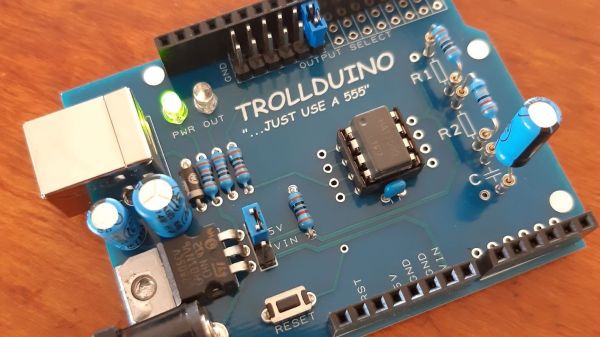
Arduino Wannabe Should Have Used A 555. Oh Wait, It Does.

It’s a little known secret that when the Hackaday writers gather in their secret underground bunker to work on our plans for world domination, we often take breaks to play our version of the corporate “Buzzword Bingo”, where paradigms are leveraged and meetings circle back to loop in offline stakeholders, or something like that. Our version, however, is “Comment Line Bingo”, and right in the middle of the card is the seemingly most common comment of all: “You should have used a 555,” or variations thereof.

So it was with vicious glee that we came across the Trollduino V1.0 by the deliciously named [Mild Lee Interested]. It’s the hardware answer to the common complaint, which we’ll grant is often justified. The beautiful part of this is that Trollduino occupies the same footprint as an Arduino Uno and is even pin-compatible with the microcontroller board, or at least sort of. The familiar line of components and connectors sprout from the left edge of the board, and headers for shields line the top and bottom edges too. “Sketches” are implemented in hardware, with jumpers and resistors and capacitors of various values plugged in to achieve all the marvelous configurations the indispensable timer chip can be used for. And extra points for the deliberately provocative use of Comic Sans in the silkscreen.

Hats off to [Lee] for a thoroughly satisfying troll, and a nice look at what the 555 chip can really do. If you want a more serious look at the 555, check out this 555 modeled on a breadboard, or dive into the story of the chip’s development.

Interference Patterns Harnessed For Optical Logic Gates

The basics of digital logic are pretty easy to master, and figuring out how the ones and zeroes flow through various kinds of gates is often an interesting exercise. Taking things down a level and breaking the component AND, OR, and NOR gates down to their underlying analog circuits adds some complexity, but the flow of electrons is still pretty understandable. Substitute all that for photons, though, and you’ll enter a strange world indeed.

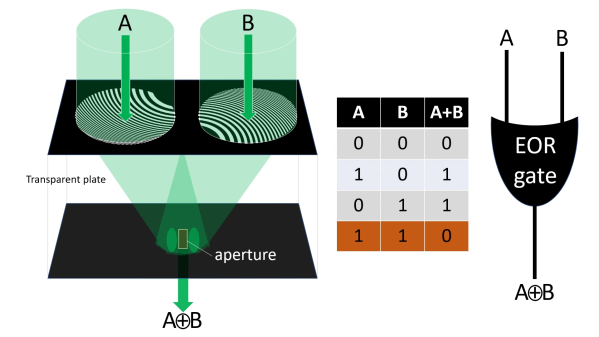
At least that’s our take on [Jeroen Vleggaar]’s latest project, which is making logic gates from purely optical components. As he himself admits in the video below, this isn’t exactly unexplored territory, but his method, which uses constructive and destructive interference, seems not to have been used before. The basic “circuit” consists of a generator, a pair of diffraction patterns etched into a quartz plate, and an evaluator, which is basically a pinhole in another plate positioned to coincide with the common focal point of the generator patterns. An OR gate is formed when the two generators are hit with in-phase monochromatic light. Making the two inputs out of phase by 180° results in an XOR gate, as destructive interference between the two inputs prevents any light from making it out of the evaluator.

Continue reading “Interference Patterns Harnessed For Optical Logic Gates”