Federal Aviation Administration Announces Major Drone Rule Changes

If new rules from the FAA regarding unmanned aircraft operations in the US are any indication, drones are becoming less of a niche hobby and more integrated into everyday life. Of course, the devil is in the details, and what the Federal Aviation Administration appears to give with one hand, it takes away with the other.

The rule changes, announced on December 28, are billed as “advanc[ing] safety and innovation” of the drone industry in the United States. The exciting part, and the aspect that garnered the most attention with headline writers, is the relaxation of rules against night operation and operating above people and moving vehicles. Since 2016, it has been against FAA regulations to operate drones less than 55 pounds (25 kg) at night or over people without a waiver. This rule can be seen as stifling innovations in drone delivery, since any useful delivery service will likely need to overfly populated areas and roadways and probably do so at night. The new rules allow these operations without a waiver for four categories of drones, classified by how much damage they would do if they were to lose control and hit someone. The rules also define the inspection and certification regimes for both aircraft and pilot, as well as stipulating that operators have to have their certificate and ID on their person while flying.

While this seems like great news, the flip side of the coin is perhaps less shiny. The rule changes also impose the requirement for “Remote ID” (PDF link), which is said to be “a major step toward full integration of drones into the national airspace system.” Certain drones will be required to carry a system that transmits identification messages directly from the aircraft, including such data as serial number, location and speed of the drone, as well as the location of the operator. The rules speculate that this would likely be done over WiFi or Bluetooth, and would need to be receivable with personal wireless devices. The exact technical implementation of these rules is left as an exercise to manufacturers, who have 30 months from the time the rules go into effect in January to design systems, submit them for certification, and get them built into their aircraft. Drone operators have an additional year to actually start using the Remote ID drones.

For the drone community, these rule changes seem like a mixed bag. To be fair, it’s not exactly unexpected that drones would be radio tagged like this, and the lead time allowed by the FAA for compliance on Remote ID seems generous. The ability to operate in riskier environments will no doubt be welcomed by commercial drone operators. So who knows — maybe the rules will do what they say they will, and this will stimulate a little innovation in the industry. If so, it could make this whole thing a net positive.

Hackaday Links Column Banner

Hackaday Links: December 27, 2020

We’re always pleased to see one of our community’s projects succeed, and we celebrate that success in whatever what it comes. But seeing a company launched to commercialize an idea that started as a Hackaday.io project and a Hackaday Prize entry is especially gratifying. So we were pleased as punch to see that MAKESafe Tools has managed to bring the idea of add-on machine tool braking to market. We’d love to add this to several tools in our shop. Honestly, of all the terrifying ways machine tools can slice, dice, and shred human flesh asunder, we always considered the lowly bench grinder fairly low-risk — and then we had a chance to “Shake Hands with Danger.”

Another great thing about the Hackaday community is the way we all try to keep each other up to speed on changes and news that affects even our smallest niches. Just last week Tom Nardi covered a project using the venerable TI eZ430-Chronos smartwatch as a makeshift medical alert bracelet for a family member. It’s a great application for the proto-smartwatch, but one eagle-eyed commenter helpfully pointed out that TI is shutting down their processors wiki in just a couple of weeks. The banner at the top of each page warns that the wiki is not read-only and that any files needed should be downloaded by January 15. Also helpfully, subsequent comments include instructions to download the entire wiki and a torrent link to the archive. It’s always sad to see a platform lose support, especially one that has gained a nice following, but it’s heartening to see the community pull together to continue to support each other like this.

We came across an interesting article this week that’s was a fascinating glimpse into how economic forces shape  and drive technological process, and vice versa. It turns out that some of the hottest real estate commodities these days are the plots of land occupied by AM radio stations serving metropolitan markets. It’s no secret that terrestrial radio in general, and AM radio in particular, are growing increasingly moribund, and the infrastructure needed to keep them on the air is getting harder and harder to justify. Chief among these are the large tracts of land devoted to antenna farms, which are often located in suburban and exurban areas near major cities. They’re tempting targets for developers looking to plunk down the physical infrastructure needed to support “New Economy” players like Amazon, which continue to build vast automated warehouses in areas that are handy to large customer bases. It’s a bit sad to watch a once mighty industry unravel and be sold off like this, but such is the nature of progress.

And finally, you may recall a Links article mention a few weeks back about a teardown of a super-sized IBM processor module. A quarter-million dollar relic of the 1990s, the huge System/390 module was an engineering masterpiece that met an unfortunate end at the hands of EEVblog’s Dave Jones. As a follow-up, Dave teamed up with fellow YouTuber CPU Galaxy to take a less-destructive tour of the module using X-ray analysis. The level of engineering needed for a 64-layer ceramic backplane is astonishing, and Dave’s play-by-play is pretty entertaining too. As a bonus, CPU Galaxy has some really interesting stuff; his place is basically a museum of vintage tech, and he just earned a new sub.

Put A Hardened Edge On Mild Steel With Just A Drill Bit. Sort Of.

People have been working metal for so long that the list of tips and tricks is now nearly infinite. So it’s always a joy to pick up a new trick, especially one as simple as putting a hardened edge on mild steel using a drill bit as a filler rod.

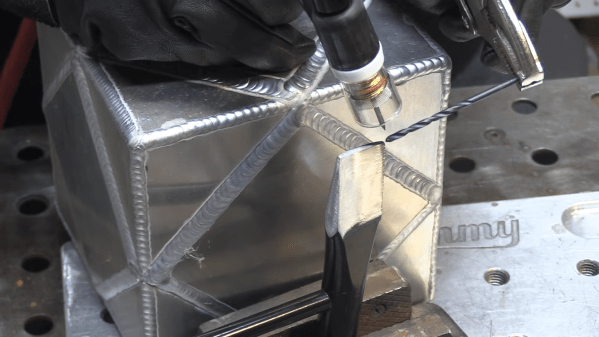
This tip comes to us by way of [Jody], aka “The Weldmonger” on YouTube. Subscribing to his channel is a sure way to keep your welding ego in check; you may be good, but [Jody] is better, and he’s willing to share as much of his experience in video format as possible. For this tip, he starts with a cheap chipping hammer, the universal welder’s tool that helps remove the glass-like slag that forms during shielded-metal arc welding, or what’s commonly known as stick welding. The mild steel of the hammer makes it hard to keep an edge, so [Jody] pulled out his TIG welder and laid down a bead on the cutting edge using an old drill bit as a fill rod. The video below shows the process in all its simplicity.

The tool steel of the drill bit is far harder than the mild steel of the hammer, but still soft enough to take an edge, and the resulting tool is much improved. We’ve seen something similar to this before, when hard-facing filler rod was built up on the edge of a mild steel slug to make a cutter for internal weld seams. We liked that hack, but knowing the same thing can be done with something we’ve all likely got in abundance in the shop is a neat trick. Thanks, [Jody]!

Continue reading “Put A Hardened Edge On Mild Steel With Just A Drill Bit. Sort Of.”

No Doorknobs Needed For This Nitrogen Laser Build

Sometimes the decision to tackle a project or not can boil down to sourcing parts. Not everything is as close as a Digi-Key or Mouser order, and relying on the availability of surplus parts from eBay or other such markets can be difficult. Knowing if and when a substitute will work for an exotic part can sometimes be a project all on its own.

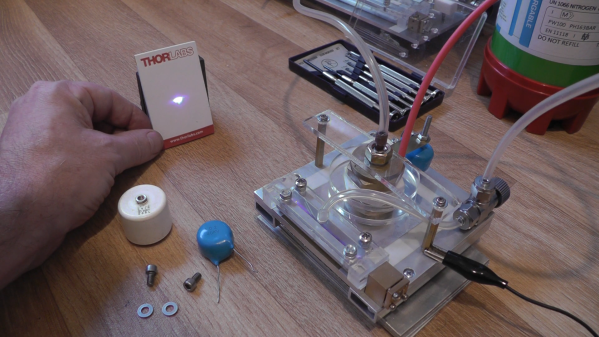
Building lasers is a great example of this, and [Les Wright] recently looked at substitutes for hard-to-find “doorknob” capacitors for his transversely excited atmospheric lasers. We took at his homebrew TEA lasers recently, which rely on a high voltage supply and very rapid switching to get nitrogen gas to lase. His design uses surplus doorknob caps, big chunky parts rated for very high voltages but also with very low parasitic inductance, which makes them perfect for the triggering circuit.

[Les] tried to substitute cheaper and easier-to-find ceramic power caps with radial wire leads rather than threaded lugs. With a nominal 40-kV rating, one would expect these chunky blue caps to tolerate the 17-kV power supply, but as he suspected, the distance between the leads was short enough to result in flashover arcing. Turning down the pressure in the spark gap chamber helped reduce the flashover and prove that these caps won’t spoil the carefully engineered inductive properties of the trigger. Check out the video below for more details.

Thanks to [Les] for following up on this and making sure everyone can replicate his designs. That’s one of the things we love about this community — true hackers always try to find a way around problems, even when it’s just finding alternates for unobtanium parts.

Continue reading “No Doorknobs Needed For This Nitrogen Laser Build”

For Your Holiday Relaxation: The Clickspring Sundial Build Megacut

The fortunate among us may very well have a bit of time off from work coming up, and while most of that time will likely be filled with family obligations and festivities, there’s probably going to be some downtime. And if you should happen to find yourself with a half hour free, you might want to check out the Clickspring Byzantine Calendar-Sundial mega edit. And we’ll gladly accept your gratitude in advance.

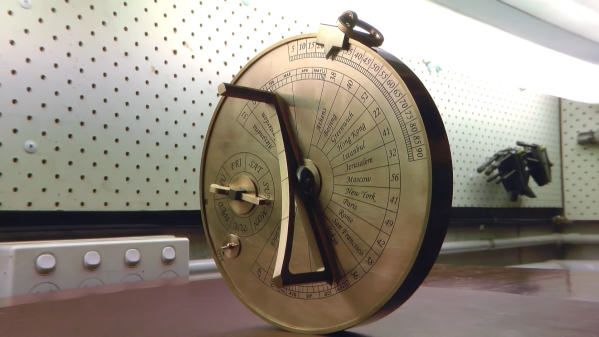
Fans of machining videos will no doubt already be familiar with Clickspring, aka [Chris], the amateur horologist who, through a combination of amazing craftsmanship and top-notch production values, managed to make clockmaking a spectator sport. We first caught the Clickspring bug with his open-frame clock build, which ended up as a legitimate work of art. [Chris] then undertook two builds at once: a reproduction of the famous Antikythera mechanism, and the calendar-sundial seen in the video below.

The cut condenses 1,000 hours of machining, turning, casting, heat-treating, and even hand-engraving of brass and steel into an incredibly relaxing video. There’s no narration, no exposition — nothing but the sounds of metal being shaped into dozens of parts that eventually fit perfectly together into an instrument worthy of a prince of Byzantium. This video really whets our appetite for more Antikythera build details, but we understand that [Chris] has been busy lately, so we’ll be patient.

Continue reading “For Your Holiday Relaxation: The Clickspring Sundial Build Megacut”

Hackaday Links Column Banner

Hackaday Links: December 20, 2020

If development platforms were people, Google would be one of the most prolific serial killers in history. Android Things, Google’s attempt at an OS for IoT devices, will officially start shutting down on January 5, 2021, and the plug will be pulled for good a year later. Android Things, which was basically a stripped-down version of the popular phone operating system, had promise, especially considering that Google was pitching it as a secure alternative in the IoT space, where security is often an afterthought. We haven’t exactly seen a lot of projects using Android Things, so the loss is probably not huge, but the list of projects snuffed by Google and the number of developers and users left high and dry by these changes continues to grow. Continue reading “Hackaday Links: December 20, 2020”

This Expedient Microfiche Reader Illuminates Retro Datasheets

You have to be of a certain vintage to remember doing research on microfilm and microfiche. Before the age of mass digitization of public records, periodicals, and other obscure bits of history, dead-tree records were optically condensed onto fine-grain film, either in roll form or as flat sheets, which were later enlarged and displayed on a specialized reader. This greatly reduced the storage space needed for documents, but it ended up being a technological dead-end once the computer age rolled around.

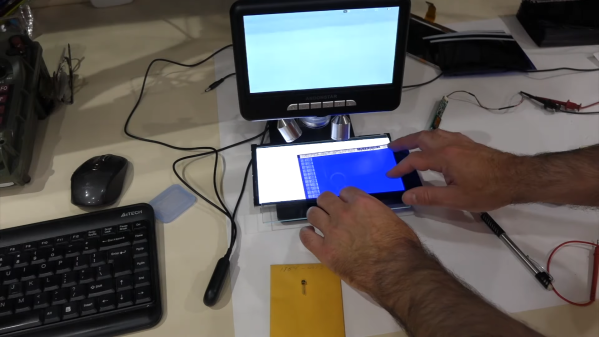
This was the problem [CuriousMarc] recently bumped into — a treasure trove of Hewlett-Packard component information on microfiche, but no reader for the diminutive datasheets. So naturally, he built his own microfiche reader. In a stroke of good luck, he had been gifted a low-cost digital microscope that seemed perfect for the job. The scope, with an HD camera and 5″ LCD screen, was geared more toward reflective than transmissive use, though, so [Marc] had trouble getting a decent picture of the microfiches, even with a white paper backing.

Version 2.0 used a cast-off backlight, harvested from a defunct DVD player screen, as a sort of light box for the stage of the microscope. It was just about the perfect size for the microfiches, and the microscope was able to blow up the tiny characters as well as any dedicated microfiche reader could, at a fraction of the price. Check out the video below for details on the build, as well as what [Marc] learned from the data sheets about his jackpot of HP parts.

With the wealth of data stored on microforms, we’re surprised that we haven’t seen any readers like this before. We have talked about microscopic wartime mail, though.

Continue reading “This Expedient Microfiche Reader Illuminates Retro Datasheets”