Solar Panel Keeps Car Battery Topped Off Through OBD-II Port

Up until the 1980s or so, a mechanic could check for shorts in a car’s electrical system by looking for sparks while removing the battery terminal with everything turned off in the car. That stopped being possible when cars started getting always-on devices, and as [Kerry Wong] learned, these phantom loads can leave one stranded with a dead battery at the airport after returning from a long trip.

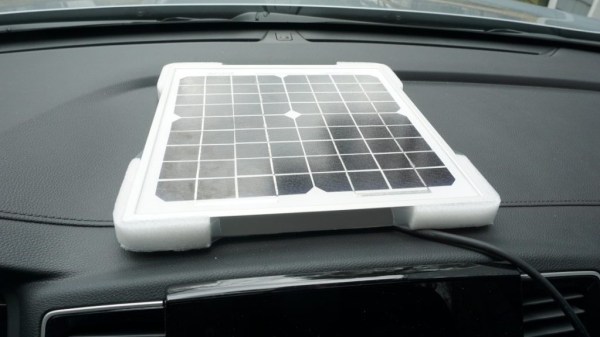
[Kerry]’s solution is simple: a solar trickle charger. Such devices are readily available commercially, of course, and generally consist of a small photovoltaic array that sits on the dashboard and a plug for the lighter socket. But as [Kerry] points out in the video below, most newer model cars no longer have lighter sockets that are wired to work without the ignition being on. So he chose to connect his solar panel directly to the OBD-II port, the spec for which calls for an always-on, fused circuit connected directly to the positive terminal of the vehicle battery. He had to hack together an adapter for the panel’s lighter plug, the insides of which are more than a little scary, and for good measure, he added a Schottky diode to prevent battery discharge through the panel. Even the weak winter sun provides 150 mA or so of trickle charge, and [Kerry] can rest assured his ride will be ready at the end of his trip.

We used to seeing [Kerry] tear down test gear and analyze unusual devices, along with the odd post mortem on nearly catastrophic failures. We’re glad nothing burst into flames with this one.

Continue reading “Solar Panel Keeps Car Battery Topped Off Through OBD-II Port”

Fear Of Potato Chips: Samy Kamkar’s Side-Channel Attack Roundup

What do potato chips and lost car keys have in common? On the surface, it would seem not much, unless you somehow managed to lose your keys in a bag of chips, which would be embarrassing enough that you’d likely never speak of it. But there is a surprising link between the two, and Samy Kamkar makes the association in his newly published 2019 Superconference talk, which he called “FPGA Glitching and Side-Channel Attacks.

Continue reading “Fear Of Potato Chips: Samy Kamkar’s Side-Channel Attack Roundup”

PCB Finishes Hack Chat

Join us on Wednesday, March 11 at noon Pacific for the PCB Finishes Hack Chat with Mark Hughes and Elijah Gracia!

There’s no way to overestimate the degree to which the invention of the printed circuit board revolutionized electronics. What was once the work of craftspeople weaving circuits together with discrete components, terminal strips, and wiring harnesses could now be accomplished with dedicated machines, making circuit construction an almost human-free process. And it was all made possible by figuring out how to make copper foil stick to a flat board, and how to remove some of it while leaving the rest behind.

​Once those traces are formed, however, there’s more work to be done. Bare copper is famously reactive stuff, and oxides soon form that will make the traces difficult to solder later. There are hundreds of different ways to prevent this, and PCB surface finishing has become almost an art form itself. Depending on the requirements for the circuit, traces can be coated with tin, lead, gold, nickel, or any combination of the above, using processes ranging from electroplating to immersion in chemical baths. And the traces aren’t the only finishes; solder resist and silkscreening are both important to the usability and durability of the finished board.

For this Hack Chat, we’ll be talking to Elijah Gracia and Mark Hughes from Royal Circuit Solutions. They’re both intimately familiar with the full range of PCB coatings and treatments, and they’ll help us make sense of the alphabet soup​: HASL, OSP, ENIG, IAg, LPI, and the rest. We’ll learn what the different finishes do, which to choose under what circumstances, and perhaps even learn a bit about how to make our homebrew boards look a little more professional and perform a bit better.

join-hack-chatOur Hack Chats are live community events in the Hackaday.io Hack Chat group messaging. This week we’ll be sitting down on Wednesday, March 11 at 12:00 PM Pacific time. If time zones have got you down, we have a handy time zone converter.

Click that speech bubble to the right, and you’ll be taken directly to the Hack Chat group on Hackaday.io. You don’t have to wait until Wednesday; join whenever you want and you can see what the community is talking about.

Hackaday Links Column Banner

Hackaday Links: March 8, 2020

A lot of annoying little hacks are needed to keep our integer-based calendar in sync with a floating-point universe, and the big one, leap day, passed us by this week. Aside from the ignominy of adding a day to what’s already the worst month of the year, leap day has a tendency to call out programmers who take shortcuts with their code. Matt Johnson-Pint has compiled a list of 2020 leap day bugs that cropped up, ranging from cell phones showing the wrong date on February 29 to an automated streetlight system in Denmark going wonky for the day. The highest-profile issue may have been system crashes of Robinhood, the online stock trading platform. Robinhood disagrees that the issues were caused by leap day code issues, saying that it was a simple case of too many users and not enough servers. That seems likely given last week’s coronavirus-fueled trading frenzy, but let’s see what happens in 2024.

Speaking of annoying time hacks, by the time US readers see this, we will have switched to Daylight Saving Time. Aside from costing everyone a precious hour of sleep, the semiannual clock switch always seems to set off debates about the need for Daylight Saving Time. Psychologists think it’s bad for us, and it has elicited a few bugs over the years. What will this year’s switch hold? Given the way 2020 has been going so far, you’d better buckle up.
Continue reading “Hackaday Links: March 8, 2020”

A Quick And Easy Recipe For Synthetic Rubies

With what it takes to make synthetic diamonds – the crushing pressures, the searing temperatures – you’d think similar conditions would be needed for any synthetic gemstone. Apparently not, though, as [NightHawkInLight] reveals his trivially easy method for making synthetic rubies.

Like their gemstone cousin the sapphire, rubies are just a variety of corundum, or aluminum oxide. Where sapphire gets its blue tint mainly from iron, rubies get their pink to blood-red hue from chromium. So [NightHawkInLight]’s recipe starts with aluminum oxide grit-blasting powder and chromium (III) oxide, a common green pigment and one of the safer compounds in a family that includes spectacularly toxic species like hexavalent chromium compounds. When mixed together, the two powders are heated in a graphite crucible using an arc welder with a carbon electrode. The crucible appears to be made from an EDM electrode; we’ve seen them used for air bearings before, but small crucibles are another great use for the stuff. There’s some finesse required to keep the nascent rubies from scattering all over the place, but in the end, [NightHawkInLight] was rewarded with a large, deep pink ruby.

This looks like a fun, quick little project to try sometime. We wonder if the method can be refined to create the guts of a ruby laser, or if perhaps it can be used to create sapphires instead.

Continue reading “A Quick And Easy Recipe For Synthetic Rubies”

Robotic Ball Bouncer Uses Machine Vision To Stay On Target

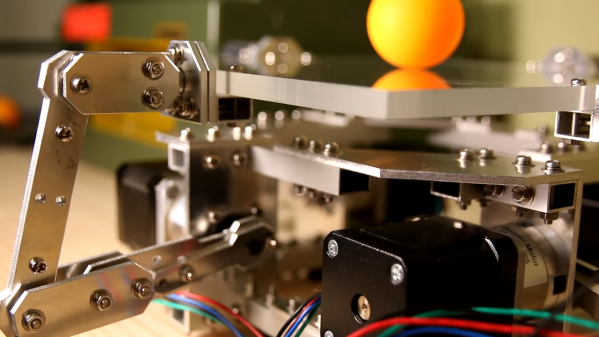
When we first caught a glimpse of this ball juggling platform, we were instantly hooked by its appearance. With its machined metal linkages and clear polycarbonate platform, its got an irresistibly industrial look. But as fetching as it may appear, it’s even cooler in action.

You may recognize the name [T-Kuhn] as well as sense the roots of the “Octo-Bouncer” from his previous juggling robot. That earlier version was especially impressive because it used microphones to listen to the pings and pongs of the ball bouncing off the platform and determine its location. This version went the optical feedback route, using a camera mounted under the platform to track the ball using OpenCV on a Windows machine. The platform linkages are made from 150 pieces of CNC’d aluminum, with each arm powered by a NEMA 17 stepper with a planetary gearbox. Motion control is via a Teensy, chosen for its blazing-fast clock speed which makes for smoother acceleration and deceleration profiles. Watch it in action from multiple angles in the video below.

Hats off to [T-Kuhn] for an excellent build and a mesmerizing device to watch. Both his jugglers do an excellent job of keeping the ball under control; his robotic ball-flinger is designed to throw the ball to the same spot every time.

Continue reading “Robotic Ball Bouncer Uses Machine Vision To Stay On Target”

Camera And Code Team Up To Make Impossible Hovering Laser Effect

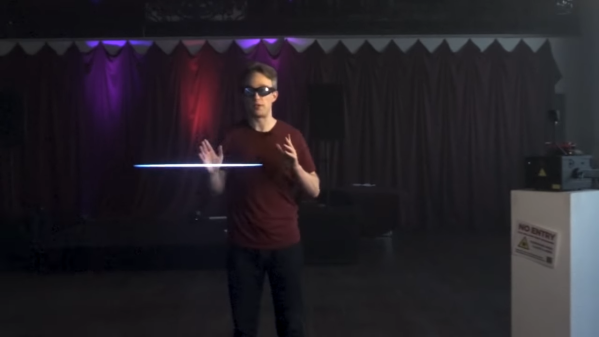
Right off the bat, we’ll say that this video showing a laser beam stopping in mid-air is nothing but a camera trick. But it’s the trick that’s the hack, and you’ve got to admit that it looks really cool.

It starts with the [Tom Scott] video, the first one after the break. [Tom] is great at presenting fascinating topics in a polished and engaging way, and he certainly does that here. In a darkened room, a begoggled [Tom] poses with what appears to be a slow-moving beam of light, similar to a million sci-fi movies where laser weapons always seem to disregard the laws of physics. He even manages to pull a [Kylo Ren] on the slo-mo photons with a “Force Stop” as well as a slightly awkward Matrix-style bullet-time shot.  It’s entertaining stuff, and the effect is all courtesy of the rolling shutter effect. The laser beam is rapidly modulated in sync with the camera’s shutter, and with the camera turned 90 degrees, the effect is to slow down or even stop the beam.

The tricky part of the hack is the laser stuff, which is the handiwork of [Seb Lee-Delisle]. The second video below goes into detail on his end of the effect. We’ve seen [Seb]’s work before, with a giant laser Asteroids game and a trick NES laser blaster that rivals this effect.

Continue reading “Camera And Code Team Up To Make Impossible Hovering Laser Effect”