Turning A Bad Bench Supply Into A Better Bench Supply

‘Tis the season for dropping hints on what new doodads would make a hacker happy, and we have to admit to doing a little virtual window shopping ourselves. And as a decent bench power supply is on our list, it was no surprise to see videos reviews that the hive mind thinks will help us make a choice pop up in our feed. It’s a magical time to be alive.

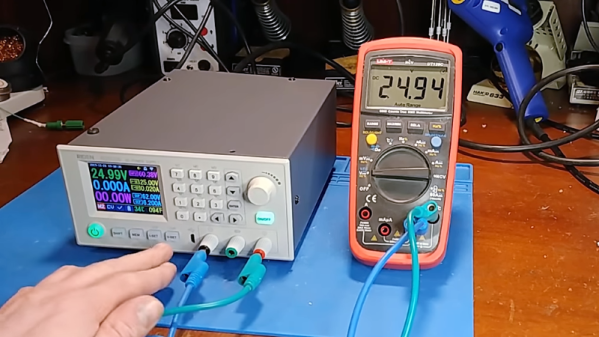
What did surprise us was this video on a mashup of two power supplies, both of which we’ve been eyeing, with the result being one nicely hacked programmable bench PSU. It comes to us courtesy of [jeffescortlx], who suffered with one of those no-name, low-end 30V-5A bench supplies that has significant lag when changing the settings, to the point that it’s difficult to use, not to mention dangerous for sensitive components.

So he got a hold of a Riden RD6006 programmable buck converter, which is something like those ubiquitous DPS power supply modules we’ve seen so much of, only on steroids. The Riden takes up to 70V input and turns it into a 0-60V output at up to 6 amps, at constant current or constant voltage. It also just happens to (almost) fit as a replacement for the faceplate of the dodgy old supply. A few SMD resistors simulate the original front panel pots being pegged so that the supply outputs maximum voltage and current, and a little finagling with the case and fan was needed to fit everything up, but the finished product actually looks really good, and fixes all the problems of the original.

We love this hack, and may well cobble this together for our bench.

Continue reading “Turning A Bad Bench Supply Into A Better Bench Supply”

Simple Acrylic Plates Make Kirlian Photography A Breeze

We know, we know – “Kirlian photography” is a term loaded with pseudoscientific baggage. Paranormal researchers have longed claimed that Kirlian photography can explore the mood or emotional state of a subject through the “aura”, an energy field said to surround and emanate from all living things. It’s straight-up nonsense, of course, but that doesn’t detract from the beauty of plasma aficionado [Jay Bowles]’ images produced by capacitive coupling and corona discharge.

Technically, what [Jay] is doing here is not quite Kirlian photography. The classic setup for “electrophotography” is a sandwich of photographic film, a glass plate, and a metal ground plate. An object with a high-voltage, high-frequency power supply attached is placed on top of the sandwich, and the resulting corona discharge exposes the film. [Jay]’s version is a thin chamber made of two pieces of solvent-welded acrylic and filled with water. A bolt between the acrylic panes conducts current from a Tesla coil – perhaps this one that we’ve featured before – into the water. When something is placed on the acrylic, a beautiful purple corona discharge streams out from the object.

It’s an eerie effect, and it’s easy to see how people can see an aura and attribute mystical properties to it. In the end, though, it’s not much different than touching a plasma globe, and just about as safe. Feeling a bit more destructive? Corona discharge is a great way to make art, both in wood and in acrylic.

Continue reading “Simple Acrylic Plates Make Kirlian Photography A Breeze”

Retrotechtacular: The Art Of The Foundry

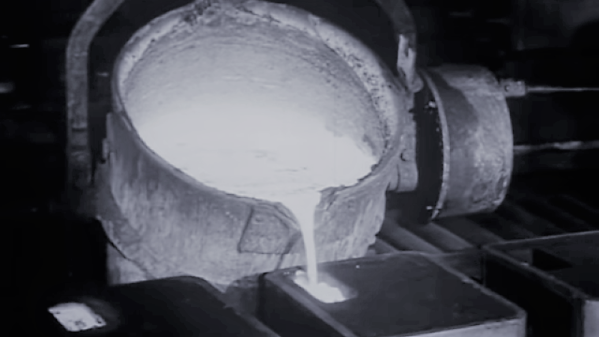
Mention the term “heavy industry” and the first thing to come to mind might well be the metal foundry. With immense machines and cauldrons of molten metal being shuttled about by crane and rail, the image of the foundry is like a scene from Dante’s Inferno, with fumes filling a vast impersonal factory, and sparks flying through the air. It looks like a dangerous place, as much to the soul as to the body, as workers file in each day to suffer mindlessly at the hearths and ladles, consumed in dirty, exhausting work even as it consumes them.

Things are not always as they appear, of course. While there’s no doubting the risks associated with working in a foundry such as the sprawling Renfrew works of Babcock and Wilcox Ltd. in the middle of the previous century, as the video below shows the work there was anything but mindless, and the products churned out by the millions from this factory and places like it throughout the world were critical to today’s technology.

Continue reading “Retrotechtacular: The Art Of The Foundry”

Steel Tubes And Ground Plates Form The Skeleton Of This DIY Vertical CNC Mill

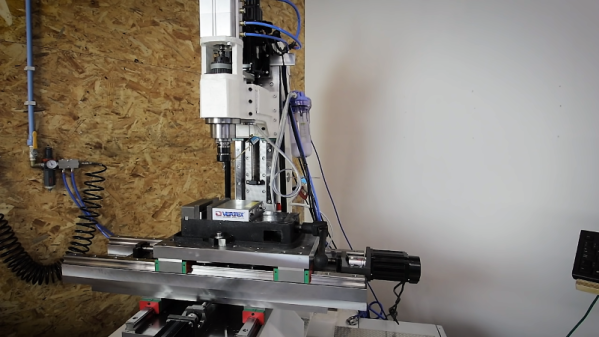
If you’re going to do it yourself, you might as well outdo yourself. That seems to be the thinking behind this scratch-built CNC mill, and it’s only just getting started.

According to [Kris Temmerman], the build will cost about $10,000 by the time he’s done. So it’s not cheap, and a personal CNC from Tormach can be had for less, but that’s missing the point entirely. [Kris] built most of the structural elements for the vertical mill from cheap, readily available steel tubing, of the kind used for support columns in commercial buildings. Mounted to those are thick, precision-ground steel plates, which eat up a fair fraction of the budget. Those in turn hold 35 mm linear bearings and ball screws for the three axes, each powered by a beefy servo. The spindle is a BT30 with a power drawbar, belt-driven by an external motor that [Kris] doesn’t share the specs on, but judging from the way it flings chips during the test cut in the video below, we’d say it’s pretty powerful.

There’s still plenty to do, not least of which is stiffening the column; perhaps filling it with epoxy granite would do the trick? But it sure looks like [Kris] is building a winner here, and if he keeps the level of craftsmanship up going forward, he’ll have a top-quality machine on his hands.

Continue reading “Steel Tubes And Ground Plates Form The Skeleton Of This DIY Vertical CNC Mill”

Turning OLEDs And Acrylic Into Faux Nixie Tubes

Love ’em or hate ’em, Nixies and the retro clocks they adorn are here to stay. At least until the world’s stock of surplus Soviet tubes is finally depleted, that is. The glow discharge tubes were last mass manufactured in the 1980s, and while they’re not too hard to get a hold of yet, they will be eventually. And what better way to get ready for that dreaded day than by rolling your own OLED faux Nixie tubes?

Granted, [Derek]’s faux Nixies, appropriately dubbed “Fixies,” require just a touch of willing suspension of disbelief. We’ve never see Nixies with tiny jam jars as envelopes, so that’s probably the first giveaway. But looking past that, the innards of these fake displays do a pretty convincing job of imitating the texture of the real thing.

The numbers themselves are displayed on a 128×64 white OLED display using a Nixie-like True Type font. An orange acrylic filter in front of the display gives it that warm amber Nixie glow, with laser etchings mimicking both the fine hexagonal anode grid and the ghostly cathodes of the non-illuminated numerals. The tubes looked convincing enough that a clock was in order, and after sorting through an I2C bottleneck with the help of a multiplexer, [Derek] had a pretty decent faux-Nixie clock, complete with a solenoid-actuated mechanical gong. The double-digit display for the seconds will no doubt cause some consternation among Nixie purists, but that’s probably part of the fun.

Of course, just because Nixies aren’t being mass-produced today doesn’t mean you can’t get new ones. You just have to be willing to pay for them, and [Dalibor Farný] will gladly set you up with his handmade artisanal Nixies, or even a clock kit using them.

Continue reading “Turning OLEDs And Acrylic Into Faux Nixie Tubes”

Fail Of The Week: Z-Tape Is No Substitute For Solder

Here at Hackaday, we see all kinds of mechanical construction methods. Some are impressively solid and permanent, while others are obviously temporary in nature. The latter group is dominated by adhesives – sticky stuff like cyanoacrylate glue, Kapton tape, and the ever-popular hot glue. They’ve all got their uses in assembling enclosures or fixing components together mechanically, but surely they have no place in making solid electrical connections, right?

Maybe, maybe not. As [Tom Verbeure] relates, so-called Z-tape just might be an adhesive that can stand in for solder under certain circumstances. Trouble is, he couldn’t find the right conditions to make the tape work. Z-tape, more properly called “Electrically Conductive Adhesive Transfer Tape 9703”,  derives its nickname from the fact that it’s electrically conductive, but only in the Z-axis. [Tom] learned about Z-tape in [Joe FitzPatrick]’s malicious hardware prototyping workshop at the 2019 Hackaday Superconference, and decided to put it to the test.

A card from a Cisco router served as a testbed thanks to an unpopulated chip footprint. The 0.5-mm pin spacing on the TSOP-48 chip was within spec for the Z-tape, but the area of each pin was 30 times smaller than the recommended minimum bonding area. While the chip was held down mechanically by the Z-tape, only five of the 48 pins were electrically connected to the pads. Emboldened by the partial success, [Tom] tried a 28-pin SOIC chip next. The larger pins and pads were still six times smaller than the minimum, and while more of the pins ended up connected by the tape, he was unable to make all 28 connections.

Reading the datasheet for the adhesive revealed that constant pressure from a clamp or clip might be necessary for reliable connections, which suggests that gluing down SMD chips is probably not the best application for the stuff. Still, we appreciate the effort, and the fine photomicrographs [Tom] made showing the particles within the Z-tape that make it work – at least in some applications.

Hackaday Links Column Banner

Hackaday Links: November 24, 2019

It barely seems like it, but it’s been a week since the 2019 Hackaday Superconference wrapped up in sunny Pasadena. It was an amazing weekend, filled with fun, food, camaraderie, and hacks galore. For all who were there, it’ll likely take quite some time before spinning down to Earth again from the post-con high. For those who couldn’t make it, or for those who did but couldn’t squeeze in time for all those talks with everything else going on, luckily we’ve got a ton of content for you to review. Start on the Hackaday YouTube channel, where we’ve got videos already posted from most of the main stage talks. Can’t-miss talks include Chris Gammell’s RF deep-dive, Kelly Heaton’s natural electronic art, and Mohit Bhoite’s circuit sculpture overview. You’ll also want to watch The State of the Hackaday address by Editor-in-Chief Mike Szczys. More talks will be added as they’re edited, so watch that space for developments.

One of the talks we missed – and video of which appears not to be posted yet – was Adam Zeloof’s talk on thermodynamic design for your circuits. While we wait for that, here’s an interesting part that might prove useful for your next high-power design. It’s a Thermal Jumper Chip, which is essentially a ceramic SMD component that can conduct heat but not electricity. It’s intended to be used where a TO-220 case needs to be electrically isolated but thermally connected to a heatsink. Manufacturer TT Electronics has a whole line of the chips in various sizes and specs, plus a lot of other cool components like percussive igniters.

We got an interesting tip this week about a new development in the world of 3D-printing. A group from Harvard demonstrated a multinozzle extruder that can print multimaterial objects in a single pass. The work is written up in a Nature article entitled “Voxelated soft matter via multimaterial multinozzle 3D printing”, which is unfortunately paywalled, but the abstract and supplementary videos are really interesting. This appears not to be a standard hot plastic extrusion process; rather, the extruder uses elastomeric inks that cure after they’re extruded. They manage some clever tricks, including a millipede-like, vacuum-powered soft robot extruded in one pass from both soft and rigid silicone elastomers. It’s genuinely interesting stuff, and watching the multimaterial extruder head switch materials at up to 50 times per second is mesmerizing.

People really seemed to get worked up over the transit of Mercury across the face of the Sun last week, and for good reason – astronomical alignments such as these which can be seen from Earth are rare indeed, and worth taking time to see. Not everyone was in the right place at the right time with the right gear to view the transit directly, though, which is why we were glad that Justin over at The Thought Emporium did a video on leveraging online assets for space-based observations. We’ve featured a ton of hacks using SDRs and the like to intercept data from weather satellites, and while those hacks are fun and you should totally try them, Justin points out that most of these streams are readily available for free over the Internet. Clouds, lightning, forest fires and Earth changes, and yes, even the state of the Sun can all be monitored from the web.

Speaking of changes, do you know what has changed in Unix over the last 50 years? For that matter, did you know that Unix turned 50 recently? Sean Haas did after reading this article in Advent of Computing, which he shared on the tipline. The article compares a modern Debian distro to documentation from 1971 that pre-dates Unix version 1; we assume the “Dennis_v1” folder in the doc’s URL refers to none other than Dennis Ritchie himself. It turns out that Unix is remarkably well-conserved over 50 years, at least in the userspace. File system navigation and shell commands are much the same, while programming was much different. C didn’t yet exist – Dennis was busy – but there were assemblers and linkers, plus a FORTRAN compiler and an interpreter for BASIC. It’s comforting to know that if you drop into a wormhole and end up sitting in front of a PDP-11 with Three Dog Night singing “Joy to the World” on the radio in the background, you’ll at least be able to look like you belong there.

And finally, it’s nearly Sparklecon time again. Sparklecon VII will be held on January 25 and 26, 2020, at the 23b Shop hackspace in Fullerton, California. We’ve covered previous Sparkelcons and we’ve even sponsored the meetup in the past, and it looks like a blast. The organizers have put out a Call for Proposals for talks and workshops, so if you’re in the mood for some mischief, get your application going. And be quick about it – the CFP closes on December 8.