Dambusting, R/C Style

Disclaimer: no dams were actually busted in the making of the video below. But that doesn’t mean that a scale-model homage to the WWII Dam Busters and their “Bouncing Bombs” isn’t worth doing, of course.

In a war filled with hacks, [Barnes Wallis]’ Bouncing Bomb concept might just be the hackiest. In the video below, [Tom Stanton] explains that [Wallis] came up with the idea of skipping a bomb across the surface of a lake to destroy enemy infrastructure after skipping marbles across the water. Using barrel-shaped bombs, he built a rig that could give them the proper amount of backspin and release them at just the right time, letting them skip across the surface of the lake while the bomber made an escape. Upon hitting the rim of the dam, the bomb would sink to explode near the base, maximizing damage.

[Tom]’s scale rig ended up being a clever design with spring-loaded arms to release a 3D-printed barrel after being spun up by a brushless motor. He teamed up with R/C builder [James Whomsley], who came up with a wonderful foam-board Lancaster bomber, just like RAF No. 617 Squadron used. With a calm day and smooth water on the lake they chose for testing, the R/C Lanc made a few test runs before releasing the first barrel bomb. The first run was a bit too steep, causing the bomb to just dive into the water without skipping. Technical problems and a crash landing foiled the second run, but the third run was perfect – the bomb skipped thrice while the plane banked gracefully away. [Tom] also tried a heavy-lift quadcopter run with the bomb rig, something [Barnes Wallis] couldn’t even have dreamed of back in the day.

Hats off to [Tom] and [James] for collaborating on this and getting the skipping to work. It reminds us a bit of the engineered approach to rock-skipping, though with less deadly intentions.

Continue reading “Dambusting, R/C Style”

Fast Fresnel Hack Embiggens The Smallest Of Heads

Aside from frightening small children, we have absolutely no idea why anyone would need a face-magnifying headpiece. But the video below gives us a chuckle every time we see it, and we figure a good laugh that incorporates a quick optics hack is worth a look.

When he’s not playing geek in a box, [Curious Marc]’s videos usually have more of a retrocomputing theme, like his recent conversion of a vintage terminal to a character set from a made-up language, or helping to revive an Apollo Guidance Computer. Given gems like those, we were surprised to learn that [Marc]’s background is physics – optics, to be precise – and that he studied at École Polytechnique, the same school famed physicist Augustin-Jean Fresnel attended. Which fits right into this build since it features one of those large, plastic Fresnel lenses. After a fascinating detour into the history of Fresnel’s namesake lens, [Marc] proceeds with the build.

It’s simplicity itself – a box big enough to wear on the head with one end replaced by the Fresnel lens. A strip of LEDs – warm white, please, lest the wearer takes on a deathly pall – lines the edge of the box just behind the lens. If you want to get fancy, maybe attaching a hard-hat suspension piece would make it more wearable, but even as is it’s just a hoot to see someone with a magnified and distorted head walking around. One probably should be careful not to look at the sun while wearing this, however, for reasons that become apparent beginning at the 3:24 mark of the video.

Thanks to [Marc] for perhaps the oddest YouTube face-reveal yet, and for a great idea for a quick cosplay hack.

Continue reading “Fast Fresnel Hack Embiggens The Smallest Of Heads”

A Newbie Takes The SMD Challenge At Supercon

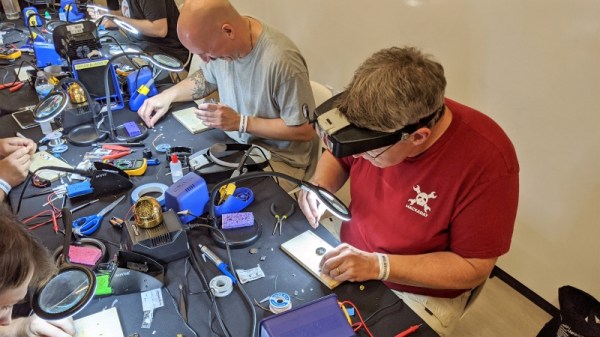
First-time visitors to Disneyworld often naively think they’re going to “do” the park in three days: one day for the Magic Kingdom, one day for Epcot, and one day for everything else. It’s easy to spot such people, collapsed on a bench or dragging exhausted kids around while trying to make their way to the next must-see attraction. Supercon is something like that — a Disney-esque theme park for hackers that will exhaust you if you don’t have a plan, and if you don’t set reasonable expectations. Which is why I was glad that I set only one real goal for my first Supercon: take the SMD Soldering Challenge.

Now, while I’m pretty handy with a soldering iron, I was under no illusion that I would be at all competitive. All my soldering experience has been with through-hole components, and while I also used to doing some production soldering on fine-pitch connectors, the whole surface-mount thing is new to me. I entered mainly because I wanted to see what was possible coming in raw. At best I’d learn what my limits are, and at worst I’d fail spectacularly and provide grist for a “Fail of the Supercon” post. It’s a win either way.

Continue reading “A Newbie Takes The SMD Challenge At Supercon”

Used EDM Electrodes Repurposed As Air Bearings For Precision Machine Tools

If you’ve ever played air hockey, you know how the tiny jets of air shooting up from the pinholes in the playing surface reduce friction with the puck. But what if you turned that upside down? What if the puck had holes that shot the air downward? We’re not sure how the gameplay would be on such an inverse air hockey table, but [Dave Preiss] has made DIY air bearings from such a setup, and they’re pretty impressive.

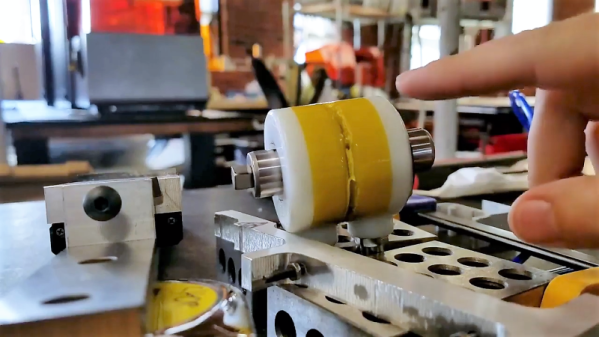
Air bearings are often found in ultra-precision machine tools where nanometer-scale positioning is needed. Such gear is often breathtakingly expensive, but [Dave]’s version of the bearings used in these machines are surprisingly cheap. The working surfaces are made from slugs of porous graphite, originally used as electrodes for electrical discharge machining (EDM). The material is easily flattened with abrasives against a reference granite plate, after which it’s pressed into a 3D-printed plastic plenum. The plenum accepts a fitting for compressed air, which wends its way out the micron-sized pores in the graphite and supports the load on a thin cushion of air. In addition to puck-style planar bearings, [Dave] tried his hand at a rotary bearing, arguably more useful to precision machine tool builds. That proved to be a bit more challenging, but the video below shows that he was able to get it working pretty well.

We really enjoyed learning about air bearings from [Dave]’s experiments, and we look forward to seeing them put to use. Perhaps it will be in something like the micron-precision lathe we featured recently.

Continue reading “Used EDM Electrodes Repurposed As Air Bearings For Precision Machine Tools”

Hackaday Links Column Banner

Hackaday Links: November 17, 2019

Friday, November 15, 2019 – PASADENA. The 2019 Hackaday Superconference is getting into high gear as I write this. Sitting in the Supplyframe HQ outside the registration desk is endlessly entertaining, as attendees pour in and get their swag bags and badges. It’s like watching a parade of luminaries from the hardware hacking world, and everyone looks like they came ready to work. The workshops are starting, the SMD soldering challenge is underway, and every nook and cranny seems to have someone hunched over the amazing Hackaday Superconference badge, trying to turn it into something even more amazing. The talks start on Saturday, and if you’re not one of the lucky hundreds here this weekend, make sure you tune into the livestream so you don’t miss any of the action.

The day when the average person is able to shoot something out of the sky with a laser is apparently here. Pablo, who lives in Argentina, has beeing keeping tabs on the mass protests going on in neighboring Chile. Huge crowds have been gathering regularly over the last few weeks to protest inequality. The crowd gathered in the capital city of Santiago on Wednesday night took issue with the sudden appearance of a police UAV overhead. In an impressive feat of cooperation, they trained 40 to 50 green laser pointers on the offending drone. The videos showing the green beams lancing through the air are quite amazing, and even more amazing is the fact that the drone was apparently downed by the lasers. Whether it was blinding the operator through the FPV camera or if the accumulated heat of dozens of lasers caused some kind of damage to the drone is hard to say, and we’d guess that the drone was not treated too kindly by the protestors when it landed in the midsts, so there’s likely not much left of the craft to do a forensic analysis, which is a pity. We will note that the protestors also trained their lasers on a police helicopter, an act that’s extremely dangerous to the human pilots which we can’t condone.

In news that should shock literally nobody, Chris Petrich reports that there’s a pretty good chance the DS18B20 temperature sensor chips you have in your parts bin are counterfeits. Almost all of the 500 sensors he purchased from two dozen vendors on eBay tested as fakes. His Github readme has an extensive list that lumps the counterfeits into four categories of fake-ness, with issues ranging from inaccurate temperature offsets to sensors without EEPROM that don’t work with parasitic power. What’s worse, a lot of the fakes test almost-sorta like authentic chips, meaning that they may work in your design, but that you’re clearly not getting what you paid for. The short story to telling real chips from the fakes is that Maxim chips have laser-etched markings, while the imposters sport printed numbers. If you need the real deal, Chris suggests sticking with reputable suppliers with validated supply chains. Caveat emptor.

A few weeks back we posted a link to the NXP Homebrew RF Design Challenge, which tasked participants to build something cool with NXP’s new LDMOS RF power transistors. The three winners of the challenge were just announced, and we’re proud to see that Razvan’s wonderfully engineered broadband RF power amp, which we recently featured, won second place. First place went to Jim Veatch for another broadband amp that can be built for $80 using an off-the-shelf CPU heatsink for thermal management. Third prize was awarded to a team lead by Weston Braun, which came up with a switch-mode RF amp for the plasma cavity for micro-thrusters for CubeSats, adorably named the Pocket Rocket. We’ve featured similar thrusters recently, and we’ll be doing a Hack Chat on the topic in December. Congratulations to the winners for their excellent designs.


Tindie Seller Reviews A Knock-Off Of His Own Product

If imitation is the sincerest form of flattery, online creators are being sincerely flattered at an alarming rate these days. We Hackaday scribes see it all the time, as straight copy-pastes of our articles turn up on other websites under different bylines. It’s annoying, but given prevailing attitudes toward intellectual property rights, there’s very little point in getting upset about it anymore. But what if it’s hardware that’s being infringed upon?

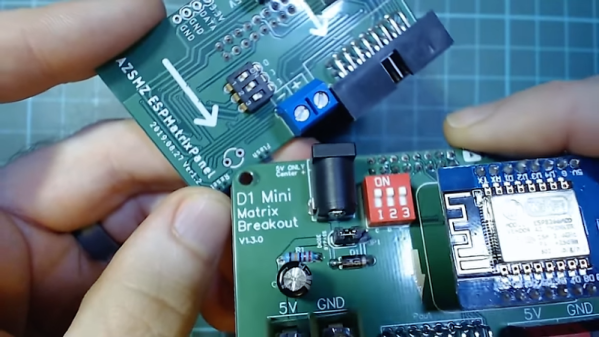
Hacker and Tindie store proprietor [Brian Lough] recently ran into this problem with one of his products, but rather than get upset, he did a remarkably fair and thoughtful review of the knock-off. The board in question, a D1 Mini Matrix Shield, makes it a snap to use LED matrix panels in projects like his Tetris-themed YouTube sub counter. The knock-off came via Ali Express, with the most “flattering” aspect being the copy and the images on the Ali Express listing, some of which are pulled straight from [Brian]’s Tindie store. While the board’s layout is different, it’s pretty clear that it was strongly inspired by the original. And the changes they did make – like terminal choices and undersizing some traces – only serve to lower the quality of the knock-off. Surely this was a cost-cutting move, so they could undercut sales of the original, right? Apparently not – the knock off is more expensive. Yes, [Brian]’s board is a kit and the imitator is fully assembled, but it still begs the question of why?

Hats off to [Brian] for not only making a useful product, but for taking the time to engineer it properly and having the ambition to put it on the market. It’s a pity that someone felt the need to steal his work, but it seems to be a rite of passage these days.

Continue reading “Tindie Seller Reviews A Knock-Off Of His Own Product”

HF Propagation And Earthquakes

For all the successes of modern weather forecasting, where hurricanes, blizzards, and even notoriously unpredictable tornadoes are routinely detected before they strike, reliably predicting one aspect of nature’s fury has eluded us: earthquakes. The development of plate tectonic theory in the middle of the 20th century and the construction of a worldwide network of seismic sensors gave geologists the tools to understand how earthquakes happened, and even provided the tantalizing possibility of an accurate predictor of a coming quake. Such efforts had only limited success, though, and enough false alarms that most efforts to predict earthquakes were abandoned by the late 1990s or so.

It may turn out that scientists were looking in the wrong place for a reliable predictor of coming earthquakes. Some geologists and geophysicists have become convinced that instead of watching the twitches and spasms of the earth, the state of the skies above might be more fruitful. And they’re using the propagation of radio waves from both space and the ground to prove their point that the ionosphere does some interesting things before and after an earthquake strikes.

Continue reading “HF Propagation And Earthquakes”