The Ifs Make Learning To Code Child’s Play

Anyone who has done the slightest bit of programming knows about the “Hello, World!” program. It’s the archetypal program that one enters to get a feel for a new language or a new architecture; if you can get a machine to print “Hello, World!” back to you, the rest is just details. But what about teaching kids to program? How does one get toddlers thinking in logical, procedural ways? More particularly, what’s a “Hello, World!” program look like for the pre-literate set?

Those are the sort of questions that led to The Ifs by [Makeroni Labs]. The Ifs are educational toys for teaching kids as young as three the basics of coding. Each If is a colorful plastic cube with a cartoon face and a “personality” that reflects what the block does – some blocks have actuators, some have sensors. The blocks are programmed by placing magnetic tabs on the top representing conditions and actions. A kid might choose to program a block to detect when it’s being shaken, or when the lights come on, and then respond by playing a sound or vibrating. The blocks can communicate with each other too, so that when the condition for one block is satisfied, something happens on another block.

The Ifs look like a lot of fun, and they’re a great jumpstart on the logical thinking skills needed for coders and non-coders alike. We’re not alone in thinking this is a pretty keen project – the judges for this year’s Hackaday Prize selected The Ifs as one of the twenty finalists. Will it win? We’ll find out next week at the 2019 Hackaday Superconference. If you won’t be in Pasadena with us, make sure you tune in to the livestream to watch the announcement.

Mechanical Seven-Segment Display Mixes Art With Hacking

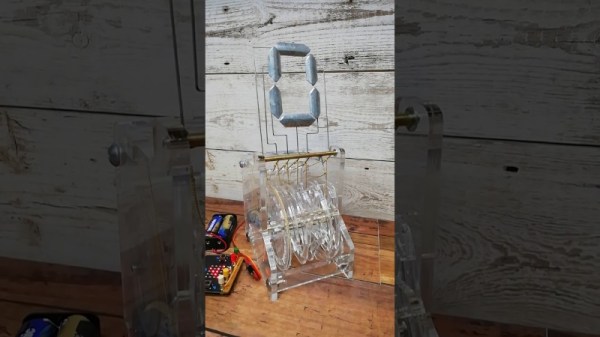
We’re not sure what to call this one. Is it a circuit sculpture? Sort of, but it moves, so perhaps it’s a kinetic circuit sculpture. Creator [Tomohiro Tsuchita] calls it “something beautiful but totally useless,” which we find a tad harsh. But whatever you call it, we think this mechanical seven-segment display is really, really cool.

Before anyone gets to thinking that this is something like the other mechanical seven-segment displays we’ve seen lately, think again. This one is not addressable; it simply goes through the ten digits in order. So you won’t be building a clock from it, although we suppose the mechanism could be modified to allow that. Then again, looking at that drive train of laser-cut acrylic cams, maybe not. Each segment has its own cam with lobes or valleys for each segment. A cam follower lowers and raises the segments as the cams rotate on a common shaft. A full-rotation servo powers the display under the control of a Micro:bit; the microcontroller is overkill for now but will be used in version two, which will allow the speed to change in response to sensors.

Watching this display change at its stately pace is strangely soothing. We love the look of this, but then again, we’re partial to objets d’art-circuit. After all, we ran a circuit sculpture contest earlier in the year, and just wrapped up a Hack Chat dedicated to the subject.

Continue reading “Mechanical Seven-Segment Display Mixes Art With Hacking”

Hackaday Links Column Banner

Hackaday Links: November 10, 2019

In the leafy suburbs of northern Virginia, a place ruled by homeowner’s associations with tremendous power to dictate everything from the color of one’s front door to the length of grass in the lawn, something as heinous as garage doors suddenly failing to open on command is sure to cause a kerfuffle. We’ve seen this sort of thing before, where errant RF emissions cause unintentional interference, and such stories aren’t terribly interesting because the FCC usually steps in and clears things up. But this story is a little spicier given the source of the interference: Warrenton Training Center, a classified US government communications station located adjacent to the afflicted neighborhood. WTC is known to be a CIA signals intelligence station, home to spooks doing spooky stuff, including running high-power numbers stations. The interference isn’t caused by anything as cloak-and-dagger as that, though; rather, it comes from new land-mobile radios that the Department of Defense is deploying. The new radios use the 380-400 MHz band, which is allocated to the Federal Government and unlicensed Part 15 devices, like garage door remotes. But Part 15 rules, which are clearly printed on every device covered by them, state that the devices have to accept unwanted interference, even when it causes a malfunction. So the HOA members who are up in arms and demanding that the government buy them new garage door openers are likely to be disappointed.

Speaking of spooks, if you’re tired of the prying electronic eyes of facial recognition cameras spoiling your illusion of anonymity, have we got a solution for you. The Opt-Out Cap is the low-tech way to instantly change your face for a better one, or at least one that’s tied to someone else. In a move which is sure not to arouse suspicion in public, doffing the baseball cap deploys a three-piece curtain of semi-opaque fabric, upon which is printed the visage of someone who totally doesn’t look creepy or sketchy in any way. Complete instructions are provided if you want to make one before your next trip to the ATM.

It’s always a great day when a new Ken Shirriff post pops up in our feed, and his latest post is no exception. In it, Ken goes into great detail about the history of the 80×24 (or 25) line standard for displays. While that may sound a bit dry, it’s anything but. After dispelling some of the myths and questionable theories of the format’s origin – sorry, it’s not just because punch cards had 80 columns – he discusses the transition from teletypes to CRTs, focusing on the very cool IBM 2260 Display Station. This interesting beast used an acoustic delay line made of 50′ (15 m) of nickel wire. It stored data as a train of sound pulses traveling down the wire, which worked well and was far cheaper than core memory, even if it was susceptible to vibrations from people walking by it and needed a two-hour warm-up period before use. It’s a fascinating bit of retrocomputing history.

A quick mention of a contest we just heard about that might be right up your alley: the Tech To Protect coding challenge is going on now. Focused on applications for public safety and first responders, the online coding challenge addresses ten different areas, such as mapping LTE network coverage to aid first responders or using augmented reality while extricating car crash victims. It’s interesting stuff, but if you’re interested you’ll have to hurry – the deadline is November 15.

And finally, Supercon starts this week! It’s going to be a blast, and the excitement to hack all the badges and see all the talks is building rapidly. We know not everyone can go, and if you’re going to miss it, we feel for you. Don’t forget that you can still participate vicariously through our livestream. We’ll also be tweet-storming and running a continuous chat on Hackaday.io to keep everyone looped in.


Keep An Eye On The Neighborhood With This Passive Radar

If your neighborhood is anything like ours, walking across the street is like taking your life in your own hands. Drivers are increasingly unconcerned by such trivialities as speed limits or staying under control, and anything goes when they need to connect Point A to Point B in the least amount of time possible. Monitoring traffic with this passive radar will not do a thing to slow drivers down, but it’s a pretty cool hack that will at least yield some insights into traffic patterns.

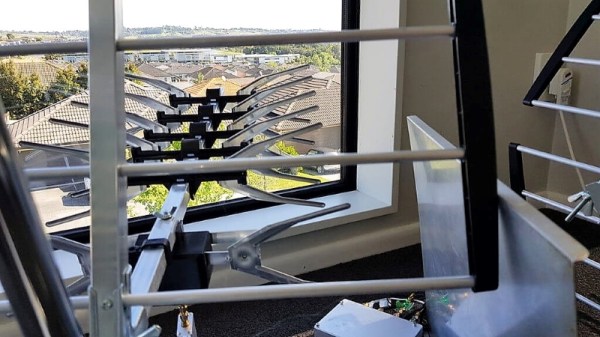
The principle behind active radar – the kind police use to catch speeders in every neighborhood but yours – is simple: send a microwave signal towards a moving object, measure the frequency shift in the reflected signal, and do a little math to calculate the relative velocity. A passive radar like the one described in the RTL-SDR.com article linked above is quite different. Rather than painting a target with an RF signal, it relies on signals from other transmitters, such as terrestrial TV or radio outlets in the area. Two different receivers are used, both with directional antennas. One points to the area to be monitored, while the other points directly to the transmitter. By comparing signals reflected off moving objects received by the former against the reference signal from the latter, information about the distance and velocity of objects in the target area can be obtained.

The RTL-SDR test used a pair of cheap Yagi antennas for a nearby DVB-T channel to feed their KerberosSDR four-channel coherent SDR, a device we last looked at when it was still in beta. Essentially four SDR dongles on a common board, it’s available now for $149. Using it to build a passive radar might not save the neighborhood, but it could be a lot of fun to try.

Well-Engineered RF Amplifier Powers Ham Radio Contacts

Typically, amateur radio operators use the minimum power needed to accomplish a contact. That’s just part of being a good spectrum citizen, and well-earned bragging rights go to those who make transcontinental contacts on the power coming from a coin cell. But sometimes quantity has a quality all its own, and getting more power into the ether is what the contact requires. That’s where builds such as this well-engineered 600W broadband RF amplifier come into play.

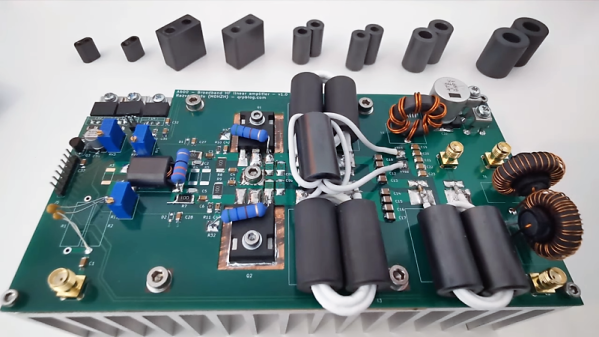
We’re really impressed with the work that [Razvan] put into this power amp. One of the great joys of being a ham is being able to build your own gear, and to incorporate the latest technology long before the Big Three manufacturers start using it. While LDMOS transistors aren’t exactly new – laterally-diffused MOSFETs have been appearing in RF power applications for decades – the particular parts used for the amp, NXP’s MRF300 power transistors, are pretty new to the market. A pair of the LDMOS devices form the heart of the push-pull amp, as do an array of custom-wound toroids and transformers including a transmission line transformer wound with 17-ohm coax cable. [Razvan] paid a lot of attention to thermal engineering, too, with the LDMOS transistors living in cutouts in the custom PCB so they can mate with a hefty heatsink. Even the heatsink compound is special; rather than the typical silicone grease, he chose a liquid metal alloy called Gallinstan. The video below gives a tour of the amp and shows some tests with impressive results.

Continue reading “Well-Engineered RF Amplifier Powers Ham Radio Contacts”

3D-Printed Magazines Tame The SMD Tape Beast

Chances are pretty good that you’ve got a box or a bin somewhere in your shop with coils of SMD component tapes in it. If you’re lucky, the coils are somewhat contained in their conductive Mylar bags; if you’re more like us, the tapes are flopping around loose in an attempt to seemingly tie themselves together. In either case, these 3D-printed SMD magazines will bring a little order to the chaos, and make board assembly a little bit easier.

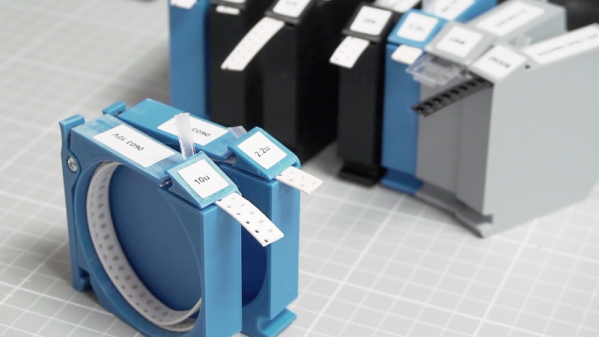
When we saw [Robin Reiter]’s build, we thought these would be cassettes for some sort of pick-and-place machine. But while they certainly look like they could be adapted to an automated PnP setup, [Robin]’s main goal was to provide organized storage for loose tapes. Each magazine has a circular reservoir to hold the coiled tape, with an exit slot at the front and a wedge that directs the cover tape in the opposite direction. This removes the cover tape to expose the components, clears it away from the pickup area, and as a bonus, allows the component tape to be advanced just by pulling back on the cover. Each magazine has a spring-loaded latch that clips onto a base that looks a bit like a DIN-rail; the weighted base holds several magazines and makes it easy to set up a manual pick-and-place session. The video below shows all the details.

For certain personality types, this really scratches an itch. We love the modular design, and the organization that these would bring to our shop would really help clean things up a bit. And if [Robin] were ever to take this design to the next level, adding something like this could be useful.

Continue reading “3D-Printed Magazines Tame The SMD Tape Beast”

Circuit Sculpture Hack Chat

Join us on Wednesday, November 6 at noon Pacific for the Circuit Sculpture Hack Chat with Mohit Bhoite!

For all the effort engineers put into electronic design, very few people ever get to appreciate it. All the hard work that goes into laying out a good PCB and carefully selecting just the right components is hidden the moment the board is slipped into an enclosure, only to be interacted with again through a user interface that gets all the credit for the look and feel of the product.

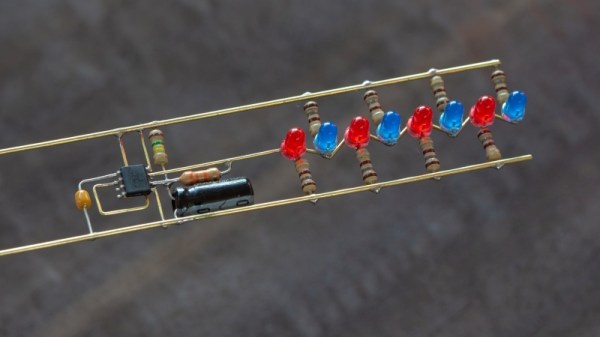
And yet there are some who design circuits purely as works of art. They may do something interesting or useful, but function is generally secondary to form for these circuit sculptors. Often consisting of skeletons of brass wire bent at precise angles to form intricate structures, circuit sculptures are the zen garden of electronic design: they’re where the designer turns to quiet the madness of making deadlines and meeting specs by focusing on the beauty of components themselves and putting them on display for all to enjoy.

By day, our host Mohit designs and builds hardware at Particle. By night, however, the wires and pliers come out, and he makes circuit sculptures that come alive. Check out his portfolio; you won’t be disappointed. This Hack Chat will be your chance to find out everything that goes into making these sculptures. Find out where Mohit gets his inspiration, learn his secrets for such precise, satisfyingly crisp wire-bending, and see what it takes to turn silicon into art.

join-hack-chat

Our Hack Chats are live community events in the Hackaday.io Hack Chat group messaging. This week we’ll be sitting down on Wednesday, November 6 at 12:00 PM Pacific time. If time zones have got you down, we have a handy time zone converter.

Click that speech bubble to the right, and you’ll be taken directly to the Hack Chat group on Hackaday.io. You don’t have to wait until Wednesday; join whenever you want and you can see what the community is talking about. Continue reading “Circuit Sculpture Hack Chat”