Fitness Tracker Hacked Into Optical Density Meter

What do fitness trackers have to do with bacterial cultures in the lab? Absolutely nothing, unless and until someone turns a fitness band into a general-purpose optical densitometer for the lab.

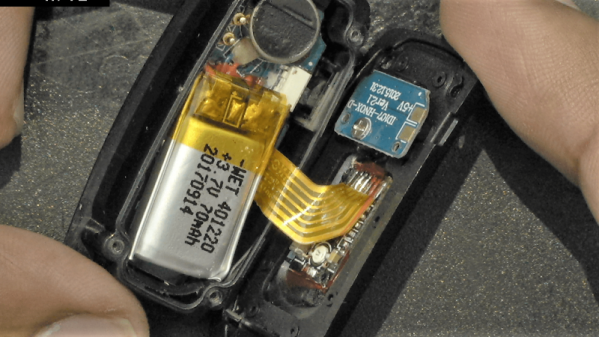
This is one of those stories that shows that you never know from where inspiration is going to come. [Chinna Devarapu] learned that as a result of playing around with cheap fitness bands, specifically an ID107HR. A community has built up around hacking these bands; we featured a similar band that was turned into an EEG. With some help, [Chinna] was able to reflash the microcontroller and program it in the Arduino IDE, and began looking for a mission for the sensor-laden platform.

He settled on building a continuous optical densitometer for his biology colleagues. Bacterial cultures become increasingly turbid as the grow, and measuring the optical density (OD) of a culture is a common way to monitor its growth phase. This is usually done by sucking up a bit of the culture to measure, but [Chinna] and his team were able to use the hacked fitness band’s heartrate sensor to measure the OD on the fly. The tracker fits in a 3D-printed holder where an LED can shine through the growing culture; the sensor’s photodiode measures the amount of light getting through and the raw data is available via the tracker’s Bluetooth. The whole thing can be built for less than $20, and the plans have been completely open-sourced.

We really like the idea of turning these fitness bands into something completely different. With the capabilities these things pack into such a cheap and compact package, they should start turning up in more and more projects.

Riding The Nostalgia Train With A 6502 From The Ground Up

In the very early days of the PC revolution the only way to have a computer was to build one, sometimes from a kit but often from scratch. For the young, impoverished hobbyist, leafing through the pages of Popular Electronics was difficult, knowing that the revolution was passing you by. And just like that, the days of homebrewing drew to a close, forced into irrelevance by commodity beige boxes. Computing for normies had arrived.

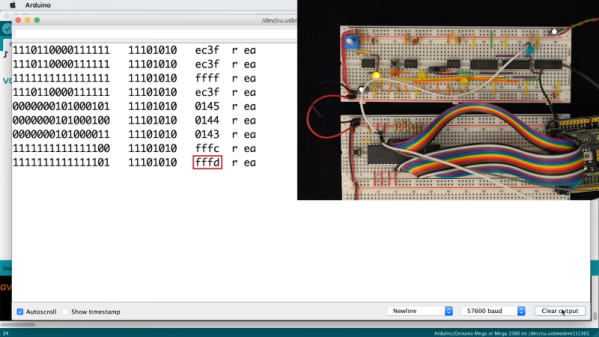
Many of the homebrewers-that-never-were are now looking back at this time with the powerful combination of nostalgia and disposable income, and projects such as [Ben Eater]’s scratch-built 6502 computer are set to scratch the old itch. The video below introduces not only the how-to part of building a computer from scratch, but the whys and wherefores as well. Instead of just showing us how to wire up a microprocessor and its supporting chips, [Ben] starts with the two most basic things: a 6502 and its datasheet. He shows what pins do what, which ones to make high, and which ones get forced low. Clocked with a custom 555 circuit that lets him single-step and monitored with an Arduino Mega-based logic analyzer, we get a complete look at the fetch and execute cycle of a simple, hard-wired program at the pin level.

This is one of those rare videos that was over too soon and left us looking for more. [Ben] promises a follow-up to add a ROM chip and a more complex program, and we can’t wait to see that. He’s selling kits so you can build along if you don’t already have the parts. There seems to be a lot of interest in 6502 builds lately, some more practical than others. Seems like a good time to hop on the bandwagon.

Continue reading “Riding The Nostalgia Train With A 6502 From The Ground Up”

Solar System Wars: Walmart Versus Tesla

It seems like hardly a day goes by that doesn’t see some news story splashed across our feeds that has something to do with Elon Musk and one or another of his myriad companies. The news is often spectacular and the coverage deservedly laudatory, as when Space X nails another double landing of its boosters after a successful trip to space. But all too often, it’s Elon’s baby Tesla that makes headlines, and usually of the kind that gives media relations people ulcers.

The PR team on the automotive side of Tesla can take a bit of a breather now, though. This time it’s Elon’s solar power venture, Tesla Energy Operations, that’s taking the heat. Literally — they’ve been sued by Walmart for rooftop solar installations that have burst into flames atop several of the retail giant’s stores. While thankfully no lives have been lost and no major injuries were reported, Walmart is understandably miffed at the turn of events, leading to the litigation.

Walmart isn’t alone in their exposure to potential Tesla solar problems, so it’s worth a look to see what exactly happened with these installations, why they failed, and what we as hackers can learn from the situation. As we’ll see, it all boils down to taking electrical work very seriously and adhering to standards designed to keep everyone safe, even when they just seem like a nuisance.

Continue reading “Solar System Wars: Walmart Versus Tesla”

Tiny Woodshop Is Packed With Space-Saving Hacks

Fair warning: once you’ve watched [Stephen]’s tiny workshop tour, you will officially be out of excuses for why you need to expand your workshop. And, once you see his storage and organization hacks, you’ll be shamed into replicating some in whatever space you call home.

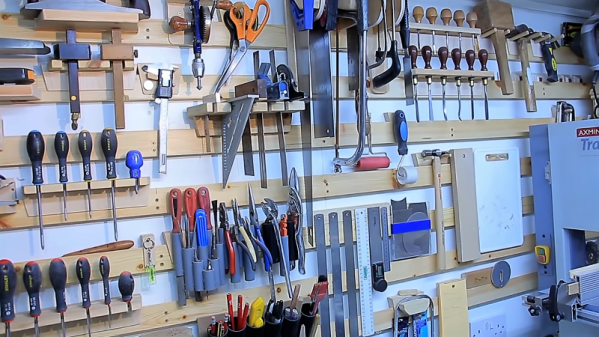
[Stephen]’s woodshop is a cozy 6′ x 8′ (1.8 m x 2.4 m) garden shed. The front wall is almost entirely occupied by the door and a window, reducing the amount of wall space available but providing ample natural light and keeping the small space from inducing claustrophobia. Absolutely every square inch of the remaining space is optimized and organized. [Stephen] wisely eschews bulky cabinets in favor of hanging tool racks, all mounted flexibly to the wall on French cleats. Everything has a place, and since every hand tool is literally within arm’s reach, it stays stored until it’s needed and goes right back when it’s done. The shop boasts way more than hand tools, though; a lathe, drill press, thickness planer, sander, air compressor, scroll saw, band saw, and even a table saw all fit in there. There’s even dust collection courtesy of “The Beast”, [Stephen]’s DIY dust extractor.

No matter whether you work in wood, metal, or silicon, we could all learn some lessons from [Stephen]’s shop. It’s a model of efficiency and organization, and while he’s not likely to build a full-size [Queen Anne] dresser in there, it’s clear from his blog that he gets a lot done with it. Too bad we missed this one the last time we did a roundup of tiny shops.

Continue reading “Tiny Woodshop Is Packed With Space-Saving Hacks”

Arduino, Accelerometer, And TensorFlow Make You A Real-World Street Fighter

A question: if you’re controlling the classic video game Street Fighter with gestures, aren’t you just, you know, street fighting?

That’s a question [Charlie Gerard] is going to have to tackle should her AI gesture-recognition controller experiments take off. [Charlie] put together the game controller to learn more about the dark arts of machine learning in a fun and engaging way.

The controller consists of a battery-powered Arduino MKR1000 with WiFi and an MPU6050 accelerometer. Held in the hand, the controller streams accelerometer data to an external PC, capturing the characteristics of the motion. [Charlie] trained three different moves – a punch, an uppercut, and the dreaded Hadouken – and captured hundreds of examples of each. The raw data was massaged, converted to Tensors, and used to train a model for the three moves. Initial tests seem to work well. [Charlie] also made an online version that captures motion from your smartphone. The demo is explained in the video below; sadly, we couldn’t get more than three Hadoukens in before crashing it.

With most machine learning project seeming to concentrate on telling cats from dogs, this is a refreshing change. We’re seeing lots of offbeat machine learning projects these days, from cryptocurrency wallet attacks to a semi-creepy workout-monitoring gym camera.

Continue reading “Arduino, Accelerometer, And TensorFlow Make You A Real-World Street Fighter”

Keeping Clocks On Time, The Swiss Way

Could there be a worse fate for a guy with a Swiss accent than to be subjected to a clock that’s seconds or even – horrors! – minutes off the correct time? Indeed not, which is why [The Guy With the Swiss Accent] went to great lengths to keep his IKEA radio-controlled clock on track.

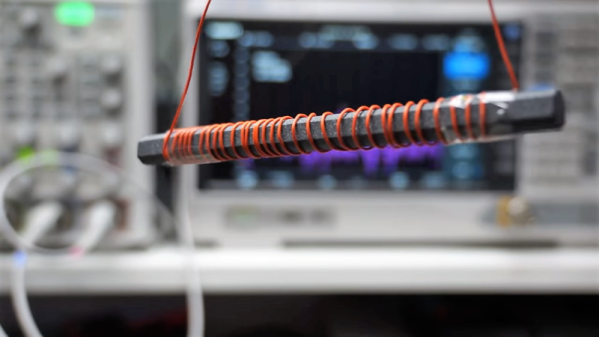
For those who haven’t seen any of [Andreas Spiess]’ YouTube videos, you’ll know that he pokes a bit of fun at Swiss stereotypes such as precision and punctuality. But really, having a clock that’s supposed to synchronize to one of the many longwave radio atomic clocks sprinkled around the globe and yet fails to do so is irksome to even the least chrono-obsessive personality. His IKEA clock is supposed to read signals from station DCF77 in Germany, but even the sensitive receivers in such clocks can be defeated by subterranean locales such as [Andreas]’ shop. His solution was to provide a local version of DCF77 using a Raspberry Pi and code that sends modulated time signals to a GPIO pin. The pin is connected to a ferrite rod antenna, which of course means that the Pi is being turned into a radio transmitter and hence is probably violating the law. But as [Andreas] points out, if the power is kept low enough, the emissions will only ever be received by nearby clocks.

With his clock now safely synced to an NTP server via the tiny radio station, [Andreas] can get back to work on his other projects, such as work-hardening copper wire for antennas with a Harley, or a nuclear apocalypse-Tweeting Geiger counter.

Continue reading “Keeping Clocks On Time, The Swiss Way”

Software Defined Radio Hack Chat

Join us on Wednesday, September 18 at noon Pacific for the Software Defined Radio Hack Chat with Corrosive!

If you’ve been into hobby electronics for even a short time, chances are you’ve got at least one software-defined radio lying around. From the cheap dongles originally intended to watch digital TV on a laptop to the purpose-built transmit-capable radio playgrounds like HackRF, SDR has opened up tons of RF experimentation. Before SDR, every change of band or mode would need new hardware; today, spinning up a new project is as simple as dragging and dropping a few blocks around on a screen, and SDRs that can monitor huge swaths of radio spectrum for the tiniest signal have been a boon to reverse engineers everywhere.

Corrosive is the handle of Harold Giddings, amateur callsign KR0SIV, and he’s gotten into SDR in a big way. Between his blog, his YouTube channel, and his podcast, all flying under the Signals Everywhere banner, he’s got the SDR community covered. Whether it’s satellite communications, aircraft tracking, amateur radio, or even listening in on railway operations, Harold has tried it all, and has a wealth of SDR wisdom to share. Join us as we discuss the state of the SDR ecosystem, which SDR to buy for your application, and even how to transmit with an SDR (hint: you’ll probably want a ham license.)

join-hack-chatOur Hack Chats are live community events in the Hackaday.io Hack Chat group messaging. This week we’ll be sitting down on Wednesday, September 18 at 12:00 PM Pacific time. If time zones have got you down, we have a handy time zone converter.

Click that speech bubble to the right, and you’ll be taken directly to the Hack Chat group on Hackaday.io. You don’t have to wait until Wednesday; join whenever you want and you can see what the community is talking about.