Laser Harp Sounds Real Thanks To Karplus-Strong Wave Equation

The harp is an ancient instrument, but in its current form, it seems so unwieldy that it’s a wonder that anyone ever learns to play it. It’s one thing to tote a rented trumpet or clarinet home from school to practice, but a concert harp is a real pain to transport safely. The image below is unrelated to the laser harp project, but proves that portable harping is begging for some good hacks.

Concert grand harps are so big there’s special equipment to move them around. This thing’s called the HarpCaddy

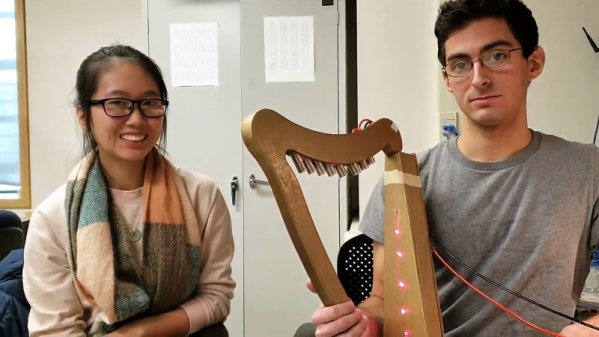
Enter this laser harp, another semester project from [Bruce Land]’s microcontroller course at Cornell. By replacing strings with lasers aimed at phototransistors, [Glenna] and [Alex] were able to create a more manageable instrument that can be played in a similar manner. The “strings” are “plucked” with the fingers, which blocks the laser light and creates the notes.

But these aren’t just any old microcontroller-generated sounds. Rather than simply generating a tone or controlling a synthesizer, the PIC32 uses the Karplus-Strong algorithm to model the vibration of a plucked string. The result is very realistic, with all the harmonics you’d expect to hear from a plucked string. [Alex] does a decent job putting the harp through its paces in the video below, and the write-up is top notch too.

Unique musical instruments like laser harps are far from unknown around these parts. We’ve seen a few that look something like a traditional harp and one that needs laser goggle to play safely, but this one actually looks and sounds like the real thing. Continue reading “Laser Harp Sounds Real Thanks To Karplus-Strong Wave Equation”
Dainty Delta Is About As Small As A Robot Can Be

There’s something mesmerizing about delta robots. Whether they are used at a stately pace for a 3D-printer or going so fast you can barely see them move in a pick and place machine, the way that three rotary actuators can work together to produce motion in three axes is always a treat to watch. Especially with a delta robot as small as this one.

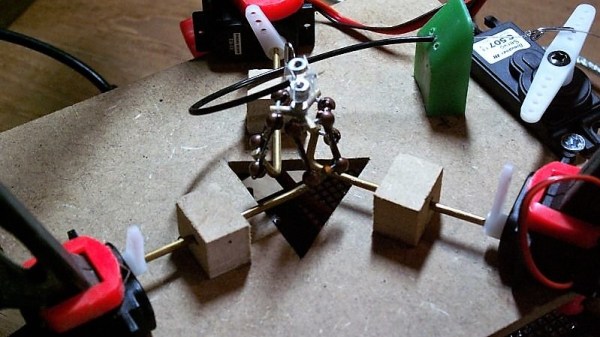
[KarelK16] says this is one of those “just because I can” projects with no real application. And he appears to have been working on it for a while; the video below is from eight years ago. Regardless, the post is new, and it’s pretty interesting stuff. The tiny ball joints used in the arms are made from jewelry parts; small copper crank arms connect the three upper arms to micro-servos. The manipulator [KarelK16] attached is very clever, too – rather than load down the end of the arms with something heavy, a fourth servo opens an closes a flexible plastic grasper through a Bowden cable. It’s surprisingly nimble, and grasps small objects firmly.

There are certainly bigger deltas – much bigger – and more useful ones, too, but we really like this build. And who knows – perhaps model robotics will join model railroading as a hobby someday. If it does, [KarelK16]’s diminutive delta might be the shape of things to come.

Continue reading “Dainty Delta Is About As Small As A Robot Can Be”

Make An Impression At The Bar With A CNC Coaster Plotter

If you’re anything like us, your success with the opposite sex at the bar wasn’t much to brag about. But imagine if you had only had this compact CNC polar plotter and could have whipped up a few custom coasters for your intended’s drink. Yeah, that definitely would have helped.

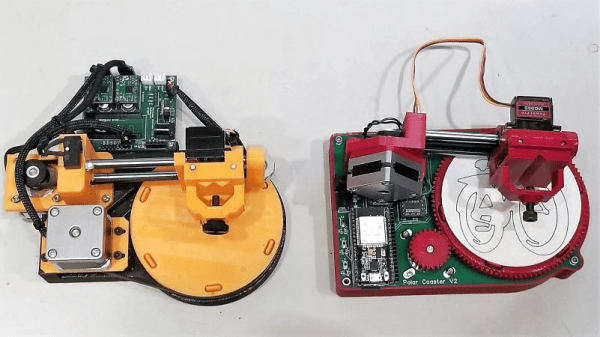
Or not, but at least it would have been fun to play with. This is actually an improved version of [bdring]’s original “Polar Coaster”. Version 2 is really just a more compact and robust version of the original. The new one has a custom controller for the steppers and pen-lift servo, and everything is mounted neatly to the main PCB. Where the original used a timing belt to drive the platter, the new one uses 3D-printed helical gears, and the steppers have been replaced by slimmer motors. It even has an SD card and smartphone UI, and the coasters look pretty good.

There’s no video of the new one, but you can see its predecessor in action below and imagine the possibilities. Snap a picture and have a line art rendition of someone plotted while you’re waiting for drinks? Just remember not to take any laser engraved wooden nickels.

Continue reading “Make An Impression At The Bar With A CNC Coaster Plotter”

Delicious Vector Game Console Runs Pac-Man, Tetris, And Mario

The only question we have about [mitxela]’s DIY vector graphics game console is: Why did he wait five years to tell the world about it?

Judging by the projects we’ve seen before, from his tiny LED earrings to cramming a MIDI synthesizer into both a DIN plug and later a USB plug, [mitxela] likes a challenge. And while those projects were underway, the game console you’ll see in the video below was sitting on the shelf, hidden away from the world. That’s a shame, because this is quite a build.

Using a CRT oscilloscope in X-Y mode as a vector display, the console faithfully reproduces some classic games, most of which, curiously enough, were not originally vector games. There are implementations of the Anaconda, RetroRacer, and AstroLander minigames from Timesplitter 2. There are also versions of Pac-Man, Tetris, and even Super Mario Brothers. Most of the games were prototyped in JavaScript before being translated into assembly and placed onto EEPROM external cartridges, to be read by the ATMega128 inside the console. Sound and music are generated using the ATMega’s hardware timers, with a little help from a reverse-biased transistor for white noise and a few op-amps.

From someone who claims to have known little about electronics at the beginning of the project, this is pretty impressive stuff. Our only quibbles are the delay in telling us about it, and the lack of an Asteroids implementation. The former is forgivable, though, because the documentation is so thorough and the project is so cool. The latter? Well, one can hope.

Continue reading “Delicious Vector Game Console Runs Pac-Man, Tetris, And Mario”

Kinetic Wire Animatronics Bend It Like Disney

The House of Mouse has been at the forefront of entertainment technology from its very beginnings in an old orange grove in Anaheim. Disney Imagineers invented the first modern animatronics in the 1960s and they’ve been improving the technology ever since, often to the point of being creepy.

But the complicated guts of an animatronic are sometimes too much for smaller characters, so in the spirit of “cheaper, faster, better”, Disney has developed some interesting techniques for animated characters made from wire. Anyone who has ever played with a [Gumby] or other posable wireframe toys knows that eventually, the wire will break, and even before then will plastically deform so it can’t return to its native state.

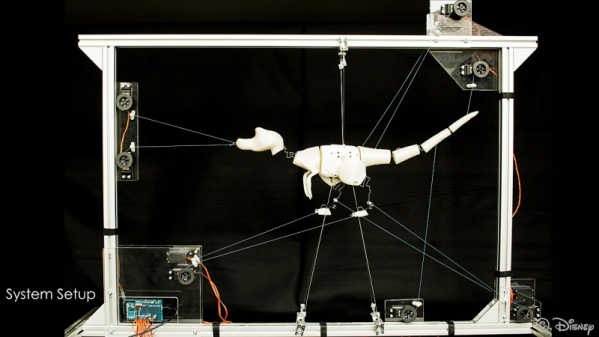
Wires used as the skeletons of animated figures can avoid that fate if they are preloaded with special shapes, or “templates,” that redirect the forces of bending. The Disney team came up with a computational model to predict which template shapes could be added to each wire to make it bend to fit the animation needs without deforming. A commercially available CNC wire bender installs the templates that lie in the plane of the wire, while coiled templates are added later with a spring-bending jig.

The results are impressive — the wire skeleton of an animated finger can bend completely back on itself with no deformation, and the legs of an animated ladybug can trace complicated paths and propel the beast with only servos pulling cables on the jointless legs. The video below shows the method and the animated figures; we can imagine that figures animated using this technique will start popping up at Disney properties eventually.

From keeping guests safe from robotic harm to free-flying robotic aerialists, it seems like the Disney Imagineers have a hardware hacker’s paradise at the Happiest Place on Earth.

Continue reading “Kinetic Wire Animatronics Bend It Like Disney”

Fail Of The Week: Hard Lessons In 3D-Printed Bushings For A Giant RC Car

Can you turn 47 pounds (21 kg) of PLA filament into a gigantic working 3D-printed RC car? No, no you can’t — at least not if you eschew proper bearings in favor of printed bushings.

That’s the hard lesson that [Joel Telling] learned with his scaled up version of the OpenRC F1 car, an RC car that can be mostly 3D-printed. The small version still has its share of non-printed parts, mainly screws and bearings. In his video series documenting the build of the upsized version, [Joel] elaborates on some of the reasons for going with printed bushings rather than bearings, which mainly boil down to hoping that the graphite lubricant powder he added would reduce friction enough to prevent the parts from welding themselves together.

The car came out looking great, and even managed to scoot about nicely for a few seconds before its predictably noisy and unhappy demise. But what was unexpected was the actual failure mode. The plastic-on-plastic running gear seemed to handle the rolling loads fine; it was the lateral force exerted on the axle by the tension of the drive belt that was too much for the printed bushing to bear.

As [Joel] rightly points out, it’s only a failure if you fail to learn something, so kudos to him for at least giving this a try. And all that PLA won’t go to waste, of course — everything else on the car worked fine, so adding one bearing should get it back on the road. He should check out our primer on bearings for a few tips on selecting the right one.

Continue reading “Fail Of The Week: Hard Lessons In 3D-Printed Bushings For A Giant RC Car”

Achieving Zen The Arduino Way

The purpose of a Zen garden, those stylized landscapes created by painstakingly placing rocks and raking gravel into perfect patterns, is the doing of the thing. Making sure every line is perfectly formed is no mean feat, and the concentration required to master it is the point of the whole thing. But who has time for that? Why not just build a robot to create the perfect Zen garden in miniature?

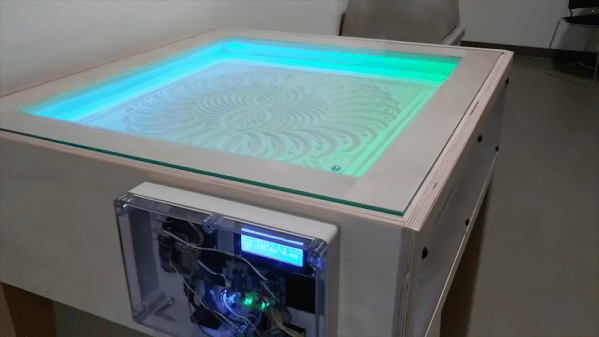
That was what [Tim Callinan] and his classmates did for a semester project, and the “ZenXY” sand plotter was the result. There isn’t a build log for the device per se, although the video below makes it plain how they went about this. The sand table itself is a plywood box whose bottom is layered with fine white sand and contains a single steel ball. Below the table is an X-Y gantry carrying a powerful magnet. A gShield riding on top of an Uno turns G code into slow, stately movement of the ball through the sand. The patterns are remarkably intricate, and while it might not be the same as mastering the body control needed to rake gravel with precision, watching the ball push the sand around is pretty Zen all by itself

This isn’t the first time we’ve seen someone try to automate a traditional Japanese practice. This tea ceremony robot comes to mind, and this nicely crafted sand table is very similar to the ZenXY.

Continue reading “Achieving Zen The Arduino Way”