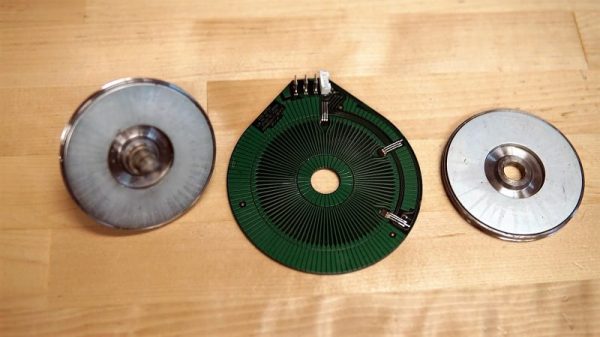
Teardown Shows Why Innovative Designs Sometimes Fail

Some ideas are real head-scratchers from a design standpoint: Why in the world would you do it that way? For many of us, answering that question often requires a teardown, which is what [Ben Katz] did when this PCB motor-powered weed whacker came across his bench. The results are instructive on what it takes to succeed in the marketplace, or in this case, how to fail.

The unit in question comes from an outfit called CORE Outdoor Power. The line trimmer was powered by a big lithium-ion battery pack, but [Ben] concentrated on the unique motor for his teardown. After a problematic entry into the very sturdy case at the far end of the trimmer’s shaft, he found what looks like a souped-up version of [Carl Bugeja]’s PCB brushless motors. The rotors, each with eight large magnets embedded, are sandwiched on either side of a very thick four-layer PCB with intricately etched heavy copper traces. The PCB forms the stator, with four flat coils. The designer pulled a neat trick with the Hall-effect sensors needed for feedback; rather than go with surface-mount sensors, which would add to the thickness of the board, they used through-hole packages soldered to surface pads, with the body of the sensor nestled in a hole in the board. The whole design is very innovative, but sadly, [Ben]’s analysis shows that it has poor performance for its size and weight.

Google around a bit and you’ll see that CORE was purchased some years back by MTD, a big player in the internal combustion engine outdoor power market. They don’t appear to be a going concern anymore, and it looks as though [Ben] has discovered why.

[Jozef] tipped us off to this one. Thanks!

A Quartet Of Drills Put The Spurs To This Electric Utility Vehicle

Low-slung body style. Four-wheel drive. All electric drivetrain. Turns on a dime. Neck-snapping acceleration. Leather seating surface. Is it the latest offering from Tesla? Nope; it’s a drill-powered electric utility vehicle, and it looks like a blast to drive.

Surprisingly, this isn’t a just-for-kicks kind of build. There’s actually a practical reason for the low form factor and long range of [Axel Borg]’s little vehicle. We’ll leave the back story to the second video below, but suffice it to say that this will be a smaller version of the crawler NASA used to roll rockets out to the launch pad, used instead to transport his insanely dangerous looking manned-multicopter. The running gear on this vehicle is the interesting bit: four hefty electric drills, one for each of the mobility cart wheels. The drills are powered by a large series-connected battery pack putting out 260V at full charge. The universal motors of the drills are fine with DC, and the speed of each is controlled via the PWM signals from a pair of cordless drills. The first video below shows [Axel] putting it through its paces; he didn’t hold back at all, but the vehicle kept coming back for more.

We know this cart is in service to another project, but we’d have a hard time concentrating on anything if we had the potential for that much fun sitting in the shop. Still, we hope that multirotor gets a good test flight soon, and that all goes well with it.

Continue reading “A Quartet Of Drills Put The Spurs To This Electric Utility Vehicle”

Super Simple Sensor Makes DSLR Camera Motion Sensitive

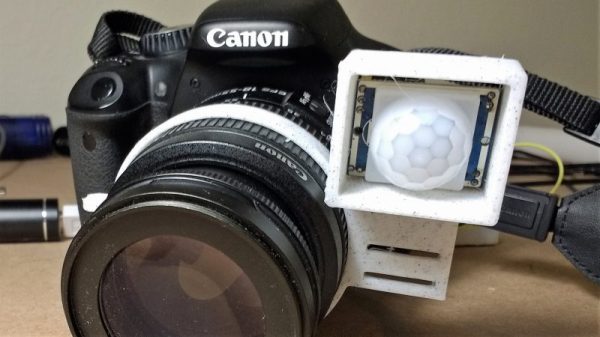
Do you have a need to photographically document the doings of warm-blooded animals? If so, a game camera from the nearest hunting supplier is probably your best bet. But if you don’t need the value-added features such as a weather-resistant housing that can be chained to a tree, this DIY motion trigger for a DSLR is a quick and easy build, and probably loads more fun.

The BOM on [Jeremy S Cook]’s build is extremely short – just a PIR sensor and an optoisolator, with a battery, a plug for the camera’s remote jack, and a 3D-printed bracket. The PIR sensor is housed in a shroud to limit its wide field of view; [Jeremy] added a second shroud when an even narrower field is needed. No microcontroller is needed because all it does is trigger the camera when motion is sensed, but one could be added to support more complicated use cases, like an intervalometer or constraining the motion sensing to certain times of the day. The video below shows the build and some quick tests.

Speaking of intervalometers, we’ve seen quite a few of those over the years. From the tiny to the tinier to the electromechanical, people seem to have a thing for taking snapshots at regular intervals.

Continue reading “Super Simple Sensor Makes DSLR Camera Motion Sensitive”

Pi Zero Gives Amateur Astronomer Affordable Control Of Telescope

Like many other hobbies, astronomy can be pursued on many levels, with equipment costs ranging from the affordable to the – well, astronomical. Thankfully, there are lots of entry-level telescopes on the market, some that even come with mounts that automatically find and track heavenly bodies. Finding a feature is as easy as aligning to a few known stars and looking up the object in the database embedded in the remote.

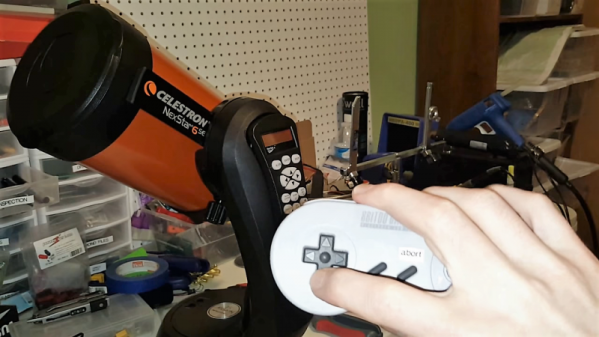
Few of the affordable mounts are WiFi-accessible, though, which is a gap [Dane Gardner]’s Raspberry Pi interface for Celestron telescopes aims to fill. For the price of a $10 Pi Zero W and a little know-how, [Dane] was able to gain full control over his ‘scope. His instrument is a Celestron NexStar, a Schmidt-Cassegrain reflector with a 150-mm aperture, has a motorized altitude-azimuth mount. The handheld remote had enough room for him to add the Zero, powering it from the mount’s battery pack. The handset has an RS-232 serial port built-in, but with the level differences [Dane] just connected the Pi directly to the handset before the UART. Running INDI, a cross-platform astronomical instrument control library, he now has total control of the scope, and he can use open source astronomy software rather than the limited database within the handset. As a neat side trick, the telescope can now be controlled with a Bluetooth gamepad.

Astronomy and electronics go hand in hand, whether in the optical or radio part of the spectrum. We like the way [Dane] was able to gain control of his telescope, and we’d like to hear about what he sees with his new tool. Assuming the Seattle weather ever cooperates.

Continue reading “Pi Zero Gives Amateur Astronomer Affordable Control Of Telescope”

The Mother Of All Demos, 50 Years On

If you’re like me, chances are pretty good that you’ve been taught that all the elements of the modern computer user interface — programs running in windows, menus, icons, WYSIWYG editing of text documents, and of course, the venerable computer mouse — descended from the hallowed halls of the Xerox Corporation’s Palo Alto Research Center in the early 1970s. And it’s certainly true that PARC developed these technologies and more, including the laser printer and object-oriented programming, all of which would grace first the workplaces of the world and later the homes of everyday people.

But none of these technologies would have existed without first having been conceived of by a man with a singular vision of computing. Douglas Engelbart pictured a future in which computers were tools to sharpen the human intellectual edge needed to solve the world’s problem, and he set out to invent systems to allow that. Reading a Twitter feed or scanning YouTube comments, one can argue with how well Engelbart’s vision worked out, but there’s no arguing with the fact that he invented almost all the trappings of modern human-computer interaction, and bestowed it upon the world in one massive demonstration that became known as “The Mother of All Demos.”

Continue reading “The Mother Of All Demos, 50 Years On”

DIY Ribbon Element Upgrades A Studio Microphone

For those with some experience with pro audio, the term “ribbon microphone” tends to conjure up an image of one of those big, chunky mics from the Golden Age of radio, the kind adorned with the station’s callsign and crooned into by the latest heartthrob dreamboat singer. This DIY ribbon mic is none of those things, but it’s still really cool.

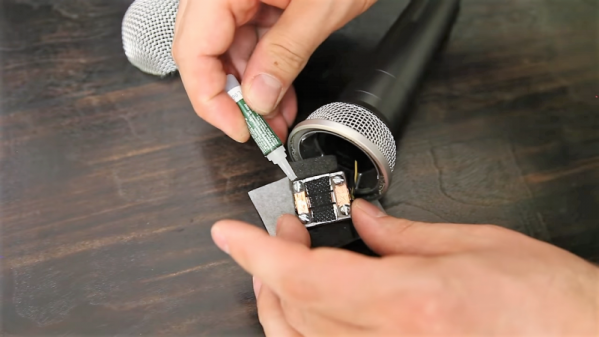
Of course the ribbon mic isn’t always huge, and the technology behind it is far from obsolete. [Frank Olsen]’s ribbon mic starts out with gutting a run-of-the-mill studio mic of its element, leaving only the body and connector behind. The element that he constructs, mostly from small scraps of aluminum and blocks of acrylic, looks very much like the ribbon element in commercial mics: a pair of magnets with a thin, corrugated strip of foil suspended between them. The foil was corrugated by passing it through a jig that [Frank] built, which is a neat tool, but he says that a paper crimper used for crafting would work too. There’s some pretty fussy work behind the cartridge build, but everything went together and fit nicely in the old mic body. The video below was narrated using the mic, so we know it works.

Fun fact: the ribbon microphone was invented by Walter Schottky. That Walter Schottky. Need more on how these mics work? Our colleague [Al Williams] has you covered with this article on the basics.

Continue reading “DIY Ribbon Element Upgrades A Studio Microphone”

35C3: A Deep Dive Into DOS Viruses And Pranks

Oh, the hijinks that the early days of the PC revolution allowed. Back in the days when a 20MB hard drive was a big deal and MS-DOS 3.1 ruled over every plain beige PC-clone cobbled together by enthusiasts like myself, it was great fun to “set up” someone else’s machine to do something unexpected. This generally amounted to finding an unattended PC — the rooms of the residence hall where I lived in my undergrad days were a target-rich environment in this regard — and throwing something annoying in the AUTOEXEC.BAT file. Hilarity ensued when the mark next booted the machine and was greeted with something like an inverted display or a faked hard drive formatting. Control-G was good to me too.

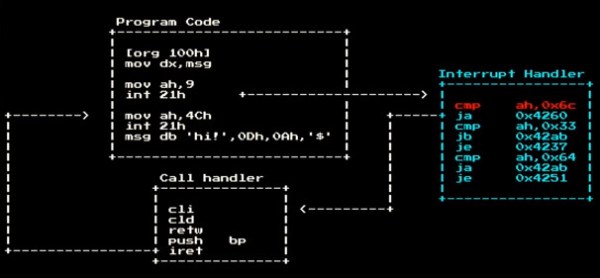
So it was with a sense of great nostalgia that I watched [Ben Cartwright-Cox]’s recent 35C3 talk on the anatomy and physiology of viruses from the DOS days. Fair warning to the seasoned reader that a sense of temporal distortion is inevitable while watching someone who was born almost a decade after the last meaningful release of MS-DOS discuss its inner workings with such ease. After a great overview of the DOS API elements that were key to getting anything done back then, malware or regular programs alike, he dives into his efforts to mine an archive of old DOS viruses, the payloads of most of which were harmless pranks. He built some tools to find viruses that triggered based on the system date, and used an x86 emulator he designed to test every day between 1980 and 2005. He found about 10,000 malware samples and explored their payloads, everything from well-wishes for the New Year to a bizarre foreshadowing of the Navy Seal Copypasta meme.

We found [Ben]’s talk a real treat, and it’s good to see someone from the current generation take such a deep dive into the ways many of us cut our teeth in the computing world.

Continue reading “35C3: A Deep Dive Into DOS Viruses And Pranks”