Custom Split-Flap Display Is A Unique Way To Show The Weather

There’s little doubt about the charms of a split-flap display. Watching a display build up a clear, legible message by flipping cards can be mesmerizing, whether on a retro clock radio from the 70s or as part of a big arrival and departure display at an airport or train station. But a weather station with a split-flap display? That’s something you don’t see often.

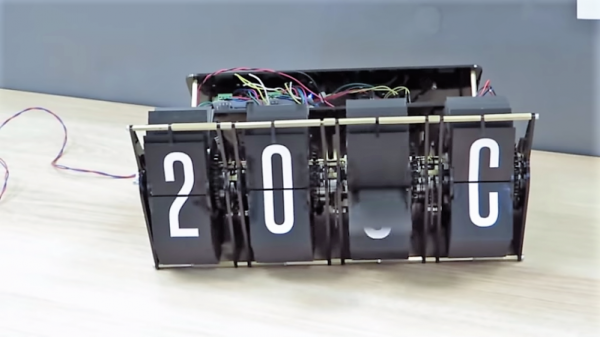
We usually see projects using split-flap units harvested from some kind of commercial display, but [gabbapeople] decided to go custom and build these displays from the ground up. The frame and mechanicals for each display are made from laser-cut acrylic, as are the flip-card halves. Each cell can display a full alphanumeric character set on 36 cards, with each display driven by its own stepper. An Arduino fetches current conditions from a weather API and translates the description of the weather into a four-character code. The codes shown in the video below seem a little cryptic, but the abbreviation list posted with the project makes things a bit clearer. Bonus points if you can figure out what “HMOO” is without looking at the list.

We like the look and feel of this, but we wonder if split-flap icons might be a neat way to display weather too. It seems like it would be easy enough to do with [gabbapeople]’s detailed instructions. Or you could always look at one of the many other custom split-flap displays we’ve featured for more inspiration.

Continue reading “Custom Split-Flap Display Is A Unique Way To Show The Weather”
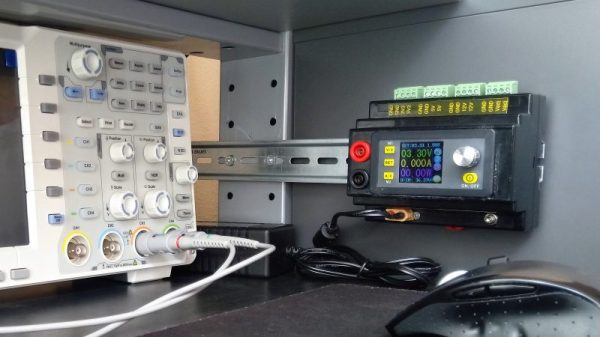
Bench Power Supply Packs A Lot Into A DIN-Rail Package

We’re not sure why we’ve got a thing for DIN-rail mounted projects, but we do. Perhaps it’s because we’ve seen so many cool industrial control cabinets, or maybe the forced neatness of DIN-mounted components resonates on some deep level. Whatever it is, if it’s DIN-rail mounted, chances are good that we’ll like it.

Take this DIN-mounted bench power supply, for instance. On the face of it, [TD-er]’s project is yet another bench supply built around those ubiquitous DPS switching power supply modules, the ones with the colorful displays. Simply throwing one of those in a DIN-mount enclosure isn’t much to write home about, but there’s more to this project than that. [TD-er] needed some fixed voltages in addition to the adjustable output, so a multi-voltage DC-DC converter board was included inside the case as well. The supply has 3.3, 5, and 12 volt fixed outputs along with the adjustable supply, and thanks to an enclosed Bluetooth module, the whole thing can be controlled from his phone. Plus it fits nicely in a compact work area, which is a nice feature.

We haven’t seen a lot of DIN-rail love around these pages — just this recent rotary phase converter with very tidy DIN-mounted controls. That’s a shame, we’d love to see more.

Semi-automated Winder Spins Rotors For Motors

What’s your secret evil plan? Are you looking for world domination by building a machine that can truly replicate itself? Or are you just tired of winding motor rotors and other coils by hand? Either way, this automated coil winder is something you’re probably going to need.

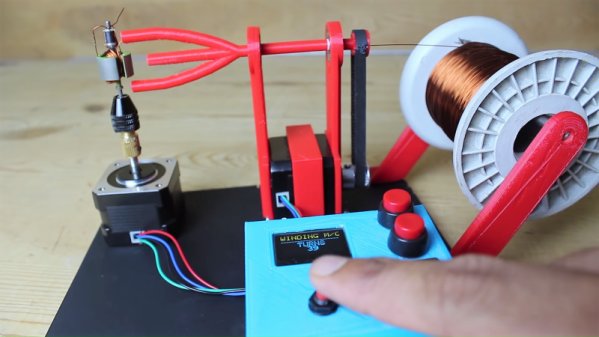
We jest in part, but it’s true that closing the loop on self-replicating machines means being able to make things like motors. And for either brushed or brushless motors, that means turning spools of wire into coils of some sort. [Mr Innovative]’s winder uses a 3D-printed tube to spin magnet wire around a rotor core. A stepper motor turns the spinner arm a specified number of times, pausing at the end so the operator can move the wire to make room for the next loop. The rotor then spins to the next position on its own stepper motor, and the winding continues. That manual step needs attention to make this a fully automated system, and we think the tension of the wire needs to be addressed so the windings are a bit tighter. But it’s still a nice start, and it gives us some ideas for related coil-winding projects.

Of course, not every motor needs wound coils. After all, brushless PCB motors with etched coils are a thing.

Continue reading “Semi-automated Winder Spins Rotors For Motors”

A Radar Module Teardown And Measuring Fan Speed The Hard Way

If you have even the slightest interest in microwave electronics and radar, you’re in for a treat. The Signal Path is back with another video, and this one covers the internals of a simple 24-GHz radar module along with some experiments that we found fascinating.

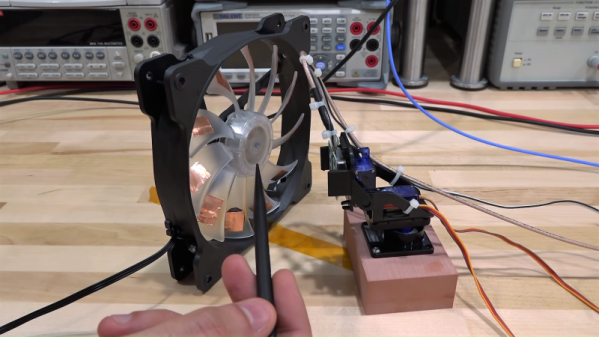
The radar module that [Shahriar] works with in the video below is a CDM324 that can be picked up for a couple of bucks from the usual sources. As such it contains a lot of lessons in value engineering and designing to a price point, and the teardown reveals that it contains but a single active device. [Shahriar] walks us through the layout of the circuit, pointing out such fascinating bits as capacitors with no dielectric, butterfly stubs acting as bias tees, and a rat-race coupler that’s used as a mixer. The flip side of the PCB has two arrays of beam-forming patch antennas, one for transmit and one for receive. After a few simple tests to show that the center frequency of the module is highly variable, he does a neat test using gimbals made of servos to sweep the signal across azimuth and elevation while pointing at a receiving horn antenna. This shows the asymmetrical nature of the beam-forming array. He finishes up by measuring the speed of a computer fan using the module, which has some interesting possibilities in data security as well as a few practical applications.

Even though [Shahriar]’s video tend to the longish side, he makes every second count by packing in a lot of material. He also makes complex topics very approachable, like what’s inside a million-dollar oscilloscope or diagnosing a wonky 14-GHz spectrum analyzer.

Continue reading “A Radar Module Teardown And Measuring Fan Speed The Hard Way”

Internet Of Tea: Coaster Watches For Optimum Drinking Temperature

Ah, the age-old question: at what temperature does one’s tea need to be for maximum enjoyment? It’s subjective, of course, but subjective in a way that makes everyone else’s opinion demonstrably wrong. What’s worse, the window of opportunity for optimum tea temperature is extremely narrow. What’s a tea drinker to do?

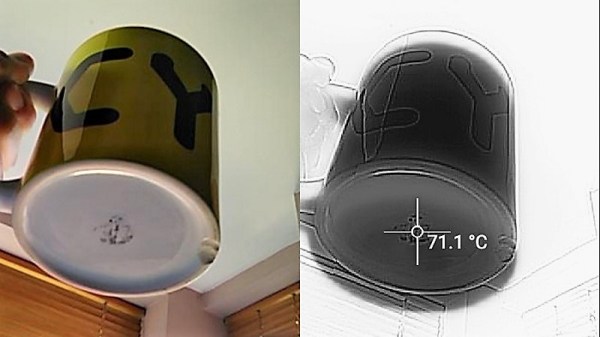
Throw a little technology at the problem, of course, in the form of this Internet of Tea smart coaster. Through careful experimentation, [Benjojo] determined the temperature of his favorite mug when the tea within was just right for drinking and designed a coaster to alert him to that fact. The coaster is 3D-printed and contains an MLX90616 IR temperature sensor looking up at the bottom of the mug. An ESP8266 lives inside the coaster too and watches for the Optimum Tea Window to open, sending an alert via Discord when the time is right. Yes, he admits that a simple blinking LED on the coaster would keep his tea habit metadata from being slurped up by the international tea intelligence community, but he claims he has nothing to hide. Good luck with that.

What’s next for [Dane]’s tea preparation? Perhaps he can close the loop and automate the whole pre-consumption process.

Oil-Immersed Raspberry Pi Keeps Its Cool Under Heavy Loads

As a general rule, liquids and electronics don’t mix. One liquid bucks that trend, though, and can contribute greatly to the longevity of certain circuits: oil. Dielectric oil cools and insulates everything from the big mains transformers on the pole to switchgear in the substation. But what about oil for smaller circuits?

[Lord_of_Bone] was curious to see if an oil-cooled Raspberry Pi is possible, and the short answer is: for the most part, yes. The experimental setup seen in the video below is somewhat crude — just a Pi running Quake 3 for an hour to really run up the CPU temperature, which is monitored remotely. With or without heatsinks mounted, in free air the Pi ranges from about 50°C at idle to almost 70°C under load, which is pretty darn hot. Dunking the Pi in a bath of plain vegetable oil, which he admits was a poor choice, changes those numbers dramatically: 37°C at idle and an only warmish 48°C after an hour of gaming. He also tested the Pi post-cleaning, which is where he hit a minor hiccup. The clean machine started fine but suffered from a series of reboots shortly thereafter. Twelve hours later the Pi was fine, though, so he figures a few stray drops of water that hadn’t yet evaporated were to blame.

Is oil immersion a practical way to cool a Pi? Probably not. It doesn’t mean people haven’t tried it before, of course, but we applaud the effort and the careful experimentation.

Continue reading “Oil-Immersed Raspberry Pi Keeps Its Cool Under Heavy Loads”

The Ins And Outs Of Geiger Counters, For Personal Reasons

There are times in one’s life when circumstances drive an intense interest in one specific topic, and we put our energy into devouring all the information we can on the subject. [The Current Source], aka [Derek], seems to be in such a situation these days, and his area of interest is radioactivity and its measurement. So with time to spare on his hands, he has worked up this video review of radioactivity and how Geiger counters work.

Why the interest in radioactivity? Bluntly put, because he is radioactive, at least for the next week. You see, [Derek] was recently diagnosed with thyroid cancer, and one of the post-thyroidectomy therapeutic options to scavenge up any stray thyroid cells is drinking a cocktail of iodine-131, a radioisotope that accumulates in thyroid cells and kills them. Trouble is, this leaves the patient dangerously radioactive, necessitating isolation for a week or more. To pass the time away from family and friends, [Derek] did a teardown on a commercial Geiger counter, the classic Ludlum Model 2 with a pancake probe. The internals of the meter are surprisingly simple, and each stage of the circuit is easily identified. He follows that up with a DIY Geiger counter kit build, which is also very simple — just a high-voltage section made from a 555 timer along with a microcontroller. He tests both instruments using himself as a source; we have to say it’s pretty alarming to hear how hot he still is. Check it out in the video below.

Given the circumstances, we’re amazed that [Derek] is not only keeping his cool but exhibiting a good sense of humor. We wish him well in his recovery, and if doing teardowns like this or projects like this freezer alarm or a no-IC bipolar power supply helps him cope, then we all win.

Continue reading “The Ins And Outs Of Geiger Counters, For Personal Reasons”