Roll Your Own Rotary Encoders

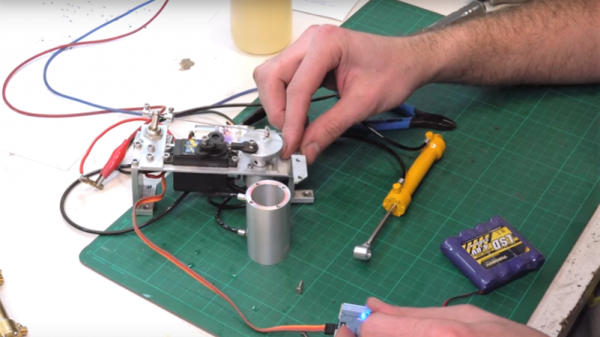
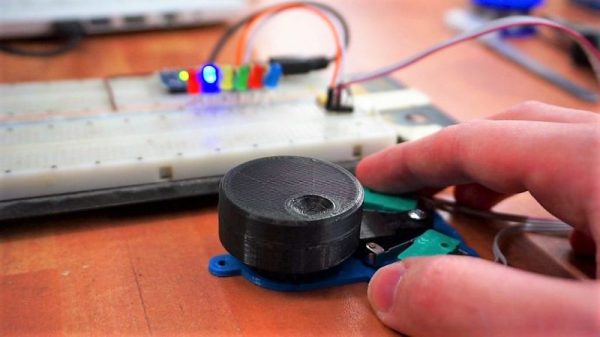
[miroslavus] hasn’t had much luck with rotary encoders. The parts he has tested from the usual sources have all been problematic either mechanically or electrically, resulting in poor performance in his projects. Even attempts to deal with the deficiencies in software didn’t help, so he did what any red-blooded hacker would do — he built his own rotary encoder from microswitches and 3D-printed parts.

[miroslavus]’s “encoder” isn’t a quadrature encoder in the classic sense. It has two switches and only one of them fires when it turns a given direction, one for clockwise and one for counterclockwise. The knob has a ratchet wheel on the underside that engages with a small trip lever, and carefully located microswitches are actuated repeatedly as the ratchet wheel moves the trip lever. The action is smooth but satisfyingly clicky. Personally, we’d forsake the 3D-printed baseplate in favor of a custom PCB with debouncing circuitry, and perhaps relocate the switches so they’re under the knob for a more compact form factor. That and the addition of another switch on the shaft’s axis to register knob pushes, and you’ve got a perfectly respectable input device for navigating menus.

We think this is great, but perhaps your project really needs a legitimate rotary encoder. In that case, you’ll want to catch up on basics like Gray codes.
Continue reading “Roll Your Own Rotary Encoders”

Threat Meter Gauges Risk Of Creeper-Assisted Suicide

If you’ve played even just a few minutes of Minecraft, you know what a creeper is. For those not familiar with the wildly popular sandbox game, a creeper is a monster that creeps along silently until it’s close to a player, whereupon it self-destructs by exploding. Sometimes it kills the player outright, and other times the explosion blows them into lava or off a cliff, or off a cliff and then into lava. Creepers have no friends.

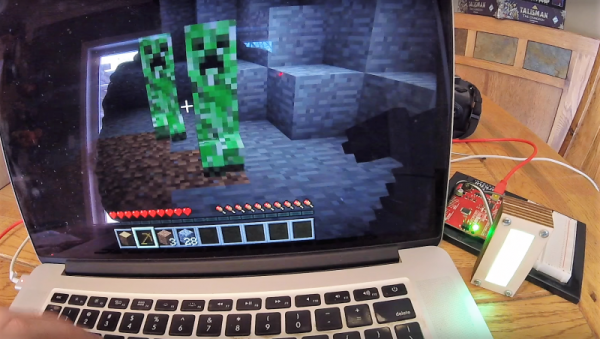
But now there’s a way to avoid creeper attacks, or at least get a little heads up that these green nasties are lurking about. With [John Allwine]’s creeper detector, Minecraft players can get a real-world indicator of the current in-game creeper threat. The hardware end is simple enough — it’s just a SparkFun RedBoard and a small strip of Neopixels in a laser-cut plywood case. The LEDs lie behind a piece of etched acrylic to diffuse their glow — extra points for the creeper pattern in the lens. The detector talks over USB to a Minecraft mod that [John] wrote to interface the game with the real world. The closer a creeper gets to the player, the brighter the light. — and when it flashes, watch out. See it in action in the video below, if you can stomach watching someone dig straight down. Never dig straight down.

If interfacing the Minecraft world and the real world sounds familiar, maybe it’s because we featured [John]’s SerialCraft mod a while back and admired the potential for using Minecraft as a gateway for getting kids into hardware hacking. We agree that this is a great project to work on with kids, but we may just order the parts to do it for our own Minecraft world. Creeper hate isn’t just for kids.

Continue reading “Threat Meter Gauges Risk Of Creeper-Assisted Suicide”

Mini Lathe Makes Tiny Hydraulic Cylinders For RC Snow Plow

You can get pretty much any part you need online these days, but some specialty parts are a little hard to come by. So if your needs are esoteric, like tiny hydraulic cylinders for RC snow plows, you might just have to roll your own.

To be honest, we never really knew that realistic working hydraulics on such a small scale were a thing, but [tintek33]’s video below opened our eyes to a new world of miniature mechanicals. You’d think a linear actuator would be a fine stand-in for the hydraulic ram on a tiny snow plow for an RC truck, but apparently no detail is too small to address in painstaking detail. And as with many things in life, the lathe is the way to get there. Every part is scratch-built from raw brass, aluminum and steel on a mini lathe, with the exception of a few operations that were sent over to the mill that could have been done with hand tools in a pinch. The video is longish, so if you’re not into machining you can skip to 16:40 or so and pick the action up at final assembly. The finely finished cylinder is impressively powerful when hooked up to [tintek33]’s hydraulic power pack, and looks great on the plow. He’s got some other videos on his site of the RC snow plow in action that are worth a look, too.

Ready to take the plunge with a lathe but don’t know where to start? We’ve covered the basics of adopting a new lathe before.

Continue reading “Mini Lathe Makes Tiny Hydraulic Cylinders For RC Snow Plow”

Great Beginnings For Vintage Computing In Seattle; VCF PNW

The pitch to my wife was simple: “Feel like spending the weekend in Seattle?” That’s how I ended up at the inaugural Vintage Computer Festival Pacific Northwest last weekend, and I’m glad we made the five-hour drive into The Big City to check it out. Hackaday is a VCF sponsor, after all, so it seemed like a great excuse to make the trip. That it ended up being two consecutive days of great Seattle weather was only icing on the cake of being able to spend time with fellow retro computer aficionados and their dearest bits of old hardware, in a great museum dedicated to keeping computer history alive and accessible.

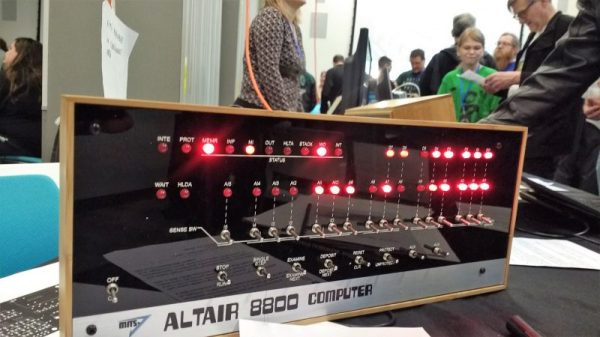
The fact that Seattle, home of Microsoft, Amazon, and dozens of other tech companies, has until now been left out of the loop in favor of VCF East in New Jersey and VCF West in Mountain View seems strange, but judging by the reception, VCF PNW is here to stay and poised to grow. There were 20 exhibitors for this go around, showing off everything from reanimated PDP-11 and Altair 8800 control panels to TRS-80s from Model 1 through to the CoCo. Almost every class of reasonably transportable retro hardware was represented, as well as some that pushed the portability envelope, like a working PDP-8 and a huge Symbolics 3640 LISP workstation.

Continue reading “Great Beginnings For Vintage Computing In Seattle; VCF PNW”

3D-Printed Punch And Die Stand Up To Steel

When you think of machine tooling, what comes to mind might be an endmill made of tungsten carbide or a punch and die made of high-speed steel. But surely there’s no room in the machine tool world for 3D-printed plastic tools, especially for the demanding needs of punching parts from sheet metal.

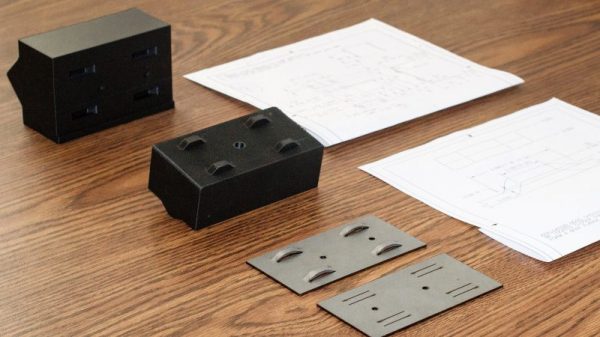
As it turns out, it is possible to make a 3D-printed punch and die set that will stand up to repeated use in a press brake. [Phil Vickery] decided to push the tooling envelope to test this, and came away pleasantly surprised by the results. In fairness, the die he used ended up being more of a composite between the carbon-fiber nylon filament and some embedded metal to reinforce stress points in the die block. It looks like the punch is just plastic, though, and both were printed on a Markforged Mark 2, a printer specifically designed for high-strength parts. The punch and die set were strong enough to form 14-gauge sheet steel in a press brake, which is pretty impressive. The tool wasn’t used to cut the metal; the blanks were precut with a laser before heading to the press. But still, having any 3D-printed tool stand up to metal opens up possibilities for rapid prototyping and short production runs.

No matter what material you make your tooling out of, there’s a lot to know about bending metal. Check out the basics in our guide to the art and science of bending metal.

Continue reading “3D-Printed Punch And Die Stand Up To Steel”

Homebrew Wrist Brace Helps Beat Injury With Style

Repetitive motion injuries are no joke, often attended by crippling pain and the possibility of expensive surgery with a lengthy recovery. Early detection and treatment is the key, and for many wrist and hand injuries such as [ktchn_creations] case of “Blackberry thumb,” that includes immobilization with a rigid brace.

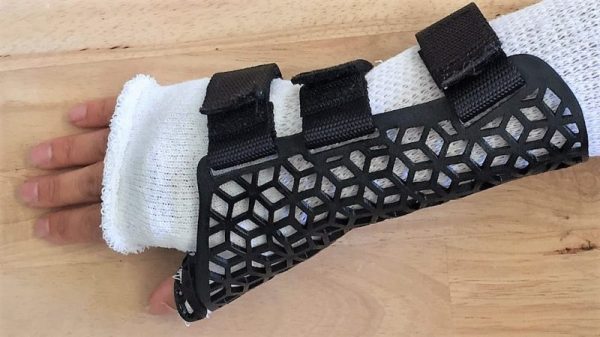
Sadly, the fiberglass brace her doctor left her with was somewhat lacking in the style department, and rather than being left with something unappealing to wear for half a year, she 3D-printed a stylish and functional wrist immobilizer. Starting in Autocad, she designed the outline of the brace, essentially an unwrapped version of the splint she started with. For breathability as well as aesthetics, a pattern of tessellated hexagons was used. The drawing was then exported to Fusion 360 for modeling and printing in black PLA. We were surprised to see that the brace was printed flat and later heat formed around her wrist, but that makes more sense than printing it in its final wrapped state. With a few velcro straps, the thermoformed brace was ready for service on the long road to recovery.

While [ktchn_creations] stipulates that looks were the motivator here, we’re not unaware that a 3D-printed brace might be more affordable than something dispensed by a doctor. But if you do build your own DIY appliance, whether for bracing your wrist, your knee, or your wayward teeth, you’ll want to run it past your health care provider, of course.

Mechanisms: Bearings

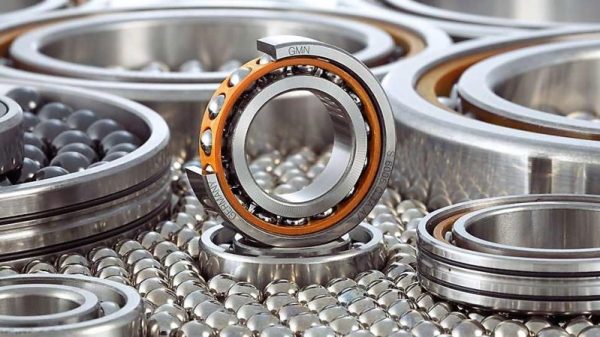
They lie at the heart of every fidget spinner and in every motor that runs our lives, from the steppers in a 3D printer to the hundreds in every car engine. They can be as simple as a lubricated bushing or as complicated as the roller bearing in a car axle. Bearings are at work every day for us, directing forces and reducing friction, and understanding them is important to getting stuff done with rotating mechanisms.

Continue reading “Mechanisms: Bearings”