A Perfect Rose, A Stepper, An X-Ray Machine, And Thee

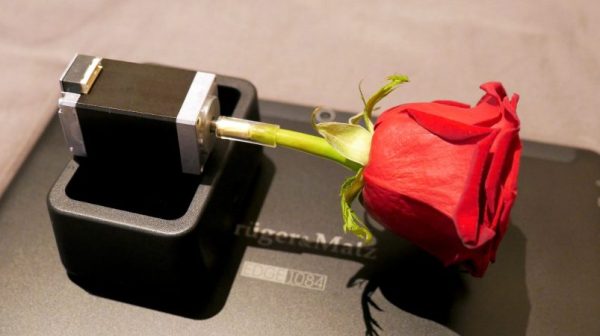
The Day of Compulsory Romance is once more upon us, and in recognition of that fact we submit for your approval an alternative look at one of the symbols of romantic love: an X-ray of a rose.

Normally, diagnostic X-rays are somewhat bland representations of differential densities of the tissues that compose various organs and organ systems, generally rendered in shades of gray. But [Linas K], a physicist with time to kill and access to some cool tools, captured the images in the video below not only in vivid color, but as a movie. The imaging side of the project consists of a low-power X-ray tube normally used for non-clinical applications and a CMOS sensor panel. The second video shows that [Linas] did an impressive upgrade on the X-ray controller, rolling his own from an FPGA. This allowed him to tie in a stepper motor to rotate the rose incrementally while taking images which he stitched together in post.

Watching the interior structure of the flower as it spins is fascinating and romantic in its own right, for certain subsets of romance. And really, who wouldn’t appreciate the work that went into this? But if you don’t have access to X-ray gear, fear not — a lovely Valentine’s gift is only a bottle of ferric chloride away.

Continue reading “A Perfect Rose, A Stepper, An X-Ray Machine, And Thee”
Biohacking Lactose Intolerance

Would you pop a homemade pill containing genetically engineered virus particles just so that you can enjoy a pizza? Not many people would, but then again, if you’ve experienced the violent reaction to lactose that some people have, you just might consider it.

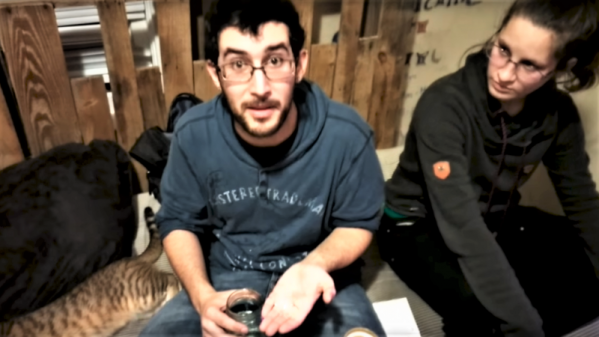
Such was the position that [The Thought Emporium] found himself in at age 16, suddenly violently lactose intolerant and in need of a complete diet overhaul. Tired of scanning food labels for telltale signs of milk products and paying the price for the inevitable mistakes, he embarked on a journey of DIY gene therapy to restore his ability to indulge in comfort foods. The longish video below details a lot of that journey; skip to 15:40 if you want to cut to the chase. But if you’re at all interested in the processes of modern molecular biology, make sure you watch the whole thing. The basic idea here is to create an innocuous virus that carries the lac gene, which encodes the enzyme β-galactosidase, or lactase, and use it to infect the cells of his small intestine. There the gene will hopefully be expressed, supplementing the supply of native enzyme, which in most adult humans is no longer expressed at the levels it was when breast milk was our primary food.

Did it work? We won’t ruin the surprise, but in any case, the video is a fascinating look at mammalian cell transfection and other techniques of genetic engineering that are accessible to the biohacker. Still, it takes some guts to modify your own guts, but bear in mind that this is someone who doesn’t mind inserting magnetic implants in his fingers.

Continue reading “Biohacking Lactose Intolerance”

Pipes, Tees, And Gears Result In Smooth Video Shots

It’s depressingly easy to make bad videos, but it only takes a little care to turn that around. After ample lighting and decent audio — and not shooting in portrait — perhaps the biggest improvements come from stabilizing the camera while it’s moving. Giving your viewers motion sickness is bad form, after all, and to smooth out those beauty shots, a camera slider can be a big help.

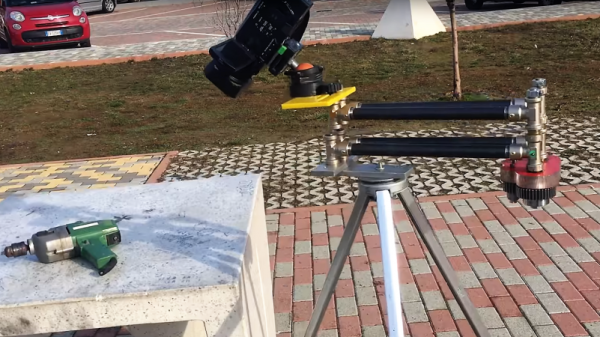
Not all camera sliders are built alike, though, and we must admit to being baffled while first watching [Rulof Maker]’s build of a smooth, synchronized pan and slide camera rig. We just couldn’t figure out how those gears were going to be put to use, but as the video below progresses, it becomes clear that this is an adjustable pantograph rig, and that [Rulof]’s eBay gears are intended to link the two sets of pantograph arms together. The arms are formed from threaded pipe and tee fittings with bearings pressed into them, which is a pretty clever construction technique that seems highly dependent on having the good fortune to find bearings with an interference fit into the threads. But still, [Rulof] makes it work, and with a little epoxy and a fair amount of finagling, he ends up with a complex linkage that yields the desired effects. And bonus points for being able to configure the motion with small adjustments to the camera bracket pivot points.

We saw a similar pantograph slider a few months back. That one was 3D-printed and linked with timing belts, but the principles are the same and the shots from both look great.

Continue reading “Pipes, Tees, And Gears Result In Smooth Video Shots”

Custom Parts Feeder Aims To Keep Pace With Pick And Place

When your widgets have proven so successful that building them gets to be a grind, it might be time to consider a little mechanical help in the form of a pick and place machine (PnP). If you’re going to roll your own though, there’s a lot to think about, not the least of which is how to feed your beast with parts.

Managing the appetite of a PnP is the idea behind this custom modular parts feeder, but the interesting part of [Hans Jørgen Grimstad]’s work-in-progress project has more to do with the design process. The feeders are to support a custom PnP being built in parallel, and so the needs of one dictate the specs of the other. Chief among the specs are the usual big three: cheap, fast, and reliable. But size is an issue too insofar that the PnP could be working with dozens of component reels at once. Flexibility was another design criteria, so that reels of varied width can be accommodated.

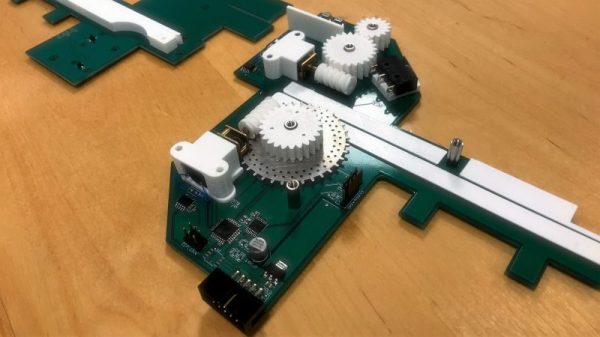
With all that in mind, [Hans] and company came up with a pretty slick design. The frame of the feeder is made out of the PCBs that house the motors for handling the tape, and the ATmega168 that controls everything. Tapes are driven by a laser-cut sprocket driven by 3D-printed worm gears. The boards have fingers that mate up to the aluminum extrusion that the PnP will be built from, and at only a few millimeters wider than the tape, lots of feeders can be nestled together. The video below shows the feeder undergoing some tests.

Alas, this build isn’t quite done, so you’ll have to check back for the final schematics and PCB files if you want to build one for yourself. While you’re waiting, you might want to build your own pick and place.

Continue reading “Custom Parts Feeder Aims To Keep Pace With Pick And Place”

Hacking When It Counts: Churchill’s Toy Shop

Nothing brings out the worst in humanity like war. Perversely, war also seems to exert an opposite if not equal force that leads to massive outbursts of creativity, the likes of which are not generally seen during times of peace. With inhibitions relaxed and national goals to meet, or in some cases where the very survival of a people is at stake, we always seem to find new and clever ways to blow each other to smithereens.

The run-up to World War II was a time where almost every nation was caught on its heels, and the rapidity of events unfolding across Europe and in Asia demanded immediate and decisive response. As young men and women mobilized and made ready for war, teams of engineers, scientists, and inventors were pressed into service to develop the weapons that would support them. For the British, these “boffins” would team up under a directorate called Ministry of Defence 1, or MD1. Informally, they’d be known as “Churchill’s Toy Shop,” and the devices they came up with were deviously clever hacks.

Continue reading “Hacking When It Counts: Churchill’s Toy Shop”

Neural Network Zaps You To Take Better Photographs

It’s ridiculously easy to take a bad photograph. Your brain is a far better Photoshop than Photoshop, and the amount of editing it does on the scenes your eyes capture often results in marked and disappointing differences between what you saw and what you shot.

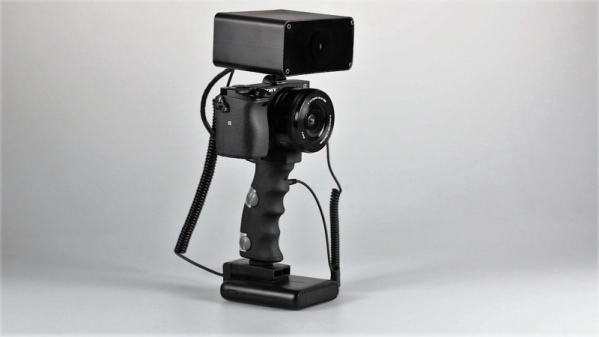
Taking your brain out of the photography loop is the goal of [Peter Buczkowski]’s “prosthetic photographer.” The idea is to use a neural network to constantly analyze a scene until maximal aesthetic value is achieved, at which point the user unconsciously takes the photograph.

But the human-computer interface is the interesting bit — the device uses a transcutaneous electrical nerve stimulator (TENS) wired to electrodes in the handgrip to involuntarily contract the user’s finger muscles and squeeze the trigger. (Editor’s Note: This project is about as sci-fi as it gets — the computer brain is pulling the strings of the meat puppet. Whoah.)

Meanwhile, back in reality, it’s not too strange a project. A Raspberry Pi watches the scene through a Pi Cam and uses a TensorFlow neural net trained against a set of high-quality photos to determine when to trip the shutter. The video below shows it in action, and [Peter]’s blog has some of the photos taken with it.

We’re not sure this is exactly the next “must have” camera accessory, and it probably won’t help with snapshots and selfies, but it’s an interesting take on the human-device interface. And if you’re thinking about the possibilities of a neural net inside your camera to prompt you when to take a picture, you might want to check out our primer on TensorFlow to get started.

Continue reading “Neural Network Zaps You To Take Better Photographs”

The Tachometer Inside Your Smartphone

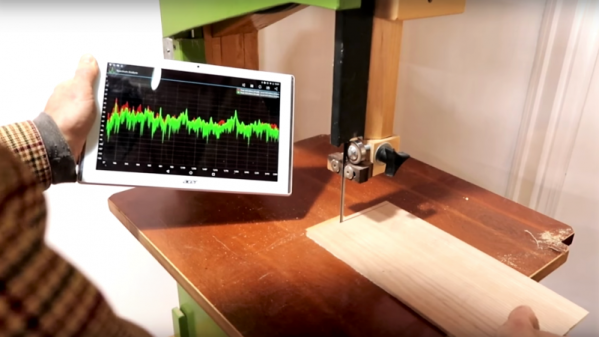
It’s the latest in instrumentation for the well-appointed shop — an acoustically coupled fast Fourier transform tachometer. Sounds expensive, but it’s really just using a smartphone spectrum analyzer app to indirectly measure tool speeds. And it looks like it could be incredibly handy.

Normally, non-contact tachometers are optically coupled, using photoreceptors to measure light flashing off of a shaft or a tool. But that requires a clear view of the machine, often putting hands far too close to the danger zone. [Matthias Wandel]’s method doesn’t require line of sight because it relies on a cheap spectrum analyzer app to listen to a machine’s sound. The software displays peaks at various frequencies, and with a little analysis and some simple math, the shaft speed of the machine can be determined. [Matthias] explains how to exclude harmonics, where to find power line hum, isolating commutator artifacts, and how to do all the calculations. You’ll need to know a little about your tooling to get the right RPM, and obviously you’ll be limited by the audio frequency response of your phone or tablet. But we think this is a great tip.

[Matthias] is no stranger to shop innovations and putting technology to work in simple but elegant ways. We wonder if spectrum analysis could be used to find harmonics and help with his vibration damping solution for a contractor table saw.

Continue reading “The Tachometer Inside Your Smartphone”