The ‘All-Seeing Pi’ Aids Low-Vision Adventurer

Adventure travel can be pretty grueling, what with the exotic locations and potential for disaster that the typical tourist destinations don’t offer. One might find oneself dangling over a cliff for that near-death-experience selfie or ziplining through a rainforest canopy. All this is significantly complicated by being blind, of course, so a tool like this Raspberry Pi low-vision system would be a welcome addition to the nearly-blind adventurer’s well-worn rucksack.

[Dan] has had vision problems since childhood, but one look at his YouTube channel shows that he doesn’t let that slow him down. When [Dan] met [Ben] in Scotland, [Ben] noticed that he was using his smartphone as a vision aid, looking at the display up close and zooming in to get as much detail as possible from his remaining vision. [Ben] thought he could help, so he whipped up a heads-up display from a Raspberry Pi and a Pi Camera. Mounted to a 3D-printed frame holding a 5″ HDMI display and worn from a GoPro head mount, the camera provides enough detail to help [Dan] navigate, as seen in the video below.

The rig is a bit unwieldy right now, but as proof of concept (and proof of friendship), it’s a solid start. We think a slimmer profile design might help, in which case [Ben] might want to look into this Google Glass-like display for a multimeter for inspiration on version 2.0.

Continue reading “The ‘All-Seeing Pi’ Aids Low-Vision Adventurer”

Using Backscatter Radio For A Soil Sensor Network

With almost 8 billion souls to feed and a changing climate to deal with, there’s never been a better time to field a meaningful “Internet of Agriculture.” But the expansive fields that make industrial-scale agriculture feasible work against the deployment of sensors and actuators because of a lack of infrastructure to power and connect everything. So a low-power radio network for soil moisture sensors is certainly a welcome development.

We can think of a lot of ways that sensors could be powered in the field. Solar comes to mind, since good exposure to the sun is usually a prerequisite for any cropland. But in practice, solar has issues, the prime one being that the plants need the sun more, and will quickly shade out low-profile soil-based sensors.

That’s why [Spyros Daskalakis] eschewed PV for his capacitive soil moisture sensors in favor of a backscatter technique very similar to that used in both the Great Seal Bug and mundane RFID tags alike. The soil sensor switches half of an etched PCB bowtie antenna in and out of a circuit at a frequency proportional to soil moisture. A carrier signal from a separate transmitter is reflected off the alternately loaded and unloaded antenna, picking up subcarriers with a frequency proportional to soil moisture. [Spyros] explains more about the sensor design and his technique for handling multiple sensors in his paper.

We really like the principles [Spyros] leveraged here, and the simplicity of the system. We can’t help but wonder what sort of synergies there are between this project and the 2015 Hackaday Prize-winning Vinduino project.

Continue reading “Using Backscatter Radio For A Soil Sensor Network”

Wireless Doorbell Hacked Into Hands-on MQTT Tutorial

The project itself is very simple: getting push notifications via MQTT when a wireless doorbell sounds. But as [Robin Reiter] points out, as the “Hello, world!” program is a time-honored tradition for coders new to a language, so too is his project very much the hardware embodiment of the same tradition. And the accompanying video build log below is a whirlwind tour that will get the first-timer off the ground and on the way to MQTT glory.

The hardware [Robin] chose for this primer is pretty basic – a wireless doorbell consisting of a battery-powered button and a plug-in receiver that tootles melodiously when you’ve got a visitor. [Robin] engages in a teardown of the receiver with attempted reverse engineering, but he wisely chose the path of least resistance and settled on monitoring the LEDs that flash when the button is pushed. An RFduino was selected from [Robin]’s ridiculously well-organized parts bin and wired up for the job. The ‘duino-fied doorbell talks Bluetooth to an MQTT broker on a Raspberry Pi, which also handles push notifications to his phone.

The meat of the build log, though, is the details of setting up MQTT. We’ve posted a lot about MQTT, including [Elliot Williams]’ great series on the subject. But this tutorial is very nuts and bolts, the kind of thing you can just follow along with, pause the video once in a while, and have a working system up and running quickly. There’s a lot here for the beginner, and even the old hands will pick up a tip or two.

Continue reading “Wireless Doorbell Hacked Into Hands-on MQTT Tutorial”

Unique Planetary Gearbox Can Be Custom Printed For Steppers

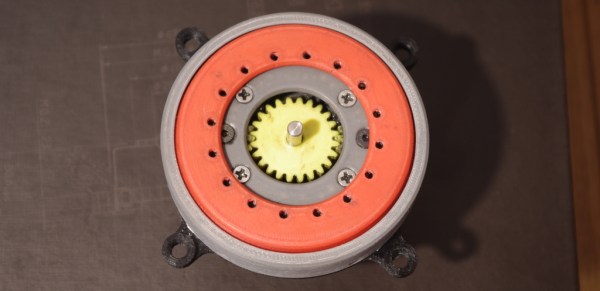
Stepper motors are a staple in all sorts of projects, but it’s often the case that a gearbox is needed, especially for applications like the linear drives in CNC machines and 3D printers. In those mechanisms, a high-torque, low backlash gearbox might be just the thing, and a 3D printable split planetary harmonic drive for the popular NEMA 17 motors would be even better.

Right up front, we’ll say that we’re skeptical that any plastic gearbox can stay as backlash free as [SirekSBurom] claims his creation is. But we can see the benefits of the design, and it has some nice features. First off, of course, is that it’s entirely 3D printed, except for a few screws. That it mates perfectly with a NEMA 17 motor is a really nice feature, too, and with the design up on Thingiverse it shouldn’t be too tough to scale it up and down accordingly. The videos below show you the theory: the stepper drives a sun gear with two planet gears orbiting, each of which engages a fixed ring of 56 teeth, and an output ring of 58 teeth. Each revolution of the planets around the fixed ring rotates the output ring by one tooth, leading to almost 100:1 reduction.

We think the ‘harmonic’ designation on this gearbox is a little of a misnomer, since the defining feature of a harmonic drive seems to be the periodic deformation of a flex spline, as we saw in this 3D-printed strain wave gear. But we see the resemblance to a harmonic drive, and we’ll admit this beastie is a little hard to hang a name tag on. Whatever you call it, it’s pretty cool and could be a handy tool for all kinds of builds.

Continue reading “Unique Planetary Gearbox Can Be Custom Printed For Steppers”

Heat Pump Gets Brain Transplant; Such Is Life In Latvia

If you buy a used heat pump that was made in China and try to use it in Northern Europe, there are bound to be issues. If said heat pump ends up encased in a block of ice that renders it ineffective, you’ve got two choices: give up and buy a proper heater, or hack a new ice-busting brain board into the heat pump and get back to life.

fnfvpksiz6c8s0h-medium
A little too icy.

[Evalds] chose the latter course, obviously, and in the process he gives us a pretty good look at how heat pumps work and how to overcome their deficiencies. In [Evalds]’ Latvia, winters can be both cold and humid, which can worsen an inherent problem with air-coupled heat pumps: they tend to ice up. As the outside coil is cooled to pick up as much heat as possible from the outside air, water vapor condenses out on the coils and freezes. Most heat pumps account for this by occasionally running in reverse, heating the outdoor coils to clear the ice buildup. [Evalds]’  had nothing more than a simple timer to kick off the defrost cycle, and it wasn’t keeping up with the Latvian winter. An Arduino replaced the OEM controller, and wired up to temperature sensors and an IR sensor that watches for ice buildup on the lower part of the coil, the heat pump is now much better behaved.

Of course it wasn’t as smooth as all that — [Evalds] has some hoops to jump through, including EMI problems and a dodgy Arduino clone. But he stuck with it and brought the heat pump back online, likely at far less expense than HVAC techs would charge for a service call.

Continue reading “Heat Pump Gets Brain Transplant; Such Is Life In Latvia”

DIY Syringe Pump Saves Big Bucks For Hacker’s Lab

If you had a choice between going to your boss and asking for funds for a new piece of gear, would you rather ask for $3000 to buy off-the-shelf, or $200 for the parts to build the same thing yourself? Any self-respecting hacker knows the answer, and when presented with an opportunity to equip his lab with a new DIY syringe pump for $200, [Dr. D-Flo] rose to the challenge.

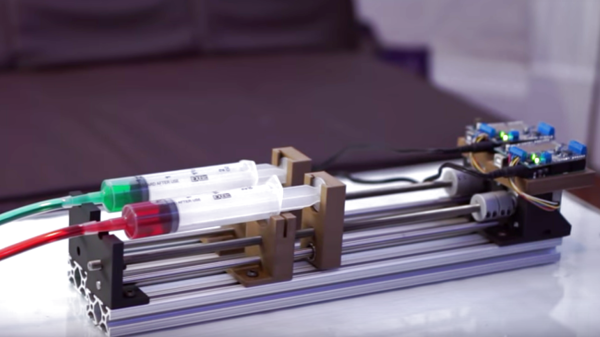
The first stop for [Dr. D-Flo] was, naturally, Hackaday.io, which is where he found [Naroom]’s syringe pump project. It was a good match for his budget and his specs, but he needed to modify some of the 3D printed parts a little to fit the larger syringes he intended to use. The base is aluminum extrusion, the drive train is a stepper motor spinning threaded rod and a captive nut in the plunger holders, and an Arduino and motor shield control everything. The drive train will obviously suffer from a fair amount of backlash, but this pump isn’t meant for precise dispensing so it shouldn’t matter. We’d worry a little more about the robustness of the printed parts over time and their compatibility with common lab solvents, but overall this was a great build that [Dr. D-Flo] intends to use in a 3D food printer. We look forward to seeing that one.

It’s getting so that that you can build almost anything for the lab these days, from peristaltic pumps to centrifuges. It has to be hard to concentrate on your science when there’s so much gear to make.

Continue reading “DIY Syringe Pump Saves Big Bucks For Hacker’s Lab”

Ask Hackaday: What Can You Do With Origami?

At some point, most of us have learned a little of the ancient art of origami. It’s a fascinating art form, and being able to create a recognizable model by simply folding paper in the right order can be hugely satisfying. Most of us move on to other pursuits once we master the classic crane model, but the mathematics behind origami can lead some practitioners past the pure art to more practical structures, like this folding ballistic barrier for law enforcement use.

The fifty-pound Kevlar and aluminum structure comes from Brigham Young University’s College of Mechanical Engineering, specifically from the Compliant Mechanisms Research program. Compliant mechanisms move by bending or deflecting rather than joints between discrete parts, and this ballistic shield is a great example. The mechanism is based on the Yoshimura crease pattern, which can be quickly modeled with a piece of paper. Scaling that up to a full-sized structure, light enough to be fielded but strong enough to stop a .44 Magnum round, was no mean feat. But as the video below shows, the prototype has a lot of potential.

Now it’s your turn: what applications have you seen for compliant mechanisms? Potential applications range in scale from MEMS linkages for microinjecting cells to huge antennas that unfurl in orbit. We’ve featured a few origami-like structures before, like this self-assembling robot or a folding quadcopter, but neither of these really rates as compliant. This elegant parabolic satellite antenna is more like it, though. There are applications for designing origami and a mathematical basis for the field; has anyone tried using these tools to design compliant structures? Sound off in the comments below.

Continue reading “Ask Hackaday: What Can You Do With Origami?”