Living Hinges At The Next Level

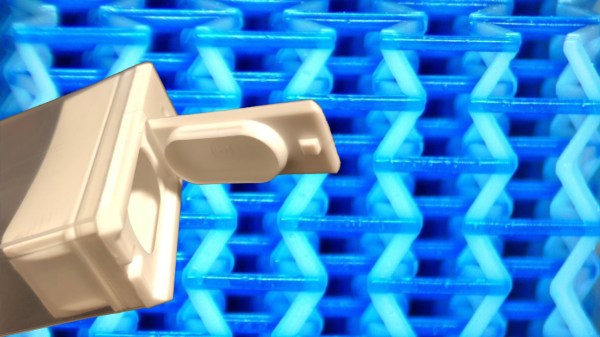
First of all, a living hinge is not a biological entity nor does it move on its own. Think of the top of a Tic Tac container where the lid and the cover are a single piece, and the thin plastic holding them together flexes to allow you to reach the candies disguised as mints. [Xiaoyu “Rayne” Zheng] at Virginia Tech designed a method of multimaterial programmable additive manufacturing which is fancy-ese for printing with more than one type of material.

The process works under the premise of printing a 3D latticework, similar to the “FILL” function of a consumer printer. Each segment of material is determined by the software and mixed on the spot by the printer and cured before moving onto the next segment. Like building a bridge one beam at a time, if that bridge were meant for tardigrades and many beams were fabricated each minute. Mixing up each segment as needed means that a different recipe results in a different rigidity, so it is possible to make a robotic leg with stiff “bones” and flexible “joints.”

We love printing in different materials, even if it is only one medium at a time. Printing in metal is useful and could be consumer level soon, but you can print in chocolate right now.

Via Phys.org. Thank you again for the tip, [Qes].
Detect Elevated Carbon Monoxide (Levels)

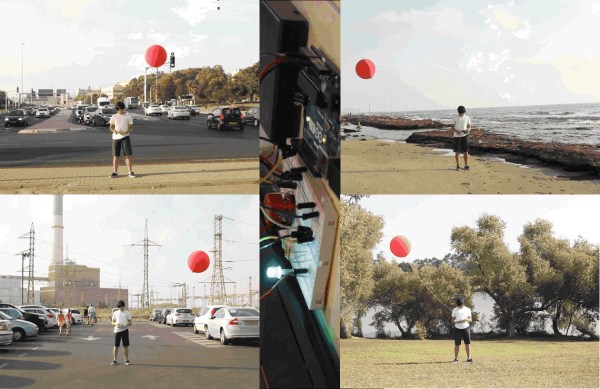
The molar mass of carbon monoxide (CO) is 28.0, and the molar mass of air is 28.8, so CO will rise in an ambient atmosphere. It makes sense to detect it farther from the ground, but getting a tall ladder is not convenient and certainly doesn’t make for fast deployment. What do you do if you don’t care for heights and want to know the CO levels in a gymnasium or a tall foyer? Here to save the day, is the Red Balloon Carbon Monoxide Detector.

Circuit.io generates the diagram and code to operate the CO sensor and turn a healthy green light to a warning red if unsafe levels are detected. The user holds the batteries, Arduino, and light while a red balloon lifts the sensor up to fifteen feet, or approximately five three meters. It is an analog sensor which needs some time to warm up so it pays to be warned about that wire length and startup.

Having a CO sentinel is a wise choice for this odorless gas.

Continue reading “Detect Elevated Carbon Monoxide (Levels)”

The Little Cat That Could

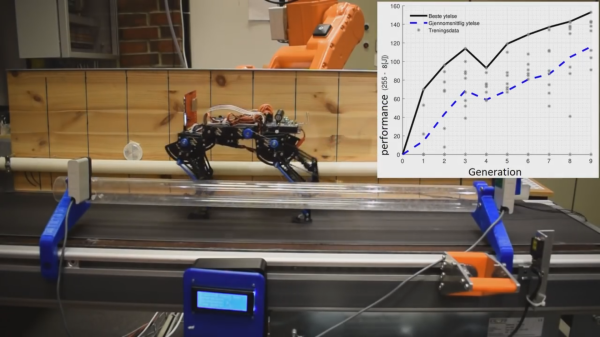
Most humans take a year to learn their first steps, and they are notoriously clumsy. [Hartvik Line] taught a robotic cat to walk [YouTube link] in less time, but this cat had a couple advantages over a pre-toddler. The first advantage was that it had four legs, while the second came from a machine learning technique called genetic algorithms that surpassed human fine-tuning in two hours. That’s a pretty good benchmark.

The robot itself is an impressive piece inspired by robots at EPFL, a research institute in Switzerland. All that Swiss engineering is not easy for one person to program, much less a student, but that is exactly what happened. “Nixie,” as she is called, is a part of a master thesis for [Hartvik] at the University of Stavanger in Norway. Machine learning efficiency outstripped human meddling very quickly, and it can even relearn to walk if the chassis is damaged.

We have been watching genetic algorithm programming for more than half of a decade, and Skynet hasn’t popped forth, however we have a robot kitty taking its first steps.

Continue reading “The Little Cat That Could”

Help For High-Frequency Hobbyists

Dead-bug circuit building is not a pretty affair, but hey, function over form. We usually make them because we don’t have a copper circuit board available or the duty of making one at home is not worth the efforts and chemical stains.

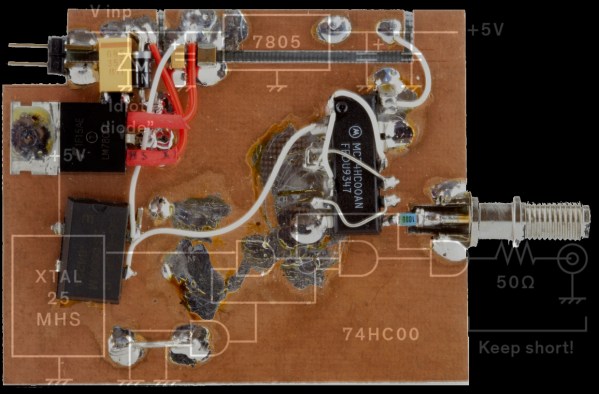
[Robert Melville and Alaina G. Levine] bring to light a compromise for high-frequency prototypes which uses the typical FR4 blank circuit board, but no etching chemicals. The problem with high-frequency radio is that building a circuit on a breadboard will not work because there is too much added inductance and capacitance from the wiring that will wreak havoc on the whole circuit. The solution is not new, build your radio module on a circuit board by constructing “lands” over a conductive ground plane, where components can be isolated on the same unetched board.

All right, sometimes dead-bug circuits capture an aesthetic all their own, especially when they look like this and they do allow for a darned small package for one-off designs.

Walk It Off, Healing Robots

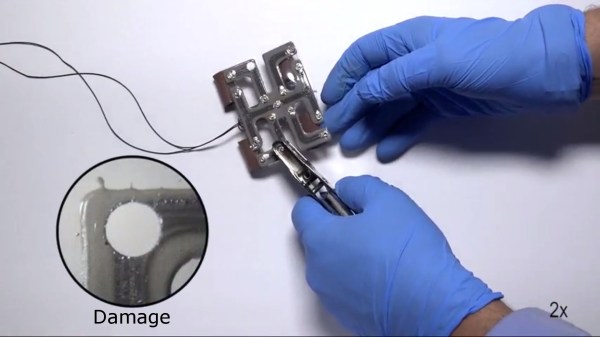
For many of us, our first robots, or technical projects, were flimsy ordeals built with cardboard, duct tape, and high hopes. Most of us grow past that scene, and we learn to work supplies which require more than a pair of kitchen scissors. Researchers at Carnegie Mellon University and Iowa State University have made a material which goes beyond durable, it can heal itself when wounded. To a small robot, a standard hole puncher is a dire assailant, but the little guy in the video after the break keeps hopping around despite a couple of new piercings.

The researcher’s goal is to integrate this substance into bio-inspired robots which may come to harm in the field. Fish-like robots could keep swimming after a brush with a bit of coral or a curious predator. Robot snakes could keep slithering after a fall or a gravel road.

Of course, robotic simulacrums are not the only ones who can benefit from healing circuitry. Satellites are prey to punctures from errant space debris.

Continue reading “Walk It Off, Healing Robots”

A Nibble And A Half Of Wooden Bits

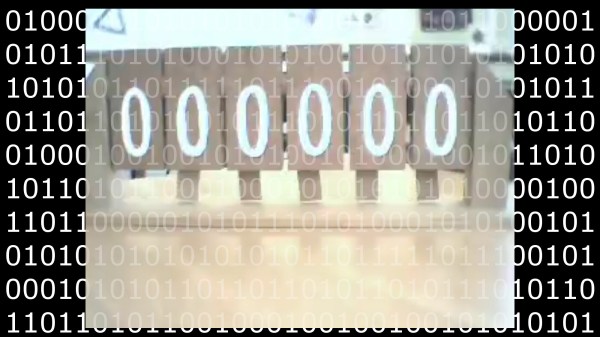
If you are familiar with binary, what would you need to teach someone who only knows decimal? If you do not know how to count in binary, let us know if the video below the break helps you understand how the base-2 number system works. If learning or counting binary is not what you are interested in, maybe you can appreciate the mechanics involved with making a counter that cycles through all the ones and zeros (links to the video shown below). The mechanism is simple enough. A lever at the corner of each “1” panel is attached off-center, so it hangs when it is upside-down, then falls to the side when it is upright, so it can swivel the adjacent panel.

Perhaps this is a desktop bauble to show off your adeptness at carpentry, or skills with a laser cutter, or 3D printer. No matter what it is made out of, it will not help you get any work done unless you are a teacher who wants to demonstrate the discrete nature of binary. If wood and bits are up your alley, we have a gorgeous binary driftwood clock to feast your eyes on. Meanwhile if analog methods of working digital numbers suit you, we have binary math performed with paper models.

Continue reading “A Nibble And A Half Of Wooden Bits”

Greasing Robot Hands: Variable Friction Makes Robo-Mitts More Like Our Own

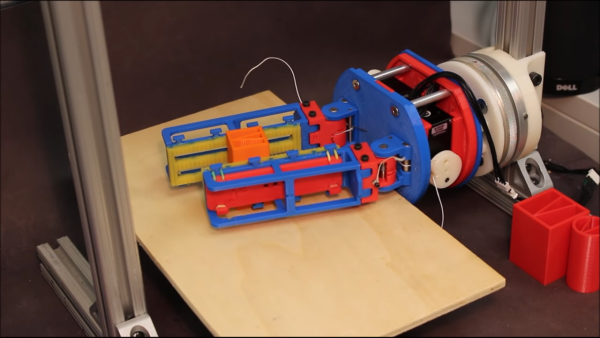
Unless you are in the fields of robotics or prosthetics, you likely take for granted the fine motor skills our hands have. Picking up and using a pen is no small feat for a robot which doesn’t have a dedicated pen-grabbing apparatus. Holding a mobile phone with the same gripper is equally daunting, not to mention moving that phone around once it has been grasped. Part of the wonder of our hands is the shape and texture which allows pens and phones to slide around at one moment, and hold fast the next moment. Yale’s Grab Lab has built a gripper which starts to solve that problem by changing the friction of the manipulators.

A spring-loaded set of slats with a low-friction surface allow a held object to move freely, but when more pressure is exerted by the robot, the slats retract and a high-friction surface contacts the object. This is similar to our fingers with their round surfaces. When we brush our hands over something lightly, they graze the surface but when we hold tight, our soft flesh meets the surface of the object and we can hold tightly. The Grab Lab is doing a great job demonstrating the solution and taking steps to more capable robots. All hail Skynet.

We have no shortage of gripper designs to choose from, including pneumatic silicone and one that conforms to an object’s surface, similar to our hands.

Continue reading “Greasing Robot Hands: Variable Friction Makes Robo-Mitts More Like Our Own”