Submarine To Plane: Can You Hear Me Now? The Hydrophone Radar Connection

How does a submarine talk to an airplane? It sounds like a bad joke but it’s actually a difficult engineering challenge.

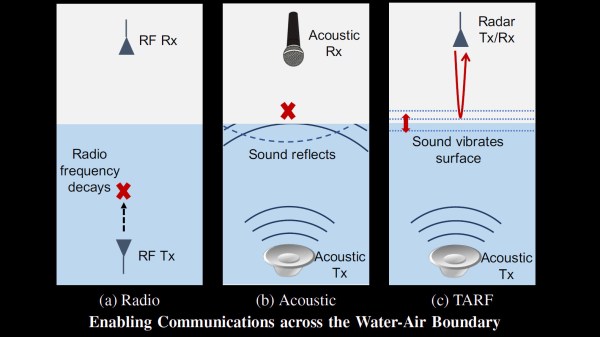
Traditionally the submarine must surface or get shallow enough to deploy a communication buoy. That communication buoy uses the same type of radio technology as planes. But submarines often rely on acoustic transmissions via hydrophones which is fancy-talk for putting speakers and microphones in the water as transmitters and receivers. This is because water is no friend to radio signals, especially high frequencies. MIT is developing a system which bridges this watery gap and it relies on acoustic transmissions pointed at the water’s surface (PDF warning) and an airplane with high-precision radar which detects the oscillations of the water.

The complexity of the described setup is mind-boggling. Right now the proof of concept is over short distances and was tested in a water tank and a swimming pool but not in open water. The first thing that comes to mind is the interference caused by waves and by aerosols from wind/wave interactions. Those challenges are already in the minds of the research team. The system has been tested to work with waves of 8 cm (16 cm measured peak to trough) caused by swimmers in the pool. That may not sound like much, but it’s about 100,000 times the surface variations being measured by the millimeter wave radar in order to detect the hydrophone transmissions. Add to that the effects of Doppler shift from the movement of the plane and the sub and you have a signal processing challenge just waiting to be solved.

This setup is very interesting when pitched as a tool for researching aquatic life. The video below envisions that transmitters on the backs of sea turtles could send communications to aircraft overhead. We love seeing these kinds of forward-thinking ocean research projects, like our 2017 Hackaday prize winner which is an open source underwater glider. Oceanic studies over long distances have been very difficult but we’re beginning to see a lot of projects chipping away at that inaccessibility.

Continue reading “Submarine To Plane: Can You Hear Me Now? The Hydrophone Radar Connection”

I Hear You Offer WiFi

We are swimming in radio transmissions from all around, and if you live above the ground floor, they are coming at you from below as well. Humans do not have a sensory organ for recognizing radio signals, but we have lots of hardware which can make sense of it. The chances are good that you are looking at one such device right now. [Frank Swain] has leaped from merely accepting the omnipresent signals from WiFi routers and portable devices to listening in on them. The audio signals are mere soundwaves, so he is not listening to every tweet and email password, merely a representation of the data’s presence. There is a sample below the break, and it sounds like a Geiger counter playing PIN•BOT.

We experience only the most minuscule sliver of information coming at us at any given moment. Machines to hack that gap are not had to find on these pages so [Frank] is in good company. Magnetosensory is a popular choice for people with a poor sense of direction. Echolocation is perfect for fans of Daredevil. Delivering new sensations could be easier than ever with high-resolution tactile displays. Detect some rather intimate data with ‘SHE BON.’

Continue reading “I Hear You Offer WiFi”

Touch Anything And Everything

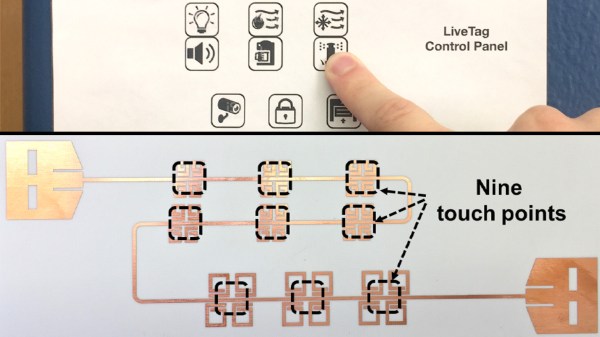
Powering IoT devices is often a question of batteries or mains power, but in rare exceptions to this rule there is no power supply (PDF Warning). At the University of Wisconsin-Madison and the University of California, San Diego, researchers have gone the extra mile to make advanced backscatter devices, and these new tags don’t need the discrete components we have seen in previous versions. They are calling it LiveTag, and it doesn’t need anything aside from a layer of foil printed or etched on a flexible ceramic-PTFE laminate. PTFE is mostly seen in the RF sector as a substrate for circuit boards.

We have seen some of the wild creations with wifi backscatter that range from dials to pushbuttons. RF backscatter works by modulating the RF signals in which we are continuously swimming. Those radio waves power the device and disrupt the ambient signals, which disruption can be detected by a receiver. With a BOM that looks like a statement more than a list, integration with many devices becomes a cost-effective reality. Do not however broadcast important data because you cannot expect great security from backscatter.

[Via IEEE Spectrum]

Braille On A Tablet Computer

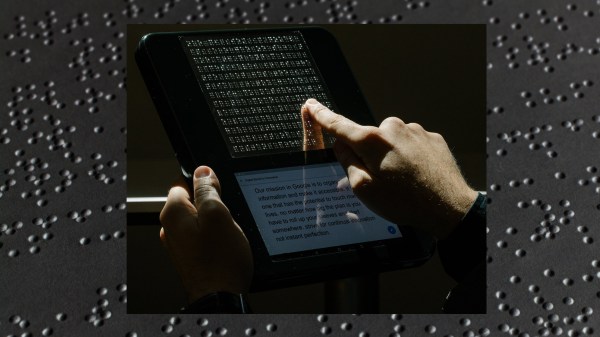
Signing up for college classes can be intimidating, from tuition, textbook requirements, to finding an engaging professor. Imagine signing up online, but you cannot use your monitor. We wager that roughly ninety-nine percent of the hackers reading this article have it displayed on a tablet, phone, or computer monitor. Conversely, “Only one percent of published books is available in Braille,” according to [Kristina Tsvetanova] who has created a hybrid tablet computer with a Braille display next to a touch-screen tablet running Android. The tablet accepts voice commands for launching apps, a feature baked right into Android. The idea came to her after helping a blind classmate sign up for classes.

Details on the mechanism are not clear, but they are calling it smart liquid, so it may be safe to assume hydraulic valves control the raised dots, which they call “tixels”. A rendering of the tablet can be seen below the break. The ability to create a full page of braille cells suggest they have made the technology pretty compact. We have seen Braille written on PCBs, a refreshable display based on vibrator motors, and a nicely sized Braille keyboard that can fit on the back of a mobile phone.

Continue reading “Braille On A Tablet Computer”

Unphotogenic Lighting As A Feature

Have you ever taken a picture indoors and had unsightly black bars interrupt your otherwise gorgeous photo? They are caused by lighting which flickers in and out in its normal operation. Some people can sense it easier than others without a camera. The inconsistent light goes out so briefly that we usually cannot perceive it but run-of-the-mill camera phones scan rows of pixels in sequence, and if there are no photons to detect while some rows are scanned, those black bars are the result. Annoying, right?

What if someone dressed that bug of light up as a feature? Instead of ruining good photos, researchers at the University of California-San Diego and the University of Wisconsin-Madison have found out what different frequencies of flicker will do to a photograph. They have also experimented with cycling through red, green, and blue to give the effect of a poorly dubbed VHS.

There are ways an intelligent photographer could get around the photo-ruining effect with any smartphone. Meanwhile DSLR cameras are already immune and it won’t work in sunlight, so we are not talking about high security image protection. The neat thing is that this should be easy to replicate with some RGB strips and a controller. This exploits the row scanning of new cameras, so some older cameras are immune.

120 Second Shower Cap

Do you have a couple of minutes? Literally and precisely, two minutes. That’s how long these ten songs play. So what? A short song is not new, but these ten songs are part of a campaign to encourage residents of Cape Town, South Africa to cap their showers at one-hundred-twenty seconds. Some of us do not have to worry about droughts or water bills, but most of us are concerned about one or both of those, and this ingenious campaign alerted people to the problem, gave them the means to time themselves, and made it pleasant, not oppressive. The songs are freely available, and one might even pique your listening tastes from the biggest stars in South Africa.

So, where is the hack? Some of us have experimented with egg timers on the towel rack, timers on the showerhead, servos on the faucet knobs, or occupancy sensors, but those are strong-arm techniques or only for measuring, not regulating water use. These songs attack the most viable vector, the showerer. Or is it showeree? Telling people there is a drought is one thing, but giving them the ability to regulate themselves in such a way that they comply is a hacker’s approach. The songs on the site do not autoplay so there will be no hanging out under the water spray to find the best song. Which is your favorite?

Robots Invade Your Personal Space

If you have ever had to complete a task such as building a LEGO model over a remote connection, you will know that the challenges are like an absurd grade school group project. The person giving directions often has trouble describing what they are thinking, and the person doing the work has trouble interpreting what the instructor wants. “Turn the blue block over. No, only half way. Go back. Now turn it. No, the other way. NO! Not clockwise, downward. That’s Upward! Geez. Are you even listening‽” Good times.

While you may not be in this situation every day, the Keio University of Japan has an intuitive way to give instructors a way to physically interact with an instructee through a Moore/Swayze experience. The instructor has a camera in typical pirate parrot placement over the shoulder. Two arms are controlled by the instructor who can see through stereoscopic cameras to have a first-person view from across the globe. This natural way to interact with the user’s environment allows muscle memory to pass from the instructor to the wearer.

For some of the other styles of telepresence, see this deep-sea bot and a cylindrical screen that looks like someone is beaming up directly from the holodeck.

Continue reading “Robots Invade Your Personal Space”