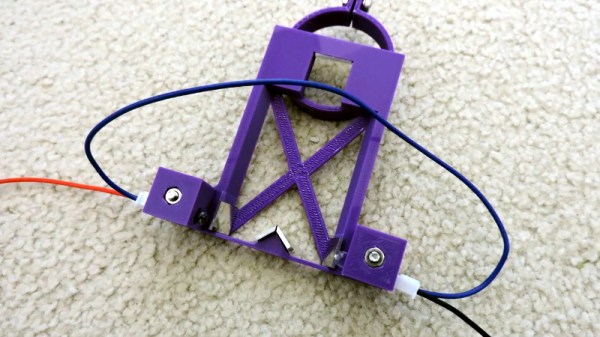
Heavy Metal Cyberdeck Has An Eye Towards Expansion

Whether we’re talking about Gibson’s Sprawl or our increasingly dystopian reality, one of the defining characteristics of a cyberdeck is that it can be easily customized and upgraded over time. While a few of the builds we’ve covered over the last couple of years have focused more on style than substance, we really appreciate the designs that embrace the concept of modularity to make sure the system can evolve to meet the changing demands of hacking on the go.

To that end, the M3TAL from [BlastoSupreme] is a perfect example of what a cyberdeck should be. Naturally it’s got the cyberpunk aesthetics we’ve come to expect, but more importantly, it’s designed so modifications and repairs are as quick and painless as possible. The trick is the use of a 2020 aluminum extrusion frame, which allows external panels and components to be attached anywhere along the length of the deck using T-Nuts. Similarly, by mounting internal components to “sleds” that ride between the pieces of extrusion, the electronics can easily be removed or swapped out as complete modules.

The M3TAL is currently outfitted with a Raspberry Pi 4 and a pair of 26650 batteries.

Furthering the idea of expandability, [BlastoSupreme] included an authentic 3.5 floppy drive on the M3TAL that allows him to pack an incredible 1.44 MB onto each rugged and portable disk. OK, so maybe the floppy drive isn’t terribly impressive compared to 2021 tech, but it does seem oddly appropriate for a cyberdeck. On the opposite side of the deck there’s a RetroCART slot, which cloaks modern USB devices in clunky faux cartridges. This provides a unified physical format for everything from removable storage to microcontrollers and software defined radio receivers.

Continue reading “Heavy Metal Cyberdeck Has An Eye Towards Expansion”

Crew Dragon’s Short Hop Begins The Era Of Valet Parking At The ISS

They weren’t scheduled to return to Earth until April 28th at the earliest, so why did NASA astronauts Michael Hopkins, Victor Glover, and Shannon Walker, along with Japan Aerospace Exploration Agency (JAXA) astronaut Soichi Noguchi, suit up and climb aboard the Crew Dragon Resilience on April 5th? Because a previously untested maneuver meant that after they closed the hatch between their spacecraft and the International Space Station, there was a chance they weren’t going to be coming back.

On paper, moving a capsule between docking ports seems simple enough. All Resilience had to do was undock from the International Docking Adapter 2 (IDA-2) located on the front of the Harmony module, itself attached to the Pressurized Mating Adapter 2 (PMA-2) that was once the orbital parking spot for the Space Shuttle, and move over to the PMA-3/IDA-3 on top of Harmony. It was a short trip through open space, and when the crew exited their craft and reentered the Station at the end of it, they’d only be a few meters from where they started out approximately 45 minutes prior.

The maneuver was designed to be performed autonomously, so technically the crew didn’t need to be on Resilience when it switched docking ports. But allowing the astronauts to stay aboard the station while their only ride home undocked and flew away without them was a risk NASA wasn’t willing to take.

What if the vehicle had some issue that prevented it from returning to the ISS? A relocation of this type had never been attempted by an American spacecraft before, much less a commercial one like the Crew Dragon. So while the chances of such a mishap were slim, the crew still treated this short flight as if it could be their last day in space. Should the need arise, all of the necessary checks and preparations had been made so that the vehicle could safely bring its occupants back to Earth.

Thankfully, that wasn’t necessary. The autonomous relocation of Crew Dragon Resilience went off without a hitch, and SpaceX got to add yet another “first” to their ever growing list of accomplishments in space. But this first relocation of an American spacecraft at the ISS certainly won’t be the last, as the comings and goings of commercial spacecraft will only get more complex in the future.

Continue reading “Crew Dragon’s Short Hop Begins The Era Of Valet Parking At The ISS”

Homebrew RISC-V Computer Has Beauty And Brains

Building your own CPU is arguably the best way to truly wrap your head around how all those ones and zeros get flung around inside of a computer, but as you can probably imagine even a relatively simple processor takes an incredible amount of time and patience to put together. Plus, more often than not you’re then left with a maze of wires and perfboards that takes up half your desk and doesn’t do a whole lot more than blink some LEDs.

An early prototype of the Pineapple ONE.

But the Pineapple ONE, built by [Filip Szkandera] isn’t your average homebrew computer. Oh sure, it still took two years for him to design, debug, and assemble, his 32-bit RISC-V CPU and all its associated hardware; but the end result is a gorgeous looking machine that runs C programs and offers a basic interactive shell over VGA. In fact with its slick 3D printed enclosure, vertically stacked construction, and modular peripheral connections, it looks more like some kind of high-tech scientific instrument than a computer; homebrew or otherwise.

[Filip] says he was inspired to build this 500 kHz (yes, kilohertz) beauty using only discrete logic components by [Ben Eater]’s well known 8-bit  breadboard computer and [Robert Baruch]’s LMARV-1 (Learn Me A RISC-V, version 1). He spent six months simulating the machine before he even started creating the schematics, let alone design the individual boards. He tried to keep all of his PCB’s under 100 x 100 mm to take advantage of discounts from the fabricator, which ultimately led to the decision to align the nine boards vertically and connect them together with pin headers.

In the video below you can see [Filip] start up the computer, call up a bit of system information, and even play a rudimentary game of snake before peeking and poking some of the machine’s 512 kB of RAM. It sounds like there’s still some work to be done and bugs to squash, but we’ve already seen enough to say this machine has more than earned entry into the pantheon of master-crafted homebrew computers.

Continue reading “Homebrew RISC-V Computer Has Beauty And Brains”

Teardown: Linkimals Musical Moose

Like so many consumer products these days, baby toys seem to get progressively more complex with each passing year. Despite the fact that the average toddler will more often than not be completely engrossed by a simple cardboard box, toy companies are apparently hell-bent on producing battery powered contraptions that need to be licensed with the FCC.

As a perfect example, we have Fisher-Price’s Linkimals. These friendly creatures can operate independently by singing songs and flashing their integrated RGB LEDs in response to button presses, but get a few of them in the room together, and their 2.4 GHz radios kick in to create an impromptu mesh network of fun.

They’ll soon be back, and in greater numbers.

Once connected to each other, the digital critters synchronize their LEDs and sing in unison. Will your two year old pay attention long enough to notice? I know mine certainly wouldn’t. But it does make for a compelling commercial, and when you’re selling kid’s toys, that’s really the most important thing.

On the suggestion of one of our beloved readers, I picked up a second-hand Linkimals Musical Moose to take a closer look at how this cuddly pal operates. Though in hindsight, I didn’t really need to; a quick browse on Amazon shows that despite their high-tech internals, these little fellows are surprisingly cheap. In fact, I’m somewhat embarrassed to admit that given its current retail price of just under $10 USD, I actually paid more for my used moose.

But you didn’t come here to read about my fiscal irresponsibility, you want to see an anthropomorphic woodland creature get dissected. So let’s pull this smug Moose apart and see what’s inside.

Continue reading “Teardown: Linkimals Musical Moose”

Newest PlayStation Exploit Skips The Disc

Last month we brought you word of tonyhax, a clever exploit for the original Sony PlayStation that leveraged a buffer overflow in several of the games from the Tony Hawk Pro Skater series to load arbitrary code from a specially prepared memory card. But now [Bradlin] has taken that idea a step further and developed a software exploit for Sony’s iconic console that doesn’t need to be triggered from a game.

The exploit is considerably more complex this time around, but [Bradlin] does an excellent job of breaking it down for those who want the gritty details. The short version is that missing boundary checks in the PlayStation’s built-in memory card handling routines mean a carefully formatted “block” on the memory card can get the console to execute a small 128 byte payload. That’s not a lot of room to work with, but it ends up being just enough to load up additional code stored elsewhere on the memory card and really kick things off.

Unlike tonyhax, which was designed specifically to allow the user to swap their retail Tony Hawk disc with a game burned to a CD-R, [Bradlin]’s FreePSXBoot is presented as more of a generic loader. As of right now, it doesn’t allow you to actually play burned games, although its inevitable that somebody will connect those last few dots soon.

If you want to check out the progress so far, all you need is wire a PlayStation memory card up to an Arduino, write the provided image to it, and stick it in the slot. [Bradlin] says the exploit doesn’t work 100% of the time (something else that will surely be addressed in future releases), but it shouldn’t take too many attempts before you’re greeted with the flashing screen that proves Sony’s 27 year old console has now truly been bested.

Continue reading “Newest PlayStation Exploit Skips The Disc”

Kerbal Space Program Goes To The Movies In Stowaway

Fans of the lusciously voiced space aficionado [Scott Manley] will know he often uses Kerbal Space Program (KSP) in his videos to knock together simple demonstrations of blindingly complex topics such as orbital mechanics. But as revealed in one of his recent videos, YouTube isn’t the only place where his KSP craft can be found these days. It turns out he used his virtual rocket building skills to help the creators of Netflix’s Stowaway develop a realistic portrayal of a crewed spacecraft in a Mars cycler orbit.

The Mars cycler concept was proposed in 1985 by Buzz Aldrin as a way to establish a long-term human presence on the Red Planet. Put simply, it describes an orbit that would allow a vehicle to travel continuously between Earth and Mars while needing only an occasional engine burn for course corrections. The spacecraft couldn’t actually stop at either planet, but while it made a close pass, smaller craft could rendezvous with it to hitch a ride. The concept can be thought of as a sort of interplanetary train: where passengers and cargo are picked up and dropped off at “stations” above Earth and Mars. It’s worth noting that a similar cycler orbit should be possible for Earth-Venus trips, but nobody really wants to go there.

An early KSP proof of concept for Stowaway.

The writers of Stowaway wanted their film to take place on a Mars cycler, and to avoid having to create the illusion of weightlessness, they wanted their fictional craft to also have some kind of artificial gravity. The only problem was, they weren’t sure what that would actually look like. So they reached out to [Scott], who in turn used KSP to throw together a rough idea of how such a ship might work in the real-world.

As you can see in the video below, the CGI spacecraft shown in the film’s recently released trailer ended up bearing a strong resemblance to its KSP prototype. While naturally some artistic license was used, [Scott] is excited by what he’s seen so far. The spinning spacecraft, which uses a spent upper stage to counterbalance its crew module and features a stationery utility node at the center, certainly looks impressive; all the more so with the knowledge that it’s based on sound principles.

While Netflix has had a hand in some surprisingly realistic science fiction in the past, they’ve also greenlit some real groan-worthy productions (if you haven’t watched Away, don’t). So until we can see the whole thing for ourselves, we can only hope that [Scott]’s sage advice will allow the crew of Stowaway to fly safe.

Continue reading “Kerbal Space Program Goes To The Movies In Stowaway

Taking A Peek Inside The Newest Echo Show 10

When Amazon released the original Echo, it was a pretty simple affair. Cylinder, some LEDs on top, done. Then they came out with the Echo Dot, which was basically the same thing, but shorter. It seemed like there was a pretty clear theme for awhile, but then at some point Amazon decided it would be a good idea to start producing Echo devices in every form factor imaginable, from wall plugs to literal sunglasses, and things got a lot more complicated. As a perfect example, take a look at this teardown of the third generation Echo Show 10 by [txyzinfo].

Granted the base still looks a bit like the Echos of old, but the family resemblance stops there. As you can probably gather from the name, the Show features a high resolution 10.1 inch LCD panel, greatly improving the number and type of advertisements Amazon is able to force on the user. In true Black Mirror fashion, there’s even a brushless motor in the base that allows the machine to rotate the display towards the user no matter how hard they try to escape.

A salvageable part if there ever was one.

The teardown is presented with no commentary; in both the video below and on the Hackaday.IO page, all you’ll find are clear and well-lit images of the device’s internals. But for those who are just interested in what the inside of one of these $250 USD gadgets looks like, that’s all you really need.

At this point, it doesn’t seem like [txyzinfo] is trying to reverse engineer the Show or figure out how it all works, and looking at the complexity of that main board, we’re not surprised. Still, it’s a marvel to look at all the hardware they packed into such a relatively small device.

If you’re looking for a more technical examination at the newer Echo devices, [Brian Dorey] did some impressive poking around on the third generation Dot in 2019 and [electronupdate] went as far as decapping a few of the chips inside the Flex. On the software side of things, check out the recent efforts to craft an open source firmware for the original Echo.

Continue reading “Taking A Peek Inside The Newest Echo Show 10”