The library at 3DCarParts, no filters applied.

3DCarParts.org May Have STLs For Your Next Auto Repair

Statistically speaking, you’re likely to own an automobile. If you don’t, feel free to skip reading and be smug in the comments, but those of us who do require two-tonne death machines to get around also know they need repairs from time to time. Some of those repairs involve things that make one think, “Surely I could print this”– which is the thought that led [Will Leuke] to found 3DCarParts.org, a clearinghouse for 3D models of car parts.

Most of the parts in the library seem to be simple replacements for a wide range of parts, from knobs and handles to trim, vents, and even drive gears for power seating. There are, however, some parts to help you make aftermarket modifications, like adding a touchscreen to an old Mustang. The site hosts files locally and indexes files on Thingiverse, but its ability to search by make and model is what makes it stand out. If you’ve scanned or otherwise redesigned a replacement part, you can upload it to the site as well– this is by no means a one-man show.

Continue reading “3DCarParts.org May Have STLs For Your Next Auto Repair” →
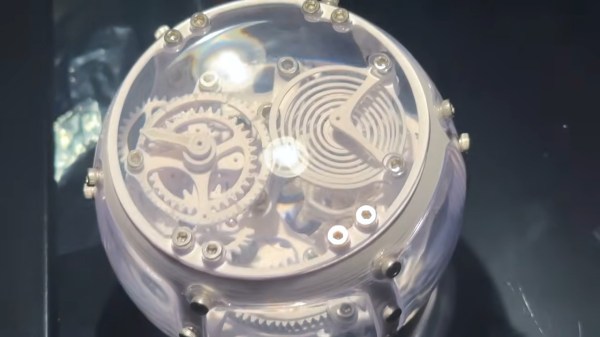
3D Printed Pocket Watch For People With Big Pockets

In this case, we mean “big pockets” quite literally — it wouldn’t cost much to print all the parts for [Nerd3D]’s 3D-printed pocket watch, but at the size of an extra-large apple, you’re going to need 2000s-era baggy cargo shorts to carry it. Those are back in style, right?

If not, they should be, if only for this project. The whole thing is a skeleton design, with crystal-clear resin prints from [Nerd3D]’s sponsor making up the shell so you can see the beautiful action in motion. We can’t help but wonder whether switching from FDM to resin for the remainder of the watch would let the design shrink for easier pocket-ability, but then he’d need to find a resin that could work as a torsion spring, which might prove difficult. [Nerd3D]’s choice of FDM printing, well proven in the clock world for over a decade now,  is thus eminently practical — even if it means he does need deep pockets.

We particularly like the glow-in-the-dark filament used on the skeleton dial, and can hardly complain that he’s using a metal spring in the power reserve, as that, too, is eminently practical. Watches are for more than just winding, after all. Printing plastic springs isn’t easy, as we’ve seen before, and while he’s hardly the first to use one in a clock, we were glad to see he still incorporated one in the design.  Really, the only thing we can’t praise is that he hasn’t shared the design files yet, because who doesn’t want a giant watch? Since he’s promised to do so once he’s happy with the design, we can’t complain in the least.

Continue reading “3D Printed Pocket Watch For People With Big Pockets” →

ESP32 DevKit Becomes Retro-Style Desk Gadget

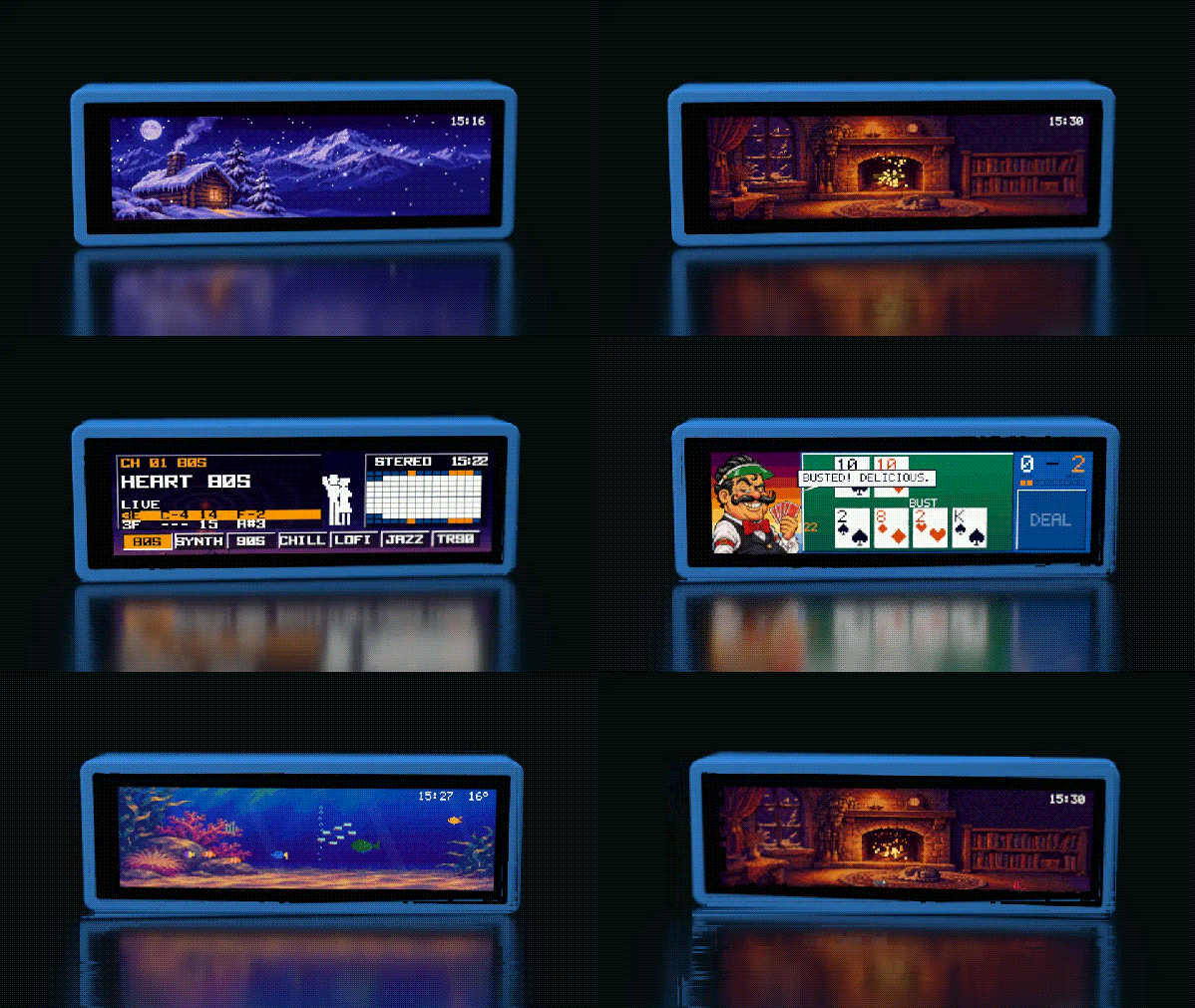
Some days you want to break out KiCAD and go an an epic journey of hardware hacking. Other days, you look at the myriad dev kits on the market, and one of them makes you say “I can work with that”– and the Phosphor desk gadget, by [melihkoray] and his imaginary amigo Claude, was evidently conceived on one of those days.

The only hardware here is the Waveshare ESP32-S3-Touch-LCD-3.49, which provides a beyond-ultrawide 640×172 candybar-shaped touchscreen with, well, you guessed it — an ESP32-S3, plus a few buttons and an accelerometer, all of which this project uses. Along with the almost-requisite clock, timer and weather display, there’s also an internet radio player and a handful of games. We particularly like the use of the accelerometer in the blackjack game, where you hit or sit by knocking the table.

Continue reading “ESP32 DevKit Becomes Retro-Style Desk Gadget” →

FARTing Packets Over The Mountains With LinHT SDR

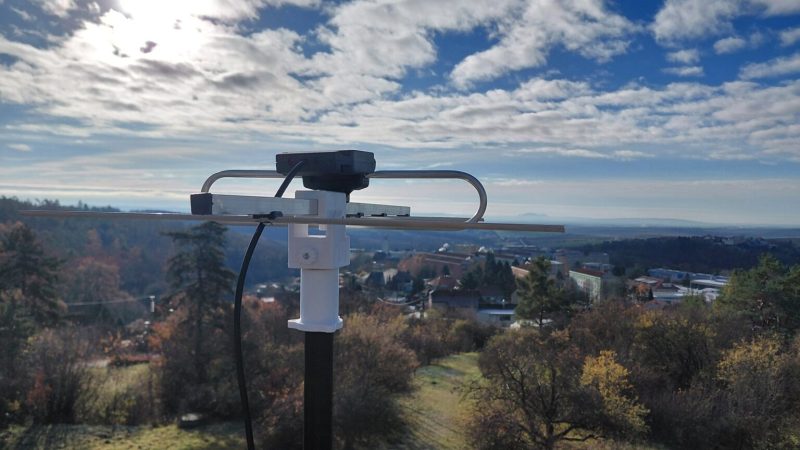
Sometimes, you just have to play Quake over a handheld Linux software-defined radio — the LinHT, in the case of [Vlastimil Slinták]. That SDR isn’t set up for WiFi, so [Vlastimil] did what anyone would do: write his own TCP/IP-based packet networking protocol, called Fast Amateur Radio Transport, or FART. Yes, FART. We love it already.

Using the SX1255 in the LinHT handheld, the software modem looks to your laptop like any USB network adapter. Most networks aren’t transmitting on the 70cm amateur band, sure, but packets are packets. That means all your networking software and knowledge already applies, so using FART is a very natural thing.

Speeds are not blistering fast — configured for 25kHz narrowband channels, they get only 14–88 kbit/s, while the 110kHz wideband channels can manage 142–400 kbit/s. Before getting too disappointed, remember that the world used to run on 9600 baud or less, and that’s only 9.6 kbit/s. Some of our readers will remember when 300 baud was enough, and think this radio modem sounds pretty snappy.

Continue reading “FARTing Packets Over The Mountains With LinHT SDR” →

PS3 Boomerang Controller Concept Flies Back Into Your Hands

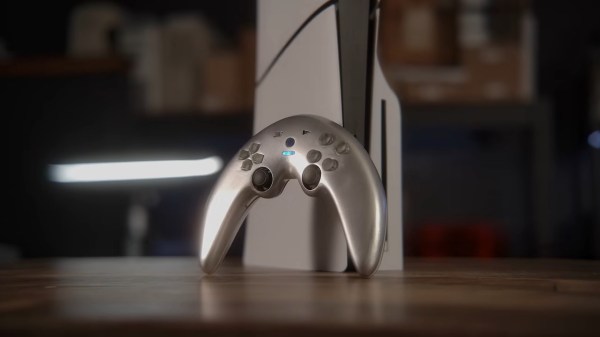
Think back long ago, to the halcyon days of 2005 — those of you who were alive and cognizant in those days, that is — specifically to E3 that year. Sony was teasing their next-generation console, the PlayStation 3, with a rather odd boomerang-shaped controller. That controller did not survive to production, but [polymatt] has decided to bring it back as an open source project.

As far as DIY game controllers go, the only exceptional thing is the shape and the history. Otherwise it’s got everything you’d expect in a PS3 Dual Shock controller. Although it doesn’t actually use PS3 parts for things like analog sticks, and has actual buttons soldered to the custom PCB. Everything goes through an ESP32, and the firmware is partially based on [lemmingDev]’s ESP32-BLE-Gamepad library, as there’s no need to reinvent the wheel to recreate a controller concept from 2005. It can even work with an original PS3, though admittedly only in wired mode, and it doesn’t look like the most ergonomic way to play.

It still beats the keychain-sized GameCube controller we featured recently, if you want to talk ergonomics. In terms of style, that’s a matter of taste, but we like the cut of anybody’s jib if they’re making their own controllers. 

Continue reading “PS3 Boomerang Controller Concept Flies Back Into Your Hands” →

ESP32 Drives MDA Display For Wireless Terminal

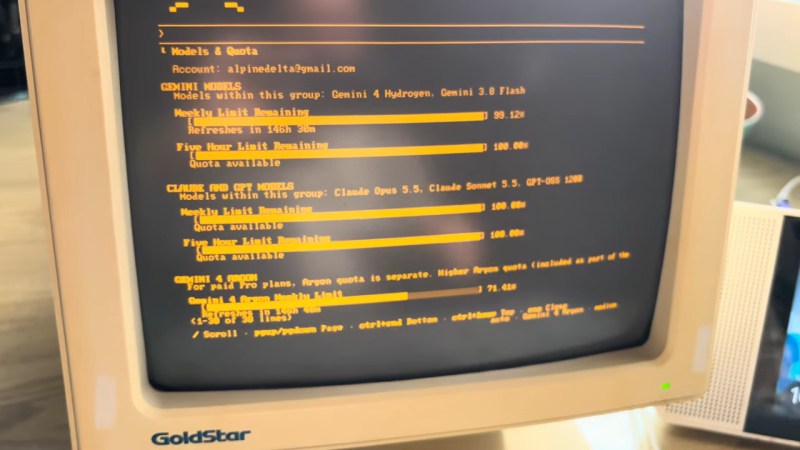
Don’t you miss the days where you had to point a particle accelerator at your face for a full shift? Well, maybe not when we think of it that way, but we still love the amber glow of the Monochrome Display Adapter (MDA) monitor [Chad Boughton] has hooked up to an ESP32 wireless terminal.

The particular ESP32 dev board he’s using comes with PS/2 input and VGA output, but of course VGA is not compatible with the TLL signal the old monochrome monitors are looking for, so he’s had to do a little bodge work– though aside from the one wire, this is evidently a software project. It took a bit of trial-and-error with the oscilloscope to get the timings right, but now that he has them he’s willing to share. [Chad] built that into a fork of FabGL’s terminal he has up on GitHub.

What he’s displaying on the terminal is equally fun, as he’s got a lovely command-line interface styled to look like IBM OfficeVision running on his server, complete with word processor and Lotus 1-2-3 spreadsheet editor– though it can also control the Plex server that carries [Chad]’s tunes. That’s also up on GitHub for anyone who wants it.

If you prefer green, check out the last CRT/ESP32 combo project we featured. For those of you with the opposite problem– a TLL output and no accompanying screen– there’s a project for that, too. 

Thanks to [Chad] for the tip!

Continue reading “ESP32 Drives MDA Display For Wireless Terminal” →

Decapitation Seems Like A Great Way To Start X-Mas Decorating

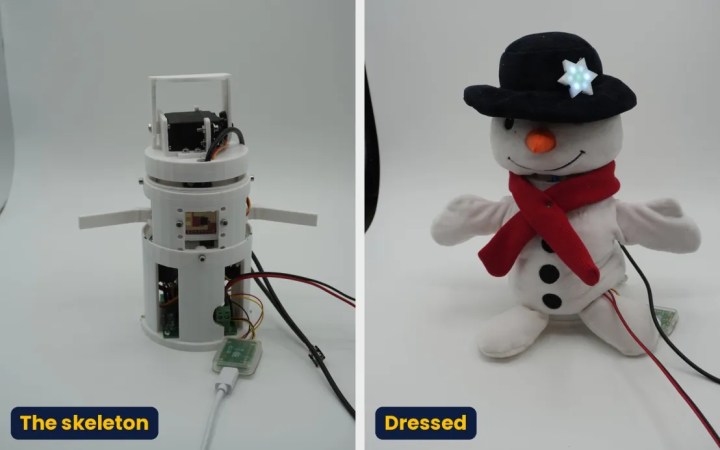
American cultural osmosis being what it is, it’s likely more people know the story of Frosty the Snowman than have ever actually had the chance to build a snowman. What if you want a dancing holiday buddy of your own, but lack the key ingrediants of (a) Snow, and (b) a magic hat? Well, [Dr Jon EA] figured he could make do with a felt puppet and bunch of servos, and we say he pulled it off, as you can see in the video embedded below.

There are four servos driving the animatronic functions of this snomwan: one for each arm, and two to pan/tilt the head. Those are driven from a Pico 2W that gets its input from a 24 GHz radar module so it can interact with people around it. [Jon] has the snowman waving at people, watching them, and if you stand in front of it it nods and gestures as though the two of you are having a conversation. The personality is written as a state machine in about 300 lines of C code– which is on GitHub— and he’s incorporated servo easing into his driving code so the machine looks more lifelike instead of just jerking into position as servos are wont to do. He’s released the servo library in its own repo, if you’re interested in that.

Our favourite part of the build is, of course, the decapitation: [Jon] couldn’t get all the bits of his 3D printed frame up into the felt snowman puppet he started with from the base, so the head had to come off. There’s just something delightful about kicking off the holiday season with Mme Guillotine.

Animatronics tend to be more of a Halloween thing around here, but we’ve got robot Santas (Santii?) going back two decades now, so this is hardly out of place.

Thanks to [Dr Jon] for the tip! If you, too, are feeling the Christmas Spirit early this year, send us a tip with whatever you and your elves have cooked up.

Continue reading “Decapitation Seems Like A Great Way To Start X-Mas Decorating” →