Crystal Oscillators Explained

We’ve read a lot about oscillators, but crystal oscillators seem to be a bit of a mystery. Hobby-level books tend to say, build a circuit like this and then mess with it until it oscillates. Engineering texts tend to go on about loop gains but aren’t very clear about practice. A [circuit digest] post that continues a series on oscillators has a good, practical treatment of the subject.

Crystals are made to have a natural resonant frequency and will oscillate at that frequency or a multiple thereof with the proper excitation. The trick, of course, is finding the proper excitation.

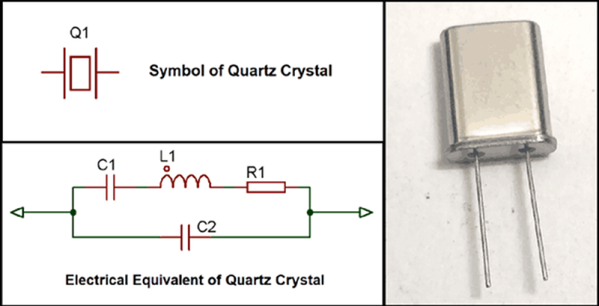
The post starts with a basic model of a crystal having a series capacitance and inductance along with a resistance. There’s also a shunt or parallel capacitor. When you order a crystal, you specify if you want the resonant frequency in series or parallel mode — that is, which of the capacitors in the model you want to resonate with the inductor — so the model has actual practical application.
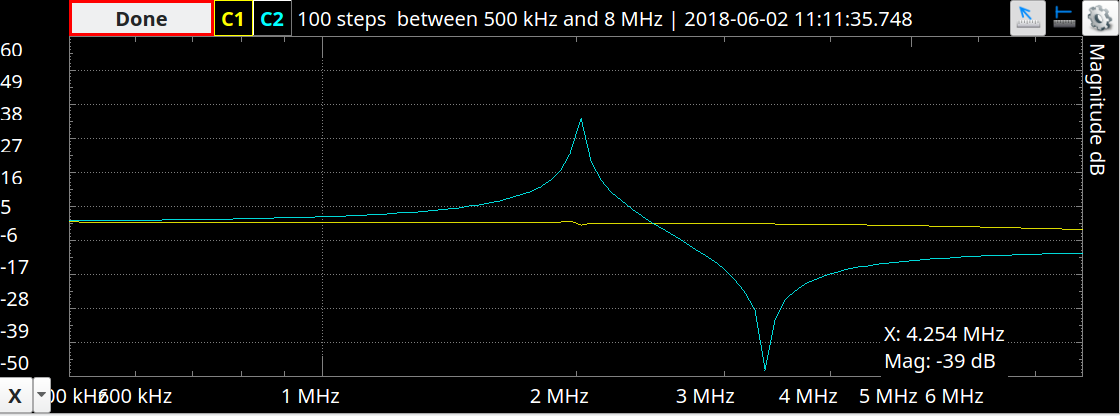
By applying the usual formula for resonance on the model you’ll see there is a null and a peak which corresponds to the two resonance points. The dip is the series frequency and the peak is the parallel. You can actually see a trace for a real crystal in a recent post we did on the Analog Discovery 2. It matches the math pretty well, as you can see on the right.
Continue reading “Crystal Oscillators Explained”

VexRISC-V Exposed

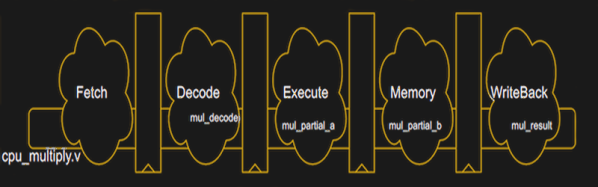
If you want to use FPGAs, you’ll almost always use an HDL like Verilog or VHDL. These are layers of abstraction just like using, say, a C compiler is to machine language or assembly code. There are other challengers to the throne such as SpinalHDL which have small but enthusiastic followings. [Tom] has a post about how the VexRISC-V CPU leverages SpinalHDL to make an extremely flexible system that is as efficient as plain Verilog. He says the example really shows off why you should be using SpinaHDL.

Like a conventional programming language, it is easy to find niche languages that will attract a little attention and either take off (say, C++, Java, or Rust) or just sort of fade away. The problem is you can’t ever tell which ones are going to become major and which are just flashes in the pan. Is SpinalHDL the next big thing? We don’t know.

Continue reading “VexRISC-V Exposed”

Magic Wand Learns Spells Through Machine Learning And An IMU

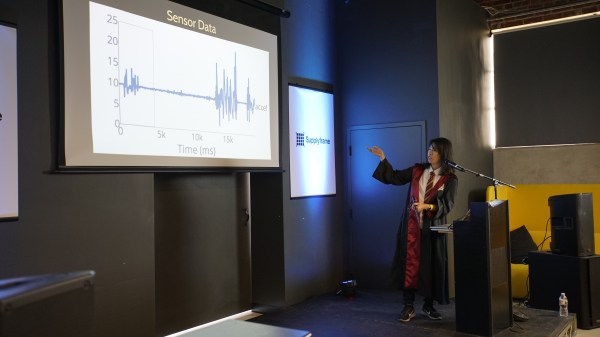
Jennifer Wang likes to dress up for cosplay and she’s a Harry Potter fan. Her wizarding skills are technological rather than magical but to the casual observer she’s managed to blur those lines. Having a lot of experience with different sensors, she decided to fuse all of this together to make a magic wand. The wand contains an inertial measurement unit (IMU) so it can detect gestures. Instead of hardcoding everything [Jennifer] used machine learning and presented her results at the Hackaday Superconference. Didn’t make it to Supercon? No worries, you can watch her talk on building IMU-based gesture recognition below, and grab the code from GitHub.

Naturally, we enjoyed seeing the technology parts of her project, and this is a great primer on applying machine learning to sensor data. But what we thought was really insightful was the discussions about the entire design lifecycle. Asking questions to scope the design space such as how much money can you spend, who will use the device, and where you will use it are often things we subconsciously answer but don’t make explicit. Failing to answer these questions at all increases the risk your project will fail or, at least, not be as successful as it could have been.

Continue reading “Magic Wand Learns Spells Through Machine Learning And An IMU”

Fail Of The Week: A Candle Caused Browns Ferry Nuclear Incident

A colleague of mine used to say he juggled a lot of balls; steel balls, plastic balls, glass balls, and paper balls. The trick was not to drop the glass balls. How do you know which is which? For example, suppose you were tasked with making sure a nuclear power plant was safe. What would be important? A fail-safe way to drop the control rods into the pile, maybe? A thick containment wall? Two loops of cooling so that only the inner loop gets radioactive? I’m not a nuclear engineer, so I don’t know, but ensuring electricians at a nuclear plant aren’t using open flames wouldn’t be high on my list of concerns. You might think that’s really obvious, but it turns out if you look at history that was a glass ball that got dropped.

In the 1960s and 70s, there was a lot of optimism in the United States about nuclear power. Browns Ferry — a Tennessee Valley Authority (TVA) nuclear plant — broke ground in 1966 on two plants. Unit 1 began operations in 1974, and Unit 2 the following year. By 1975, the two units were producing about 2,200 megawatts of electricity.

That same year, an electrical inspector and an electrician were checking for air leaks in the spreading room — a space where control cables split to go to the two different units from a single control room.  To find the air drafts they used a lit candle and would observe the flame as it was sucked in with the draft. In the process, they accidentally started a fire that nearly led to a massive nuclear disaster.

Continue reading “Fail Of The Week: A Candle Caused Browns Ferry Nuclear Incident”

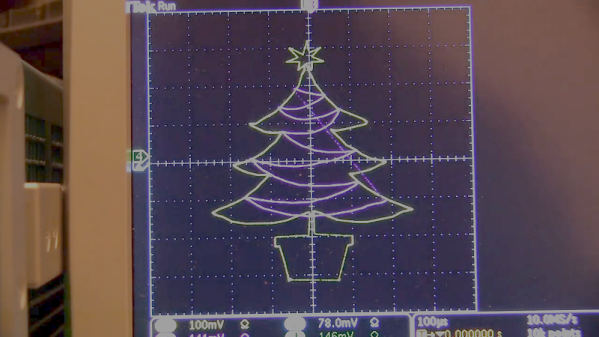
A Christmas Tree For Your Lab

It seems like holiday decorations come up earlier and earlier every year. You might not have room for a full-blown tree in your lab, but if you have an arbitrary waveform generator and a scope, Tektronix has a way for you to show your spirit electronically.

You can see the video below. Naturally, it features Tektronix gear, but we are pretty sure you could make it work with any arbitrary waveform generator that has at least two channels and a scope with an XY mode.

Continue reading “A Christmas Tree For Your Lab”

Linux Fu: Turn A Web App Into A Full Program

I hate to admit it. I don’t really use Linux on my desktop anymore. Well, technically I do. I boot into Linux. Then I do about 95% of my work in Chrome. About the only native applications I use anymore are development tools, the shell, emacs, and GIMP. If I really wanted to, I could probably find replacements for nearly all of those that run in the browser. I don’t use it, but there’s even an ssh client in the browser. Mail client? Gmail. Blogging? WordPress. Notes? OneNote or Evernote. Wouldn’t it be great to run those as actual applications instead of tabs in a browser? You can and I’ll show you how.

Having apps inside Chrome can be a real problem. I wind up with dozens of tabs open — I’m bad about that anyway. Restarting chrome is a nightmare as it struggles to load 100 tabs all at once. (Related tip: Go to chrome://flags and turn “Offline Auto-Reload Mode” off and “Only Auto-Reload Visible Tabs” on.) I also waste a lot of time searching since I try to organize tabs by window. So I have to find the window that has, say, Gmail in it and then find Gmail among the twenty or so tabs in that window.

What I want is a way to wrap web applications in their own window so that they’d show up in the task bar with their own icon, but external web pages that open from these apps ought to open in Chrome rather than in the same window. If applications were outside of the single browser window, I could move them to different desktops and organize them like they were any other program, including adding them to a launcher. Hopefully, this would let me have fewer windows like this:

Continue reading “Linux Fu: Turn A Web App Into A Full Program”

Getting Started With Free ARM Cores On Xilinx

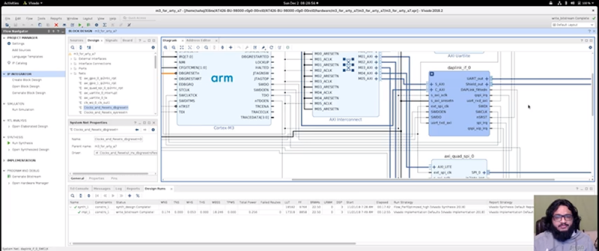
We reported earlier about Xilinx offering free-to-use ARM Cortex M1 and M3 cores. [Adam Taylor] posted his experiences getting things working and there’s also a video done by [Geek Til It Hertz] based on the material that you can see in the second video, below.

The post covers using the Arty A35T or Arty S50 FPGA boards (based on Artix FPGAs) and the Xilinx Vivado software. Although Vivado will allow you to do conventional FPGA development, it also can work to compose function blocks to produce CPUs and that’s really what’s going on here.

Continue reading “Getting Started With Free ARM Cores On Xilinx”