FT8: Saving Ham Radio Or Killing It?

It is popular to blame new technology for killing things. The Internet killed newspapers. Video killed the radio star. Is FT8, a new digital technology, poised to kill off ham radio? The community seems evenly divided. In an online poll, 52% of people responding says FT8 is damaging ham radio.  But ham operator [K5SDR] has an excellent blog post about how he thinks FT8 is going to save ham radio instead.

If you already have an opinion, you have probably already raced down to the comments to share your thoughts. I’ll be honest, I think what we are seeing is a transformation of ham radio and like most transformations, it is probably both killing parts of ham radio and saving others. But if you are still here, let’s talk a little bit about what’s going on in ham radio right now and how it relates to the FT8 question. Oddly enough, our story starts with the strange lack of sunspots that we’ve been experiencing lately. Continue reading “FT8: Saving Ham Radio Or Killing It?”

Hands On With The Arduino FPGA

All of the tools you need to work with the FPGA Arduino — the Vidor — are now in the wild!

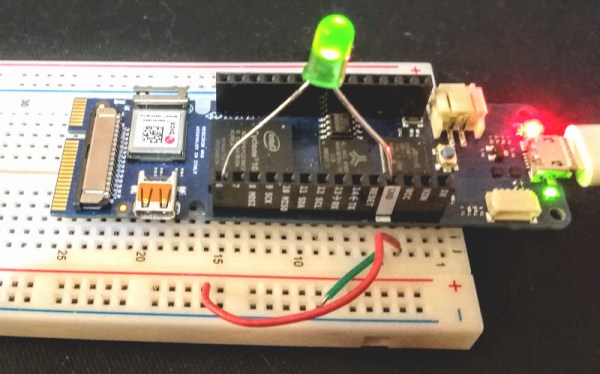
We reported earlier that a series of French blog posts finally showed how all the pieces fit together to program the FPGA on the Arduino MKR4000 Vidor board. Of course, I wasn’t content to just read the Google translation, I had to break out the board and try myself.

I created a very simple starter template, a tool in C to do the bitstream conversion, required, and bundled it all together in one place. Here’s how you can use my starter kit to do your own FPGA designs using the Vidor. I’m going to assume you know about FPGA basics and Verilog. If you don’t, why not check out the FPGA boot camps first?

The first thing you’ll want to do is grab my GitHub repo. You’ll also need the Arduino IDE (a recent copy) and Intel’s Quartus software. Inside, you’ll find three directories, two of which contain slightly modified copies of original Arduino files. But before you start digging in, let’s get the high-level overview of the process.

Continue reading “Hands On With The Arduino FPGA”

Ask Hackaday: What Are Your Less Extreme Brain Hacks?

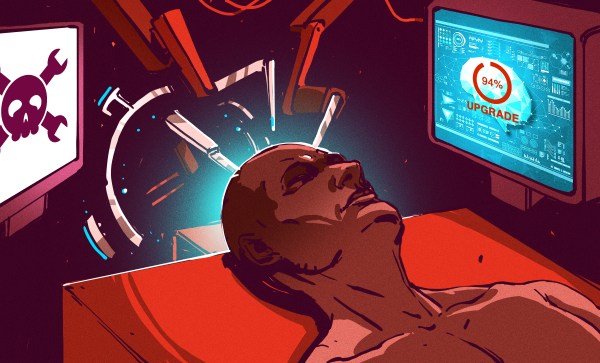
Kahn — perhaps Star Trek’s best-hated villain — said: “Improve a mechanical device and you may double productivity, but improve man and you gain a thousandfold.” In fact, a lot of hacking effort goes into doing just that. Your phone has become an extension of your memory, for example. We use glasses, cameras, and hearing aids to shore up failing senses or even give us better senses than normal. But hacking your body — or someone else’s — has always been controversial. While putting an RFID chip in your finger is one thing, would you consider having a part of your brain removed? That sounds crazy, but apparently, there is a growing interest in having your amygdala removed.

To be clear: we think this is a terrible idea. The science is shaky, at best, and we certainly wouldn’t want to be among the first to try something so radical. But why is anyone even talking about it?

The amygdala is part of your brain that causes at least some of your fear and anxiety. Get rid of your amygdala, get rid of anxiety? What’s even stranger is this the procedure — an amygdalectomy — has been going on since the 1960s! Injections of oil and wax destroy the tissue and this treatment is used for some forms of epilepsy and to manage certain aggressive behavior problems in mentally ill patients. In modern times, the procedure is not very common although it appears that it does still occur in some places. But the technology to do it does exist. There have also been documented cases where people lose their amygdala from natural causes that gives us some clues of what life would be like without one.

However, it is hard to say if these people lost fear. Most of the surgical patients were already suffering from a variety of problems. There is some evidence that the naturally occurring amygdalaless patients experienced less fear in some situations, but may experience more fear in others. They also may have other problems such as difficulty understanding social cues or making eye contact. We’re not 100% sure what the amygdala does, even disregarding potential side effects.

Continue reading “Ask Hackaday: What Are Your Less Extreme Brain Hacks?”

Helium Can Stop Your IPhone — Maybe Other MEMS, Too

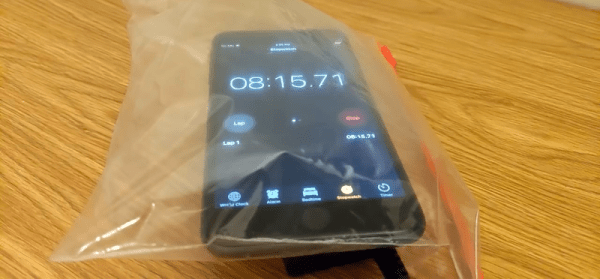
Sometimes hacking isn’t as much about building something, it’s about getting to the root of a particularly difficult problem. [Erik Wooldrige] was facing a problem like that. He’s a system specialist at a hospital near Chicago. Suddenly a bunch of iPhones and Apple watches were failing or glitching. The only thing anyone could think of was the recent install of an MRI machine.

Sure, an MRI machine can put out some serious electromagnetic pulses, but why would that only affect Apple products? Everything else in the hospital, including Android phones, seemed to be OK. But about 40 Apple devices were either dead or misbehaving.

Continue reading “Helium Can Stop Your IPhone — Maybe Other MEMS, Too”

Brain Cell Electronics Explains Wetware Computing Power

Neural networks use electronic analogs of the neurons in our brains. But it doesn’t seem likely that just making enough electronic neurons would create a human-brain-like thinking machine. Consider that animal brains are sometimes larger than ours — a sperm whale’s brain weighs 17 pounds — yet we don’t think they are as smart as humans or even dogs who have a much smaller brain. MIT researchers have discovered differences between human brain cells and animal ones that might help clear up some of that mystery. You can see a video about the work they’ve done below.

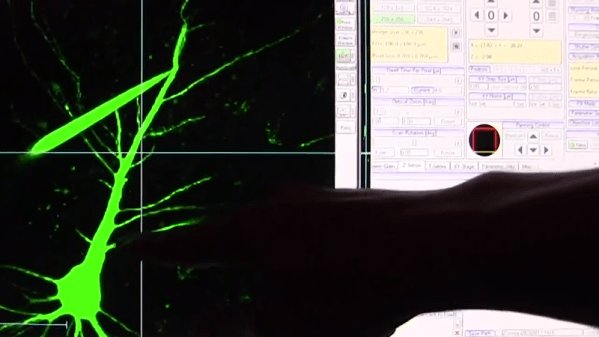
Neurons have long finger-like structures known as dendrites. These act like comparators, taking input from other neurons and firing if the inputs exceed a threshold. Like any kind of conductor, the longer the dendrite, the weaker the signal. Naively, this seems bad for humans. To understand why, consider a rat. A rat’s cortex has six layers, just like ours. However, whereas the rat’s brain is tiny and 30% cortex, our brains are much larger and 75% cortex. So a dendrite reaching from layer 5 to layer 1 has to be much longer than the analogous neuron in the rat’s brain.

These longer dendrites do lead to more loss in human brains and the MIT study confirmed this by using human brain cells — healthy ones removed to get access to diseased brain cells during surgery. The researchers think that this greater loss, however, is actually a benefit to humans because it helps isolate neurons from other neurons leading to increased computing capability of a single neuron. One of the researchers called this “electrical compartmentalization.” Dig into the conclusions found in the research paper.

We couldn’t help but wonder if this research would offer new insights into neural network computing. We already use numeric weights to simulate dendrite threshold action, so presumably learning algorithms are making weaker links if that helps. However, maybe something to take away from this is that less interaction between neurons and groups of neurons may be more helpful than more interaction.

Watching them probe neurons under the microscope reminded us of probing on an IC die. There’s a close tie between understanding the brain and building better machines so we try to keep an eye on the research going on in that area.

Continue reading “Brain Cell Electronics Explains Wetware Computing Power”

New AVR-IOT Board Connects To Google

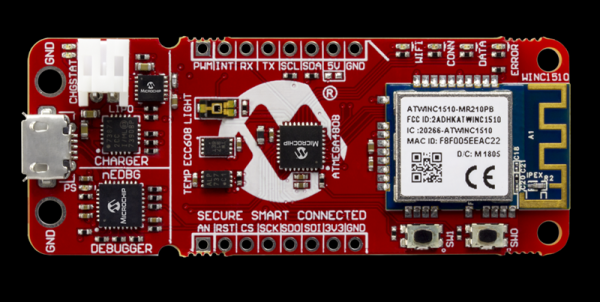
Readers of Hackaday are no strangers to using a microcontroller to push data to WiFi. Even before the ESP8266 there were a variety of ways to do that. Now Microchip is joining the fray with a $29 board called the AVR-IOT WG that contains an 8-bit ATmega4808, a WiFi controller, and hardware-based crypto chip for authenticating with Google Cloud.

The board has a section with a USB port for charging a battery and debugging that looks like it is made to cut away. There are a number of LEDs and buttons along with a light sensor and a temperature sensor. It feels like the goal here was to pack as many Microchip parts onto a single dev board as possible. You’ll find the ATmega4808 as the main controller, an ATWINC1510 WiFi controller (a castellated module reminiscent of the ESP8266), the ATECC608A cryptographic co-processor, MCP73871 LiPo charger, MIC33050 voltage regulator, and an MCP9808 temperature sensor. We can’t find much info about the “nEDBG Programmer/Debugger” chip. If you’ve used it on one of a handful of other dev board, let us know in the comments about off-board programming and other possible hacks.

Naturally, the board works with AVR Studio or MPLAB X IDE (Microchip bought Atmel, remember?). Of course, Atmel START or MPLAB Code Configurator can configure the devices, too. There’s also an AVR-IoT-branded website that lets you use Google cloud to connect your device for development. The headers along the top and bottom edges are compatible with MicroElektronika Click boards which will make anyone with a parts bin full of those happy.

Looks like you can pick up the Microchip boards now from the usual places. From reading what Microchip is saying, they would like to position this as the “IoT Arduino” — something someone without a lot of experience could pick up and use to pipe data into Google cloud. While that’s probably good, it isn’t that hard to use an ESP-device to do the same thing using the Arduino IDE and then you have a 32-bit processor and you can use whatever cloud vendor you want. Sure, it would be a little more work, so maybe that’s where this offering will appeal.

On the plus side, we really liked that there was a battery option with a charger already on board — it seems like that’s something we always have to add anyway. It may be buried in the documentation, but the user’s guide and the technical guide didn’t appear to have an average and maximum current draw specified, so battery life is an open question, although the video says “low power.”

Although it isn’t quite the same thing, we’ve seen ESP8266’s talk to Google servers for interfacing with Google Home. And while it is on the Amazon cloud, we’ve even seen a 6502 up there.

Continue reading “New AVR-IOT Board Connects To Google”

Travel To Mercury On Ion Power

Star Trek — as much as we love it — was guilty sometimes of a bit of hyperbole and more than its share of inconsistency. In some episodes, ion drives were advanced technology and in others they were obsolete. Make up your mind!

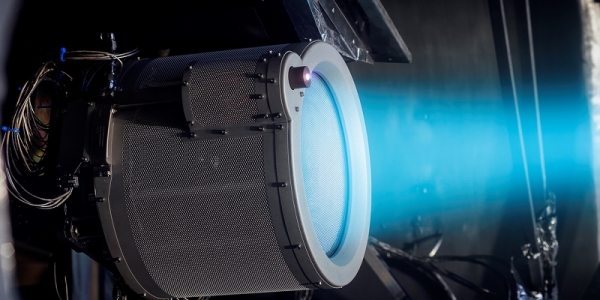
The ESA-JAXA BepiColombo probe is on its way to Mercury riding on four ion thrusters developed by a company called QinetiQ. But unlike the ion drive featured in the infamous “Spock’s Brain” episode, BepiColombo will take over seven years to get to Mercury. That’s because these ion drives are real.

The craft is actually two spacecraft in one with two different Mercury missions. The Mercury planetary orbiter will study the surface while the magnetosphere orbiter will study the little planet’s magnetic field. Check out a video about the mission, below. The second video shows [Neil Wallace] talking about how the ion propulsion — also known as solar electric engines — differ from traditional chemical thrusters.

Continue reading “Travel To Mercury On Ion Power”